Parliamentary elections 2019: Does Switzerland risk flying digital blind?
Only 18 percent of the candidates for the 2019 federal elections took the time to answer the questions in the Digitalization Monitor and thus make their positions transparent. Still, those who participated in the survey see more opportunities than risks.


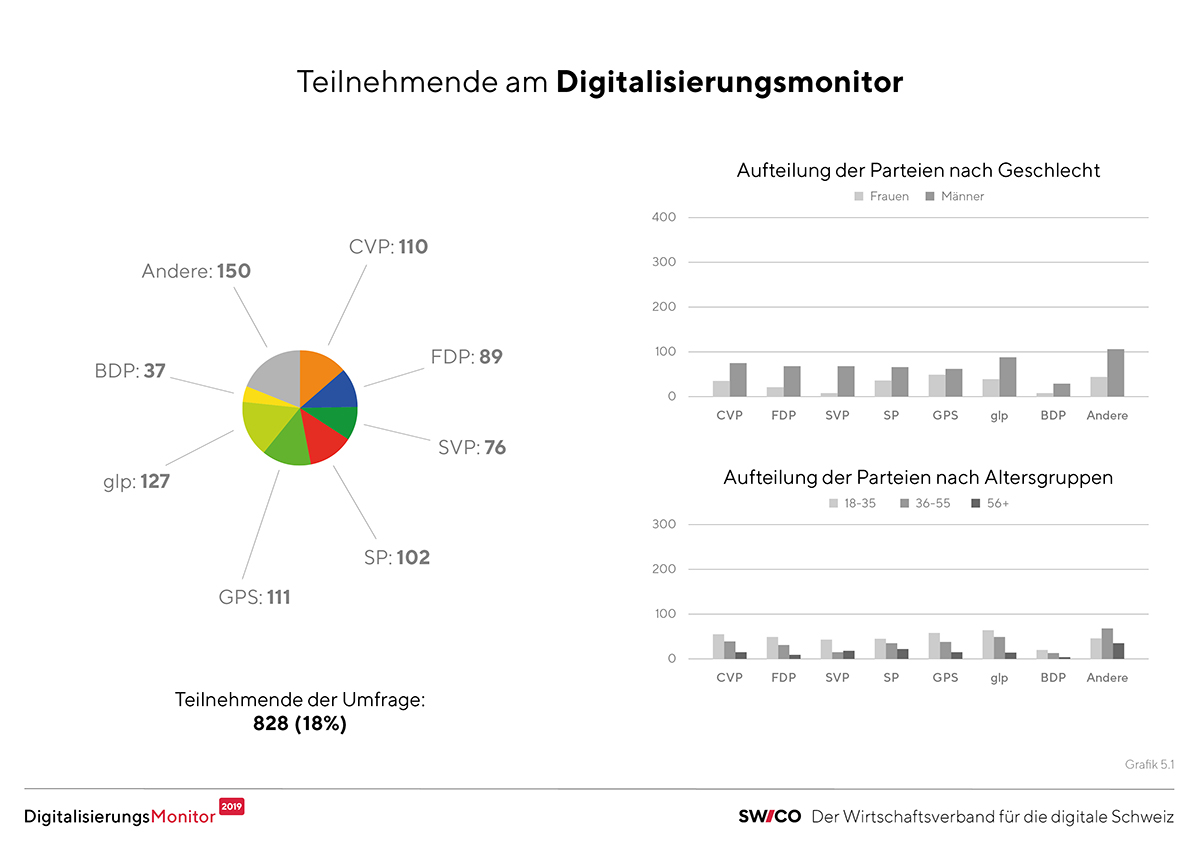
The topic of digitization still plays a subordinate role for many politicians: Although 3571 have created their Smartvote profile, only 18 percent of all candidates (828 out of a total of 4596) for a National Council mandate have completed the additional surveys on digitization topics on Smartvote. The digitization monitor was launched by Swico in collaboration with the Bern University of Applied Sciences (BFH) and the universities of Zurich and Geneva.
For Swico President Andreas Knöpfli, the numbers speak for themselves: "Digitalization has still not arrived in Bern. Of the 4,600 or so candidates who want to go to Bern, only a fraction have dealt with this development, which is fundamentally changing our society right now." Knöpfli sees a corresponding need for action: "The new parliament absolutely has to use the new legislative period and prioritize digital topics more strongly in the political agenda.
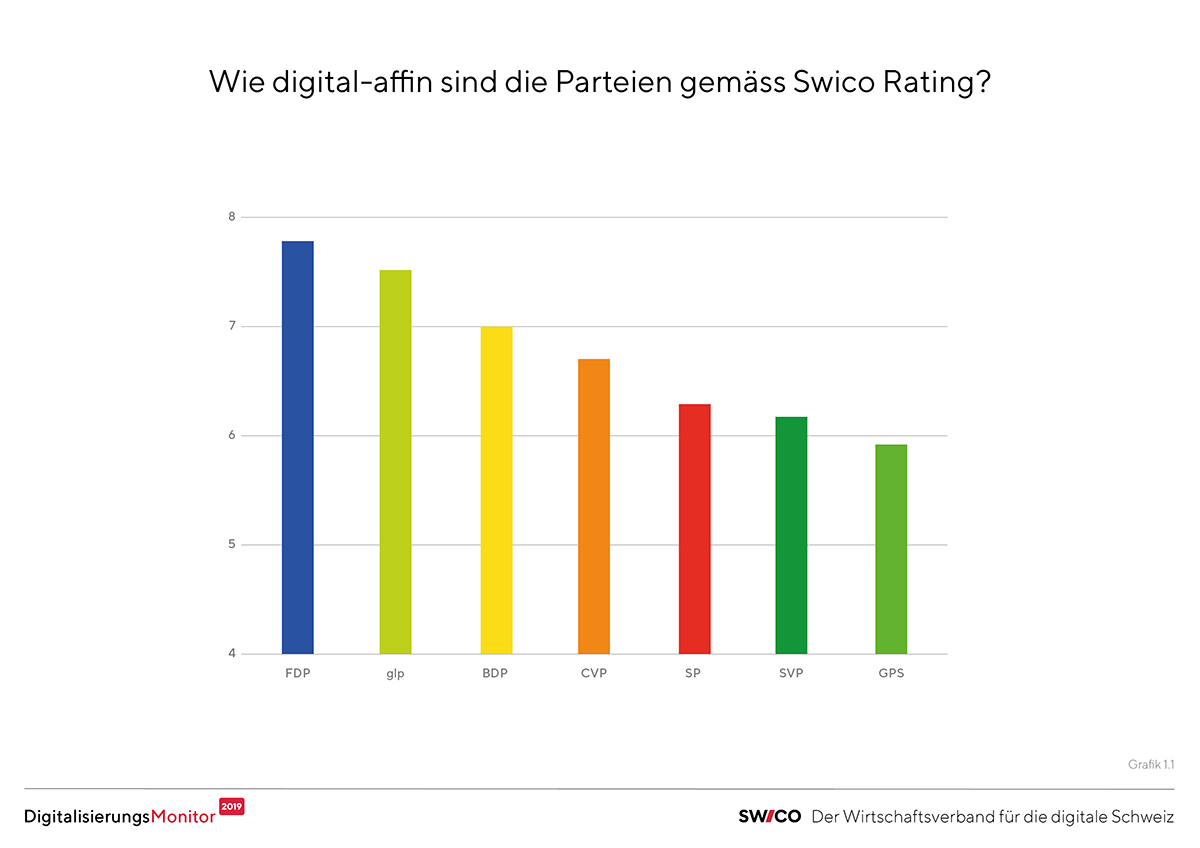
How digitally savvy are politicians?
Basically, all parties see opportunities rather than risks and assess the effects positively. Women tend to be more skeptical than men. Among the major parties, the most positive views are held by the FDP with 81 percent and the GLP with 75 percent. The highest proportion of skeptics is among the Greens, at 14 percent.
Greater digital affinity among the newcomers
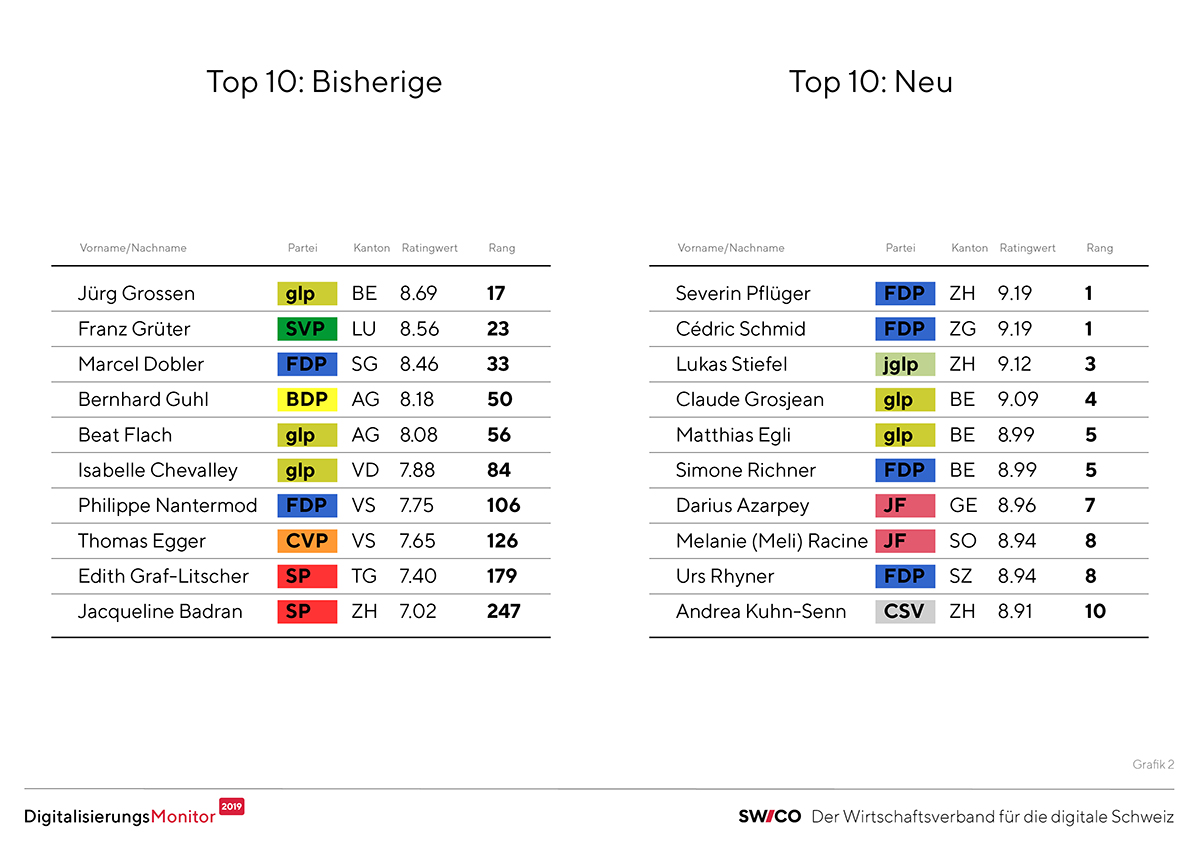
A look at the newcomers at least shows a glimmer of hope: overall, they appear to be more digitally affine and more engaged with digital issues than the National Council members running again.
Digitization as an opportunity
Majorities in all parties agree with the statements that digitization secures prosperity, that it promotes the compatibility of family and career, and that the quality of work is increasing. The parties also almost unanimously support the statement that digitization facilitates access to knowledge and education.
Impact on the economy
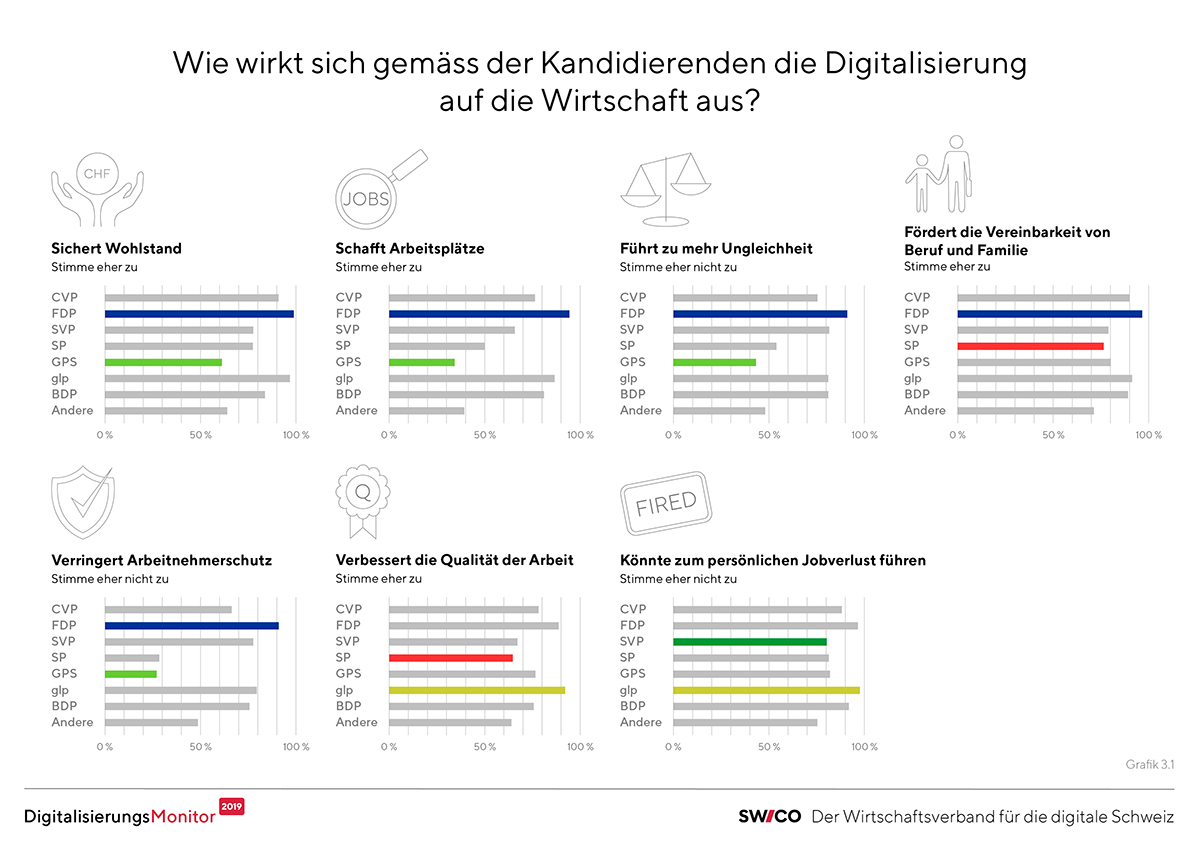
The FDP candidates have the most positive view of the effects of digitization on economic life across all statements, while the Greens are the most skeptical. The statements regarding the creation of jobs and the reduction of employee protection are judged controversially.
FDP and GLP want more speed in digitization
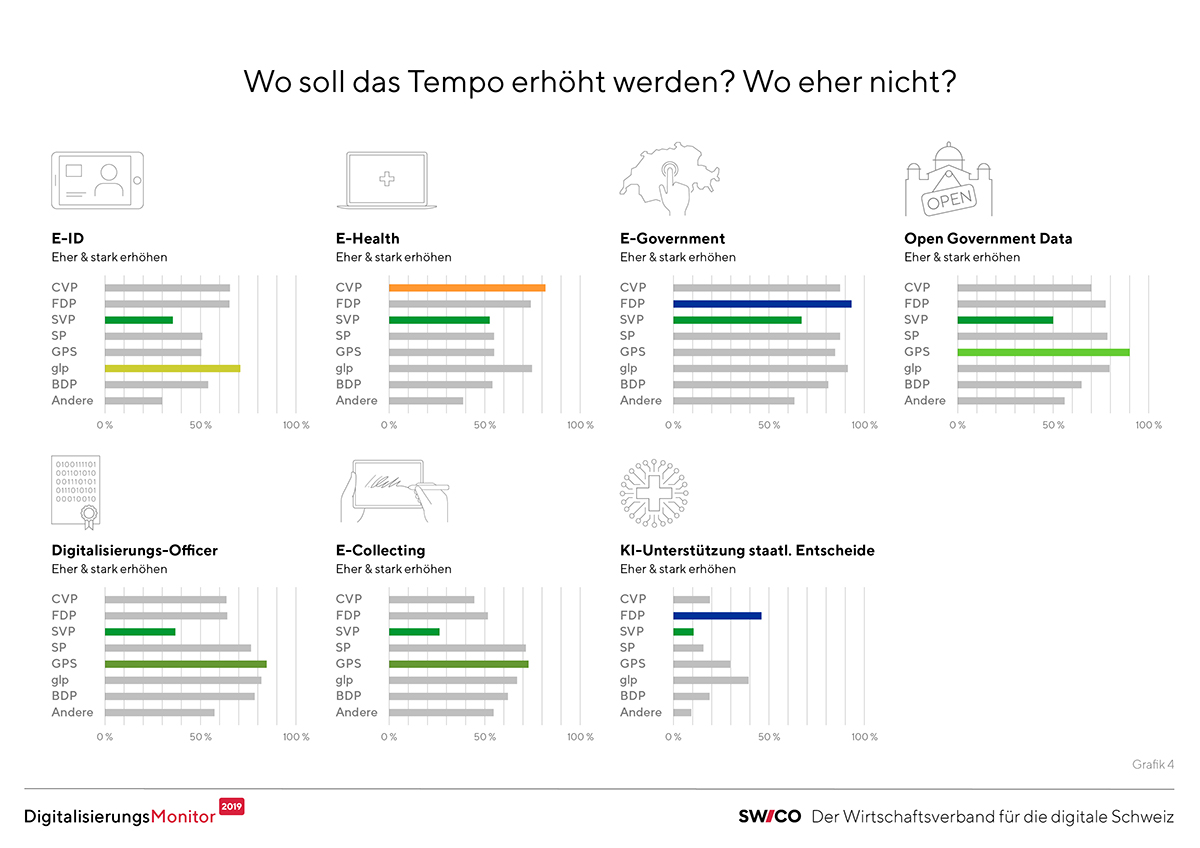
While the parties assess individual topics very differently, the following can be seen consistently across all areas: The candidates of the GLP and the FDP want to move forward the fastest. The SVP candidates are clearly more reserved, and they are least likely to want to increase the pace.
Disagreement on measures
Opinions differ on the measures to be taken. The majority of the candidates think that (far) too little is being done in elementary schools in terms of ICT skills. With the exception of the SVP, all parties are in favor of retraining measures as a reaction to the changes; the unconditional basic income, on the other hand, is only supported by the SP and the Greens.
The taxation of (AI-supported) hardware and software (robot tax) is clearly welcomed by SP and Greens; clearly rejected by FDP and SVP; CVP, glp and BDP are split here. SP, Greens, CVP and BDP would like to see stronger regulation of online intermediary businesses such as Airbnb or Uber; FDP and GLP are opposed, with young people clearly less in favor of regulation.
And the women?
The gender distribution shows a similar picture as in the economy: women are underrepresented. In the Smartvote survey, 2139 men and 1442 women responded (78 percent of candidates each). The questions in the Digitization Monitor were answered by 21 percent of men, but only 13 percent of women.
Women also tend to be more skeptical than men, with the exception of e-voting. "Women need to be made more aware of digitization," says Swico President Andreas Knöpfli in response. "We need to push the proportion of women in STEM subjects and specifically challenge and promote women in all areas."
In the run-up to the federal elections on October 20, 2019, Swico has launched the "Digitization Monitor 2019" in collaboration with the online voting tool "Smartvote", the Bern University of Applied Sciences BFH, the University of Zurich and the University of Geneva.
In addition to four questions on digitization in the standard Smartvote questionnaire, candidates had the opportunity to express their positions on various dimensions of digitization in an additional survey and thus make their position transparent to the public.
Judith Bellaiche, Managing Director of Swico, is running for the National Council. She has deliberately chosen not to participate in order to avoid any conflicts of interest.