
From the gut - how Behaviour Patterns influence purchase decisions
All people have two decision-making systems: a rational one and an intuitive one. 95 percent of all decisions are made by the intuitive decision-making system. Currently, websites are mostly optimized for the rational part of the customer’s brain. As a result, website operators are squandering a great deal of potential—not only in terms of conversion but also in terms of the user experience and overall customer satisfaction.


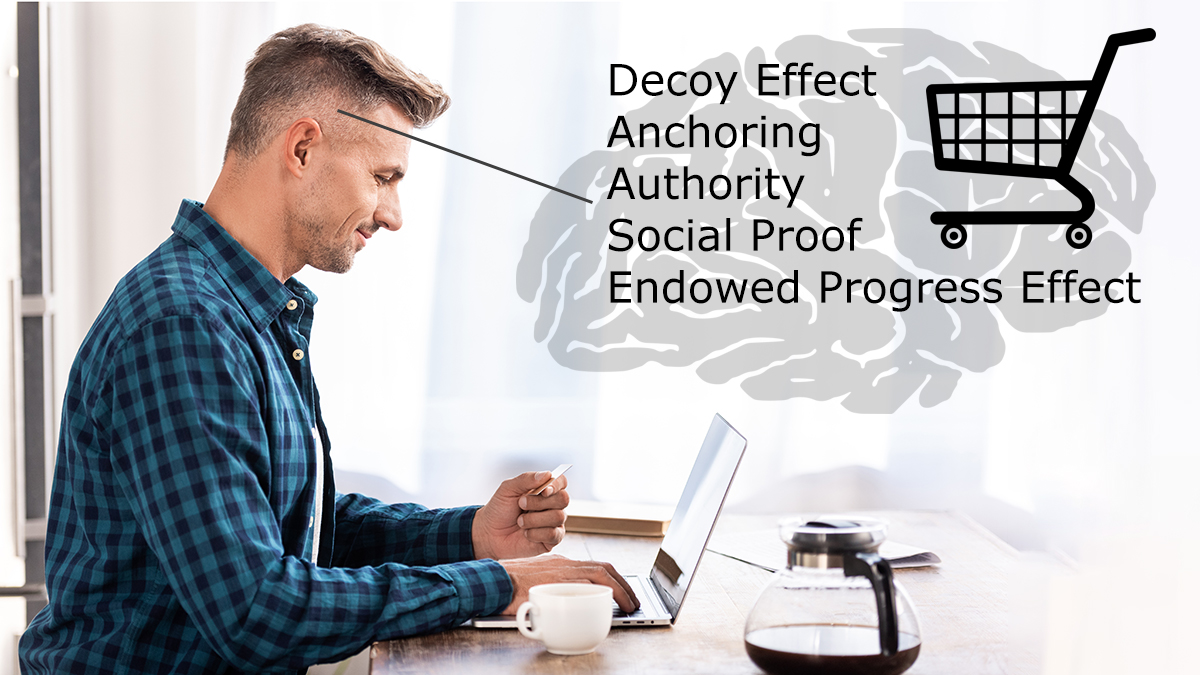
Intuitive thought processes do not arise by chance. They result from clearly defined and recurring patterns of behavior - behavior patterns. These patterns can be thought of as templates for our actions. In everyday life, for example, a white coat or a stethoscope is often enough for us to consider a person trustworthy. In e-commerce, these shortcuts to building trust are achieved through testimonials or external seals of approval, for example.
Effectiveness of behavior patterns in e-commerce confirmed
We were able to prove the positive effect of behavior patterns in e-commerce in a study of 2,400 participants. The results of the study show that behaviour patterns have a positive effect on the user experience and conversion rate of the optimized site at several points along the sales funnel in e-commerce. The shopping cart size increases on sites that address unconscious behavior patterns. The business value, i.e. the combination of conversion rate and shopping cart size, increases regardless of whether a modified page was rated better or not - by an average of 23.4 percent.
Deliberate manipulation of customers?
When using behavior patterns, the question quickly arises as to whether it is a matter of manipulating buyers. The answer is yes, behavior patterns can be used to manipulate. Anyone dealing with this topic must face up to the discussion about where manipulation begins and define clear rules about where the red line is drawn. However, the debate is not only based on moral aspects. It also has a convincing economic foundation: any manipulation of users is punished with post-purchase dissonance. The undesirable consequences of this are increased rates of returns and cancellations as well as impaired customer relationships. If you think in terms of customer life cycles and are interested in a long-term profitable relationship, you should adapt the decision-making architecture so that users only receive a small nudge in the direction that meets their needs.
Select the right patterns
There are countless behavior patterns that influence our decisions. Not all patterns have an equally strong effect on the user. In order to find out which patterns can be effective for your own target group and should therefore be used for optimization, the implementation phase is preceded by an analysis phase. The aim here is to get to know the customer and their needs as well as possible. Based on this, the most relevant patterns are defined in the context of the product and used for optimization in the implementation phase.
The top 5 most effective behavior patterns
Despite all the differences depending on the target group and business model, some particularly effective patterns can be defined:
- Decoy Effect: If people have to decide between a cheaper option A and a more expensive option B, they usually choose the cheaper alternative. However, if a third, significantly more expensive option C is added, this can make the decision in favor of option B easier. Option C is the unattractive decoy ("bait") that differs so much in price or performance from option B that the latter now appears attractive.
- Anchoring: Pattern anchoring can be understood as a metaphor. If you drop an anchor in a boat, you can't move far from that spot. The so-called price anchor works in a similar way. Once a numerical value has been perceived, it is always used as a reference when processing a price. Regardless of whether the numerical value is related to the price or not. If you integrate high values on your website (e.g. via visitor numbers or satisfied customers), this ensures a lower perception of prices. The same applies to lowered prices: The higher strike price should always appear first in order to make the reduced price appear even more favorable.
- Authority: We have a tendency to believe authorities. Recommendations from experts, trust seals or our own expert status can act as authorities and convince the buyer of the quality and persuade them to buy.
- Social Proof: If we find it difficult to make a decision, the actions of other people are a good guide. Whether individuals (experts, testimonials, influencers), the collective of other customers or users or, for example, test institutes: if we are unsure, we believe that other people who have already made a decision have more specific knowledge in this situation, on the basis of which they could make a well-founded decision.
- Endowed Progress Effect: Our brain likes to complete incomplete tasks. If people have already been brought closer to their goal through artificially created progress, their motivation to achieve the goal increases. In online shopping, this effect can be used during the check-out process. If the progress bar already shows progress at the first step, this increases our motivation to complete the process.
Conclusion
Behavior patterns hold tremendous potential for website operators to optimize their online stores. However, this potential is still largely untapped. Not only in terms of pure conversion. Those who base their customer approach on behavior patterns improve the customer experience and thus also contribute to long-term business success.
Practical example Jumbo
The Jumbo online store, which is just one year old, was designed with a clear omnichannel focus from the outset. The focus was on cross-channel processes and features right from the start. Elaboratum supported Jumbo in further developing and optimizing the user experience of the cross-channel processes with the help of customer-centric behavior patterns. The formulated goal was to improve the user experience and ensure intuitive use by the customer. The aim of the optimization was to increase both store sales and visits as well as the e-commerce conversion rate. To this end, Elaboratum analyzed tracking data, created a sector benchmark and carried out a compact user test, on the basis of which concrete concepts and drafts for optimization were created. At Jumbo, for example, a more pleasant and simpler shopping experience was created for the customer by reducing the complexity of the decisions required in the purchase and information process in the online store.
Practical example Sunrise
Sunrise focused on a different point in the customer journey. Behavior patterns were used to optimize the checkout area in the Sunrise webshop. When selecting and designing the patterns and triggers, only measures with very low complexity in the technical implementation were selected in order to take into account restrictions due to parallel projects and still create improvements quickly. The focus was on adapting the text elements. Even with this limited scope for design, an increase in the conversion rate of 16% was achieved by using over 15 patterns in the checkout. This example shows that optimizing for behavior patterns does not always have to be visual. Sometimes it is even enough to adapt small text passages with even less effort to achieve a better result.

Authors:
Philipp Spreer is Principal Consultant at the digital consultancy Elaboratum. He has been empirically studying user behavior in a digital context for over 10 years. His focus is on holistic UX concepts and growth strategies using behavioral psychology. Spreer completed his doctorate at the interface between marketing, IT and psychology. His latest book "PsyConversion" has been available in stores since August 2018.
Marco Schulz is Director of the digital consultancy Elaboratum Suisse and responsible for elaboratum's Swiss business and the Bern office. Marco has been working on a wide range of digital and e-commerce topics for almost ten years. As a member of the PsyConversion team, he supports Swiss projects in particular (including Jumbo and Sunrise) in optimizing user experience and conversion with the help of behavioral science findings.


