
Customer Centricity? Praised, but not lived!
The customer is the most important person in a company. Yet traditional organizations don’t even include them in their organizational charts. A guest column by Anne M. Schüller.


While conventional managers think primarily about the competition, their quarterly targets and costs, the elite of young entrepreneurs have long understood that everything, really everything, revolves around customer satisfaction. They are constantly looking for customer problems and a suitable solution. All products, processes and technologies are strictly orchestrated around customer needs. To ensure that everything fits one hundred percent, solutions are developed iteratively and in constant dialog with the targeted customers. Traditional companies, on the other hand, usually only chase after what prospective customers and consumers want and desire. And they fall further and further behind. This is because they remain stuck in organizational structures that date back to the depths of the last century.
Customer centricity is the number one challenge. Today, companies no longer achieve a leading position through what they do, but through how the customer perceives this - and what they tell third parties about it. However, in classic organizational models, symbolized by an organizational chart, customers are not even mentioned. Even companies that make a point of being customer-centric do not include customers in their organizational charts. How can you talk about customer centricity? It is praised, but not practiced.
Because what does a standard organizational chart convey? Essentially, it documents hierarchically who is superior to whom and who is subordinate to whom. The boss sits enthroned at the top, with his well-behaved team of followers locked in boxes below. The management team revolves purely around itself. They concentrate on power and not on the market. They work in formations that are often referred to as "silos". The right hand often does not know what the left hand is doing, and that is precisely the crux of the matter: silo thinking is not compatible with the flexibility that customers demand today. Functional silos are anomalies. They stand for compartmentalization, isolated solutions and isolation. Like the monocultures in our forests during a hurricane, they don't stand a chance in the digital storm.
The actual problems that customers encounter are usually cross-functional: communication and coordination problems in the tussle between responsibilities, departmental egos and efficiency. From the customer's point of view, however, processes must be interdisciplinary and dovetail smoothly with one another. Everyone in the company must take care of the customer's well-being. Their expectations are rising every day. And they have a smartphone, their all-powerful device. If something doesn't suit them, they can be gone with a swipe. On the web, people are constantly tempted to be unfaithful. "Everything for the customer" is the credo. But isn't that completely normal? No, not at all.
Most companies are self-centered and efficiency-driven. As far as possible, customers are expected to comply with the processes designed by the providers, accept cumbersome formalities and tick to the beat of their ageing software. In other words, clients should work hard so that you don't have so much work yourself. Some companies are really good at making procedures tedious, stealing your time and spreading bad feelings. Nobody seriously believes that people will put up with this for much longer! The power has long been with the consumers. With their actions, in which they join together in virtual swarms, they can decide the life and death of a provider in no time at all.
Everything that does not directly benefit the customer must be systematically eliminated. In the end, only those who shift all possible annoyances from the customer to the provider so that only positive experiences remain are truly customer-oriented. And that is more than a subtle difference. Because every single customer-related inconvenience is a gateway for disruptors. So: first the customer, then internal efficiency. A customer-centric organizational structure, as the Orbit model makes clear, is more important than ever before.
Today, companies are driven by customer requirements. Only if the customers are doing well will the company also do well. People who are willing to pay, top talents and society as a whole also expect a company to pursue higher goals than market leadership and maximum returns. They want to know what value a provider offers people. This utility value, the sense of existence and higher purpose is called "purpose". It determines the identity of a company, generates qualitative growth and makes competitive advantages very likely. I will come back to this in a future article.
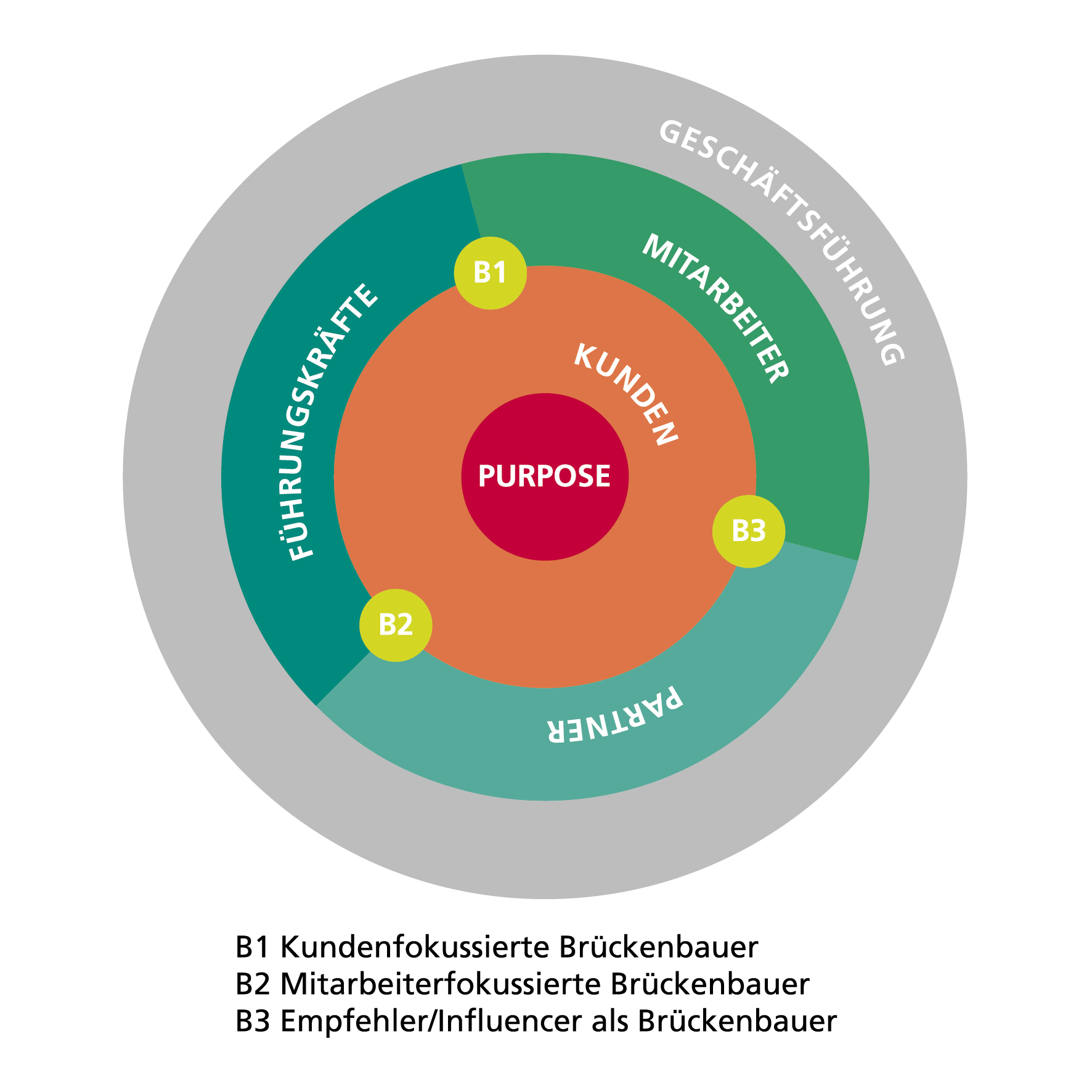
Instead of the classic organization chart: the Orbit model (Source: Anne M. Schüller)
The author: Anne M. Schüller is a management thinker, keynote speaker, multiple award-winning bestselling author and business coach. With a degree in business administration, she is a leading expert in touchpoint management and customer-focused corporate management. She is one of the most sought-after speakers in the German-speaking world. In 2015, she was inducted into the Hall of Fame of the German Speakers Association for her life's work. She was named Top Voice 2017/2018 by the business network LinkedIn and Top Xing Writer 2018 by the business network Xing. Her clients include the business elite. Her Touchpoint Institute trains certified touchpoint managers. Anneschueller.com
The book on the subject
Anne M. Schüller, Alex T. Steffen
The Orbit Organization
9 steps to a business model for the digital future
Gabal Verlag 2019, 312 pages
ISBN: 978-3869368993


