
Swiss study shows: Mobile advertising achieves wide reach


 Around 80 percent of the Swiss population has a smartphone. This holds great potential for companies: they have the opportunity to interact with consumers at any time and from any location. Conversely, consumers are also not tied to fixed opening hours when it comes to contacting companies and using their services. As part of the "Mobile as an innovator in marketing and sales" project, the Lucerne University of Applied Sciences and Arts and the University of St.Gallen (HSG) investigated how strong this digital connection between smartphone users and companies actually is. They surveyed 1,535 people of all ages in German-speaking and French-speaking Switzerland and analyzed, among other things, which mobile touchpoints companies and smartphone users have, how intensively the device is used along the customer journey and how much personal data consumers are willing to disclose.Mobile Touchpoints: Advertising dominant, location-based interactions rare The study shows: Half of those surveyed see advertising on websites, in apps and while using search engines on their smartphones several times a month. For around 40 percent, contact via mobile advertising takes place several times a week, for over 20 percent daily. Almost 40 percent of respondents also come into contact with advertising on social media via their smartphones several times a month. "From these results, we conclude that at least half of smartphone users in Switzerland can be reached regularly with mobile advertising on their smartphones. Companies should take this reach and frequency into account when allocating their advertising budgets to different channels," says mobile expert and co-project manager Thomas Wozniak from Lucerne University of Applied Sciences and Arts.significantly more than half of respondents regularly use company websites and apps on their smartphone. In terms of frequency of use, websites are ahead of apps: Websites are accessed more quickly and do not need to be installed first; however, apps have the potential for a richer user experience and more varied interactions.Location-based offers, for example push notifications triggered by beacons, on the other hand, are only used regularly by a small proportion of respondents. This is partly due to the fact that only a few companies provide them at all, as a company survey conducted by Lucerne University of Applied Sciences and Arts and the University of St.Gallen in spring 2016 made clear. "But such offers also have potential. Innovative consumers in particular show a much stronger affinity for location-based services," says behavioral psychologist and co-project manager Dorothea Schaffner from Lucerne University of Applied Sciences and Arts.
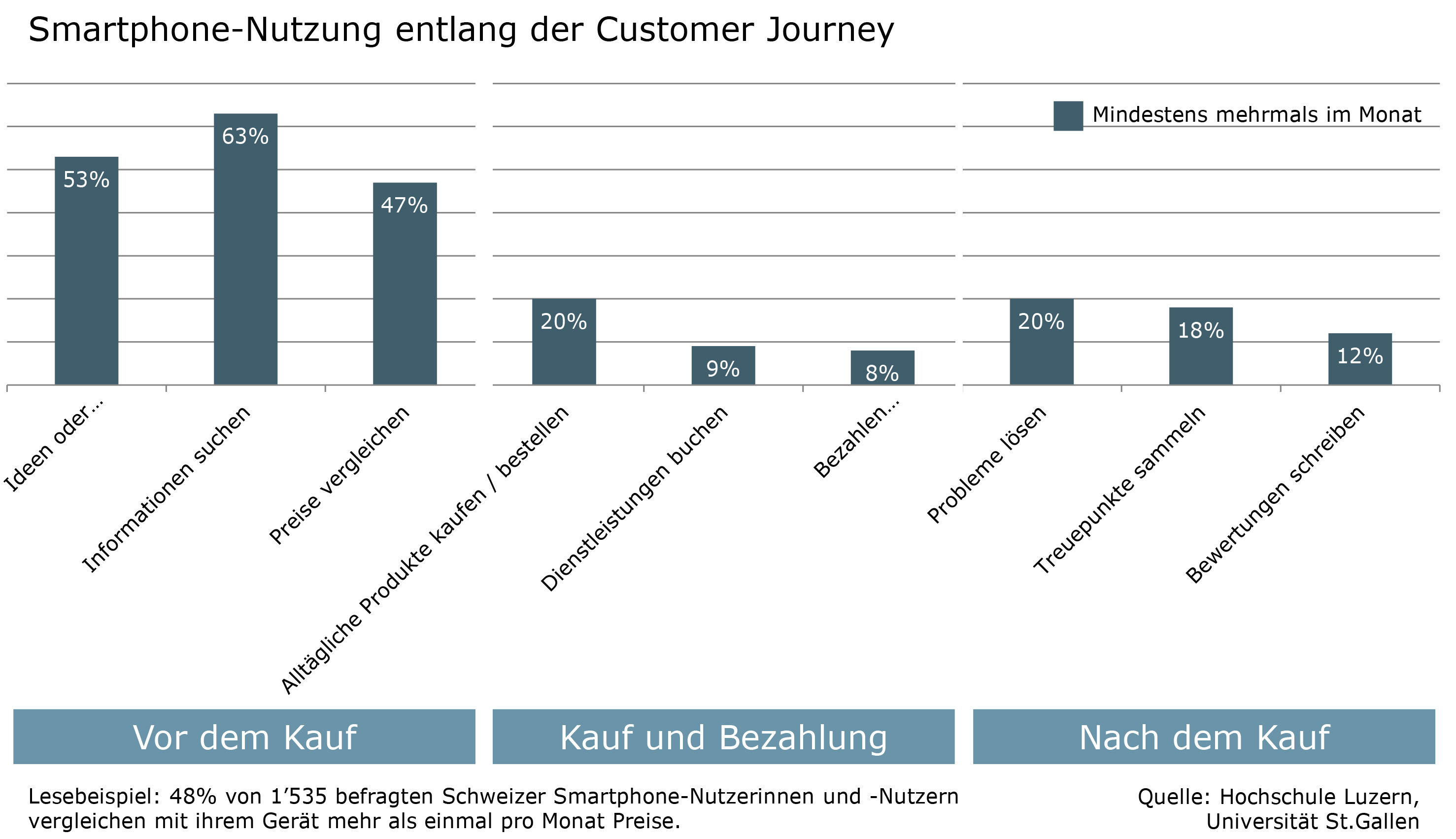
Mobile customer journey: moderate use at the beginning, lots of potential in later phasesThe study also shows that smartphones are used to varying degrees in the different phases of the customer journey. More than half of those surveyed regularly use their smartphone to find ideas or inspiration for products and services and to obtain information about products and services. "The smartphone is a very ubiquitous, immediate and spontaneous means of communication that is always at hand when users need information about products," explains Katarina Stanoevska-Slabeva, an expert in digital communication at the University of St.Gallen.Slightly less than half regularly use their smartphone to compare prices. It is used much less frequently for transactions such as purchasing products or booking services. However, more than 15 percent of respondents use their smartphone to shop online several times a month. By contrast, only a very small proportion of respondents currently pay with mobile services such as Twint, Paymit or Apple Pay. Payments at the point of sale are even more widespread than peer-to-peer payments. "Regardless of the specific provider, the study provides evidence that 20 percent of smartphone users would pay with their device at the checkout," says Wozniak. However, for many, the smartphone does not appear to be the communication tool of choice for sharing experiences with companies and evaluating products or services. Nevertheless, 20 percent regularly use it to search the internet for solutions to a problem with a product or for answers regarding a specific service. There is therefore still great potential at the back end of the customer journey, for example for service and customer support. "Chat-based messenger applications such as WhatsApp are now becoming increasingly important in this phase of the customer journey. They are particularly attractive because they enable the establishment of a direct, bilateral relationship with customers. This strengthens the bond between companies and customers," says Katarina Stanoevska-Slabeva.Individualization versus privacy concernsThe company survey conducted by the Lucerne University of Applied Sciences and Arts and the University of St.Gallen in spring 2016 showed that companies are still not tailoring their content and messages enough to individual customers. To do this, companies need more information about their customers, and they have recognized that consumers' concerns about data protection represent an obstacle to individualized mobile marketing.The survey of smartphone users now confirms that they are predominantly reluctant to share personal data such as their current location with companies via smartphone. According to the survey, 81% of respondents are concerned that their data, and therefore their privacy, is not sufficiently protected. Nevertheless, just under 20 percent would provide socio-demographic information so that companies can tailor information, offers or discounts more individually. 17% would also share their current location in order to receive a more targeted offer. Tracking usage behaviour in apps and on websites as well as the current location in the background is less popular, so is individualized mobile marketing hardly possible due to the great reluctance of respondents to disclose personal data? "Yes, it is, because research shows that many users will pass on personal information despite their concerns about data protection if they receive added value in return. Attitudes and concrete actions are drifting apart," says Wozniak. According to the research team, companies are nevertheless well advised to take these concerns seriously, for example by communicating clearly and transparently for what purpose which data is used and what the added value of data sharing is for users.


