Programmatic Marketing Analysis, Part 1: Frequency


A frequency analysis in programmatic marketing helps to determine when it is worth displaying advertising to the user. This requires the right tools and correct interpretation.

Frequency analysis is about understanding how high the advertising frequency should be on average per user.This article is based on a conversation between Eticus Rozas, Programmatic & Custom Planner, and Ivano Celia*, CEO of media BROS. It focuses on three aspects that explain Programmatic Marketing in a simple way and yet give a relatively deep insight on how the Programmatic Marketing method works. It is about the following aspects/analyses:- Frequency- Days of the week & times- Overlaps/overlapThe article is more aimed at advanced planners and marketers. The definition of Programmatic Marketing is deliberately omitted, because the term is best described in many places, as also on the media BROS. BlogThis article describes the Frequency, also called Frequency Capping. In the following articles then the days of the week & times as well as overlaps.

In the illustration, three completely different campaign results are compared together - from three different areas and with their corresponding specific campaign goals.Why Frequency Analysis?Frequency analysis is about understanding how high the advertising frequency should be on average per user - how many impressions are needed per user - in order to get a deal, a conversion. The advertising pressure per user to get the interaction/action from the user. The point is to understand when the maxim is reached and at what point it is no longer worthwhile to show users the advertising, because the probability of a conversion becomes proportionately less and less likely.Programmatic marketing learns and delivers the individually required frequency per userThe green line shows the average conversion curve. The blue bars are the delivered impressions. The average frequency required per user to achieve a sale is a value that is recognized and learned independently by the tool and its algorithm in programmatic marketing. The value automatically adapts to the individual user behavior during the campaign. This is a peculiarity and an advantage in online marketing that only programmatic marketing can offer to date.The heart piece of a Programmatic Tool is the goodness of its algorithmSo not all programmatic marketing tools are the same. It depends on who has the best algorithm. In this case, we expressly advise against the use of self-made Swiss tools. These are usually put together from modular solutions from software manufacturers. RTB features integrated into ad servers and ad management tools are also no real alternative to programmatic marketing and can at best be a tactical variant for more favorable media purchasing. The trick is to discover the tool that delivers the best results, i.e. the one with the best algorithm. media BROS. has been relying on the world's largest and publisher-neutral platform DataXU from Boston since 2011 and has thus achieved the greatest successes for its customers. More on this topic at www.mediabros.ch/programmatic.Not everyone can operate their own programmatic tool, a so-called desk. This requires a license, which costs a considerable amount, as well as corresponding contracts with Google and other providers in order to be able to access their inventories in real time. SMEs in the B2C sector should join forces with a specialized online marketing agency and, especially in the beginning, equip various providers with test campaigns to find out the best partner for them. This would be the ideal way, which unfortunately is only sporadically followed.Compared to programmatic marketing, individual placements have the disadvantage of not being linked together. This means they lack the important intelligence for performance marketingThe average frequency value received from Programmatic campaigns, can be used, for example, for setting individual placements. Unfortunately, individual publishers - in contrast to Programmatic Marketing - can apply the frequency per user to the duration of a campaign. NOT set. Also, in contrast to programmatic marketing, individual placements are not linked to each other, so that the possible frequency settings only ever apply to the individual publisher. With several individual placements, the user is always counted from the beginning. This means that they receive far too high contact doses, which are ultimately uneconomical and can lead to aversion on the part of the user. This is a dilemma for which there is still no solution, but one that experienced online media planners and publishers are aware of.Frequency & runtime per user, is the KPI pair for maximum ROI return-on-investment.The runtime per user is the second key figure, which forms a pair with the frequency and should be considered together. If you analyze and optimize these two metrics, you're well on your way to getting the most out of your online media budget. A few other factors are also required, which we will also examine and report on together for readers in the course of this series of articles.The dialog that gave rise to this article can be viewed as a video under blog.mediabros.ch/programmatic be viewed.
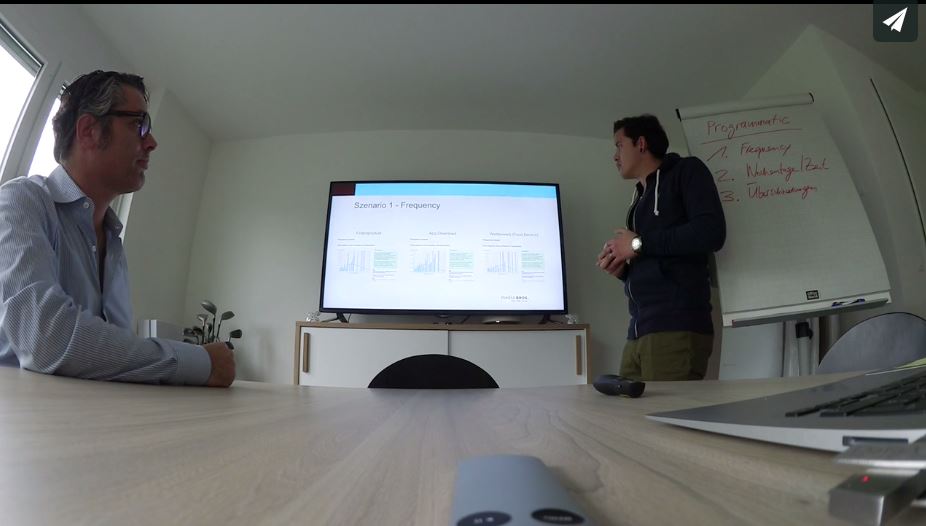
Managing Director Ivano Celia (left) and Programmatic & Custom Planner Eticus Rozas of media BROS. discuss frequency analysis in programmatic marketing.In the next article we will turn to the consideration of the days of the week and time analysis.