More TV viewers than expected!


ADVERTISING MARKET Following the release of the TV lineup for the first half of 2015, significant price increases compared to the previous year were expected. The actual figures for the first quarter of 2015 are now better than anyone expected. Somewhat surprisingly, there was an increase in TV viewership.

Private TV channels in particular have benefited from higher TV usage in recent months.For the first half of 2015, we expected a significant increase in TV costs compared to the previous year. On the one hand, the budgeted costs for 2015 on the basis of CPP (cost per GRP) were significantly higher than the budgeted costs for 2014; on the other hand, we assumed that the ratings for many broadcasters had been set too high due to developments last year. This is because the actual advertising block values were higher than the forecast values for most broadcasters, in some cases very significantly so. The table below shows the indexed development of selected broadcasters. It is based on the average advertising block ratings (GRP) in the target group of people aged 15-49, which were achieved in prime time (7 p.m. - 2 p.m.) from January to March 2015. The index shows the extent to which the actual values deviate from the forecast values. Reading example: With an index of 1.0, the forecast corresponds to the effective value; with an index of 1.40, as in the RTL example, the deviation is plus 40 percent, i.e. the effective advertising block value in prime time was on average 40 percent higher than the forecast value.
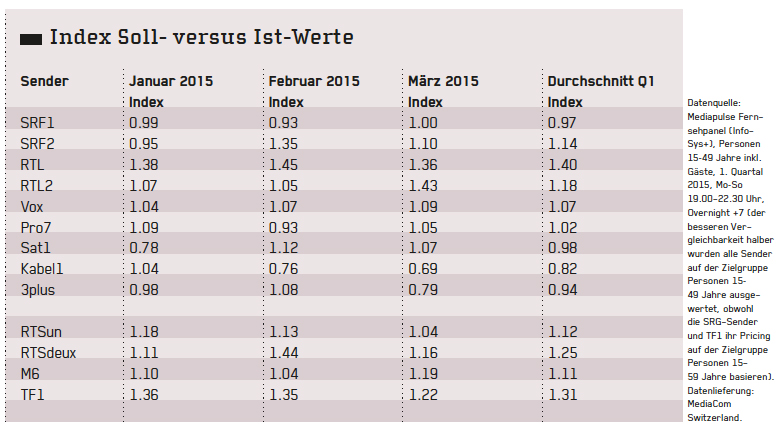
High TV usage in recent monthsThe development at RTL is particularly striking, but also at TF1. Here, the actual figures were massively higher than the forecast figures. By contrast, Sat1 and Kabel1 have weakened, although Sat1's performance is more positive than that of Kabel1. 3plus was also well below the forecast figures in some cases. However, the channel often shows strong fluctuations, as its performance is heavily dependent on in-house productions. SRF1 is also not always able to achieve the forecast figures, but the deviations in this target group are significantly lower than in the previous year. In the target group of 15-59-year-olds (the SRG broadcasters' price-setting target group), on the other hand, the deviations are greater. The higher advertising block values reflect the higher TV usage (viewing time) in recent months, with private broadcasters benefiting most from this. This development was not expected by the market, as it contradicts the trends in neighboring countries. It would be expected that TV usage would decline slightly in line with developments in the surrounding European countries. The Mediapulse TV panel certainly measures TV usage correctly, and this is also reviewed on an ongoing basis. However, the question is whether last year's changes to the sample weighting had a greater effect than expected.Advertising pressure usually achievedNevertheless, compared to last year, the planning and monitoring of TV campaigns was much more relaxed. The planned advertising pressure was generally achieved or in some cases significantly exceeded. However, the latter also means that in some cases too much money was invested, which is of course not in the interests of advertising clients. The SWA will continue to keep an eye on the accuracy of TV forecasts and the impact on the advertising market.Authors: Monica Jäggi, Konnex and Roland Ehrler, Director SWA