Omnichannel: the seamless shopping experience


COMMERCE Multichannel and cross-channel are now being followed by omnichannel—the customer’s shopping experience across all channels, with seamless transitions and a consistent brand experience. An omnichannel commerce study reveals how far companies have come in this area, what is considered standard, and what obstacles remain.For the study, 25 retail companies were interviewed. This was carried out by the EHI Retail Institute. Further results can be found in the dossier "Omnichannel commerce 2015" summarized.
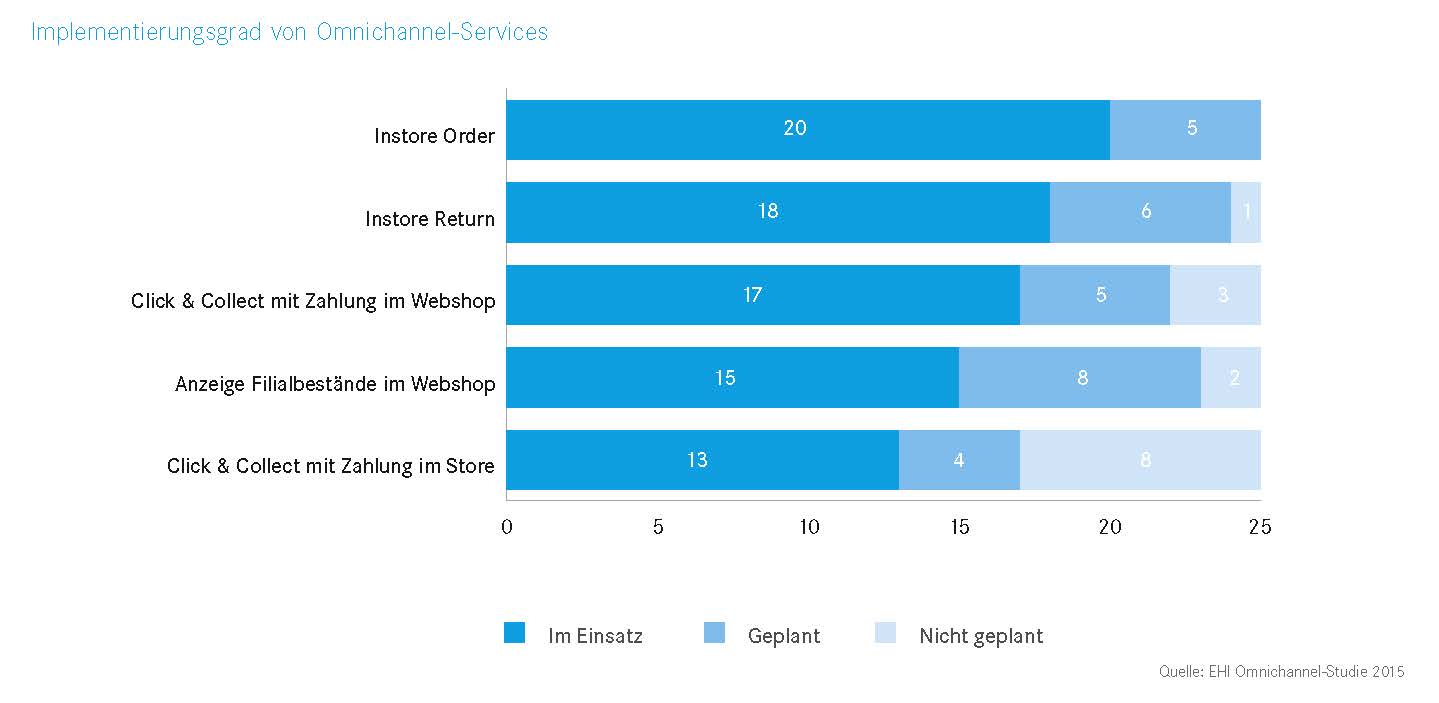
Despite the fact that many retailers are still in an experimental phase when it comes to omnichannel, five services can be identified as part of a successful omnichannel implementation. Omnichannel service setMost retailers see the ability to return goods purchased online to stores as a clear customer expectation. Almost all retailers surveyed have already implemented instore returns (24) or are planning to do so. All respondents agree on the advantages of in-store ordering (25), as it enables an expansion of the in-store inventory due to the larger product ranges of the online stores. This is followed by click and collect, either with online payment (22) or with stationary payment (17). For many retailers, the second option is particularly attractive because the customer has already completed the order but still comes into the store and can be inspired to make further purchases there. Also among the top 5 implemented or planned omnichannel services for the majority of retailers (20) are online availability displays for stationary products. However, a particular challenge here is the real-time connection of the stationary merchandise management system to the online store, and the implementation of the services shows a wide range in terms of customer convenience. The mere introduction of an offer is no guarantee of quality. The importance of omnichannel commerce is underlined by the fact that a third of retailers have already earmarked their own budgets for this.Initiating transformation processesCurrent challenges are initially the conversion of the systems and the task of creating interfaces where none were previously planned. When asked about the most important lessons learned, some retailers stated that they had underestimated the change management requirements. This is because there are far-reaching changes for employees. Suddenly they have to accept parcels, place orders in the online store via tablet and process returned online orders. And for many (14) of them, all of this initially without incentives. In order to bring omnichannel to life for staff on the shop floor, many retailers (20) advocate training and even more provide or will provide tools such as tablets, and it was clear to all interviewees that employees must be brought on board, as omnichannel can only work if everyone in the company embraces the topic, from the managing director to the salesperson. Top management must lead the way and initiate a transformation process for the entire company.Play touchpoints individuallyWhen asked about the most important point of contact with the customer, stationary stores receive the most mentions. However, a rethink is beginning in which the individual touchpoints are used according to the customer's individual preferences. Today's customers want to use different services depending on the situation - reserving a product in-store via cell phone or choosing from the online range in-store with the preference of personal advice via tablet - the different omnichannel processes are enormously diverse.