Cross-Channel or How Online Retail Supports Stationary Trade


CROSS-CHANNEL It is clear that the retail sector is suffering from a slump in footfall. Cross-channel approaches can counteract this, as the development in the USA shows.

Online stores also serve as a "gigantic shop window" for the stationary product range.FROM NICOLE RÜDLIN*, Head of Internet WorldIn the USA, the retail sector has lost over half of its footfall in the past three years. The trend is that those without an online presence have clearly lost more than those who have at least been able to transfer their sales to e-commerce. The question of the future will therefore no longer be whether an online store is worthwhile, but whether a retailer can still afford not to have one. "Our online store is like one of our branches" - this statement is often heard from cross-channel retailers. But this interpretation falls short, especially if you want to take a holistic view of the profitability of the online store, which not only functions conceptually according to different metrics, but also in terms of processes and organization. Anyone who calls it a store is also saying that its organization is not yet ready. This is an attempt to squeeze a new type of touchpoint into a traditional organizational structure, which rarely works well. The demise of catalog mail order companies such as Quelle and Neckermann is a good lesson in this respect. Equally outdated are approaches that measure the online channel purely in terms of sales figures. This is because in terms of costs, it is generally allocated a significantly lower budget than the opening of a new store. Not to mention staffing levels.Out of (online) sight - out of mindRather, e-commerce, including m-commerce, should be seen as a kind of meta-level: as the touchpoint that guarantees the retailer a 24-hour presence, invites dialog or simply conveys competence and allows the potential customer to make a comparison with the competition. This is how customers are perceived these days: What is not available online does not exist. What I can't find on Google doesn't exist. And it is in this context that the value of the online store must be seen. In an age of extremely tight leisure budgets, people often only research online which bricks-and-mortar retailers to visit when making a new purchase. And this happens after the evaluation for the most desirable products has already taken place: the stationary retailer who is not online with his complete range during this process has already lost out. They fall through the evaluation grid both by product and by location. And this is happening on a grand scale: even today, over 50 percent of all stationary purchases are generally preceded by online research. The online store can therefore also be seen as a gigantic shop window that brings the stationary product range into the virtual space. Efficiency figures such as visitor numbers, conversion rates, net sales, contribution margins and more are certainly important, but fall short.Online stores have positive effects on their brick-and-mortar storesThe online store is no less relevant as a driver of footfall in bricks-and-mortar stores. And this is not just regular footfall, but sometimes also highly qualified footfall. The stationary customer comes to the store prepared. They know all about the product or have already developed an idea of where they want to go with their purchase. They are also aware of the competitive situation in the retail sector, which places new demands on sales staff, and a study by ECC Cologne on cross-channel behavior shows that customers who have obtained information in advance from another channel of the same provider have higher sales than if this was not the case. And this applies in all directions without exception. For example, more than a fifth of all stationary transactions are preceded by online research in the retailer's own online store, which, however, generates more than a quarter of in-store sales (27.5 percent of stationary sales are preceded by online research in the same retailer's online store). With the reverse effect at the same retailer, 6.6 percent of online store transactions are the result of preparation in the brick-and-mortar store. However, at 13.8% of online sales, this corresponds to a transaction volume that is more than twice as high.In the end, only the overall result countsThe word cannibalism often haunts the aisles of established retailers. But the quote "Cannibalize yourself before someone else does" is certainly justified and is attributed to Steve Jobs. And it is indeed true: an online store in Germany takes just 15 percent of sales away from the brick-and-mortar business, the other 85 percent is additional sales that would not have been generated without an online store. This figure is supported by various studies, the most recent of which once again comes from the ECC in Cologne.
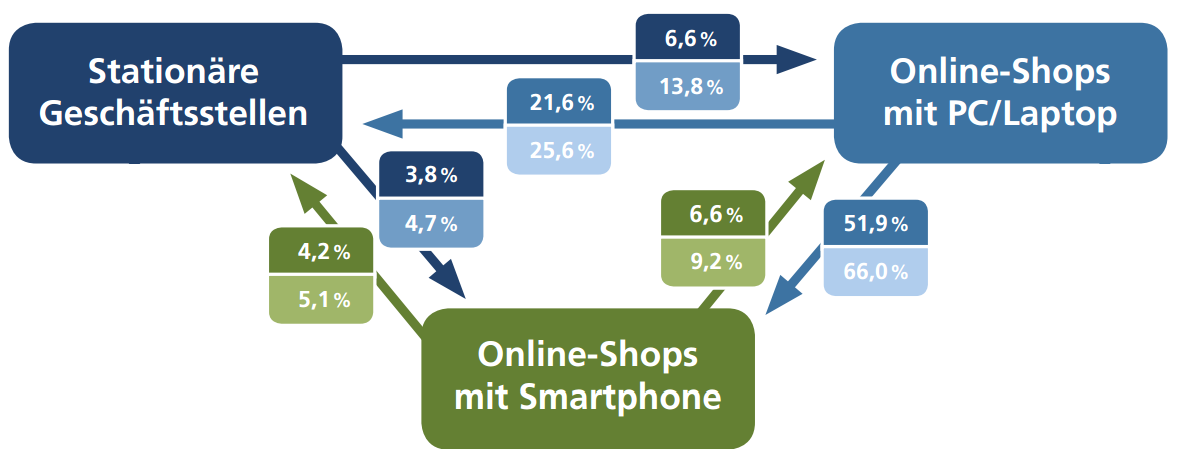
Cross-channel customers are more valuable. Searching for information in one sales channel before buying in another.Reading example: 21.6% of stationary sales are preceded by an online search. This corresponds to 25.6% of stationary sales (source: ECC Cologne)Frequency is the magic wordEvaluating online stores purely on the basis of sales figures belongs to the bygone age of multi-channel retail, where each channel was viewed in isolation. Today, however, customers are much more advanced and expect a consistent and networked shopping experience across all touchpoints. And this so-called cross-channel experience must also be taken into account in terms of measurement tools, because the value of online and mobile stores for cross-channel retailers is not just direct sales, but also the online presence of their own market performance. This in turn ensures footfall in the stores. E-commerce is an important source of sustained footfall in brick-and-mortar outlets. And that is how it should be measured.Conclusion: Multi-channel becomes cross-channel and becomes omni-channelCross-channel retailers in particular often find it difficult to determine the value of their online store. However, if you only compare costs and turnover, you are thinking too briefly, as this calculation only works in very few cases. A more comprehensive approach is required in order to obtain real values when quantifying the effective company value of the online store.
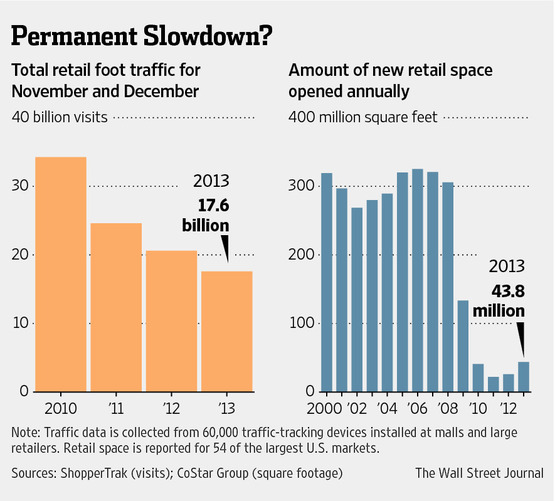
More than 50% less footfall in US retail during the peak shopping period in November and December 2013.Online retailers who want to know what effect the online channel has on the brick-and-mortar store and how this can be measured should keep an eye on or retrieve the following values from their own tracking tool:1. what are the interactions between product and store information (retrieval of stock information)?2. how often was store information such as address and opening hours called up?3. how often was the route planner to the nearest branch on your website used?4. how often was a product added to the watch list and then printed?5. how often were reservations for products made in the store online or by telephone?6. how often were online purchases collected in-store?7. how often were online vouchers redeemed in stores?8. were additional stationary sales made from online purchases and reservations?9. were there any stationary purchases that were delivered via online logistics?10. were there any online store returns that were handed in at the store?

*Nicole Rüdlin has an excellent network in the e-commerce industry. In her role as head of Internet World, the leading e-commerce trade fair in Europe, the 35-year-old is in constant contact with industry experts and scouts for trending topics in the fields of online marketing, e-commerce, mobile business and social media. The business administration graduate (FH) has been working as a topic scout for events at Neue Mediengesellschaft Ulm mbH since 2007 and has been head of the department since 2011. Prior to this, she worked in the further education sector for several years.