
"The key to successful marketing is through individuality".


DIGITIZATION At the Überall App Kongress in Vienna, Christoph Oggenfuss* spoke with futurist Dietmar Dahmen about the impact of digitalization on the marketing world. The focus is increasingly on the individual.
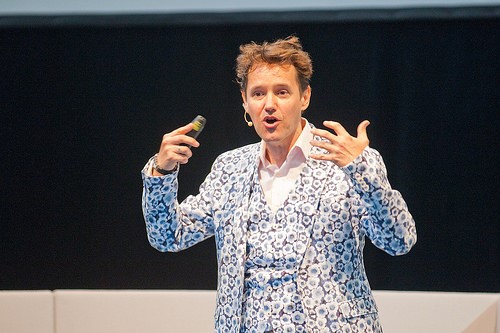
Dietmar Dahmen is a specialist in modern branding and forward-looking brand communication at the European Association of Communications Agencies, a lecturer in advertising at the Baden-Württemberg Film Academy in Ludwigsburg, a member of the Creative Club Austria and the Art Directors Club Germany.The Überall App Congress Vienna took place for the second time. This time, more than 800 congress participants met at the Marxhalle in Vienna for the European meeting place for the IT and Internet scene. Around 100 speakers of international stature showed the audience of experts the way forward for app technology, with keynote speakers including futurist Dietmar Dahmen. Christoph Oggenfuss* asked him four questionsMK The term "digital" has migrated to become the buzzword of the hour - what does it really mean?DIETMAR DAHMEN Semantically, the term "digital" is to be understood as an umbrella term, comparable to "life" or "food". Digitalization is to be seen as a social trend and everyone picks out what makes sense in the relevant context. It's different for a doctor than for a construction expert or a fashion designer. I see digitalization as a kind of "gene" that works on all devices. This is in stark contrast to the days of vinyl records, which only worked with a record player. For me, digital does not describe a state or an object, but rather a "space" for activities with great potential for innovation and opportunity.MK Which corporate functions are most at risk or specifically challenged by digitalization?DAHMEN Every corporate function is at risk! All employees must ask themselves two fundamental questions:- What can I do better than a computer program?- Where am I better than a robot?These questions seem sarcastic and misanthropic. The fact is, however, that the substitution of human labor by technology will continue at a rapid pace in the coming years, and if I as an employee cannot answer these questions clearly and positively, I am in danger. That sounds very threatening, but at the same time it also offers great opportunities. Creativity and inspiration are domains that set us apart from machines and programs - we need to actively exploit this fact. If we fail to do so, we run the risk of becoming stultified by digitalization, and we can assume that routine-based executive activities are most likely to be replaced. Why is a cab with a person at the wheel better for me? If Amazon uses real-time pricing to adjust a price twelve times a day, then a computer program can undoubtedly do this better and more reliably than a human.we are talking about B to C and B to B today. I am convinced that when the wave of digitalization subsides somewhat, H to H will become the mantra: When it comes to excitement, fun and emotions, humans have a clear advantage.MK What is your "survival kit" for classic marketeers?DAHMEN In the past, it was about finding a brand promise, a message, a big idea that was valid for as many consumers as possible; today, the task is to provide proof, not for an abstract target group but for the individual. My analogy is that in the past, marketing had to write a "book" that was read by as many people as possible. Today, marketing has to help write totally individualized "letters". This is a fundamentally new self-image that can only work if it is embedded in the corresponding technologies.MK What does "marketing" mean in 2020?DAHMEN At the core of the term marketing is the element of the market - i.e. it is about making markets. Markets are places of exchange, places of individualized exchange. It is not simply about products, but also about commonalities and attitudes (e.g. "shared vision" or interest in football) that help to develop relationships. Markets cannot be reduced to economic objectives. The significance of the brand will change to the extent that consumers will ask themselves when choosing a brand: Does this brand make me a "better person", a better "me"? Consumers will increasingly ask themselves whether the company's leitmotif is in line with their beliefs and in what sense the product or service "digitally enhances" them. Unfortunately, the marketing reality today is still very much characterized by thinking in terms of A-customers and B-customers - a kind of "categorization trap". Everything and anything wants to be clustered, we want to recognize patterns everywhere. But I ask you, dear marketeers, do you cluster things that are valuable to you in your private life? In 2020, I am convinced that the key to successful marketing will lie in distinct individuality.


