
SWA: TV forecasts with the new TV panel are suboptimal


TV ADVERTISING A comparison between the forecast values produced by TV marketers and the actual performance values achieved shows that the predictions are often imprecise. As a result, TV campaigns, particularly in German-speaking Switzerland, often achieve significantly lower advertising pressure than planned.

The Swiss Advertising Clients Association criticizes the imprecise forecasts of TV marketers. This is a contribution from the Swiss Advertisers Association (SWA). Authors: Monica Jäggi (Konnex) and Roland Ehrler (SWA)The introduction of the new TV panel on January 1, 2013, has kept the advertising market very busy. The 7 months without TV data in 2013 have not yet been forgotten. It was not until August of last year that regular data became available to all users again. But that also came at a price. For example, households that only watch TV on their PC, so-called PC-only households, were again excluded from the TV panel. In addition, TV usage via tablet or smartphone still cannot be measured for technical reasons. The survey of Swiss TV consumption thus still has considerable gaps. The SWA is working in various bodies to ensure that the new TV panel comes even closer to real TV consumption.Forecasts are off by up to 50 percentAfter 16 months of measurement with the new TV panel, it's time for an initial comparison of the forecast values produced by TV marketers with the effective data. As a reminder, the forecast values were drawn up on the basis of the experience gained with the new TV panel last year, so they should again be based on realistic foundations compared with the previous year. Nevertheless, the performance figures actually achieved deviate massively from the forecast figures in some cases. The enclosed table shows the deviations of selected TV stations. The basis is formed by the average advertising block ratings (GRPs) in the target group of persons aged 15-49*, which were achieved from January to March 2014 in prime time (19.00-23.00).
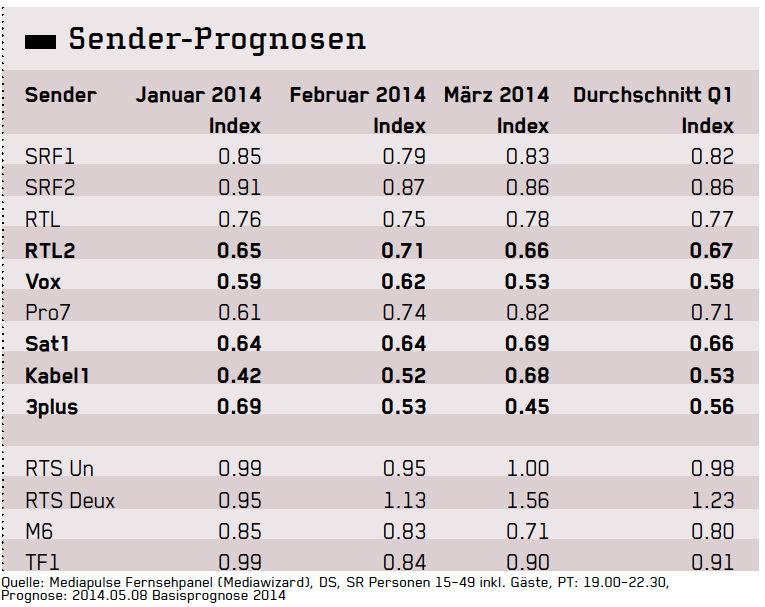
Explanation: With an index of 1.0, the forecast corresponds to the actual value; with an index of 0.53, the downward deviation amounts to 47% (Kabel1); with an index of 1.23, an additional output of 23% (RTS Deux) was achieved compared to the forecast. Over the entire period under consideration, only RTS Un just reached the forecast values; only RTS Deux exceeded them. In general, the deviations in German-speaking Switzerland are significantly greater than in French-speaking Switzerland. In both language regions, on the other hand, the SRG stations performed better than the TV stations marketed by Goldbach Media. The index of the TV station TF1 marketed by Ringier is higher than that of M6 (Goldbach Media), but lower than that of the SRG stations.Advertising at the wrong time?The imprecise forecasts mean that the TV campaigns deployed by advertising clients achieve significantly lower advertising pressure than planned in the scheduled campaign period, especially in German-speaking Switzerland, which in turn can have a negative impact on campaign effectiveness. Although most marketers provide a performance guarantee on this target group, it amounts to only 80% of the forecast value, and deployment is also delayed by at least one to two weeks. Accordingly, the value of the advertising franc used decreases significantly. Lastly, it should also be mentioned that not every Freespace franc benefits from a performance guarantee. In the case of Kabel1, for example, this means that a Freespace franc still has an average value of 53 centimes. If one takes into account not only the paid budget that is used on a station, the current developments in TV values do change the price/performance structure quite considerably.Advertising clients and their agencies are dependent on the marketers' forecasts being largely realistic. Otherwise, they will be forced to build a correction factor into their media planning. In some cases, they would have to buy in massively more power in order to get the necessary advertising pressure at the right time. But this approach is not ideal, as it leads to counter-forecasts. Ideally, the marketers themselves should improve the quality of their forecasts and enable customers and agencies to plan TV optimally. The SWA has set itself the goal of regularly investigating the topic of TV forecasts and informing the advertising market about it.*For better comparability, all stations were evaluated on the target group "persons 15-49 years", although the SRG stations and TF1 base their pricing on the target group persons 15-59 years.


