
A lot of movement on the screen


VIDEO-ADVERTISING increased significantly in 2013. The reasons are obvious: larger bandwidths, improved technology, growing video reach and users who like portals such as YouTube. Admazing, Stailamedia, Adwebster and others report on their experiences.
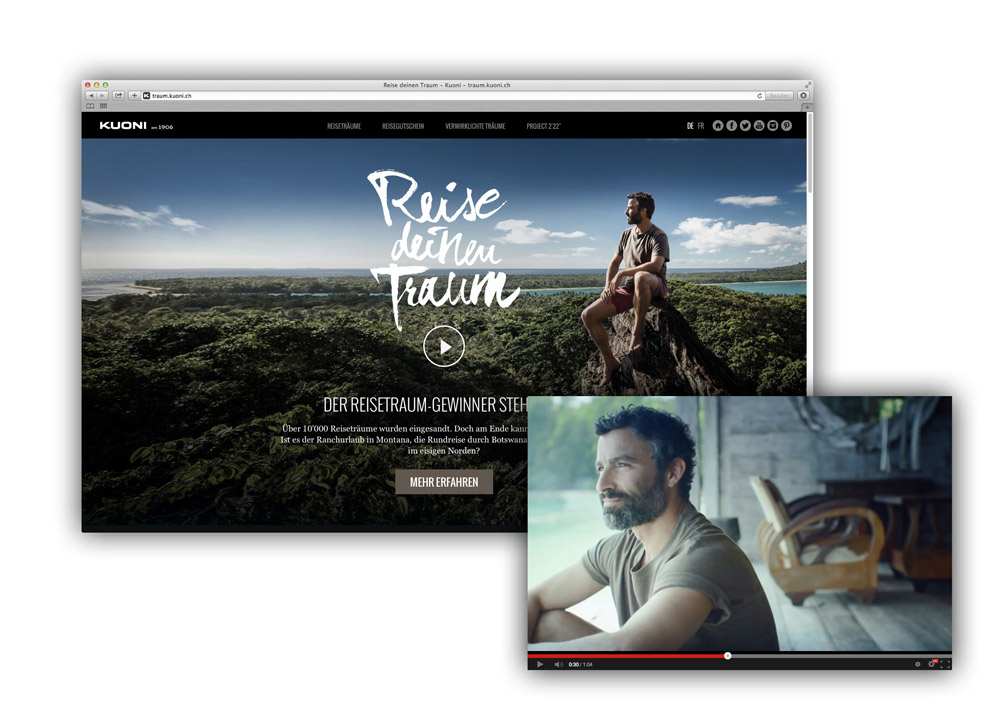
The Serranetga agency operates at the intersection of creation, media and technology. It implemented the cross-media campaign for Kuoni. BY GREGOR WASERLegs stretched out on the sofa, fingers darting across the tablet screen. At 20min.ch a video of a speech by the deposed Ukrainian President Yanukovych is available. Clicking on it starts a 20-second video spot: Hits with Katy Perry and Avicii are advertised. After 10 seconds the spot can be clicked away.One page further on sport.ch; looking for the latest soccer results, a Suva video spot appears at the top of the page with a construction worker dummy falling off a house. Both in-stream advertising, as in the first example, and in-page advertising, as in the second example, picked up speed in 2013.Video advertising grows"In Switzerland, the video advertising market grew disproportionately in 2013," says Michael Baum, managing director of Stailamedia. The agency of online brand communication operates the Swiss Video Network. "In the fourth quarter of last year, we could have filled our network twice," Baum says with surprise. He locates simplified programmatic trading of video advertising as a growth driver. "Second, interactive forms of advertising are also convincing TV-only advertisers to shift their budgets toward online. And third, moving image advertising is increasingly being planned cross-medially within agencies, because many target groups can be reached much more efficiently online," says Baum.Asked about the significance of the individual forms, the Stailamedia boss says: "The audio-visual experience of in-stream advertising makes it directly comparable with advertising on linear TV. However, it is not yet possible to build up the same reach via in-stream advertising as via classic TV advertising. That's why we like to use selected, large-scale in-page video formats to increase reach and optimize contact classes." In-page formats would be particularly suitable if further information is communicated or interaction goals are pursued on a landing page.Leonardo Kopp, Head of Marketing at Admazing, states, "We've seen consistent growth in video ads for years. This is a logical consequence of increased bandwidths, improved technology and more available video reach. Regardless, however, media planners and marketing decision makers have now realized that video advertising on the Internet offers many advantages." In addition, the change in media usage behavior is noticeable, for example in the growing popularity of channels such as YouTube. "In-stream video ads - i.e. online commercials that run directly before, between or after video content - are certainly central to further development. The user has usually activated the sound and is in a phase of heightened attention," explains Kopp. "Possibilities such as various targetings, accompanying banners or interaction objects round off the effect. But in-banner video ads can also have a strong effect. "Also at the performance marketing agency Tradedoubler the video ads segment has grown strongly. For the current year, Managing Director Immo Hütte sees a continuing increase: "The latest expert estimates assume growth of 18 percent in the moving image market.In-stream versus in-pageTradedoubler acts as a network with delivery of both in-stream and in-page video ads. "Both areas have their advantages and disadvantages, and in the evaluation you clearly have to pay attention to whether the video was played consciously or in order to view a certain content that follows," says Immo Hütte. The duration of use of the video and whether it was played in full-screen mode and with or without sound are also essential indicators. "Michel Lazecki, Managing Director of Adwebster, notes that video ads established themselves in the format mix in 2013. "Video advertising will continue to grow strongly in 2014," he is convinced. Regarding the individual formats, Lazecki says: "In-stream is comparatively expensive in Switzerland and inventory is very limited. That's why video campaigns are usually combined with in-page formats." He says this lowers the effective CPM and greatly increases the potential net reach. "We deliver in-stream and in-page video advertising with target group targeting," explains the Adwebster boss, "In addition to target group targeting, we have various other options on offer such as geographic targeting or retargeting. In many cases, we also take care of streaming and tracking for our customers. However, we have nothing to do with the production of the spots."For SMEsOmnimedia is also moving agilely in the field of video ads. With Ontrac, a product line was created specifically to meet the needs of SMEs. Ontrac-Director Stephan Muendlein says of this move: "We also enable companies with small advertising budgets to be present in the increasingly important online world. As a subsidiary of the Ringier AG we have access to the Group's high-reach online presences - the Ringier titles, Scout24, anibis.ch. We are also a Google SME Premium Partner. With our experienced campaign management and our in-house video production, we cover all relevant areas of good SME online marketing. "Serranetga skillfully plays the keyboard of the various channels. The agency operates at the intersection of creation, media and technology and implemented the cross-media campaign "Reise deinen Traum" for Kuoni last year. Primetime TV spots were flanked by online appearances. "Media usage is shifting toward online. Accordingly, our clients also invested significantly more in video ads last year," says Serranetga founder Remo Prinz, who is always involved in the planning process at an early stage: "As an agency, we are involved even before production. That means we ask ourselves how the client can best achieve its goals and develop the appropriate moving image strategy."The Dos and Dont'sBut obviously there is still a lot in development in the still young field of online video advertising. It's being tested, tried out, and experience is being gathered. What works? Which spots are clicked away immediately? When asked about the dos and don'ts, the experts are animated. Leonardo Kopp says, "It's tempting to take commercials from TV campaigns directly for online placements, but specially adapted video ads often achieve better results. Storytelling often works differently - and can be supported by many elements. Generally, short spots up to 15 seconds are better. However, there are also placements or booking forms like that can be almost any length. In any case, as long as the content is relevant to the target group.""Of course, the Internet as a medium works differently on many levels than classic television," Michael Baum holds first. "For example, content and attention spans on the Internet are shorter, but generally more intensive. And: The Internet offers opportunities for direct communication with the user. In implementation, we therefore recommend keeping the length of spots below 20 seconds if possible, positioning the brand as early as possible in the spot, and using the interaction and optimization possibilities of the medium." By planning TV and online moving images together, the entire moving image media budget can also be used much more efficiently. And significant amounts are involved.Immo Hütte refers to the good guideline of the IAB and says: "The content is highly dependent on where you advertise and who the target audience is. Basically, however, you should take advantage of the possibilities of video ads. The goal should be to engage the user as much as possible, which can be achieved, for example, by making the video interactive." Here, he mentions the possibilities of adding mouseover capabilities to the content, making the video clickable and linking it to the webstore and specific offers and coupons, as well as integrating social media components. "If you use this in parallel and in unison with TV spots and other promotional activities, and take advantage of second screens, you will get very good view and play rates and very good conversions. And Michel Lazecki says: "The most important thing is to make the main message and the brand clear in the first seven seconds of the spot. Most websites offer the user to "skip" the ad after seven seconds. If the main message is not clear then, the advertising impact is correspondingly lower."Second screen play an important roleIt is obvious that not least the strong increase in smartphones and tablest has been beneficial to the division. "Smartphones are a relevant driver of in-stream reach. In our Swiss Video Network, over 30 percent of video plays already come from smartphones and tablets," says Michael Baum. And Immo Hütte adds: "The Swiss smartphone and tablet market is already enormous and the use of second screens is constantly increasing. Not least for this reason, mobile will play a very important role for video ads in the future." Michel Lazecki agrees: "Simply because of the limited inventory, the smartphone will become a very important delivery channel for video advertising. Connection speed is still a problem in some cases. But the network is also getting faster and faster, making this problem negligible in the medium term."


