
Companies between denial and "me-too" herd instinct


DIGITAL In the second part of the series "Digital is not trivial", Christoph Oggenfuss talks to Dr. Marcus Schögel, Director of the Institute of Marketing at the University of St. Gallen, about the challenges of digital change and the impact on marketing and communication.

The digital world has long since arrived among consumers - companies, on the other hand, are lagging behind.FROM CHRISTOPH OGGENFUSS*The digitization of companies has been a topic for 15 years, for example in the sense of electronic markets. The digital technologies have gradually penetrated the companies, so to speak, without much "fuss". As a simple example, the information that was previously mapped on paper and then was and is reproduced digitally by the binary logic (0/1) helps.Individual approach as the silver bulletIn Marcus Schögel's perception, companies oscillate between denying the development of digitization and a certain "me-too" herd instinct. Neither is really conducive to achieving goals. "In the context of companies' digitization efforts, the royal road leads via the individual approach - what type and what measure of digitization sustainably strengthens one's own competitive position," says Schögel.Boundaries between business and private disappearIT in itself is to be seen more as a "generic" and in this context has a universal character. This is precisely why it is essential to work out the company-specific requirements. Digitization technologies are often reduced to the B to C field, although B to B applications offer comparable opportunities. An impressive example of the permeability in the use of IT between B to B and B to C is the social network Linkedin. "The addition of a high-quality news feed and other functions show that the boundaries between business and private are dissolving," says Schögel."Digital media are at the center of society"And what does Schögel think about the question of whether digitization is more hype or reality? "Digital media are at the center of society - customers take them for granted," says the marketing expert. The widespread presence of the "digital" can be seen as a stable basis, on which, depending on the medium or technology, wave movements and thus hypes can be detected.The Gartner hype curve is also well applicable to digital technologies. Some technologies vanish into thin air after a rapid ascent and others reach the plateau of productivity after the "valley of tears". Companies have a choice between different technologies - there is no recipe for distinguishing hype from reality. The trial and error approach lends itself to this.
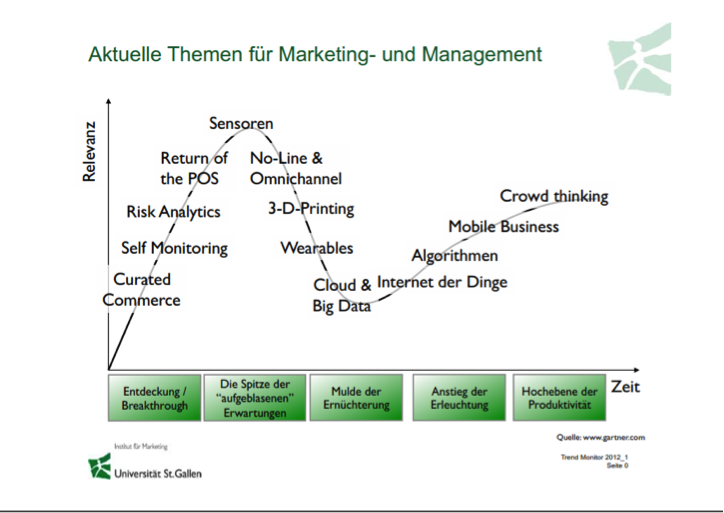
The Gartner Hype Cycle with the current topics for marketing and marketing management (reference Prof. Dr. Marcus Schögel).Networking as a central driver of digitizationFor Schögel, the central driver of digitization is the networking of devices, people or groups of people. This creates network effects that can multiply a single initiative. In contrast to the analog world, a new business approach can reach critical mass much faster and at significantly lower cost.Changed understanding of managementSchögel notices that successful companies moving in the digital world are based on a changed understanding of management. This understanding can be caricatured with the following terms:- Speed as key ingredient- Done is better than perfect- Rapid prototyping- Design thinking "The possibility of becoming closer to the customer and practicing customization in real terms is a real opportunity for companies," says Schögel. "The possibilities with digital technologies stimulate creativity regarding innovative business models." Low entry costs, leverage effects and reach are features of such business models that are attractive to young entrepreneurs or spin-offs from established companies.Loss of control among managers?Schögel sees the risks mainly in the loss of control among managers who are still operating with the previous management approach. Another observation of the internationally active professor is the fact that many managers do not have an answer to the question "What does digitalization mean for my business in concrete terms? The fact that there is no suitable example in an industry is certainly not a free pass to do nothing!"Neither euphoria nor panic helps".Schögel sees specific marketing-related challenges of digitization in companies in the following areas:- How will budget allocation change?- Is the mode of action in the marketing context understood?- How will the change from thinking in terms of "marketing awareness" to "marketing conversion" be mastered?- What new competencies and skills need to be built up in marketing and where?At the end of the conversation, the articulate Berlin-born Schögel emphasized the following key point: "Neither euphoria nor panic will help in the topic of digitization. Answering the key questions in relation to your own company with realism is goal-oriented."Companies need to close the gapAnd who should drive the topic in the company? Here, Schögel sees a choice between two types: "Either the marketing boss who has grown up with IT or the IT boss who has grown up with marketing!"The quintessence of this discussion for marketing and communications is that the digital world has long since arrived with consumers - companies are behind schedule and therefore marketing and IT are required to close this gap promptly and individually for each company.


