Audi's emotion engines roar louder, but BMW cuts the emotional ideal line more sharply
As a brand, it’s crucial to evoke strong emotions. But to win the race, you have to excel in all emotional categories. A study by Zutt & Partner compared the two German car brands, BMW and Audi.


As a brand, it is crucial to trigger intense emotions. But to win the race, you have to play all emotion disciplines well. It is not difficult for the automotive industry to arouse emotions in consumers, be it through the sound of roaring engines, the aesthetics of dynamic designs or the smell of new leather interiors. It therefore comes as no surprise that BMW and Audi are able to generate a high volume of emotions, with Audi enjoying a slight lead.
However, BMW remains close to Audi, as BMW cuts the emotional ideal line more sharply and therefore hits the desired emotions of customers more precisely. In addition, its emotional tires have a stronger profile - they trigger a narrower but more concrete spectrum of emotions. Audi arouses a wider range of emotions in consumers, but still misses a core emotion that customers want. Both brands need to optimize the consistent coordination of their brand emotions with the various touchpoints. This is shown by an independent neuromarketing study conducted with the "EmoCompass".
Key Findings:
- Both automotive giants arouse many emotions, with Audi enjoying a slight lead.
- BMW is moving closer to the Gold Standard.
- BMW conveys a more emotionally focused profile than Audi.
- As far as the emotional thread is concerned, there is potential for optimization in both brands.
| BMW | Audi | |
|---|---|---|
| 1. emotional fit to gold standard How big is the match between the respective brand and the customer's desired emotions (the perfect car brand)? |
5/5 ●●●●● |
3/5 ●●●○○ |
| 2. emotion volume How much emotion does the respective fire trigger (independent of the profile)? |
4/5 ●●●●○ |
5/5 ●●●●● |
| 3. emotional red thread How consistently are emotions carried through from touchpoint to touchpoint in the respective brand? |
3/5 ●●●○○ |
3,5/5 ●●●●○ |
| 3.1 Claim | 3/5 ●●●○○ "The joy of driving" |
4/5 ●●●●○ "Advantage through technology" |
| 3.2 Campaign | 1/5 ●○○○○ |
4/5 ●●●●○ |
Conclusion of this EmoCompass study
As BMW and Audi are very close to each other in this emotional race, it is worth taking a closer look at individual touchpoints.
As a brand, BMW conveys more adventure than Audi, but does not manage to trigger this emotion with the current campaign. The mood of BMW's campaign does not correspond to the feeling that its brand normally conveys.
Surprisingly, Audi's campaign triggers more adventure than BMW, but this emotion is not necessarily associated with their brand. Overall, however, Audi's campaign is more in line with its own profile.
In the obstacle-laden world of 4×4 vehicles, BMW succeeds well in harmonizing its advertising measures with the emotions of its brand. Things are a little bumpier at Audi. In the eyes of consumers, Audi's Quattro series mainly stands for problem solving and overcoming obstacles. In comparison, BMW's X-Drive series radiates a lot of driving fun - and therefore "driving pleasure".
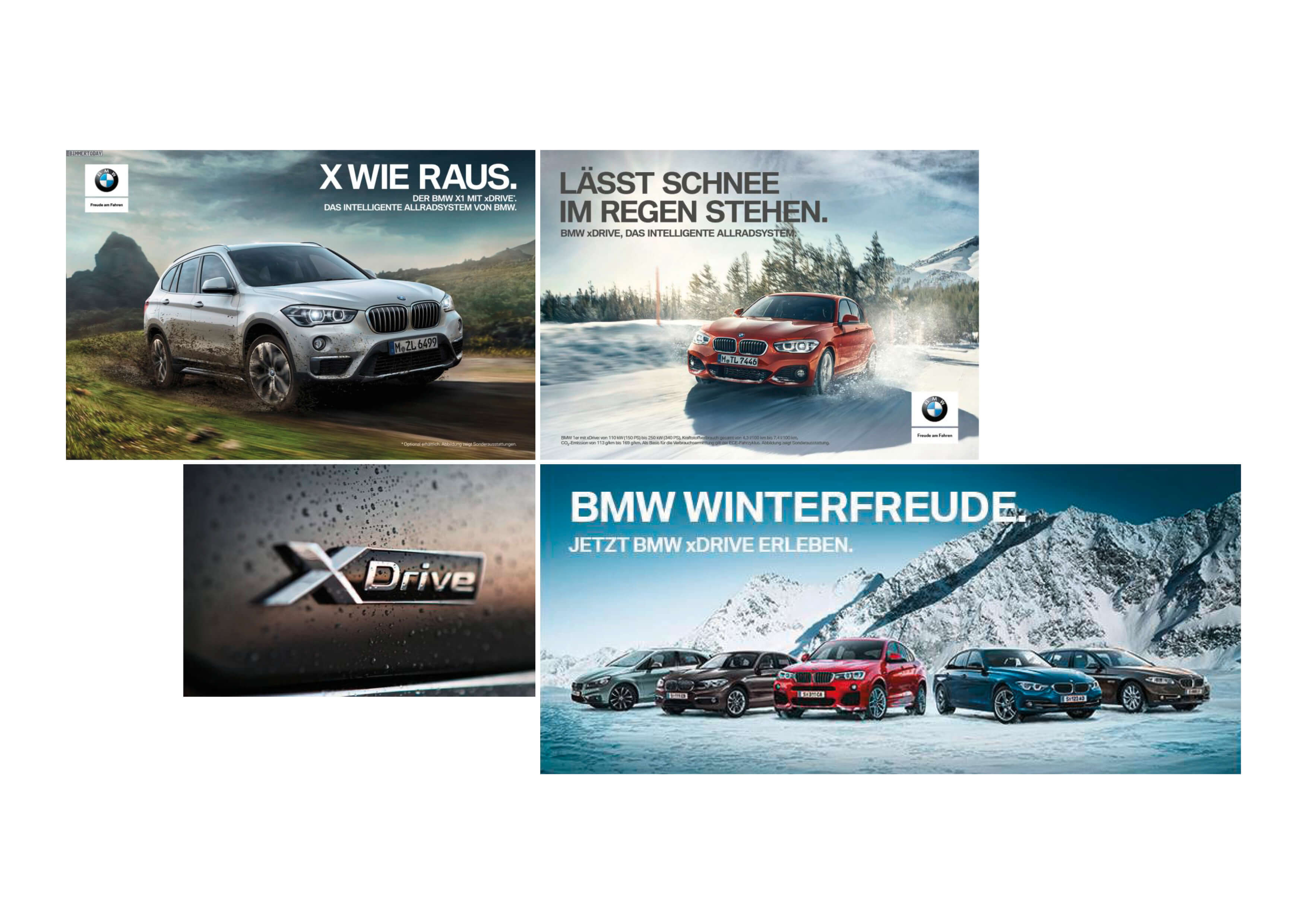

If you compare the commercials of the two brands, you can see that BMW's commercial triggers many emotions of familiarity and has a calming effect. What comes up a little short is the driving pleasure combined with adventure. Audi's commercial evokes a strong sense of innovation and seniority, thus honoring the claim "Vorsprung durch Technik". The emotional fit between the Audi commercial and the Audi claim is therefore above average.
Even after entering the home straight, there is still no clear winner of this emotional race - Audi and BMW are almost neck and neck. The course of the race shows that Audi's emotion engine howls louder and thus triggers stronger emotions in the fan curve. BMW impresses with its ability to cut the racing line more sharply and thus better fulfill the fans' desire for a fun and adventurous driving experience. Where both teams still have potential for optimization, however, is in fine-tuning their driving settings, i.e. harmonizing their touchpoints with the emotional profiling of their brand on an ongoing basis.
For the further development of the brand, it is also worth looking at the emotional positioning and classification of other car brands such as Mercedes-Benz, VW, Alfa Romeo, Skoda and so on. In addition, it is always valuable to examine what can be learned emotionally from other product categories and industries. The consistent transfer of best practices across companies and industries, combined with new knowledge about the brain and emotions, leads to the most effective customer experiences.

The results are based on a qualitative EmoCompass survey conducted in October 2018 by Zutt & Partner, a consultancy specializing in neuromarketing based in Wolfhausen in the Zurich Oberland. The survey analyzed the moods of 205 (=theoretical saturation reached) people living in Germany and German-speaking Switzerland. The survey was carried out in individual interviews conducted online - completely non-verbally using neuropsychologically coded patterns. Working with abstract colors and shapes makes it possible to tap into emotions at a deep individual association level and almost to the exclusion of cognition (rational thinking) and pure likes and dislikes. The methodology uses findings from neurology such as synaesthesia, patchwork-like working of the brain and fuzzy logic. You can find out more about the EmoCompass at Zutt.ch.