Alliance of associations and clubs calls for "bolder media law"
Despite important innovations, the new federal law on electronic media is "far" from sufficient to maintain a strong media landscape in the digital age, criticize numerous associations and societies from the media and civil society - and are therefore calling for "a bolder law".


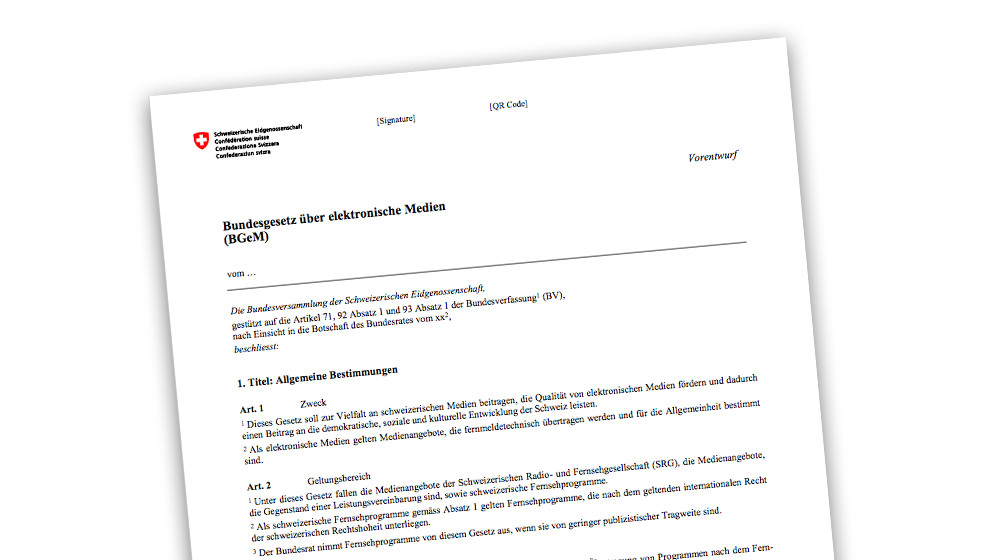
The new federal law on Electronic Media (BGeM) sets the guidelines for the future development of the Swiss media landscape. In view of digitalization, the replacement of the outdated Radio and Television Act is urgently needed. However, the new law is only half a step in the right direction, the associations and organizations involved wrote in a statement on Monday. These are Arbus, Fög, Impressum, Media Forti, Médias pour tous, SGB, SSM, Suisseculture, Syndicom, Unikom and Verband Medien mit Zukunft.
They provide following demands on:
- Online journalism must be promoted regardless of whether it is audio, video or text content. This also applies to online offerings from local and regional newspapers.
- Restricting the promotion of audio and video content on the internet makes no sense. Content must be tailored to the needs of the audience. Furthermore, the funding crisis in Swiss journalism cannot be overcome without the promotion of text offerings. A prerequisite for funding is a voluntary commitment to the rules of the Press Council and compliance with industry-standard working conditions.
- The minimum requirements in the law must also apply to radio stations without a performance mandate and to all subsidized media offerings.
- It is essential to prevent radio stations without a performance agreement from being excluded from the scope of the law. Otherwise, these heavily used stations would no longer even have to meet minimum requirements such as the obligation to present facts and events in an appropriate manner.
- A regional public service must be guaranteed in all regions.
- In regions where no private radio station wishes to provide a service mandate for regional information services, the SRG should be allowed to expand its regional reporting on the radio. This will prevent a reduction in information services for the population.
- The media levy must not be reduced any further. The financing of SRG's service mandate must be secured in the long term.
- The share of the media levy for direct media promotion must be increased to 6-10 %. In addition, the SRG's commercial income should be reduced and compensated from the media levy. To ensure that sufficient funds are available for the SRG and for direct media promotion, a further reduction in the media levy should be avoided.
- Media and user research must continue to be financed from the media levy.
- Research is key to understanding how the media in Switzerland are developing. Only then will policymakers and society have reliable findings to help shape the media landscape of the future in a meaningful way.
- The Commission for Electronic Media must be supported by a sponsor.
- An independent regulatory authority will better guarantee that the media remain independent of the state. However, in order to take account of the special features of the media industry and to anchor KOMEM democratically, a sponsorship is a good idea.
- Foreign providers should make a contribution to cultural creation.
- Like television broadcasters, video-on-demand services should also be subject to a funding obligation for Swiss and European works. In addition, a levy should be introduced on advertising windows and streaming services. Proposals should also be drawn up on how online platforms (search engines, social media) can contribute to the funding of media promotion.
At the same time, the associations and organizations from the media and civil society expressly support this:
- the technology-neutral regulatory approach,
- direct media funding for private electronic media that fulfill a performance mandate,
- indirect media promotion (digital infrastructure, press council, training and further education, news agency),
- a more precise definition of SRG's mandate and
- the introduction of an independent Commission for Electronic Media (KOMEM).