Artificial intelligence in marketing: the will is there, but the knowledge is missing so far
A recent study shows that marketing managers attach immense importance to artificial intelligence (AI) for their own work in the future. However, only very few of them have the necessary expertise, which is why they have hardly used the technology to date.


Artificial intelligence is currently on everyone's lips, and no longer just in IT-related areas. The topic has long since reached politics, business and society. French President Macron, for example, sees AI as the future of France, while Mr. Altmaier, the German Minister of Economics, sees it as a key technology of this century in which he wants to invest billions. Elon Musk, the founder of Tesla, warns of an apocalypse through AI, Bill Gates contradicts him. And in Berlin, the acquisition of a so-called robot cat was discussed intensively in the popular media in April.
AI is currently experiencing this hype because three things are coinciding: First, AI has been worked on as a concept since the 1950s. Second, it is only now that sufficient low-cost computing and storage capacity is available to allow AI to work quickly. Third, and crucially for marketing, consumers are fundamentally very willing to share their data on smartphones. AI needs vast amounts of data to learn and generate insights, and marketing works with customer data. It is only through this triad that AI is taking off in the way we are seeing.
Whereas in the first quarter of 2008 the world's three most successful brands were still Exxon Mobil, Petrochina and General Electrics, i.e. companies that based much of their success on oil, just ten years later they are Apple, Google parent Alphabet and Microsoft. The business models of these companies are based on data and software.
Marketing experts attach great importance to AI
A recent study by SRH University of Applied Sciences Berlin / International Management University entitled "AI - the future of marketing" took an in-depth look at the assessments of marketing managers in Germany, Austria and Switzerland. A total of 208 marketing managers answered questions, 53 percent of them executives and CMOs. This was preceded by interviews with experts in AI / marketing.
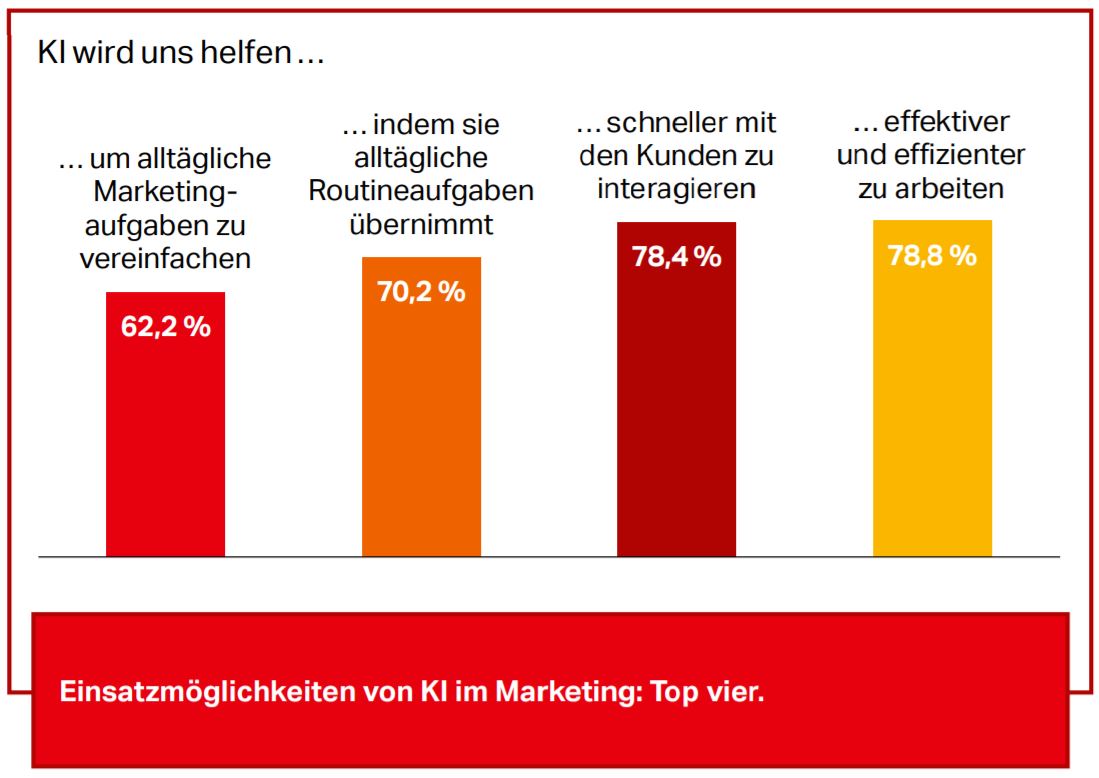
80 percent of respondents see AI as important for marketing. 93 percent predict that the importance of AI will increase significantly in the near future. AI will help in all key areas of marketing: 62 percent see AI as simplifying everyday marketing tasks, 70 percent believe that AI will take away tedious everyday routines in marketing. And AI is also expected to help in dealing with customers: 78 percent say that AI will help them interact with customers more quickly - and 79 percent believe that AI will help them be more effective and efficient.
40 percent say AI will change marketing more than anything before it. More so even than the Internet and social media. One in two confirms that in the near future AI will be decisive for the competitiveness of their own company.
Knowledge about AI and deployment are low
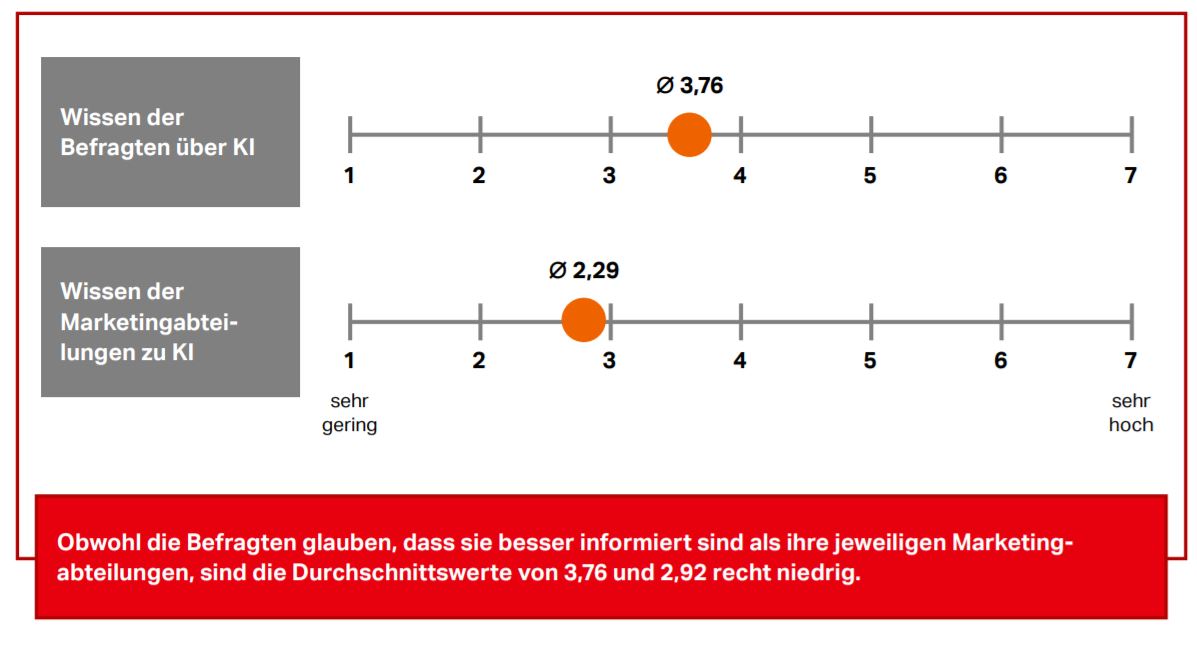
Diametrically to this attributed importance of AI, their own knowledge of it is still very low. With an average of just 3.76 on a scale of 1 (very low) to 7 (very high), marketing managers attest to a rather low level of knowledge. The own marketing department (with advertising agencies the marketing department of the customer) is still more badly trained in the range. The average score here is 2.92. This is particularly interesting because it is an anonymous survey and the respondent does not run the risk of having to say publicly how little he/she knows in this area.
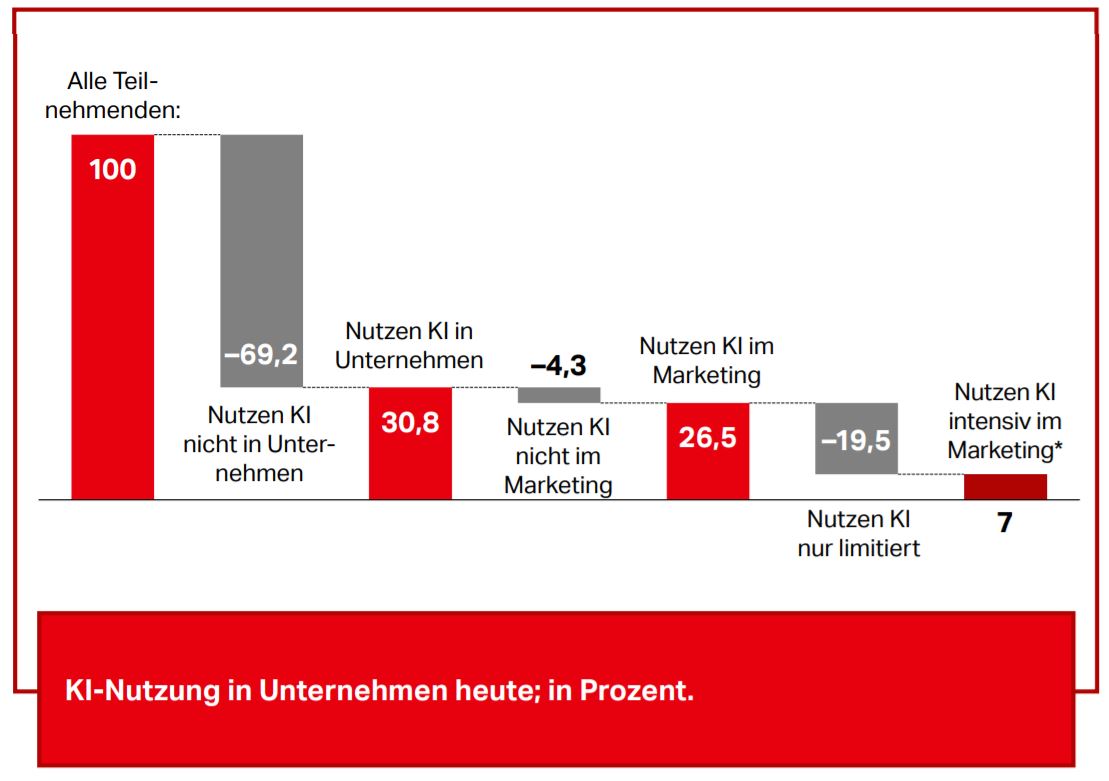
When asked about the current benefits of AI, only 31 percent say they use AI in marketing at all, with only 7 percent of them using it intensively. One in three companies employs less than 5 percent of its marketing staff to analyze data.
So, to exaggerate, you could say: AI in marketing is something everyone is talking about, but no one actually knows how it works, and no one is working with it.
Wait and see is not the solution
The survey data also show that there appears to be a correlation between the use of AI in the companies surveyed and corporate success: the difference is 14 percent. The success of the company was assessed by the respondents themselves. A simple wait-and-see approach therefore does not seem to be the solution. Rather, the expert advises working with consultants for AI in marketing until one's own team is fit, and practicing quickly and a lot with AI. Consultants can be found at universities with marketing specializations or - frequently - in marketing consultancies with an AI focus.
In addition to the survey, the team led by study author Claudia Bünte also researched worldwide which offerings already exist today for applying AI in marketing. The conclusion: There are good initial solutions and tools for almost all areas of marketing. These usually solve a special problem and are therefore still organized as islands.
Over time, these islands will certainly grow together, but that will take time. So marketing managers currently have to deal with a large number of individual solutions and providers. There is not yet a "one-stop shop".
The author: Prof. Dr. Claudia Bünte is Professor of International Business Administration with a focus on marketing at the SRH University of Applied Sciences Berlin. Her consultancy accompanies top companies in marketing and brand management. Previously, she was responsible for international marketing and brand management in leading global companies, including Coca-Cola and Volkswagen. Prior to this operational role, she advised international clients in marketing - as an executive at McKinsey & Company. She teaches and conducts research on artificial intelligence in marketing.
The article first appeared in the print edition of Werbewoche 13/2018.