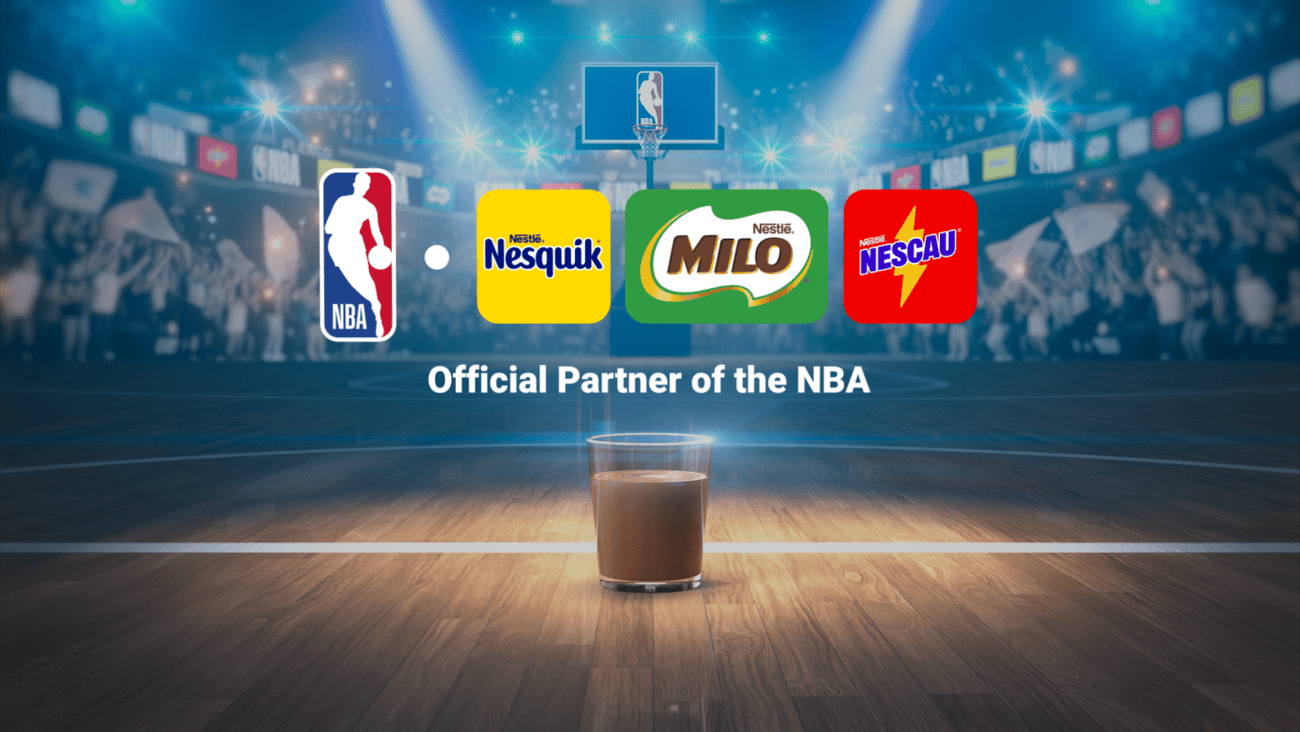
Heading Toward Global Platforms
Anyone who follows Nestlé’s marketing strategy can see a clear trend toward large, global platforms. Following recent, internationally acclaimed successes in the creative arena—such as KitKat’s strong showing at the Cannes Lions—the company is now taking the next step in sports marketing. Starting January 1, 2027, Nestlé and the National Basketball Association (NBA) will enter into a multi-year international marketing partnership.
The agreement spans 21 markets across four continents, making it the largest international brand partnership in the company’s history to date. At the heart of the partnership are the Milo, Nescau, and Nesquik brands, which will serve as official partners of the NBA. The agreement aims to connect fans worldwide and, above all, to promote youth development in basketball.
A Strong Focus on Youth Development
Plans include joint initiatives in select youth development programs and platforms such as the Jr. NBA/Jr. WNBA, the NBA Basketball School, the Coach Academies, and formats such as Her Time to Play and NBA 3X. The partnership is complemented by retail activations, on-pack promotions featuring NBA branding, and a presence at major events such as the NBA Global Games and at NBA House.
«For decades, our brands have believed in the power of sports to bring out the best in people,» explains Liberato Milo, SVP and Head of the Confectionery & Snacking Strategic Business Unit at Nestlé.
In the past, we have seen how sports release energy, build self-confidence, and promote healthy habits. Together with the NBA, we want to harness the power of basketball to reach consumers on a large scale and inspire families to be more active.
Growth Together in 21 Markets
The NBA is pleased with the scope of the partnership. Nestlé is one of the world’s best-known brands and has a long-standing global connection with consumers, emphasizes Julie Morris, NBA Senior Vice President of Commercial Development and Media. The goal is to leverage this local market presence to reach fans in new ways and support the global growth of basketball.
The partnership is launching in Australia, Brazil, Canada, Colombia, France, Germany, Ghana, Italy, Indonesia, Malaysia, Mexico, New Zealand, Nigeria, Singapore, Spain, Thailand, Turkey, the United Kingdom, the United States, and Vietnam—with the Philippines to follow in October 2027.
]]>
Nestlé's headquarters in Vevey is reminiscent of the sets from early James Bond films. Located directly on Lake Geneva, the historic building from the early 1960s rises above the former site of the Grand Hôtel. It was designed by Swiss architect Jean Tschumi, one of the most important figures of postwar modernism. With its striking Y-shaped floor plan, the cantilevered double-helix staircase inside, and its façade construction—which was revolutionary at the time—the building was regarded as a promise of the architectural future when it opened.

More than six decades later, this very contrast is palpable. Outside, a building that has long been recognized as a cultural asset of national significance. Inside, a company that is currently reinventing itself.
For while the view sweeps across Lake Geneva and the vineyards of Lavaux wind their way up the slopes, the conversations inside revolve around artificial intelligence, large language models, data platforms, and the question of how brands can thrive in a world where algorithms increasingly determine what information is made visible.
Nestlé hosted its annual «Informal Media Event.» What followed was more than just a corporate presentation. It was a glimpse into the inner workings of a corporation whose brands reach billions of people every day—and which, under new CEO Philipp Navratil, is working to prepare its billion-dollar brands for the next phase of growth following a period of turbulence.

30 Brands the World Knows
David Rennie, Executive Vice President of Strategic Business Units, Marketing, and Sales, begins with a figure that sets the stage. Nestlé has 30 so-called “billion-franc brands”—brands that each generate more than one billion francs in sales. Together, they account for about 70 percent of the Group’s total sales. No other consumer goods group has a comparable portfolio

But size alone does not explain its value.
Rennie provides examples that illustrate the cultural significance some of these brands have achieved. In the Philippines, MILO has been organizing a marathon for five decades.

In Dubai, the Burj Khalifa was lit up in bright red to celebrate NESCAFÉ's 85th anniversary. And in India, the government honored MAGGI with its own commemorative stamp to mark the brand's anniversary.

It is at this point, if not sooner, that we Swiss come to realize the scale on which some of these brands operate. While people here are still debating whether to pronounce «Maggi» with a hard «G» as in German or as “Matschi” in Italian, the brand has long been considered a national cultural treasure in India. A postage stamp for a food product may seem unusual from a Swiss perspective. For Nestlé, it’s an expression of what strong brands can become over the course of decades: cultural touchstones that extend far beyond the product itself.

It is stories like these that make it clear that Nestlé has long since moved beyond simply selling products. The company manages cultural icons—brands that are deeply embedded in the daily lives of consumers in many countries and, in some cases, even in their identities.
Fewer Brands, Greater Impact
At the same time, Nestlé is moving away from an approach that shaped the industry for many years: supporting as many brands as possible at the same time. Instead of allocating marketing budgets to around 350 brands, the company now focuses on just over 100 brands. The approach is: fewer, bigger, smarter. Or, as Nestlé puts it: «Fewer, Bigger, Smarter.».

David Rennie outlined this new direction early in the afternoon. Later, CEO Philipp Navratil revisited the idea and clarified what it entailed: Not every brand requires the same level of resources. Investments are made where innovation, differentiation, and relevance are particularly strong. The core brands, which are worth billions, are at the center of this strategy.
The foundation for this is the so-called «4Us,» which both Rennie and Navratil refer to time and again. They are far more than just a marketing model. Rather, Nestlé views them as a common language for the entire company—from research and production to communications.
- Unrivaled Superiority: Products should be demonstrably better than the competition—whether in terms of taste, quality, or technological performance.
- Unbeatable Value: Consumers should be able to find an attractive option regardless of their budget—from affordable entry-level products to premium solutions.
- Unmissable Visibility: Brands need to be visible where consumers spend their time. More and more often, that means digital platforms, social media, and e-commerce rather than traditional television advertising.
- Unforgettable Communication: Communication should be culturally relevant, spark conversations, and leave a lasting impression of brands.

What is particularly noteworthy is the consistency with which Nestlé applies these principles across the entire company. Anyone walking through the various innovation areas this afternoon will quickly notice: Whether it’s Cold Coffee, Choco Bakery, Purina, or MAGGI—almost every innovation on display can be traced back to at least one of these four principles. The 4Us are not just a framework. They represent an effort to align a corporation with many brands and thousands of products behind a common growth strategy.
The Brand as a Driver of Growth
This change is particularly evident with KitKat.
The brand was the second-most-awarded brand at the «World Advertising Championships,» the Cannes Lions. The spotlight was on the «The KitKat Heist» campaign, which turned the theft of a truck carrying 400,000 KitKat bars into a global communications story.
What began as a potential PR problem turned into one of the most successful campaigns in the company's history. According to Nestlé, the campaign reached billions of people and generated media value in the hundreds of millions. The campaign won a Grand Prix as well as numerous other Lions. m&k has reported on this in detail.

However, the mindset behind the awards is at least as important as the awards themselves.
Today, Nestlé no longer views KitKat primarily as a chocolate brand. The brand is meant to create experiences. The partnership with Formula 1 follows exactly this logic. The famous slogan «Have a Break» is placed in the context of the world’s fastest sport. At first glance, this seems like a contradiction. Upon closer inspection, however, the pit stop—just like the recently introduced hydration break at the World Cup—is arguably the most famous break in sports. Victory or defeat is decided in a matter of seconds. It is precisely this intensity that makes the partnership so interesting for Nestlé.

A classic advertising slogan is thus transformed into a global experience platform. The brand no longer appears only in commercial breaks or at the point of sale, but becomes part of a culture followed by millions of people worldwide. Products, promotions, fan engagement, hospitality offerings, and digital content all intertwine. The break is reinterpreted—not as an interruption of the action, but as its defining moment.

From Sponsorship to «Brandplatforming»
Nestlé is increasingly relying on integrated activation models that combine traditional advertising, social media, retail, influencers, and experiential marketing. Brands are no longer managed through individual campaigns, but rather through platforms that generate attention and relevance over extended periods of time.
Using KitKat as an example once again, Rouven E. Lochmüller, Global KitKat Lead, demonstrated how Nestlé uses global partnerships today as integrated brand platforms. The Formula 1 partnership encompasses far more than traditional sponsorship, ranging from limited editions to influencer activations and exclusive fan experiences.
The activation model presented here clearly illustrates how closely the various touchpoints are interlinked. From media presence to point-of-sale promotions to exclusive experiences for fans, each component serves the same purpose: to translate brand awareness into brand strength and brand strength into growth.
KitKat's Formula 1 partnership is a prime example of how modern brand management works today. The focus is not on individual advertising campaigns, but on a coordinated media mix that connects all touchpoints.

The activation bundle is complemented by exclusive products, limited editions, and experiences that fans cannot purchase. Each channel serves a distinct purpose—from increasing reach to building brand loyalty to driving sales. The goal: to transform a sponsorship partnership into a connected brand experience that makes an impact throughout the entire customer journey.
From Cold Coffee to Choco Bakery
Anyone walking through the various innovation areas at Nestlé headquarters on this late afternoon will quickly notice a pattern: Every innovation begins with a specific consumer behavior.

This is particularly evident in the coffee segment. This category is not only the company’s largest division, but also one of its most important growth platforms. And it’s no longer just about the classic morning cup of coffee.

Cold coffee, in particular, is emerging as one of the most dynamic segments worldwide. Nestlé points out that about one-third of the growth in this category stems from new consumption occasions. Coffee is no longer consumed solely to wake up. It has become part of lifestyle, enjoyment, and social interaction.

Younger target groups are experimenting with recipes, sharing their creations on TikTok or Instagram, and turning themselves into baristas. Nestlé refers to this as «coffee hacking.» Consumers are, in a sense, further developing their own beverages and creating new ways to use existing products.

Brands such as Nescafé, Starbucks, and Nespresso are responding to this trend with concentrates, new machines, ready-to-drink offerings, and products suitable for personalized creations. At the same time, Nestlé is expanding its presence beyond the home—for example, with coffee solutions for offices, hotels, and the foodservice industry. Coffee is thus increasingly becoming an ecosystem of products, devices, services, and experiences.
In the food sector, another trend is shaping the strategy. Consumers are looking for new taste experiences, but at the same time want to spend as little time as possible on preparation. Convenience and a spirit of discovery go hand in hand.
MAGGI, in particular, plays a central role here. The brand is now considered the group’s food brand with the widest global reach, as Marcin Poplawski, VP and Global Head of Marketing Transformation, revealed in his remarks. What’s remarkable is its dual role: From a global perspective, MAGGI is one of the most valuable brands in the portfolio. Locally, however, it is perceived in many places as a national brand—in India as well as in Germany or France.

That is precisely where its strength lies. While the brand benefits globally from its size and investments, it simultaneously manages to remain culturally relevant and deeply rooted in local communities. The presentations in Vevey made it clear that Nestlé increasingly views this ability to play both sides as a competitive advantage.
This new way of thinking is also evident at Choco Bakery. The combination of chocolate, cookie, and filling originated in Brazil and is now exported to numerous markets. For Nestlé, it’s a prime example of how local innovations can become global growth platforms—in line with the principle: developed locally, scaled globally.
When Cat Food Looks Like Foie Gras
The connection between brand management and science is particularly evident in the Purina division. The numbers speak for themselves. With sales of 18.4 billion Swiss francs, PetCare is one of the Group’s key growth drivers. This division now generates sales of nine billion.

Some of the examples of innovation are truly astonishing.
Cat food is designed to make it easier for cats to bite into. Jellies are modeled after natural eating habits. Packaging is developed to ensure that the product retains its shape on the plate. Other products combine insights from microbiome research, immunology, and geriatric medicine.
Behind this lies a trend that Nestlé has observed worldwide: Pets are increasingly being treated like family members. Or, as the company puts it: “Pet Humanization.”.
The next battle will take place in the AI
However, perhaps the most exciting part of the afternoon doesn't begin until near the end. Corinne Gabler and Chris Ford will demonstrate just how much artificial intelligence already influences purchasing decisions today.
The key finding: Consumers are increasingly relying on AI-powered recommendations. At the same time, platforms like Google are integrating generative AI more and more into their search results. In some Nestlé categories, AI-generated responses are already appearing in over 80 percent of search queries.

For brands, this fundamentally changes the rules of the game: It is no longer just people who decide which content is visible. Increasingly, algorithms and language models are also evaluating which sources appear to be trustworthy.
Nestlé is responding with its own strategy centered on context, content, and credibility. Thousands of employees are being trained, brands are being systematically reviewed for their visibility in AI systems, and content is being specifically optimized for this new reality.
This gives rise to a remarkable paradox.
The more powerful AI becomes, the more important brands become. After all, in a world where information can be generated at any time, trust becomes the key differentiator.
The engine room is running
Shortly before the end, Philipp Navratil himself steps before the media contingent that has traveled to the event. The new CEO refrains from offering grand visions. Instead, he soberly describes what’s at stake: Nestlé must move faster. It must get better at understanding consumers. It must get better at translating insights into innovations. It must be better at keeping brands relevant. Data and AI, he says, are not ends in themselves, but tools.

One sentence really stands out:
«AI is a driver of growth.»
Perhaps this very sentence sums up the afternoon best.
Today, Nestlé's engine room is no longer just about factories, recipes, and supply chains. It consists of data, science, creativity, and brand management.
And based on the conviction that strong brands remain the most valuable resource, even in the age of artificial intelligence.
When the engine room calls it a day
After hours filled with numbers, strategies, innovation platforms, and brand architectures, the event moves to a lower level of the historic headquarters. There, where the presentations end and the official slides disappear, the part of the afternoon that doesn’t appear on any chart begins.
At a cocktail reception, accompanied by delicate hors d’oeuvres and off-stage conversations, job titles and organizational charts fade into the background for a moment. Those in charge of billion-dollar brands become people who talk about their markets, about products that became surprisingly successful, or about ideas that never made it to market. In between, they share anecdotes, compare experiences, and make connections.
Chairman Pablo Isla also addresses the guests with a few words. What he says remains just as off the record as many of the conversations taking place that evening. That is part of the unspoken agreement at such gatherings. Not everything that is interesting belongs in the newspaper the next morning.
Perhaps that is precisely the final insight of this day on Lake Geneva.
When you look at Nestlé’s billions, what you see at first is a global powerhouse with vast resources, world-renowned brands, and an impressive innovation machine. But if you spend an afternoon looking behind the scenes, you’ll also realize something else: Behind every chart, every campaign, and every growth platform are people striving to understand consumers better than they did the day before.
The engine room behind billion-dollar brands consists of data, science, creativity, and technology. Above all, however, it consists of people.
And that is exactly why this engine is still running with astonishing power, even after more than 150 years.
]]>
«It wasn't me.»
With these four words, MrBeast posted on X. The world’s most famous YouTuber was responding to a chocolate theft that would soon become one of the most talked-about campaigns at this year’s Cannes Lions.

The story is also noteworthy from a Swiss perspective. After On had already caused a stir by winning a gold award for creativity, KitKat—a second brand with strong Swiss roots—has now made a big splash on the Croisette. The PR Grand Prix for «The KitKat Heist» demonstrates that Swiss companies rank among the world’s best not only in innovation and quality, but increasingly also in creative excellence.
What would have been a communications department’s nightmare for many companies turned out to be one of KitKat’s biggest creative successes at this year’s Cannes Lions. The «The KitKat Heist» campaign won the PR Grand Prix as well as four additional Gold Lions in the categories of PR Social Engagement, PR Real-Time Response, Social & Creator Real-Time Response, and Media Consumer Goods, along with four Silver Lions. The campaign’s haul was rounded out by two Bronze Lions for the «Little Breaks» campaign. «The KitKat Heist» is a case study that not only won over the jury but also offers a rare glimpse into the creative transformation of one of the world’s largest consumer goods companies.

A crisis becomes a cultural moment
Here’s what happened: One week before Easter—the most important sales period of the year for chocolate brands—more than 413,000 KitKat bars disappeared while being transported from Italy to Poland. Twelve metric tons of chocolate were stolen. For KitKat, this meant not only a significant loss of merchandise but also a potential crisis right before the peak of the season.
Instead of handling the incident as quietly as possible, KitKat decided to tell the story itself. With dry humor, the brand explained that the thieves had taken the famous slogan «Have a Break. Have a KitKat.» a little too literally and had taken a break themselves—with twelve metric tons of chocolate.

What followed was a chain reaction that went far beyond traditional crisis communication. The media picked up the story, social media users came up with their own theories, content creators produced material, and other brands joined the discussion. KitKat even created the «Stolen KitKat Tracker,» a tool that allowed consumers to check whether they might be holding one of the stolen bars. As a result, millions of observers became detectives.


The results are impressive: more than 2.2 million interactions with the tracker, over 6,500 media reports, approximately $224 million in earned media value, and over 70 billion social impressions worldwide—all with a zero media budget. At the same time, the campaign boosted Easter sales and strengthened the brand’s reputation.

«People needed a little lightheartedness»
In an exclusive video call with m&k, Melanie Brinbaum explains that success isn't solely due to creativity or clever storytelling.
«I think they loved the humor and wit we brought to a time that’s causing a bit of anxiety. They wanted some lightheartedness and a real break from that anxiety.»
For Brinbaum, the campaign struck a chord with the spirit of the times. People are confronted with crises, uncertainty, and negative news on a daily basis. KitKat offered them something different, if only for a moment.
«We offered a moment of wit, fun, and conversation—a sense of togetherness, humor, and lightheartedness. I think this is what we all need right now.»
The campaign thus tapped directly into the brand’s core. For over 70 years, «Have a Break. Have a KitKat.» has stood for taking a little break from everyday life. With «The KitKat Heist,» this idea was adapted for the age of social media.
Brinbaum doesn't see this as a one-time success: «This isn’t just a one-off. That’s how the ‘Have a Break. Have a KitKat.’ campaign should be brought to life from now on.»
The Magic Behind What Seems Spontaneous
Seen from the outside, this case seems like a perfect example of real-time marketing. A crisis strikes, a brand reacts quickly, and scores a direct hit.
Brinbaum disagrees with this interpretation.
«Those things don't happen by accident.»
Behind the campaign was a small team made up of members from marketing, communications, and legal, as well as external partners. Decisions had to be made within a few days, while at the same time taking care not to jeopardize the ongoing police investigation.
«If you see an opportunity, don't rush into action. First, surround yourself with professionals who have the skills you lack.»
This case serves as a prime example of how successful real-time communication is rarely improvised. What appears to be spontaneous is often based on well-coordinated teams, clear processes, and mutual trust. It is precisely these conditions that Brinbaum identifies as key factors for success.

Creative Pulse Comes to Life
However, the true significance of «The KitKat Heist» extends far beyond its success at Cannes.
When m&k met with Brinbaum in Paris last fall, she spoke at length about «Creative Pulse,» Nestlé’s initiative to strengthen creativity. The goal is ambitious: By 2030, Nestlé aims to be among the world’s most creative companies and to be honored in Cannes as the «Cannes Lions Creative Marketer of the Year.» The company is making targeted investments in creative excellence, stronger brand platforms, and a culture that fosters bold ideas.

«The KitKat Heist» now seems to be the first major proof that this approach works.
In an interview with m&k, Brinbaum points out that the idea didn't come from a central creative department, but rather from individual employees who recognized an opportunity in an unexpected situation. After winning the Grand Prix, she wrote on LinkedIn:
«Great ideas can come from anywhere—any market, any function, any individual.»
Even more important, however, is the culture that allows for such ideas.
«Creativity only thrives where people feel emotionally safe to speak up, challenge, and build on each other’s ideas.»
In doing so, Brinbaum—who was nominated for «European CMO of the Year» in 2026—describes precisely the conditions that Creative Pulse is designed to foster: trust instead of hierarchy, collaboration instead of playing it safe, and courage instead of perfectionism.
«Be brave»
When asked about her message to the Nestlé team and the agencies involved, Brinbaum responds without hesitation in her m&k interview with Beat Hürlimann:
«Be brave.»
She does not see her role as CMO as coming up with the best ideas herself.
«My job is to foster an environment that encourages creativity—one of emotional safety, passion, and grit.»
People need to know that they are free to express their ideas. That they will receive support. And that someone will stand behind them when a bold idea becomes a real project.
Brinbaum is convinced that KitKat's success has also changed perceptions of Nestlé. Several agency partners told her in Cannes that the campaign had demonstrated the company's creative capabilities.
«This proved what Nestlé is capable of.»

Just the Beginning
The Grand Prix for «The KitKat Heist» may therefore signify more than just the culmination of an extraordinary campaign. It could be remembered as the moment when Nestlé’s creative agenda first came into view.
For Brinbaum, the journey is far from over. In our conversation, she already mentions upcoming campaigns for brands such as Nescafé and Maggi. The success of KitKat is not meant to stand alone, but rather to benefit the entire brand portfolio.
When m&k reminds her, as they wrap up, of the goal to make Nestlé one of the most creative companies in the world by 2030, she replies with a smile:
«Yes, I told you. And now we've done it, so I'm very happy. This is just the beginning.»
The real coup of «The KitKat Heist» was therefore not turning a chocolate theft into a PR success. The real coup was proving that a corporation like Nestlé can take creative risks without losing its scale and professionalism. That is precisely where the true significance of this Cannes success lies—and perhaps the beginning of an even bigger chapter.
When m&k Brinbaum first heard about Creative Pulse in Paris, the goal of making Nestlé one of the world’s most creative companies by 2030 still sounded like an ambitious vision. Today, it seems much more within reach.
And from a Swiss perspective, the story takes on an additional dimension. Following On’s Gold win, KitKat is the second brand with strong Swiss roots to demonstrate at Cannes just how creative, bold, and culturally relevant Swiss brand management can be. The Grand Prix for «The KitKat Heist» therefore not only adds to Nestlé’s creative track record but also to that of a country that has long been known for precision and quality and is increasingly recognized for creative excellence.
The Team Behind Creative Code
The PR Grand Prix for «The KitKat Heist» is the result of a close collaboration between Nestlé, VML, and Burson. On the client side, the campaign was driven by Mélanie Brinbaum, Chief Marketing Officer Europe, together with Business Lead Rouven Lochmüller, Head of Marketing Wael Jabi, Global Digital Manager Vincent Vuadens, Social Manager Amy Anscomb, Lucy Thomas, Product Designer Antonio Mellado San Gabino, and spokesperson Chiara Valsangiacomo. Together, they created the blend of speed, transparency, and brand-appropriate humor that took the campaign far beyond traditional crisis communication.

VML UK handled the creative development. The work was overseen by Chief Creative Officers Debbi Vandeven, Rafael Pitanguy, Bas Korsten, Jaime Mandelbaum, and Ryan McManus. Executive Creative Director Sanjiv Mistry and Creative Director Christopher Joyce, among others, also played key roles. Burson handled the communications and PR efforts, with contributions from Creative Director Greg Double, Associate Director Fiona Baird, and Gabi Hunt, among others.
What’s remarkable isn’t so much the number of people involved as their collaboration. As Mélanie Brinbaum emphasized in an interview with m&k, «The KitKat Heist» didn’t arise from spontaneous improvisation, but rather from a small, high-impact team comprising members from marketing, communications, legal, and agency partners. It was precisely this combination of creative excellence, strategic leadership, and interdisciplinary collaboration that made the chocolate heist one of the most talked-about cases at this year’s Cannes Lions.
]]>
Two CEOs, two fans
The Zweifel tent provided the perfect setting for a spontaneous joint interview with Christoph Zweifel and Cedric Boehm on Brand Day. Shortly after Zweifel was honored for the second year in a row as «Promarca Brand of the Year» in the event tent and Boehm was newly elected to the Promarca Executive Board, the two CEOs met to discuss a collaboration that could hardly have been a better fit for the occasion.
The conversation was prompted by the new Thomy Zweifel Paprika Mayonnaise. It brings together two brands that have been part of everyday life in Switzerland for decades and are well known far beyond their respective product categories. But anyone expecting a typical discussion about product development or marketing was in for a surprise. It quickly became clear that this was a conversation between two managers who not only value their own brands but also have great respect for the achievements of the other company.
«I love the Zweifel brand—I’ve always loved it,» said Cedric Boehm in an interview with m&k. He added that the brand’s innovative spirit, quality, and the consistency with which it is managed have impressed him for years. Christoph Zweifel immediately returned the compliment, describing Thomy as «an absolutely iconic brand in Switzerland.» Rarely does a brand partnership seem more credible than when it’s based on genuine mutual admiration.
Love at First Bite
The new Thomy Zweifel Paprika Mayonnaise is much more than just a product launch for barbecue season. It brings together what has long belonged together in many Swiss households. On the one hand, there’s Thomy, whose tube has been a staple on dining tables, barbecue buffets, and picnic blankets for generations. On the other hand, Zweifel Paprika Chips, whose unmistakable flavor has been one of the country’s most successful products for decades.
Both brands share more than just their popularity. They stand for consistency, innovation, and the ability to remain relevant across generations. It therefore seems almost natural that this has led to a joint innovation. At the same time, the collaboration thrives on an element that has often become more difficult to achieve in modern marketing: it surprises.
The new tube combines two familiar flavor profiles, thereby generating exactly the kind of attention that strong brands need—without having to make a loud or artificial splash. The fact that the launch is taking place in the very year of Thomy Mayonnaise’s 75th anniversary lends the collaboration additional symbolic significance.
«I love the Zweifel brand—I’ve always loved it,» said Cedric Boehm in an interview with m&k. He added that the brand’s innovative spirit, quality, and the consistency with which it is managed have impressed him for years. Christoph Zweifel immediately returned the compliment, describing Thomy as «an absolutely iconic brand in Switzerland.» Rarely does a brand partnership seem more credible than when it’s based on genuine mutual admiration.

If there were any doubts, this partnership fits seamlessly into a strategy that has long been part of the company’s own brand management. The collaboration with Aromat alone attracted attention throughout Switzerland and demonstrated the potential inherent in combining strong brand identities. The 500,000 packages produced at the time sold out within a short time and became a talking point far beyond the snack category.
The new Thomy mayonnaise follows this same logic. It sparks conversation, piques curiosity, and breathes new life into two established brands. Christoph Zweifel responded in a similarly lighthearted manner to m&k’s question about who had actually pushed harder on this project: «The collaboration only works when both sides step on the gas equally.»
Cedric Boehm added that both companies share the same quality standards and that this is precisely the foundation of their partnership. It became clear on several occasions that mutual respect also plays a key role in this relationship. While Christoph Zweifel highlighted Nestlé’s impressive brand diversity, Boehm was impressed by the passion for the brands that is palpable at every turn in Spreitenbach.
Collaborations like this also bring something back to the world of branding that sometimes gets lost amid efficiency metrics, price promotions, and performance dashboards: emotion, surprise, and a certain sexiness. At first glance, Thomy Zweifel Paprika Mayonnaise might seem like just another new tube. In fact, it tells a story of courage, mutual appreciation, and the joy of combining familiar elements in new ways.
A Symbolic Partnership
The story behind this tube fits remarkably well with the brand’s own anniversary. After all, Promarca stands not only for the political advocacy of the branded goods industry, but also for the belief that strong brands can achieve more together than they can alone.
This concept is becoming increasingly important, especially at a time when pressure on manufacturers is growing, private labels are gaining market share, and international retail alliances are further strengthening retailers’ bargaining power. These challenges affect companies of all sizes and across a wide range of industries. This makes platforms that facilitate dialogue and highlight shared interests all the more important.
It is therefore no surprise that both Christoph Zweifel and Cedric Boehm are deeply committed to Promarca. Both see strong brands not only as models of economic success, but also as an integral part of Swiss identity and innovative strength. Platforms like Brand Day therefore do far more than just raise visibility. They foster dialogue, strengthen networks, and serve as a reminder that brands are ultimately created by people who share similar challenges.
That is precisely where Promarca’s particular strength lies. The association brings together companies that, while often competing on store shelves, share the same interests when it comes to fundamental issues. When brand manufacturers exchange ideas on innovation, quality, sustainability, and the future of Switzerland as a business location, they create the kind of collective added value that no single brand can achieve on its own.
When Brands Team Up to Step on the Gas
In the end, therefore, there is more to it than just the story of a new mayonnaise. Thomy Zweifel Paprika Mayonnaise exemplifies a form of brand management that does not rely on isolation, but rather on openness, partnership, and mutual inspiration. The fact that this collaboration came about between none other than the newly crowned «Promarca Brand of the Year» and Nestlé Switzerland lends it even greater appeal.
The palpable rapport between the two CEOs was evident throughout the entire conversation. This wasn’t simply a meeting between two companies for a product launch. It was an encounter between two brand worlds that respect each other, learn from one another, and wanted to create something together that is greater than the sum of its parts.
In the true spirit of Brand Day, this serves as an example of how modern brand management can work: through collaboration, shared values, and the courage to share one’s own appeal with other strong brands.
Or, to put it in terms of an image from the collaboration: When Swiss brands team up and step on the gas, the result is sometimes much more than just a new product.
Video: The full joint interview with Christoph Zweifel and Cedric Boehm is included in the article.
]]>In Switzerland, "cold coffee" sounds like something from yesterday. Like leftovers in a cup. Like something you'd be better off not serving anymore.
Nestlé sees it differently.
For the company, cold coffee is suddenly no longer old hat, but a new market. Not a stale drink, but a lifestyle statement. Not just emergency coffee for camping, military service, or mountain huts, but a TikTok-worthy gateway to a young generation that no longer necessarily drinks coffee hot, black, and in the morning—but cold, mixed, and at any time.
Following the launch in Paris, high up in the symbolic shadow of the Eiffel Tower, the next stop was on the Sihl River—at the Helvetia Pool Bar near Stauffacher. Less “Grande Nation,” more Helvetia. Less spectacle, more strategic test market.
But perhaps that’s exactly what makes it so exciting. Because if Nescafé Espresso Concentrate is going to succeed in Switzerland, it will have to do so in a country that loves coffee—but has never really developed a passion for instant coffee.
A Coffee-Loving Nation with a Capsule Craze
Switzerland consistently ranks among the world's top countries in terms of per capita consumption. At the same time, a large portion of the global coffee trade passes through Switzerland. Added to this is the enormous international significance of Nescafé and Nespresso as global brand powerhouses.
And yet, instant coffee has long struggled to gain a foothold in this country.
Swiss coffee culture loves fully automatic machines, portafilter machines, barista rituals, and capsule systems. Nescafé was often more associated with campgrounds, military service, or mountain huts than with an urban lifestyle statement.
That is exactly why this launch is strategically interesting and important for Nestlé.
With Espresso Concentrate, the company isn’t simply trying to sell a new product. Rather, the goal is to culturally revitalize the Nescafé brand—and align it with a consumer experience that has, until now, been more associated with Starbucks, TikTok, and urban coffee shops.
When Cold Coffee Is Served Hot
This contradiction runs like a common thread through the entire morning.
«The hottest beverage trend right now is cold coffee,» Nestlé states—almost provocatively—in its materials. And indeed, the numbers speak for themselves.
Worldwide, one in three coffee drinks served in coffee shops is now consumed cold. According to Nestlé, 11 percent of people in Switzerland already drink their coffee cold. Among those under 35, that figure rises to as high as 30 percent.

Guillaume Savoy, Head of Coffee at Nestlé Switzerland, puts it even more bluntly. For many young consumers, cold coffee is no longer a niche product but a part of everyday life.
At major international coffee shop chains, up to 75 percent of all coffee drinks are now ordered cold.
Or to put it another way: The younger generation is increasingly drinking coffee as if it were a soft drink.

Coffee Hacks, Ice Cube Style
That's exactly where the new product comes in.
Espresso Concentrate is simple to use: two tablespoons of concentrate, ice cubes, milk—and your iced latte is ready. No machine. No portafilter. No barista training.
What matters most here is not so much the recipe as the cultural logic behind it.
Coffee is going modular. Mixable. Customizable. TikTok-friendly.

Savoy explicitly refers to «coffee hacks» that are circulating by the millions on social media. Espresso martinis, tonic coffee, affogato, milkshakes, or caramelized cold coffee variations: coffee is becoming a subject of content.
And that is exactly why influencer marketing plays a central role in this launch.
Nestlé doesn't want to simply explain the product. It wants to let people see it for themselves.
Paris is followed by Zurich. Then comes the Montreux Jazz Festival. Creators are expected to demonstrate how to use the product. The influencers essentially become the brand’s user manual.
That's remarkable. Because it also shifts the role of traditional advertising.
Branding on the Rocks
Of course, Nestlé continues to focus on traditional visibility.
Out-of-home campaigns, tastings, product sampling, and special formats are also part of the strategy. Savoy even mentions advertising formats that Nescafé has never implemented before.
The fact that Cédric Böhm, CEO of Nestlé Switzerland, was personally present at the event and kicked off the launch alongside Guillaume Savoy further underscored the importance the company attaches to this initiative internally. That morning was not simply about adding another product variant to the shelves, but about a strategic future market within the global coffee business.
The more intriguing question, however, runs deeper.
What happens to a brand like Nescafé when it suddenly no longer stands primarily for a quick morning coffee, but rather for creative lifestyle moments?

Cédric Böhm, CEO of Nestlé Switzerland, talks about exactly that. For him, the product opens up «a whole new dimension» for the brand. The goal is to create a new «Nescafé moment.».
And Böhm made another key point: «Coffee was, is, and will remain a core strategic business for Nestlé.» That is precisely why it is crucial to be an early mover in new consumption trends—especially when the habits of a younger generation are undergoing fundamental changes.
That sounds like a marketing cliché. But it's highly relevant from a strategic standpoint.
After all, global brands thrive on constantly reinventing themselves culturally—especially when generations change their consumption habits.
From the field cup to the feed
And here is the slightly revised copytext:
From a historical perspective, that's almost ironic.
Nescafé once became a symbol of durability and efficiency. In Switzerland, instant coffee was long more closely associated with camping stoves, military service, and quick caffeine breaks throughout the day than with urban lifestyle rituals. It fit perfectly into an industrialized world where speed had become more important than ritual.
Today, that same brand is suddenly trying to embody creativity, individuality, and lifestyle.
The coffee is blended. Filmed. Shared. Staged.

No longer just consumed.
And perhaps that is precisely where the real transformation of this launch lies.
Cold coffee isn't the big innovation. Cold brew, frappé, and shakerato have been around for decades. The real innovation is how Nestlé is trying to turn these terms into a new everyday vocabulary for coffee.
A language that's a better fit for TikTok than for the traditional coffee commercials of the past.
Conclusion: Momentum on Hold
As this morning in Zurich draws to a close, one realization in particular stands out:
With its Espresso Concentrate, Nestlé isn't just trying to add another product to the refrigerated aisle.
Rather, the company is trying to tap into a new consumer trend.
The battle is no longer confined to the supermarket; it’s now taking place on TikTok, in coffee shops, in everyday urban life, and in the minds of a generation that thinks about coffee differently than their parents do.

For Nescafé, that could be the deciding factor.
After all, the greatest threat to established global brands is rarely a lack of brand awareness.
Rather, cultural insignificance.
And perhaps that is precisely why «cold coffee,» of all things, has suddenly become one of the hottest topics in the global coffee market.
]]>Paris can do many things. Pathos anyway. But on this evening, the Eiffel Tower was not just a postcard motif, a place of longing and a selfie magnet. It was a stage, media space, content machine and experimental set-up all in one. Below, tourists moved across the forecourt. Upstairs, in the Salon Gustave Eiffel, cold coffee was staged as if it were the next great ritual of a generation that no longer just drinks coffee, but mixes, films, shares and personalizes it.

m&k was not on the Eiffel Tower as a tourist. But as a VJ. With a camera, an eye for scenes and the question in mind of what it means when a global brand like Nescafé doesn't simply explain its new product, but lets people experience it, dance, post and tell the story.
The main role at this European launch event was not only played by the new Nescafé Espresso Concentrate. The leading role was also played by the new media logic in which creators are not the accessories of a campaign, but its visible driving force.
How Nescafé is re-staging cold coffee
The journey to the party begins like a small procession through Paris. Young influencers from various European markets, carefully styled, in a good mood, with smartphones in hand and content in view, make their way towards the Eiffel Tower. Not as a tour group, but as part of a brand moment.

For Nescafé, this evening is more than just a pretty launch. It is a pan-European kick-off for a product innovation that will be available in retail outlets in Switzerland from June 2026: Nescafé Espresso Concentrate and Nescafé Liquid Concentrates in the Black, Vanilla and Caramel variants.

The principle is simple: a liquid espresso concentrate serves as the basis for iced coffee, iced latte or your own cold coffee creations. Without a machine. Without barista know-how. Without long preparation. A shot, milk or water, ice cubes, flavor to your liking - and your cold coffee at home is ready. What sounds soberly like convenience has been recharged in Paris as an attitude to life.
The elevator as a transition to the brand world
Even the ride to the top is part of the dramaturgy. Together with the creators, we take the elevator up to the Salon Gustave Eiffel. Paris becomes smaller, the anticipation greater. At the top, not only the view over the city opens up, but also a brand world that focuses entirely on coldness, creativity and visibility.
DJ sound. Coffee jockeys mixing drinks. A violinist who adds an elegant touch to the evening. A video box where you can dance with Nescafé products. The recordings are projected directly onto a large screen. Everything is designed to be translated into images, reels, stories and personal mini-experiences. The event lasts around two hours. Long enough to show a product. Short enough to keep the energy going. And spectacular enough to turn a launch into a narrative.

When influencers not only advertise, but also demonstrate
In an exclusive interview with m&k, Guillaume Savoy, Head of Coffee at Nestlé Switzerland, explains why Nescafé is relying so heavily on influencers and creators for this launch. The product needs to be understood first. You have to show how to use it - and what creative possibilities it offers.
This is precisely the strategic core of the evening. Nescafé is not simply selling a bottle of concentrate. The brand is selling a new ritual. And rituals today are not primarily spread through classic product descriptions, but through application, imitation and social visibility.
Savoy puts it like this in the interview: "A new category is being established with this launch. That's why the first step is to educate consumers, get them excited about the product and show its versatility in real life. Influencer marketing, digital presence, out-of-home, tastings and demonstrations should work together.
In this logic, the creators are not decoration. They are translators. They show how a product becomes a drink, a drink becomes a moment and a moment becomes content.

Cold coffee was yesterday. Cold coffee is culture today
The fact that Nescafé chose the Eiffel Tower for this launch naturally has to do with symbolism. But the real reason lies deeper: the coffee market is changing. And cold coffee has long since lost its reputation as a stale punch line.
In the interview, Savoy talks about two major movements in the coffee market: premiumization and cold coffee. Cold consumption in particular is growing strongly. In Switzerland, the proportion of cold coffee occasions has risen from around five to twelve percent in recent years. This trend is being driven primarily by millennials and Gen Z.

What used to be seasonal is becoming a year-round behavior. What began in the coffee shop is moving into the home. And what used to be a drink is becoming a customizable recipe.
This is exactly where Nescafé Espresso Concentrate comes in. The brand aims to translate coffee shop aesthetics into a format that is quick, affordable, variable and suitable for everyday use. Cold coffee is therefore not seen as a ready-to-drink beverage, but as a modular system.
A pioneering brand seeks the next leap
Nescafé is not a small secondary brand for Nestlé, but a global classic. In conversation, Savoy reminds us that Nescafé was invented in Switzerland - and has always been presented as a pioneering brand. Nescafé has been on Mount Everest, on the moon and now, at least symbolically, on the Eiffel Tower.
The parallel to the Parisian landmark was chosen deliberately. At the time of its construction, the Eiffel Tower was also controversial, bold, new and not loved by everyone. Today it is a myth. Savoy sees it as a suitable stage for a brand that wants to make its pioneering spirit visible once again. That's a clever story. Because product innovations don't just need function, they need meaning. Anyone launching a concentrate can talk about dosage, taste and bottle size. Or you can place the product on the Eiffel Tower and say: this is the start of a new coffee adventure.
The party as a content machine
The video shows just how much the evening was designed to be shareable. The influencers film the way to the tower, the ride to the top, the view over Paris, the drinks, the music, the staging in the room and themselves as part of this moment.
Dana from Austria remembers being on the Eiffel Tower as a little girl. Now she has come full circle because Nescafé has invited her to this place. A personal memory becomes a brand moment.
Anais from Basel, who goes by @anaisindra on Instagram, enjoys her vanilla coffee high above the city and sums up what this event is all about: favorite taste, exceptional view, good moment.

Mimoza, @mimozarudaj, beauty, fashion and lifestyle creator, is spinning in circles with joy at Salon Gustave Eiffel. She can hardly believe that she is a Nescafé influencer at this location. And Slavia Karlen from Switzerland can hardly get enough of the cold coffee brew in the video.
This may seem easy, but it is strategically interesting. Because it is precisely this lightness that is the content. No complicated product argumentation. Not a classic commercial. Just a bunch of small scenes that convey the idea: This is what it looks like when cold coffee becomes a lifestyle moment.
From advertising message to instructions for use
This case is particularly exciting for the marketing audience because it shows how the role of communication is shifting. The product doesn't just have to be made known. It must be explained. And not in a dry way, but in an appetizing, casual and imitable way. Guillaume Savoy says in the interview that influencers and creators are the key to this concept. It's about creating your own iced coffee creations at home. Who better to demonstrate this than people who share their recipes, routines and preferences with communities on a daily basis anyway?
In countries such as the UK, where the product has already been launched, this is precisely the dynamic that works: people share their recipes, show their variations and turn the product into a personal expression. This not only creates reach around Nescafé Espresso Concentrate, but also a kind of culture of use.
This is perhaps the most important point of the launch: the campaign is not primarily selling cold coffee. It sells the idea that anyone and everyone can invent their own cold coffee.

Awareness, OOH and real tasting
As much as the evening focuses on creator logic, the campaign is not limited to influencer marketing. Savoy is talking about a mix of influencer marketing, digital, out-of-home, tastings and demonstrations.
After the reveal event in Paris, the awareness phase will begin in Switzerland. This should be about anchoring the new format in people's minds in the first place. After all, Espresso Concentrate requires more explanation than a classic instant coffee or a ready-made iced coffee from the chiller cabinet.
This is precisely why the demonstration is so important. Consumers should see how quickly the drink can be prepared, how different the recipes can be and how well the product fits into personal routines.
Or, to put it in the style of the evening: only when the shot lands in the glass, the ice clinks and the drink looks good, does the real communication begin.
The Eiffel Tower as a shortcut to meaning
Of course, such a product could also have been launched in a showroom, a pop-up store or a hip café bar. But the Eiffel Tower does a lot at once in terms of communication. It delivers international recognizability, visual impact, social media suitability and a story of boldness, height and myth.
For a brand like Nescafé, which sees itself as a pioneer, this is not just a backdrop. It is a statement.
The place says: This is bigger than a new flavor.
The party says: This belongs to a young, visual, mobile culture.
The product says: Cold coffee is made at home - but with a coffee shop feel.
The open question: Where is the strong movie?
As convincing as the evening was as an experience, creator stage and social media machine, one interesting question remains unanswered from a journalistic perspective: How does Nescafé tell the story of this new coffee world in a strong, independent film? In the interview, Guillaume Savoy referred specifically to influencer marketing, digital, out-of-home, tastings and demonstrations - but did not go into detail about a classic film presentation.
But that would be particularly exciting. Because as much as creators deliver application, proximity and speed today, a brand of the size and appeal of Nescafé still needs a strong film. An appearance that not only shows how to mix the product, but also why this new coffee ritual is culturally relevant. A spot that works for TV, cinema, YouTube and digital moving image formats. A film that turns the product promise into a brand world.
The launch on the Eiffel Tower provided plenty of material for this: Paris, height, cold, music, young people, the view over the city, the clinking of ice, the shot in the glass, the brand with its pioneering history. A strong brand film could easily be distilled from this. Precisely because Nescafé is not simply launching a new coffee here, but asserting a new ritual.

Conclusion: A cold coffee with hot media logic
At the end of the evening, there is more than just a view over Paris. With the launch of its Liquid Concentrates, Nescafé shows how product innovation, experience staging and creator marketing can go hand in hand.
The case is exciting because it doesn't simply let influencers loose on a product. It uses them where they are particularly strong: in demonstrating, varying, translating and emotionalizing. The brand provides the product, stage and symbolism. The creators provide application, proximity and distribution.

For m&k, this evening was more than just a nice date at the Eiffel Tower. It was a glimpse into a form of communication in which brands no longer just send messages, but build situations that others want to tell others about. But it was also a reminder that experience and creator power only develop their full effect when they are supported by a strong brand idea that also endures on film.
Or to put it another way: cold coffee has rarely been so charged. And the Eiffel Tower has rarely been so caffeinated. Now it would be exciting to see what movie comes out of it.

When the lights are dimmed in Paris and the audience is drawn into an alien galaxy, it becomes clear that this launch is serious. "Welcome to the Neoverse" is more than just a claim for the event, it is the runway for a new way of staging coffee - with two aliens in the leading role and the promise of "probably the best coffee in the galaxy". m&k was on site, spoke to Melanie Brinbaum, CMO Nestlé Europe, and Guillaume Savoy, Head of Coffee Brands Switzerland, and captured their insights and the atmosphere on site in a varied video.
Landing in the Neoverse: Paris as a launch pad
The venue could hardly be more symbolic: the Espace Niemeyer in Paris, both an architectural icon and a space for reflection. Under the motto "The most unexpected event in the Galaxy!", Nestlé opened a portal into its coffee world there for two days. The story: two extraterrestrials have discovered the coffee of the future and are now inviting people to celebrate on Earth.

Inside, show, performance and product staging merge into an immersive experience. A specially composed "Dreamtrack" by musician Mosimann, choreographies, the presenter Samuel Etienne, freestyler Salif Crookboyz, mentalist Charlie Haid - and again and again the aliens, who lead through the evening like hosts. After the show, guests head to the basement to test machines, pose with Miss Universe Guadeloupe and enjoy the catering. Paris becomes the arrival hall of a brand that is preparing not only to sell its coffee, but also to give it a cultural charge.


Creative Pulse: When a company switches to creative mode
There is a clear strategic picture behind this spectacle. Melanie Brinbaum openly describes how creativity was "a bit lost" in the company for a while. With the "Creative Pulse" program, Nestlé wants to change exactly that - and not just at campaign level, but as a cultural issue.
The initial situation is paradoxical: Nestlé is the global leader in the coffee market, but in the cultural conversation around coffee, the company did not see itself at the top. So creativity becomes a management task. Studies that prove that strong creative ideas are more deeply anchored in the memory and hearts of consumers provide the arguments. The direction is clear: by 2030, Nestlé wants to be positioned in such a way that awards such as the "Cannes Lions Creative Marketer of The Year" become realistic - but above all that creativity as a value within the company becomes significantly more important.
This cultural change also includes more commitment. Nestlé is investing around 40 percent more in media for Dolce Gusto this year than in the previous year, signaling that creative ambitions are backed up with serious budgets. At the same time, co-creation is becoming the new standard: instead of just working with the agency in a quiet room, celebrities, influencers and creators are involved at an early stage. The idea for the event setup and its amplification came from France - an example of how a global company is consciously bringing local creativity to the fore.
NEO as a big bet: How much future there is in a machine
In this context, NEO by Nescafé Dolce Gusto is more than just a new system in an already crowded coffee market. The Group describes NEO as a "big bet", one of its global strategic priorities. Guillaume Savoy, responsible for the coffee category in Switzerland, sees the Paris evening as a coherent condensation of what Dolce Gusto stands for: playful provocation, the courage to try the unexpected, a brand that is elastic enough to keep conquering new territories - today with aliens. It is precisely this elasticity that makes it possible to tell different stories without losing the soul of the brand.
The bet has also proved solid commercially so far: since the launch of NEO in fall 2023, the system has developed dynamically, with twice as many machines sold in Switzerland in 2025 as in the previous year. Savoy emphasizes that NEO exemplifies Nestlé's three major competencies: a deep understanding of consumer expectations in terms of quality and individualization, a strong R&D base in Switzerland and marketing that is willing to visibly invest in creativity.
Guillaume Savoy, Nestlé Coffee Brands Switzerland

Two aliens, one claim: "Probably the best coffee in the galaxy"
The centerpiece of the new appearance is the campaign, developed by the Parisian agency Marcel. The story is deliberately simple and universal: two aliens are stranded on Earth, looking for tools for their UFO - and stumble across the NEO system. One push of a button later, they realize that this coffee is "probably the best coffee in the galaxy". The question of whether they stay on this planet suddenly depends on the contents of the cup.
Nestlé is deliberately breaking with the usual narrative patterns in the coffee market, in which many brands cultivate similar tonalities. The machine is "like no other", says Melanie Brinbaum, and it is precisely this special feature that the campaign aims to reflect: bold, humorous, slightly quirky, but always connectable.


Familiar voices are used for cultural anchoring. In German-speaking Switzerland, the two aliens are voiced by David Constantin and Cedric Schild, the faces of the SRF series "Tschugger". In French-speaking Switzerland, Antoine de Caunes and Olivier Rosemberg lend their voices to the characters. This gives the galaxy a clear local accent on both sides of the Röstigraben.
Technology, sustainability and connectivity - the learning curve behind the show
Backstage, NEO shows how product innovation, sustainability and data should work together. The machine bundles Nestlé's R&D expertise in a platform that combines different brewing methods in one system and is controlled via pods and software. The home-compostable capsules and the use of recycled materials send out a clear signal: Sustainability is now mandatory, but remains a flanking factor - the purchasing decision continues to revolve around quality, choice and versatility in the cup.
It is exciting to look at connectivity: many devices are online and are actually used for personalization - from temperature and cup size to services such as troubleshooting or automatic loyalty programs. NEO is thus becoming a learning platform on which Nestlé is observing the extent to which consumers are prepared to embrace a networked coffee experience.
Message to agencies: "Please disagree"
In Paris, Nestlé is not only sending signals to consumers, but also to the agency landscape. Melanie Brinbaum puts it bluntly: Nestlé expects agencies to disagree if briefings are not strategic enough or miss the cultural conversation. What is needed are partners who have the courage to challenge a global company - and an internal culture that is prepared to be challenged.
The path to becoming "Cannes Lions Creative Marketer of The Year" is therefore seen as a long-haul flight, not a one-shot campaign. NEO acts as a testing ground: for co-creation with creators and celebrities, for bold tonalities, for networked products that bring data and experience together.
At the end of this evening at Neoverse, what remains is the image of a brand that is questioning its creative past and consciously orienting its future towards a new, bolder creative culture. Two aliens, a machine and a claim are enough to show how a company is trying to build a new gravitational field for its brand from technology, creative culture and a willingness to invest.

CREDITS
Creative agency: Marcel Groupe Publicis
Production agency: Prodigious Publicis Group
Director: Max SHERMAN
Director of Photography: Mathieu PLAINFOSSÉ
Tabletop Director of Photography: François STARR
First Assistant Director: José FERREIRA
Photographer: Cyrille ROBIN
Costumes: Pascal MOLINA
]]>Orbe as a coffee command center
Orbe is not just any location. It is the epicenter of Nestlé's coffee expertise - and at the same time a symbol of a systematic, long-term brand strategy. Here, it becomes clear how research, technology and business intelligence combine to create a global lead. Nescafé was invented in Orbe, Nespresso was developed and the entire machine-based system thinking was cultivated. The location is not only historical, but also strategic - not least due to its proximity to Lausanne and the EPFL.

From the lab to the cup
Stefan Palzer, CTO of Nestlé, emphasizes how deeply rooted innovation is in coffee. Every year, 400 to 500 patents are created here, many of them directly related to coffee and beverage systems. The R&D organization comprises 22 locations worldwide, 4,000 employees, a Deep Tech Center and a clear structure: basic research, category-specific development and regional innovation centers.

Two of the Group's six "big bets" relate to coffee - including the Nescafé Espresso Concentrate and the NEO system. They are examples of how Nestlé thinks innovation is scalable: both projects are expected to generate over CHF 100 million in additional sales in the fourth year after launch. AI is increasingly supporting all R&D processes - from recipe development to packaging.

Three stations, one promise
The guided tour through Orbe led to three stations: "Coffee at Home", "Coffee Out-of-Home" and "Coffee through Systems". Each module showed how Nestlé takes a differentiated approach to the topic - from variety breeding to the digital customer experience. The system concept runs throughout: Nestlé thinks in terms of ecosystems in which the machine, capsule and packaging are developed as a unit - such as the NEO system with its compostable pods and app-controlled personalization.
Cold coffee is traded hot
Products such as Ice Roast or the Espresso Concentrate serve the trend towards ready-to-drink and ready-to-prepare formats. "Cold is the new hot" - this phrase has been used more than once. The global cold coffee market is growing rapidly, already accounting for 14 % of the total volume and growing at double-digit rates in many regions. Nestlé is part of it - whether with soluble powder, liquid concentrate or RTD offerings.
Don Howat, Vice President and Global Lead for Nescafé, puts it in a nutshell: "We want to enable young consumers to hack their iced coffee at home - just like they know it from TikTok."

A central element of this strategy is the collaboration with the well-known YouTuber and illusionist Zach King. For the market launch of Nescafé Espresso Concentrate, King staged a global campaign in which he used digital magic to conjure up creative coffee recipes out of thin air. The message: with the concentrate, everyone can become a barista - fast, cool, individual. For Nestlé, this is more than just product advertising. It is a new way for brands and consumers to interact as equals in the creator economy. The branding combines product, lifestyle and community.

Brand power in a triad
Nescafé, Nespresso and Starbucks at Home are the three crown jewels in the Nestlé portfolio. All three are among the 100 most valuable brands in the world (Interbrand) - no other coffee group can match this. Together they cover the entire price spectrum, from the cents cup to the premium experience. Portion coffee accounts for 36 % of sales, instant for 32 % and creamers for 13 %. Regionally, Nestlé generates 41 % of its coffee sales in the Americas, 34 % in Europe and 25 % in Africa, Asia and Australia. Nestlé is the global market leader with these brands in all zones.


Research meets mechanical engineering
Systems such as NEO or the Fusion vending machines for hotels, offices and convenience stores represent a new level of complexity. Product, machine and packaging merge into a single unit. Julia Lauricella, Head of Global R&D Systems, talks about perfect interaction. Compostable pods, Wi-Fi-enabled machines, digital loyalty programs - all this is part of the new logic. The NEO system processes extra-large black cups, recognizes the beverage by code and controls the pressure, temperature and extraction sequence. The system also sets standards in terms of sustainability: The pods are home-compostable, the machines are repairable and recyclable.

Nespresso: The future is green, cold and functional
Nespresso, on the other hand, is focusing on growth platforms: Cold drinks, flavor editions and functional coffee (e.g. with ginseng or B12). Samra Origins, a collaboration with The Weeknd, is aimed specifically at Gen Z. And: 15 % of annual growth comes from flavored capsules.
Leonardo Aizpuru, CMO of Nespresso, sees this as more than just product diversification: "Young target groups today not only shape their own coffee consumption - they also influence the behavior of all other generations through social media. Our strategy: innovation with attitude and style."

Branding is also being rethought at Nespresso. The viral impact of the iconic Nespresso tumbler on TikTok or the strategic collaborations with brands such as Oatly and Vital Proteins show that coffee culture today goes far beyond taste. Lifestyle, health and attitude are merging - and Nespresso is actively shaping this new cultural identity. With accessories such as the Nanofoamer (cold milk foam), Nespresso is creating new experiences and touchpoints.
Out-of-Home: Coffee as a service promise
Nestlé is also expanding in the B2B segment. The Fusion systems and the "We Proudly Serve Starbucks" program demonstrate the differentiated approach to the requirements of hotels, hospitals and educational institutions. Telemetry, sustainability metrics and individual user interfaces have long been standard there. The entire service is digitalized: The machines proactively report maintenance requirements, analyse consumption and help to minimize waste.

Strategic depth instead of just caffeine
CEO Laurent Freixe speaks of "fewer, bigger, better innovations". Coffee is more than just a category for Nestlé - it is a strategic front. The goal: superior technology, convincing taste experiences, new consumption occasions. All supported by deeply integrated research and global market power. As one local manager put it: "I'm responsible for a scale here that I wouldn't find at any other company in the world."

Conclusion: Coffee is a top priority at Nestlé
The message from Orbe is clear: for Nestlé, coffee is not just a sales driver, but a strategic vehicle for brand management, product innovation and consumer loyalty. The entire coffee organization is designed not only to adapt to market changes, but to lead them - whether through R&D, branding, digitalization or sustainability. And while outside the temperatures climbed above 30 degrees, inside it was clear that cold coffee can be damn hot.
]]>

Branding meets financial logic
David Haigh is a bridge builder between two worlds that often talk at cross purposes: marketing and finance. As a former chartered accountant with an artistic background, he founded Brand Finance almost 30 years ago - a consulting firm specializing in brand valuation that is now a global leader. The aim: to make the value of brands visible and justify investments in branding in a measurable way.
Brand Finance's methodology is based on the strength of the brand - determined by consumer research in over 40 countries - and its financial value based on the so-called "royalty relief" approach. A certification process by the Austrian Standards Institute ensures compliance with ISO standards - ironically not by the Swiss standardization body, although the ISO is based in Geneva.

Swiss brands: "Boring is the new sexy"
According to Haigh, Switzerland is a special case: small in population but huge in brand power. With a GDP per capita of 100,000 US dollars, it is well ahead of the USA or Singapore. The recipe for success: consistent quality, perfection in execution, continuous incremental improvement - and a deep understanding of intellectual property.

In BrandFinance's "Global Soft Power Index 2025", Switzerland is among the G7 countries. After the USA, China, UK, Japan, Germany, France and Canada, Switzerland is ranked eighth, ahead of Italy.
In this model, brands are not just an advertising concept, but monetizable assets. Particularly striking: Swiss brands such as Nestlé, Rolex, Swiss or Lindt combine "Swissness" with global appeal - in a reserved, almost modest way. The expression "Boring is the new sexy" sums up this self-image.

The brand evaluation methodology comprises two main points: First, brand strength based on extensive research (surveys in 40 countries and 40 sectors on 5,000 brands that capture brand perception and customer behavior, such as willingness to pay or recommend). Secondly, the financial value of a brand based on a "royalty relief" approach, which calculates the hypothetical royalty rate one would have to pay if one did not own the brand.
Soft power through brand management
In the Global Soft Power Index, which Brand Finance compiles on the basis of 175,000 surveys in 120 countries, Switzerland occupies top positions: Number one for governance, "People & Values", as well as recommendations for products, tourism and investments. This makes Switzerland a role model for nation branding - subtle, efficient and deeply rooted.

Haigh compares this to Roger Federer: "He was never spectacularly superior either - but often simply slightly better. This small difference makes the difference in long-term success. It is a Swiss principle that also applies to brands.
The dilemma of restraint
But Haigh also sees untapped potential. Swiss brands could be more daring on the global stage. While other countries boldly conquer new industries - even at high risk - Swiss companies focus on controlled growth and quality assurance. This sometimes inhibits creativity. Especially in comparison to cultures where "weird" is allowed, such as in the USA or the UK.
Nevertheless, strong brand management succeeds - often thanks to precision, not provocation. The best example: Rolex, originally British, but which has become an icon of excellence in Switzerland.

Although Switzerland is good at technology, it focuses on incremental improvements rather than daring new industries such as cryptocurrencies, which are more common in the US and have a high failure rate. The top industries by brand value in Switzerland are food (heavily influenced by Nestlé), apparel, insurance and banking.
Favorite brand? Lindt. Of course.
When asked about his favorite brand, David Haigh didn't have to think twice: Lindt. Swiss chocolate is simply "fantastic" - and not just as a gourmet product, but also in terms of its brand management.

Well-known Swiss brands include Nestlé and Rolex. Glencore was originally non-Swiss (presumably South African) but is now classified as a Swiss brand as the company is headquartered there. The financial brand value is based on the so-called "royalty relief" approach. This simulates the license fee a company would have to pay if it did not own the brand but wanted to use it. The resulting cash value is considered an objectively comprehensible figure, especially for financial managers or tax experts.


Brand strength is determined on the basis of a comprehensive global survey. To this end, Brand Finance surveys consumers annually on 5,000 brands in 40 countries and 40 sectors. Among other things, brand awareness, perceived attributes, willingness to pay, purchase intention and recommendation are surveyed. The responses are used to create an index that evaluates a brand's performance along relevant key attributes.

"We are not boring - we are focused"
In the panel, Christoph G. Meier, Global Head of Corporate Media Relations at Nestlé, focused on a differentiated view. For him, rankings are reference points, but not a goal in themselves: "The real benchmark is success on the shelf - in other words, whether the products are bought." Nevertheless, he emphasized that in certain areas such as ESG rankings are indeed strategically relevant - for banks, for example, which use them as a basis for investment decisions. Nestlé therefore works actively with organizations such as the Carbon Disclosure Project (CDP), MSCI ESG Ratings and Sustainalytics. "If we are not top-ranked there, it means: no investment case."
Meier also described the cultural influence of brands - using Indonesia as an example: Nestlé is perceived there as a synonym for safety and health. "A product from us means: no stomach ache. That's what counts." It is an impressive example of how brands can also create trust beyond Western narratives.
"Reputation is strategic - also in the M&A process"
Swisscom's Head of Brand Olaf Geuer confirmed that rankings such as those from Brand Finance are indeed taken into account internally. Reputation is a central management tool at Swisscom that extends into business decisions - including potential acquisitions. A reputational risk can certainly become a criterion for exclusion. The most recent example of an actively managed reputation adjustment is the new brand image that Swisscom launched in May 2025. The aim is to shift the image from "distant" to "approachable" - through a revised design, new positioning and a new claim, among other things.
Brand as an experience director: Zurich Airport
Stefan Gross, Chief Commercial Officer of Zurich Airport, compared his role to that of a circus director. The airport provides the stage - the quality of the experience is created through interaction with strong partners. "The Zurich Airport brand works because it is part of a very strong product: Switzerland." Gross also attributes the fact that the airport is now in demand internationally as an operator, for example in India or Brazil, to its reputation: "We were chosen because people trust us to be competent and reliable."
Conclusion
Switzerland is the world champion in quiet brand management. But it is precisely this strength - modesty, systematics and precision - that could use a creative addition in the age of global attention. David Haigh's analysis and the subsequent panel provided a coherent picture: Swiss brands are strong - and could become even more visible with a little more courage to take corners and edges.
]]>
 Even Santa Claus is a Thomy mustard lover. There are five fine mustard varieties, including two new organic mustards with Swiss Alpine herbs and honey mustard. The message will be communicated through an OOH campaign around Coop stores in German and French-speaking Switzerland from mid-December.
Fondue sauces are also advertised
Dynamite is also bringing another treat to the festive season with Thomy Fondue Chinoise sauces: the festive announcement from Thomy will be delivered personally by Santa Claus. Five tasty fondue chinoise sauces will be served by him in handy jars. The message reaches all Coop stores in German and French-speaking Switzerland through print media and in-store communication.

Thomy mustard campaign: Responsible at Nestlé Suisse S.A.: Tobias von Rohr (Head of Marketing THOMY); Jeanne DuPasquier (Communication & E-Business Manager Thomy); Marion Morgane Segura (Social Media Thomy). Responsible at Dynamite: Roger Bosshart (consulting and text); Ralitsa Ruseva (art direction); Aleksandra Wolkow (graphics); Alex Dimitriou (animation).
Thomy Fondue Chinoise: Responsible at Nestlé Suisse S.A.: Tobias von Rohr (Head of Marketing Thomy); Jeanne DuPasquier (Communication & E-Business Manager Thomy); Florian Trampert (Marketing Thomy). Responsible at Dynamite: Roger Bosshart (consulting); Ralitsa Ruseva (art direction); Aleksandra Wolkow (graphics); Urs Zwyssig (text).
]]>
A simple idea was used for this: Mrs. Eggli, the laying hen, applies to Lukas Debrunner, the organic farmer in Mettendorf TG. This gives him the opportunity to tell everything about the working conditions at an organic egg producer. From the husbandry to the food to the jobs. In French-speaking Switzerland, the same story was realized with Madame Villenœuf and the farmer Stéphanie Moret in Vuisternens-Devant-Roman FR.
The films are available on the Thomy website in the latest PLANEThomy story embedded. To promote the application, a trailer was created for social media with the question, "Will Ms. Eggli get the job?"

Responsible at Nestlé Suisse: Jeanne DuPasquier (Communication & eBusiness Manager Thomy), Tobias von Rohr (Head of Marketing Food Switzerland). Responsible at KSP: Stephanie Waldvogel (concept, direction, camera, editing), Marie Auer (graphics, editing), Wolfram Scherer (concept, text), Uwe Schlupp (creative direction), Claudia Imholz, Patrick Plüss (consulting).
]]>
The dynamics of corporate reputation are significantly greater in the media than among the general public. After Swisscom, ABB and Swiss Life topped the SMI Reputation Index in H1 2022, Sika, Nestlé and Zurich are now at the top.
Specialty chemicals company Sika and insurer Zurich were already in the top half of the rankings in the first half of 2022, but Nestlé made the big leap. After the company had still been hit in April and May 2022 with an E. coli B
Although Nestlé was confronted with a scandal involving the use of certain chemicals and a corresponding lawsuit, the second half of the year was dominated by positive news - including on vegan product lines and the circular economy. Nestlé achieved the top score of all SMI companies in the Products & Innovation dimension and showed a balanced reputation profile in all other areas. The overall result was 2nd place.
However, the company with the best media reputation in the 2nd half of 2002 was Sika. It has the best perception as an employer and also achieved a top result in terms of profitability. Only in the area of management was the result below average. Zurich, in third place, scored very well in products & innovation and profitability, but lagged behind in sustainability.
Swisscom with top score in terms of sustainability
As in the first half of the year, Swisscom again achieved the best reputation score for sustainability in the second half. It was the only company to achieve 3 stars. Givaudan also repeated its top score in the area of management. No other SMI company achieved a similarly good media perception of its management as the flavor and fragrance manufacturer from Vernier. Swiss Life can also be pleased about its renewed top result in the reputation factor of economic efficiency. The life insurer had the most positive perception of economic issues in the media.
The ranking reveals numerous changes from the first to the second half of the year. Nestlé made the biggest leap with an improvement of 17 places. Roche (+8 places), Zurich (+5 places) and Holcim (+5 places) also developed positively. Falling back
are Richemont (-7 places) as well as ABB, Geberit, Novartis, Alcon and UBS, which all lost 6 places. Hearing system provider Sonova, which has been part of the SMI since September 2022, ranks 12th.
And this is how it is measured:
The model used in the SMI Reputation Index distinguishes between the five dimensions of products & innovation, profitability, sustainability, management and employer, which define a company's reputation. They are weighted equally for the calculation of the index. A company has a strong reputation if it has a high presence in all areas while maintaining a positive tone. To calculate the index, the first step is to filter out all German- and French-language articles about SMI companies in public Swiss online sources (journalistic online media, news portals, websites, blogs, YouTube, Twitter, Facebook and others). The statements selected in this way are checked for content and tonality within the framework of AI-based analyses and assigned to the respective reputation dimensions.
]]>