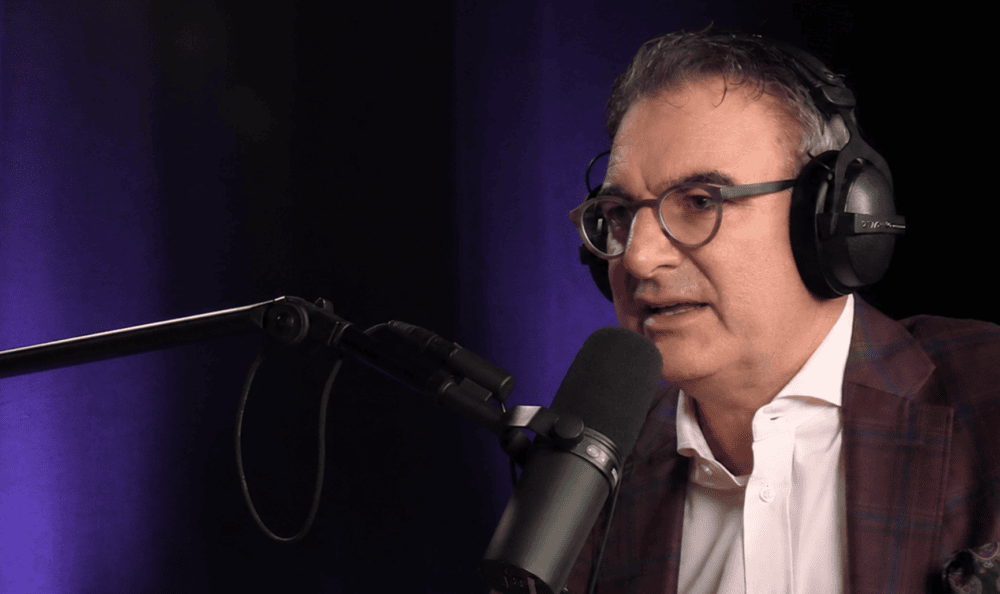
"We do - and don't just talk"
With 250,000 visitors over 16 days, the Montreux Jazz Festival—founded in 1967—is one of Switzerland’s largest cultural events. Sustainability has been a practice here for years, though the organizers haven’t made a big deal out of it. Festival director Mathieu Jaton explains why that is.


m&k go!: Mathieu Jaton, sustainability is an issue at all major events—how has Montreux Jazz addressed this issue?
Mathieu Jaton: First, we wanted to analyze what our festival’s ecological footprint actually looks like. That’s why, a few years ago, we commissioned a study conducted by the Swiss Federal Institute of Technology in Lausanne (EPFL). We wanted to know: What makes up the ecological footprint, and where are the pain points?
And where are they located?
Well, we’ve been using reusable cups here for several years now. But if you look at the environmental footprint, on-site waste accounts for no more than three percent of the environmental impact—but when it comes to travel, for example, that figure is 54 percent. With returnable cups, the main goal is to keep the festival grounds clean—and in our case, the lake as well—but this hasn’t had a major impact on sustainability yet. Still, of course, both are important.
So, is there the most that can be done when festival guests are arriving and departing?
Yes, the question was: What impact can the festival have on this? For example, by offering easy or even free travel via public transportation such as buses or trains. That was—along with measures to reduce waste—the first step.
Does this also apply to the musicians' travel to and from the venue?
We have no direct influence over how artists travel. Although they’re increasingly doing so by bus rather than by plane. Awareness in the industry has grown, and things are changing: The band Coldplay, for example, has set a goal of completing a «clean tour.».
What exactly did Coldplay do?
They said they wanted to turn their current world tour into a «green tour»: And the most important thing was the travel: When you have 100 people working on a tour and you’re flying from place to place, that’s not really eco-friendly. So Coldplay is increasingly touring by bus.
So travel and transportation account for the largest share—what else is there?
Lighting and sound, of course—a festival requires a fair amount of electricity—which is why we’ve partnered with Groupe E and Romande Energie. For some time now, our Hospitality Garden has been powered solely by energy from the on-site solar panels.
Why are you implementing all these measures?
We don’t do any of this to use it as a marketing pitch or to look good in the media. We see it more as a responsibility. Everyone should do what they can from their own perspective, with the resources and opportunities they have. If you look at a festival like Glastonbury, for example, which has 150,000 visitors a day—you can’t just say, ’No one is allowed to drive there.« It’s so far from London that you can’t expect the festival to become eco-friendly in terms of transportation overnight. While the organizers should certainly think about how they can work toward that—it’s all too easy to say that they have to do this or that. But there isn’t just one solution.
Radical environmentalists might say that festivals are generally bad for the environment—and therefore need to be abolished or at least scaled back.
There are always political, cultural, and economic aspects to consider. In Montreux, the tourism aspect comes into play as well. If the Montreux Jazz Festival were only half as big and there weren’t so many cars and people here, that might be good for politics, but it would be a disaster for the economy and tourism, as well as for the hotels and restaurants. Of course, it’s a matter of balance. The new city government in Montreux leans more toward the green side. Naturally, they’ll try to push for greater sustainability, and that’s a good thing. But the main discussion we’re having with them is how we can strike that balance, because we can’t get any smaller—but we don’t want to grow either.
So drastic measures implemented overnight are unrealistic?
When we’re organizing a festival with 20,000 people, we can’t just say from one day to the next, ’We don’t want any more cars in the city.« However, two years ago we started working with Stromer Bikes—they’re great e-bikes. We started on a very small scale. We provided these e-bikes to visitors, including the artists, simply to raise awareness of the issue.
Does an event like the Montreux Jazz Festival serve as a role model of sorts?
As such an important festival, we have a certain influence when it comes to communication. We use that in a positive way. For me, Montreux’s strategy is that we are first and foremost a music festival—but we also have a responsibility to make this festival as sustainable as possible. Not only in terms of the environment, but we also include people with disabilities.
How does that work?
For the past 20 years, we have also been organizing concerts for people with disabilities, including those with hearing and vision impairments; among other things, we have concerts interpreted in sign language. We organize concerts and music events in the park with people who provide live interpretation; the initiative is called «Singing Hands.».
So there are deaf people who come to the music festival?
Yes, «Singing Hands» has female translators. Deaf people can feel the music, and that way they, too, can experience what it’s all about. Honestly, when you see the smiles on people’s faces when they have the chance to have these experiences, it makes me so happy. But even here, it’s not about saying, “Hey, media, look at what we’re doing!” The most important thing for me is that the people who can benefit from it are happy. We don’t use this for marketing purposes.
Diversity, inclusion, sustainability—these are important issues for the Montreux Jazz Festival.
I'm not saying we're doing everything right. No, we can always do better. But there's an awareness and a desire to take action. That's a challenge for the world, a challenge for everyone, and definitely a challenge for all festivals.

The Montreux Jazz Festival is an annual music festival held in July in Montreux, in the canton of Vaud, Switzerland. The festival is one of the most prestigious in Europe and one of the largest in the world. Mathieu Jaton has been the festival's director since 2013.