Digital transformation in e-commerce is also only just beginning
The E-Commerce Report Switzerland 2017 shows: The battle for access to the customer is at the center. The digital transformation is also only just beginning in Swiss e-commerce.


Setting up an online store does not make an e-commerce success story. The first Swiss online providers are taking the next steps: Away from product focus, away from going it alone, toward new capabilities, as large international players are doing.
Digital transformation is a process that different industries are going through at different speeds. A detailed examination of the overnight accommodation industry identifies typical developments, areas of conflict, and approaches to solutions that can be transferred to other industries. At the center is the battle for access to the customer.
Since 2009, the E-Commerce Report Switzerland has been examining the status, changes and trends in sales to end consumers - as the only study series from the perspective of the providers. The survey is realized by online payment processor Datatrans and the University of Applied Sciences Northwestern Switzerland FHNW.
Concentration among strong suppliers at home and abroad
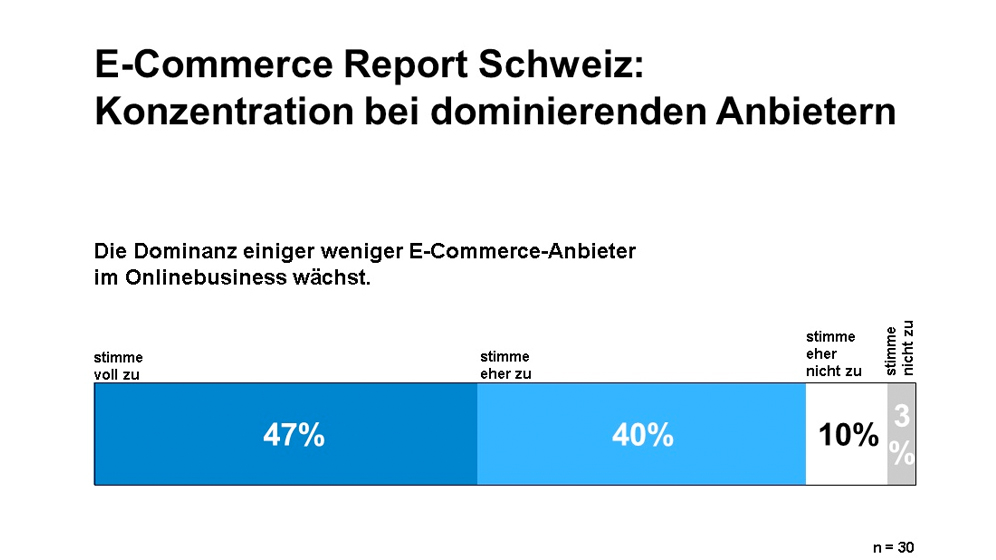
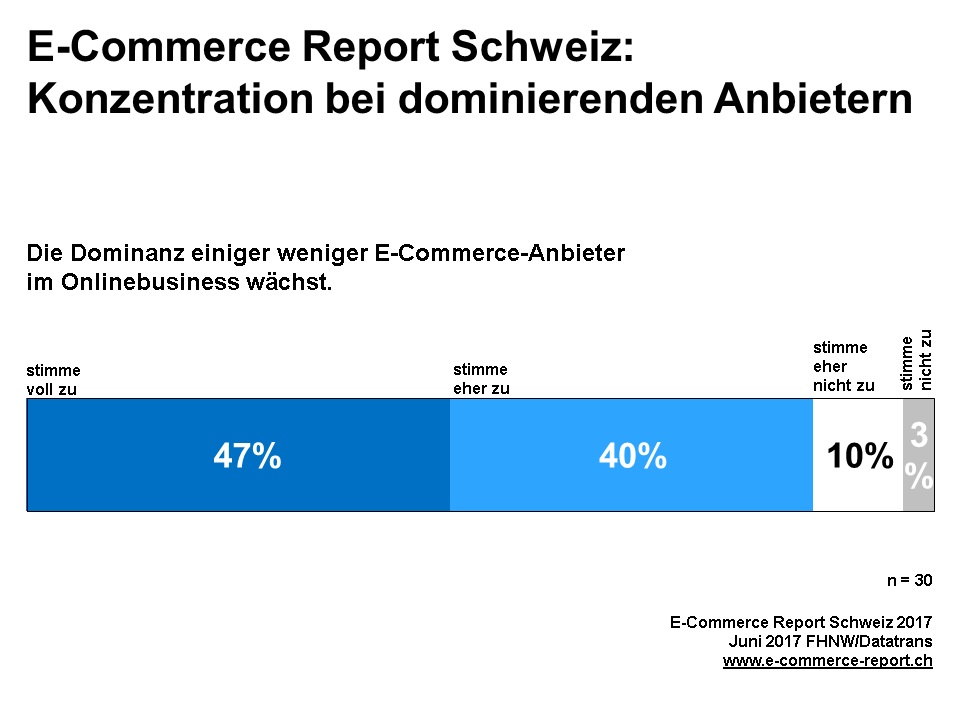
Although online retailing in Switzerland grew by a further 8 percent in 2016, by no means all online providers are benefiting from the market growth. In many sectors, the dominance of a few e-commerce providers is growing. The biggest beneficiaries continue to be a few online brands from abroad - overall, foreign online providers grew at around twice the rate of domestic providers.
"The loss of market share to foreign e-commerce providers, which has continued for years, is a cause for concern," explains study author Wölfle. "Online, the limits are lower. In e-commerce, the foreign share is already twice as high as in bricks-and-mortar retail."
Note: An interview with Ralf Wölfle and photos of the study presentation will follow on Wednesday, June 14 on Werbeowche.ch.
Increasing momentum in Swiss e-commerce
The momentum in Swiss e-commerce has increased once again. The reason for this is the large-scale investment projects Galaxus and Siroop. As online marketplaces, they aim to exploit the potential gap arising from Amazon's hesitant involvement in Switzerland to varying degrees. BRACK.CH is also expanding its offering through partnerships: In its new role as an Intersport specialist retailer, its core competencies for e-commerce are also being applied to textile ranges for the first time.
Insight into the loss of customer ownership
For many traditional retailers, the image of "owning" their customers is deeply ingrained. The location independence and market transparency associated with smartphones has shaken this marriage. Many online services support the preparation of purchases better than individual providers could ever do. Customers are changing their habits accordingly - and providers are losing their customers in the sense that they are no longer their preferred point of contact for certain needs. This development is particularly painful for the accommodation industry, which is currently losing more and more direct bookings to online platforms.
New approaches to customers - entry into digital transformation
Saying goodbye to customer entitlement leads to new attitudes and business practices when the tools of digitization are understood. Instead of passively receiving customers, successful providers actively approach them. The way to do this is through data analysis. From it, it is possible to identify the situations in which customers want something that the provider can offer them. "What the expensive location is in stationary retail, the search term is in e-commerce," explains study author Wölfle. "Identifying customers online at precisely the moments when they have a need is the supreme discipline in online marketing."
Agility instead of long-term leases
When purchasing decisions are constantly being made differently in the moment and fixed patterns are dissolving, suppliers also have no alternative but to adapt to continuously changing requirements. This requires agile organizations. In addition to efficient decisions, which are primarily based on key figures, a high level of technological competence is required in order to be able to implement new solutions quickly. It also requires the financial resources for experimentation and the willingness to accept failure.
Continued performance improvements in logistics
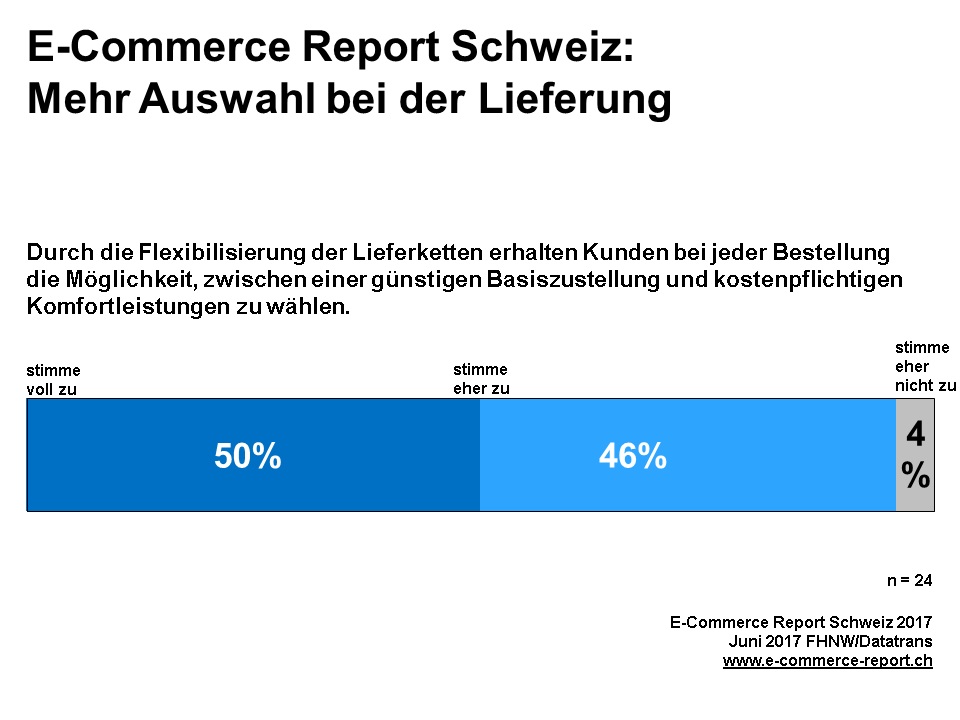
Reliability, speed and flexibility - these features of e-commerce logistics are being worked on intensively. The solutions for this are becoming more and more differentiated. Providers are asking themselves what level of service is necessary today, what costs they can bear for it, and where they can even differentiate themselves from the competition through logistics if necessary. For customers, the delivery options are becoming increasingly diverse.
Cross-channel business concepts remain highly important
Suppliers continue to build physical and digital touchpoints. But the underlying multi-channel concepts are often not yet fully developed. Only a few providers manage to offer an end-to-end, cross-channel customer experience. Complexity and the cost of organizational adaptations play a role, but a lack of strategies and employee buy-in are seen as truly critical to success today.
New push in mobile payment
More and more methods are available in the Swiss market for mobile payment systems. Merchant wallets - native apps with an integrated payment function - have spread very successfully. They are used particularly frequently in ticketing. At SBB, smartphone sales already overtook online sales in 2016. Open mobile payment solutions such as Twint or Apple Pay, on the other hand, are still in their infancy. Swiss retailers are reluctant to implement them. Too much uncertainty results from the attitude of the Twint banks.
Online trade continues to grow
Many a brick-and-mortar retailer would be happy to see the shift in sales to e-commerce exhaust itself, but that's not in the cards. For the current year, three-quarters of study panelists expect e-commerce in their industry to grow by 5 % or more. In the five-year perspective, nearly 40 percent expect the e-commerce share in their industry to grow by at least half compared to today.
Digital transformation in the accommodation industry
The overnight accommodation industry, which has already been under pressure for years as a result of the devaluation of the euro, is having a hard time with the digital transformation. The mechanisms underlying the success of online booking platforms have been known for two decades. Nevertheless, the industry in this sector - as in many others - is ill-prepared for the extent of the loss of direct bookings. The political motion by Bischof is intended to alleviate the misery. The study panel has considerable doubts as to whether it can achieve this. Simple solutions for this industry are not obvious.
The study is available free of charge at: E-commerce-report.ch/orders
Topics in the E-Commerce Report Switzerland 2017
- Location assessment for Swiss e-commerce in 2017 - Attractiveness of retail for investment - Cross-channel retail concepts - Current developments in logistics
- Current developments in online marketplaces (keywords: siroop, Galaxus, BRACK.CH, Amazon, Zalando,)
- Annual focus: Digital transformation in the accommodation industry (keywords: booking platforms, metasearch engines, Google, Airbnb, distribution costs, price fixing, Motion Bischof).
- Activity focus in 2017 - outlook for Swiss e-commerce for five years to 2022
Methodology
- Long-term study, repeated annually, since 2009
- Empirical, primarily qualitative
- Survey: Expert interviews and questionnaire
- Survey period: December 13, 2016 to April 21, 2017
Sample
- 36 potentially market-shaping online and multichannel providers of consumer goods and services based in Switzerland
- Together they represent an e-commerce volume of over CHF 4.7 billion
- Selection criteria: several years' track record in e-commerce, significance in the industry, degree of novelty of the business model
- List of study participants: E-commerce-report.ch/panel Realization Institute for Business Informatics of the University of Applied Sciences Northwestern Switzerland FHNW on behalf of Datatrans, the Swiss specialist for Internet payments.