
Federal Council rejects Billag initiative
Radio and television should continue to be funded through license fees. The Federal Council rejects the popular initiative «Yes to the Abolition of Radio and Television License Fees» without proposing an alternative.


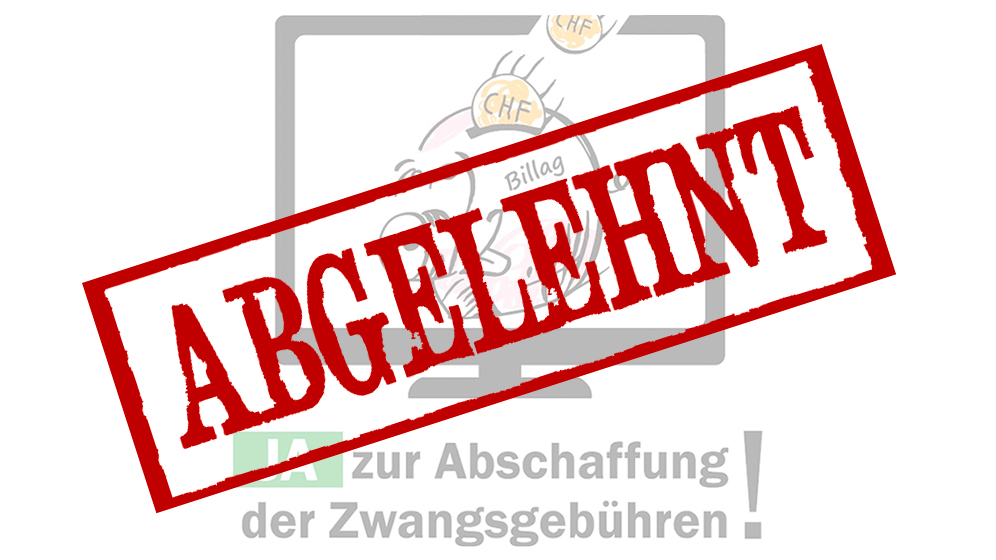
This was decided on Wednesday. The initiative fundamentally contradicts the Federal Council's media policy stance, writes the responsible department of Media Minister Doris Leuthard. The initiators are calling for the abolition of radio and television reception fees and the associated financing of radio and television. In the view of the Federal Council, this would have a "drastic impact" on the Swiss media landscape and would "considerably weaken" Switzerland as a media location. The range of radio and television broadcasters financed by fees would be drastically reduced, according to the press release. French-, Italian- and Romansh-speaking Switzerland would be particularly hard hit.
Independent offers needed
In the press release, the Federal Council also recalls the report on the public service in the media sector that it published in June. In it, it concludes that Switzerland continues to need independent, high-quality and independent radio and television services that are comparable in all language regions. The appropriate financial resources must be made available for this. In the medium term, the Federal Council wants to transform the current Radio and Television Act into an Electronic Media Act and thus adapt it to the Internet age. Restrictions currently apply to the SRG on the Internet so that it does not compete with private broadcasters.
Young SVP and Young Liberals
The Federal Council intends to submit the dispatch on the popular initiative to parliament this year. The initiative "Yes to the abolition of radio and television fees (abolition of Billag fees)" was submitted on December 11, 2015 with 112,191 valid signatures. It was backed by representatives of the Young SVP and the Young Liberals. It is already the second popular initiative calling for the abolition of reception fees. However, the initiative "Radio and television - without Billag" was not successful.
Narrow yes to new system
Radio and television fees were also discussed in the vote in June 2015. At that time, voters approved the revised Radio and Television Act by an extremely narrow margin. This laid the foundations for the change from the current reception fee to a device-independent fee. This is intended to take account of the fact that most households have receivers, as radio and TV programs can now also be received on cell phones and computers. Registration with Billag will no longer be necessary and checks will no longer be required. The changeover should take place by the beginning of 2019 at the latest. The Confederation has put the mandate out to tender: Companies wishing to collect the general fee can apply until mid-November. (SDA)


