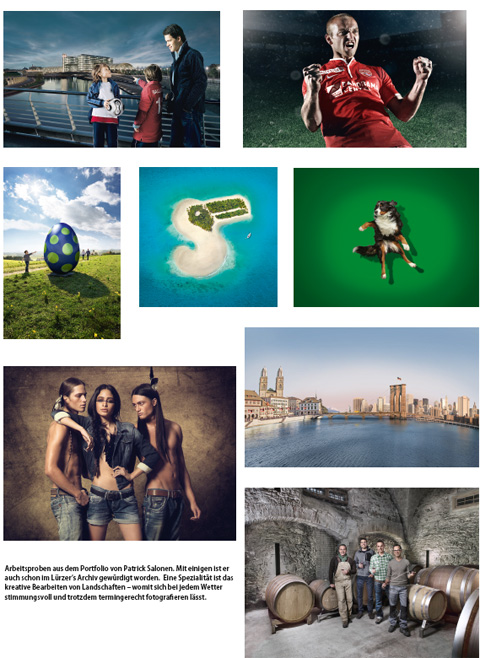
The finishing touch
Patrick Salonen specializes in high-end post production and CGI. Besides his studio in Thun, he also offers a worldwide service on location.


This morning I got some pleasant mail. The collection '200 Best Digital Artists Worldwide' from Lürzer's Archiv was in the mailbox. And me in the middle of it with a double page spread. Cool." With these words Patrick Salonen wanted to express his joy in a blog. And he added, "A reason to keep working hard every day to keep developing new images." That was in the early summer of 2013. And already in January of the current year, an image edited by Salonen of "his" photographer Michel Jaussi has been published again in Lürzer's Archive, this time among the "200 Best Ad Photographers Worldwide"
It is true that photos in which digital image processing was in the foreground or "pushed itself to the forefront of the viewer's mind" were sorted out in advance. They will be given another chance next year in the anthology of "Best Digital Artists Worldwide," which the publisher publishes every two years. Either way, however, Jaussi's work for Renault, in which the vehicle's bend lighting (see subject on right page) is staged by Salonen in a gloomy mountain landscape under a tension-filled sky, shows that in today's advertising, emotions can hardly develop their effect without image editing.
Patrick Salonen really started with this art in January 2004. At the beginning of 2014, he was able to celebrate his 10th year of self-employment. "In retrospect: a single success story," he says about the past years. As has been the case in the industry for decades, these have once again brought a concentrated load of new developments. The most obvious of these is CGI - Computer Generated Imagery - or, to put it more graphically, "3D illustrations", which have become the new benchmark and will soon become the norm.
Patrick Salonen started in his profession with a paintbrush. About 20 years ago, he did an apprenticeship as a lithographer at Henzi in Bern. At the time, this "litho shop" was considered one of the leading ones in Europe. Salonen's work with a brush on film was not to last long, however. Already in the course of his apprenticeship, polygraphs took over the reins with a new technique. Since then, the specialist has "experienced everything" via the first image processing systems to the Mac.
When Henzi was taken over and finally dissolved in 1997, a new opportunity opened up for the young professional in Thun. Salonen was "thrown in at the deep end" at the advertising agency Weber AG. He was allowed to set up and drive forward the entire litho production and, in the meantime, more and more popular image processing within the small agency. He had to acquire most of his knowledge autodidactically, because "even today, you can't officially learn image editing. Most specialists are photographers, graphic designers or polygraphs who have "somehow" moved on. However, an official regulation of the profession is likely to become an issue soon.
Autodidact and pioneer
By the end of 2003, Patrick Salonen had acquired so much artistry that he wanted to "go full-on image editing." He quit the advertising agency and founded his own company in Bern in January 2004. At that time, he knew of three companies in Zurich that could compete with him. In Bern, however, he was the top dog for the time being. In the first years, however, the established and still active litho companies were a problem for the young entrepreneur. Although they had hardly specialized in this area, they still didn't want to give up the lucrative image processing. Nevertheless, Patrick Salonen constantly received new orders with his start-up and was "also very lucky": Michel Jaussi, the well-known advertising photographer, trusted the young colleague from the very beginning and brought him many orders. The two still work closely together today. Even back then, their clients included VW Switzerland and Swiss Post, for example.
In Bern Salonen was installed with his image processing in office community with the photographer Guy Jost. He also works with this photographer, who specializes primarily in food and still life, very often and still does. "These regular jobs gave me a bit of security," recalls Patrick Salonen, because as a young father he already had to provide for a family during the first phase of his self-employment. In the meantime, there are five children between the ages of 3 months and 12 years. Nevertheless, Barbara Salonen is now working as a teacher again. "Her profession means a lot to my wife. That was also a reason why I moved back to Thun with my studio in 2013." At his family's place of residence, it was easier for the father to cover the one or other lunch hour per week as a cook for the kids. In an initial phase, the self-employed man even worked from home. "But because certain jobs often kept me out of the house for days at a time, I jumped at the chance when it came up in the old town." With a five-minute commute on his bike or a 20-minute walk, the busy man can now air out his head in an ideal way when he's once again stressed out by increasingly fast-paced deadlines. "Then I'm open again at home for my family."
Today, Patrick Salonen also finds a growing share of his jobs through his representative office in Germany. "As a one-man business, I often lack the time to acquire. Nevertheless, I don't want to expand my business. Those who come to me come because of my style of work and thus also want to be served personally. It doesn't help much if I delegate the work to an assistant and then still have to correct it again at the end." Two years after becoming self-employed, his first major international job came about through the agency Kombinatroweiss in Frankfurt. Salonen was given the opportunity to spend a week retouching a campaign for Deutsche Bahn at Ogilvy & Mather in Frankfurt. This assignment also developed into a lasting relationship. During a side trip to Germany by car with his computer and screen, Patrick Salonen discovered the need to be able to offer his services "on location" elsewhere during special assignments. "During a photo shoot, you start roughly assembling the puzzle pieces on the computer while still on set. This way, initial results can be approved by the client and agency right away, which saves an enormous amount of time." Likewise, an assignment "on sturgeon" at agencies can make sense for individual projects. "You can develop the subjects in direct interaction with the creatives."
Growing market
Image editing is needed practically everywhere today. "Hardly any image is not edited. Amazing effects are achieved with watches and jewelry. In beauty and fashion, the technology has become indispensable," says Salonen. He himself is less involved in this field. But he has all the more experience in the car advertising segment. This is especially true in collaboration with Michel Jaussi. The team is very strong in the field of landscapes. And here, Jaussi and Salonen have also discovered a market that they want to explore further together with Kombinatroweiss. For example, this could involve winter shots with new models from the automotive industry. In Germany, there are hardly any mountains for suitable photo shoots. Jaussi, on the other hand, has an archive with thousands of landscape photographs from Switzerland. The photographed or rendered cars are inserted into these templates.
The technology for this is becoming more sophisticated by the day. Since Patrick Salonen printed out the first fully rendered 3D image using CGI technology in 2007, numerous further developments have already been added. "It's a constant learning process," the accomplished digital artist knows. And he smiles when he thinks about how a photographer used to spend days poking holes in a cardboard box with a needle so that he could finally use a backlight to suggest a "starry sky." The image editor demonstrates how this art of illusion works today on his website www.patricksalonen.ch, also with his own making-of. This earns him a lot of feedback. He is aware that this also makes public "what the photographer delivers. But after all, he works closely as a team with all his partners. "And the change in the sense of an even stronger statement is our job."
Andreas Panzeri