
The end of full service
The Bernese copywriter and consultant Ben Loosli has submitted a thesis at the HFW in Bern entitled "Visionaries without visions". In it, he examines which strategies advertisers "avoid".


WW: What was the impetus for your study?
Ben Loosli: The thesis is part of my degree in business administration at the HFW Bern. On the one hand, I liked the subject of strategic management. On the other hand, it made sense for me to do something about advertising agencies. The connection to my everyday working life is very important to me and also to the school. So I looked for a starting point and soon came up with the provocative thesis: advertisers talk a lot about strategies, but in the management of their agency they often have no clear line, no vision, no clear strategy. I wanted to investigate this thesis. And above all, I wanted to offer solutions, not criticize or lecture.
In other words, have the agencies in Bern stuck with the graphics studio model and are simply doing everything that comes along?
First of all, I don't believe that there is a fundamental difference in the management of an agency between Bern, Zurich or Geneva. The difference lies in whether the agency is smaller and owner-managed or not. Large network agencies have a different background and often apply the standards of their international headquarters in their strategic management. However, the owner-managed agencies in Berne and Zurich seem to me to have a similar basic set-up. In other words, both are struggling with the same problems.
Does the ongoing fragmentation of agencies require other specialists?
The full-service concept, many also call it integrated, as a practically comprehensive agency positioning will die out. I can confirm this with my research. In future, the agencies that will win will be those that have the clearest, most unique and innovative profile possible.
Do agencies lack the courage to position themselves clearly because they have to accept all orders in the current economic situation?
That's how it is. People often lack the entrepreneurial courage to lean out of the window with a clear positioning. People think they are safe by saying: "We do everything and can do anything."
You can talk a good game, you don't bear any entrepreneurial risk yourself.
I am of course aware that it is much easier to demand a willingness to take risks in a scientific paper than to prove this in day-to-day competition. Nevertheless, other studies, experience from other sectors and conversations with owners of successful agencies in Bern confirm that those who practice consistent strategic management, as I describe in my work, are more successful in the long term.
The BSW also recently presented a study. The majority of respondents were satisfied with the business of Swiss agencies. They just need to become a little friendlier. A contradiction to your theses?
I contacted the people responsible for this BSW study at Lucerne University of Applied Sciences and Arts because I wanted to incorporate their findings into my research. Then there were delays in Lucerne and we were working in parallel. As a result, I was only able to read the BSW study when my thesis was finished. The two studies are designed differently. BSW and HSLU are more interested in customer satisfaction, so they talked more with clients. I did not take this into account in my research. I was interested in the agencies' point of view.
How did you do your research?
My research was based on five interviews with key figures from the Bernese BSW agency scene. I supplemented the insights gained from these interviews with my own thoughts, but also with models and results from other studies. And, of course, I was a lone wolf and was only able to substantiate a few results statistically. That is why my statements are more daring and more pointed.
In general, do you miss the pointedness in Swiss advertising?
You have to differentiate: My study is not about the work of the agencies. What interests me is the strategic management of an agency.
How did the agencies react to your request?
I emphasized from the outset that it was not important for me to analyze or comment on the strategic direction of individual agencies. One agency still didn't want to talk to me, they said it was "too hot" for them because I work for a competitor. But the owners who took part found it exciting.
And what was the reaction to the result?
Everyone involved has now received my finished work. I haven't heard from some of them. I don't know how to interpret that. Perhaps they find the statements too provocative. But they are all busy advertisers, so I suspect they simply didn't have time to read the work. One interviewee reacted very positively and thought it was exactly the kind of questions he was confronted with in his everyday life.
Was the sting in the wasp's nest worth it for you?
I think it is important to initiate the discussion about strategic opportunities in the industry now, both in Bern and in Zurich. The challenges facing our industry are clear: the market is becoming more competitive. That's why agencies need to start thinking today rather than tomorrow: How do we position ourselves so that we will still be around in the future? There are agencies that are doing this. For example, the new agency tbd in Zurich. They position themselves very precisely. tbd stands for "to be defined". They work with the network concept, which is a new approach for agencies in terms of corporate strategy. I find that courageous and exciting. The Bern agency Bold, for example, which is a small agency with big names in its portfolio, is also consciously turning away from the full-service concept, according to the text on its website.
What is the most important finding of your study?
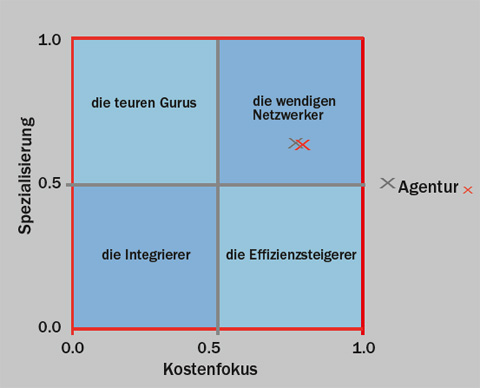
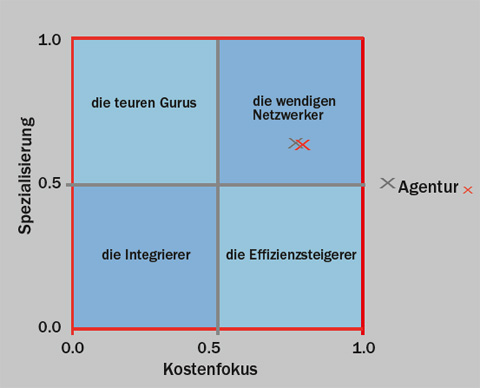
There are two. Firstly, it was confirmed that strategic management, as practiced by large companies, is neglected in most owner-managed agencies. But much more important for me was finding solutions, i.e. the second insight. I was looking for answers to the following questions: What would I do if I were an agency owner? What opportunities would I have to reposition myself? As a quintessence, I developed a matrix. This is based on the fact that today, as an agency, I can either focus on my costs and optimize them or throw out offers and only offer what I really know how to do. This results in the two dimensions of cost focus and specialization. This results in four visions, from which the corresponding strategy can then be derived. I have given the four visions, i.e. the possible agency models, names: the expensive gurus, the agile networkers, the integrators and the efficiency enhancers. The integrator model is closest to the full-service concept. The trend is therefore moving in the direction of the other three. Anyone who implements one of these models with stringent strategic management on a day-to-day basis has, in my view, at least an interesting alternative to the one-size-fits-all full-service approach.
Interview: Andreas Panzeri
Interested parties can request the work by sending an e-mail to ben.loosli(at)gmx.ch.
The thesis:
One strategy is omnipresent among Bern's advertising agencies today: full service. In their profile description, the agencies emphasize their ability to master all disciplines of marketing communication, to serve all advertising channels and to work for clients from all sectors. Ben Loosli's research has shown that this is not just intentional: rather, the advertisers lack ideas in their corporate management. Strategic management is neglected. At the same time, advertising agencies are facing uncertain times. The market is more competitive than ever. All the more reason why advertising agencies need new entrepreneurial visions for the future, and not just in Bern.
Ben Loosli
After the "Gymer" in Bern, Ben Loosli spent several years on the road as a jazz professional. The musician practiced drums in his basement for days on end and played in various bands. After this period of "research and self-discovery", he switched to journalism, became a freelancer at the Berner Zeitung and finally a copywriter at Hofer Kommunikation when the company was looking for a PR editor. Today he works for Hofer as a writing consultant. Loosli graduated from the HFW in Bern on a part-time basis.


