Working with freelancers
Employing permanent staff is expensive. The fixed costs are high, even when there is less to do. In order to save costs and administrative effort, it can therefore be worthwhile to work with freelancers as required. By Irmtraud Bräunlich Keller, lic.rer.pol., editor and employment law expert at Beobachter Beratungszentrum.


But what are freelancers? There is no legal regulation of this form of work under Swiss law. In principle, a freelancer is a person who works for a company without being as closely integrated into the company organization as an employee. Freelancers often perform their work within the framework of an assignment or contract for work and services, i.e. as self-employed persons. This means that they take care of their own social insurance and you as the employer are relieved of the burden. However, freelancers can also legally become employees if the client provides them with a workplace and requires them to adhere to working hours and follow instructions from a superior. According to the Federal Supreme Court, mixed contractual forms are also possible. One example is freelance journalists. Although they are not employed by their clients, they are considered to be employed by the AHV. This means that newspaper publishers pay social insurance contributions for their freelancers. One thing is certain: you cannot decide at will whether you want to employ someone or regard them as self-employed and simply pay them their fee at the end of the month - without any further obligation. Whether a worker is legally self-employed or employed depends on the specific circumstances (and not on contractual agreements). The classification is made by the responsible AHV compensation fund. An activity is recognized as self-employed if it is carried out:
- for its own account and at its own risk,
- with its own infrastructure (office, work equipment, address),
- for several clients
- and if the self-employed person had to make significant investments in order to be able to work.
In case of doubt, the extent of subordination and integration into the work organization of the client or employer is decisive. The more dependent and externally determined a person performs their work, the more likely they are to be an employee.
Important: Ask freelancers to show you confirmation that they have actually been recognized as self-employed by the AHV. Otherwise you run the risk that an AHV employer check will reveal that it is an employment relationship after all and you will have to make hefty additional payments - for social insurance contributions, vacations, sick pay, etc. If a freelancer is recognized as self-employed, you can regulate the collaboration very freely. The legal provisions on the contract (Art. 394ff. OR) apply.
Do you need legal advice? The Beobachter Advisory Center offers you and your employees expert advice by telephone on legal issues relating to your company - 6 months for just CHF 99. Order the consulting package for SMEs at www.beobachter.ch/kmu or 0800 83 0800.
Book tip
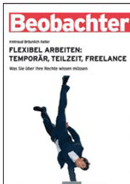
Working flexibly: Temporary, part-time, freelance What you need to know about your rights Flexible working models present opportunities and risks: This unique guide provides information on the legal basis and helps you to recognize dubious offers and avoid grey areas. 144 pages, Fr. 24.- 1st edition, 2007 ISBN 978 3 85569 377 1 Beobachter-Buchverlag