Eyjafjallajökull put to the test
Für die Fluggesellschaft SWISS werden Social-Media-Kanäle im Kundenservice zunehmend wichtiger.


When asked for a prime example of the benefits of SWISS's own social media activities, Christian Lüdi, who is responsible for social media in SWISS's online marketing department, answers immediately: When the eruption of the Icelandic volcano Eyjafjallajökull paralyzed air traffic over large parts of Europe a year ago, the hotlines were barely able to cope with the rush of stranded customers. Instead, many inquiries were made via Facebook and Twitter, where SWISS published 31 updates on the subject and handled around 1200 comments and questions. Many customers looking for forecasts and information on rebooking found these in previously answered inquiries from other customers in the same situation. For Lüdi, this FAQ effect is a key advantage of the new social media channels and he is convinced that they will play an increasingly important role in customer service, especially for service providers. This is because customers can be contacted much more quickly and, thanks to mobile devices, regardless of their location. Lüdi is certain that contact via social media is much more personal and faster than communicating via email or a contact form on the website. Customers appreciate receiving a quick response from a representative of the company who has listened to them. They are often much more satisfied if they are referred personally to the feedback form on the website. Many such inquiries start on Facebook or Twitter, but are then continued on other channels. This is because e-ticket numbers, for example, cannot be mentioned on social media channels due to data protection regulations. Lüdi has noticed clear differences between Facebook and Twitter. Twitter is mainly used by Americans and English people and a response is always expected. It is mainly about customer service, questions and complaints and this can be handled faster and more quickly via Twitter. Facebook is more emotional, simply because it offers more possibilities with photos and videos. There is feedback such as "I love SWISS" or photos and videos on the pinboard that do not require a response. Although just under half of the fans are from Switzerland (there are no reliable figures on Twitter), SWISS has opted for a presence for the whole world and therefore for English from the outset. There are occasional comments about this, but it is always understood, especially as English is the language of the Internet, says Lüdi. If there are inquiries in German or French, these are also answered accordingly. In addition to Facebook and Twitter, SWISS also uses YouTube and Flickr. These visually oriented platforms are used to share the images that SWISS already has with the community.
In an interim assessment, Lüdi sees these success factors: they took their own social media commitment and the community very seriously from the outset and invested a lot of time and resources right from the start. And it takes patience, because you can't just register 100,000 fans overnight, not even with a super campaign. It is important to listen well and carefully, to take people seriously and to respond to them. In order for the offer to be used, you have to offer interesting added value. The company has achieved a "very good social media reputation" and has also noticed that this is appreciated by the community, "which is sometimes a very important point". SWISS now values dialog with the community and repeatedly asks fans whether they like this and that and what their input is. In this way, the company is always learning and allows the community to participate in developments. For example, when it comes to desktop backgrounds with SWISS subjects, as was recently the case, where the question arose as to the desired resolutions. But among the 30 to 40 responses, there was also demand for images for the iPhone and Blackberrys, which had not been thought of. When it comes to flight offers, it has been agreed with the community that such posts are welcome once a week and will not be perceived as spam. Unlike Asian and American airlines, there are no exclusive offers on SWISS's social media channels as yet.
At SWISS, social media is part of the online marketing department, which also manages campaigns on other websites, search engine marketing and online games. Lüdi works closely with Corporate Communications and takes part in the weekly meetings of this department. Social media has already become a matter of course for many in the company and many departments are now coming up with ideas and suggestions themselves. A social media board is also being set up, where all interested and affected departments will meet weekly to plan together. On the other hand, there is no group strategy for social media within Lufthansa, but there is an exchange of ideas.
When it comes to key figures, people initially always thought it was about having as many fans as possible, but this is no longer the most important criterion. Like other social media practitioners, Lüdi now believes that qualitative analysis, i.e. having the right fans and followers, is much more important. When asked about the future, Lüdi mentions the expansion of customer service in order to be able to offer more options. There are also plans to do more in the cross-media area (an article on social media activities will appear in the next issue of the in-flight magazine) and local markets are also to be addressed directly more often in their respective languages. A major competition on Facebook is also in preparation. Apart from the fact that it will be "a novelty" and should go live in June, Lüdi did not reveal any more. Christoph J. Walther
The current social media high flyers
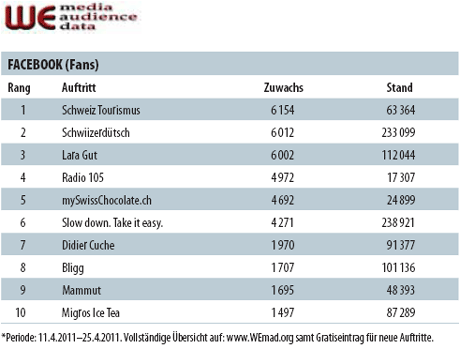
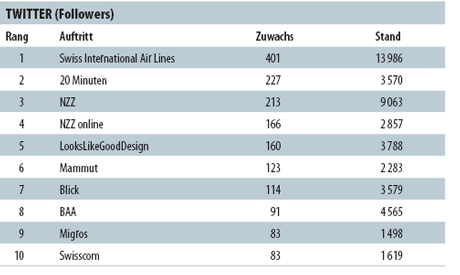
Who has gained the most in the social media hit parade on WEmad.org in the last two weeks*.