Journalism is a civil status"
Peter Wolf is a brand. For Ringier, he tests all kinds of tech products, from electric razors to smartphones. His reviews help readers navigate even the most finicky devices—and are entertaining to boot. But Wolf isn’t just a consumer journalist. Among other things, he helped build Ringier’s newsroom and is responsible for various other projects at Dufourstrasse. Who is this Wolf?


This article by Anne-Friederike Heinrich comes from the current print edition of Werbewoche.
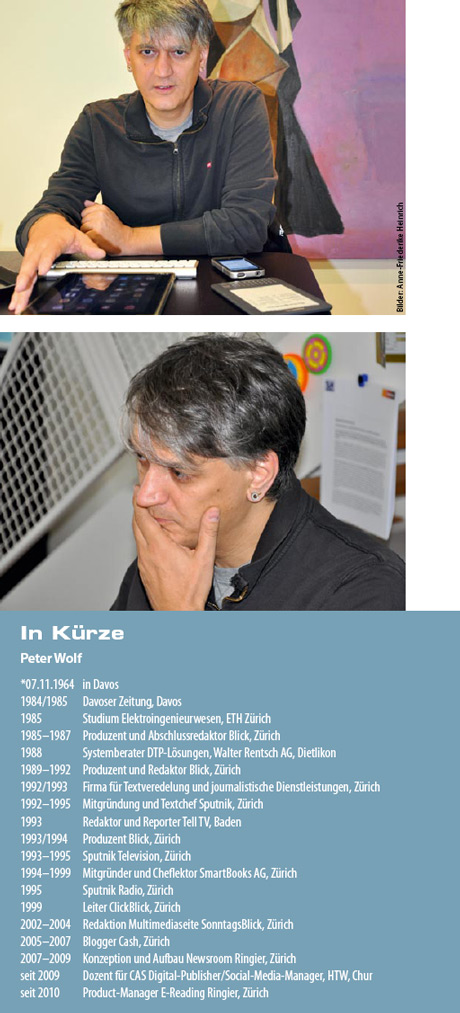
Anyone sitting at the table with Peter Wolf (45) has to be able to share. That's because his iPhone, Android phone, Blackberry, Kindle and iPad are always with him. "I'm not a gadget freak," Wolf says nonetheless. And indeed, a freak he is not. But he knows his way around pretty darn well, to be precise, and works with smartphones and reading devices like we do with a book, pad and pencil. Readers know the technology journalist primarily from his Cash blog, which has since been discontinued, and from numerous tests of technical devices in Blick, SonntagsBlick and various customer magazines. But Wolf's enthusiasm for the digital world, for networking and interconnectedness, goes much further: Not only does he always carry around at least five devices that are, of course, perfectly synchronized with each other. Wolf also designed and managed the IT and multimedia pages in Blick and SonntagsBlick. He launched the knowledge management tool Yammer at Ringier and is one of the brains behind the highly regarded Newsroom. Wolf also lectures on digital publishing and social media at the Chur University of Applied Sciences.
"Journalism is not a profession, it's a civil status," Wolf says. "At Ringier, they know I think that way. That's another reason why I enjoy a lot of freedom, for which I'm very grateful." For Wolf, work must fulfill two conditions: It has to be fun and it has to make sense. "For a documentary about the Swiss Alpine Marathon, I filmed from a helicopter," he says. "That was cool, but that wasn't the point for me. We wouldn't have gotten the shots we wanted any other way. I put a lot of things on the line for an extraordinary result."
Recognize what the world
Peter Wolf was born in Davos in 1964, which plays a bigger role than one might initially suspect. Because when there's not skiing in Davos, there's not much going on. But Wolf loves and needs variety. So, at the age of 16, he already mixes up his hometown: Together with two school friends, he produces a school newspaper, organizes and manages the youth meeting point Terminus with events and disco, and manages a selection show from the Solothurn Film Festival three years in a row. He also plays keyboards in the electropop band Didadomino, which has produced one cassette. "I just had to do something," Wolf recalls. "In the off-season, you could have slept on the street without getting run over."
Wolf is greedy: Greed for new things and the fun of change are his driving forces. His father, a master watchmaker, allows Peter to take apart and reassemble anything he wants. He does so with passion. "From ballpoint pens to music boxes, I unscrewed everything I could get my hands on," Wolf says. "Unlike today, back then there was a risk that you couldn't get things back together. I always got it right, though." Despite his penchant for precision mechanics, Wolf doesn't want to become a watchmaker. More like a veterinarian. Or an electrical engineer. Or a journalist. Wolf started in dream job No. 3 at the age of 19: In 1984 and 1985, he wrote and photographed as a freelancer for the Davos newspaper. But the paper and Davos soon became too small for Wolf. At the end of 1985, after graduating from high school, he goes to Zurich to study electrical engineering at the ETH. In doing so, he emulates his uncle, who works as an electrical engineer at NASA. A cool role model for the young man. However, Wolf does not want to go into space, but to become a technical journalist. He starts studying and joins Blick as a producer and final editor at the age of 20.
Reassuringly, Wolf also sees this career leap as needing an explanation: "My friend from Davos slipped into the Ringier journalism school by chance. He caught the eye of the editor-in-chief at the time, Peter Übersax, who hired him on the spot, as did a second participant in the summer course, who immediately quit. They needed a replacement for him quickly, and Christoph talked me into it until I said yes." Wolf, who had written his Matura thesis on "Bild and Günther Wallraff," reluctantly goes to Blick. Because he fears the paper is like the pile of pigs at Bild described by Wallraff. But he quickly revised his employer's assessment. Wolf worked as a Blick producer for three years, and from the very first day he was allowed to produce directly into the newspaper. His keen visual sense helps him in this work: Wolf is a good photographer, knows a lot about films and is passionate about reading comics.
...holds together at its core
In addition to the production job, Wolf also writes and photographs for the music, film and news pages of Blick for three years. Then he has had enough of journalism. He takes a job as a systems consultant for DTP solutions, but does too good a job: the market for early adopters is saturated after just one year. Wolf returns to Blick as a producer. After half a year, he also gets his own page, which appears weekly: "Rock & Pop with Peter Wolf". The 24-year-old travels around, does photo reports and concert reviews, and conducts over 100 interviews with greats such as the Scorpions, Pink Floyd, David Hasselhoff and Ozzy Osbourne. "Because I was on stage with the camera, most of the musicians thought I couldn't write," Wolf says. "So they often told me details that I wouldn't have known if I had asked."
This time, Wolf lasted three and a half years at Blick, 60 percent as a producer, 40 percent as a journalist. Then he had to find a new challenge. In 1992, he founded a company for text enhancement and journalistic services, and in 1993 he became a reporter and news editor at Tell TV, Switzerland's first private broadcaster. But the station runs out of money shortly before its first broadcast. "Nevertheless, I learned a lot during that time," Wolf emphasizes. "We had the basement full of editing suites and technical equipment. While my colleagues racked their brains over the financial situation, I experimented around in the editing room and acquired a lot of expertise." When a project fails, Wolf immediately starts a new one: back in 1992, he co-founded the party and trend magazine Sputnik, which was actually planned as a flyer for the first Zurich Street Parade. Now Sputnik TV is still to be created. In order to finance himself during the build-up, Wolf hires on again as a producer at Blick. From 1993 on, Sputnik TV reports every 14 days for 30 minutes about parties and trends with Peter Wolf as cameraman, editor, reporter, editor and recording manager. In 1995, Sputnik Radio also went on the air on the Radio24 frequency. Sputnik was the first media network in Switzerland.
Ringier again and again
From 1994 onwards, Wolf was also involved as a publisher. With two business partners, the jack-of-all-trades founds the publishing house "SmartBooks" and publishes guidebooks on management, Macintosh computers and the Internet. As chief editor and production manager, Wolf produces around 50 books. He climbs the management ladder before leaving the publishing house in 1999. And then? Wolf goes back to Blick. Three times, Ringier was able to bring his man back for the technical side. The third time, Wolf stayed. For eleven years so far.
But the number of years is deceptive: at Ringier, Wolf is no less lively than before. For five years, he headed the IT and multimedia pages of Blick, and from 2002 also the multimedia department of SonntagsBlick. Then he is appointed to Thomas Trüb's marketing committee, develops and implements concepts for various new Blick pages and supplements, blogs about technical achievements for Cash, is responsible for the multimedia development of the Cash daily business platform and installs the web center that produces moving images for all Ringier publications.
Wolf currently describes himself as a product manager for e-reading. A more appropriate title would be technology missionary. Every day, Wolf takes a close look at electronic reading devices, smartphones, social media platforms and other new forms of communication and tests them for their shortcomings and pitfalls. Right now, he's testing the world's smallest tablet. "Trying out all these devices takes a lot of time and is often frustrating," Wolf says. "Because not everything always works as the manufacturer promises. I then write that, which sometimes takes courage. But it's the only way I can spare my readers the same trouble I had when testing. I firmly believe that "Many a false step is made by standing still.
Future in view
When Wolf is not writing, he is involved in projects: Since November 2007, he has been part of the team that planned, set up and introduced the Integrated Newsroom, and which will now implement it internationally. And he's involved with new opportunities for digital publishing, such as e-paper. "I haven't held a piece of paper in my hand for a year, at least not for reading," he says, as if that's par for the course for a journalist. "For tickets, though, I don't yet rely solely on the electronic version. There, I always have a printout with me." Two years ago, Ringier founded the Codex consortium with Tamedia/Edipresse, NZZ, Orell Füssli and Swisscom. Codex aims to bring the content of the participating content owners to mobile displays. In August, a six-week trial run started with 150 test users. They were able to buy 20 different digital newspapers, magazines and books with play money and read them on a reader. "The test went extremely well and provided important experience. The project will continue," Wolf says. He can't reveal more.
Apparently, several good noses are organized in Codex. Because what is currently highly topical was not an issue two years ago. Wolf is one of those who sensed it early on: "You have to take a risk now and then," he says. "If you don't tackle something new until everyone is doing it, you might as well not do it at all.
Europe is now close to the tipping point in digital publishing. And we're ready." This wolf is also a trend scout. So let's ask THE question: is paper becoming obsolete? "Absolutely not," Wolf reassures. "Paper is really just a display, a newspaper is a multi-display. True, it has a slow refresh rate, nothing moves, and nothing sounds. In return, everything is colorful, crash-proof, and needs no power. The Kindle's display overwrites itself, but currently only has 16 grayscales and is too slow for videos. Each display has its advantages and disadvantages. E-ink readers could be the place to find all new book releases in the future. Depending on the price, you can unlock 10, 50 or 100 of them. But e-ink, print and tablets will coexist. I've been waiting a long time for a tablet that has an e-ink display on the back, or a laptop that has one in the lid." Wolf will let us know if that exists. And whether it's any good.
Anne-Friederike Heinrich
Anyone sitting at the table with Peter Wolf (45) has to be able to share. That's because his iPhone, Android phone, Blackberry, Kindle and iPad are always with him. "I'm not a gadget freak," Wolf says nonetheless. And indeed, a freak he is not. But he knows his way around pretty darn well, to be precise, and works with smartphones and reading devices like we do with a book, pad and pencil. Readers know the technology journalist primarily from his Cash blog, which has since been discontinued, and from numerous tests of technical devices in Blick, SonntagsBlick and various customer magazines. But Wolf's enthusiasm for the digital world, for networking and interconnectedness, goes much further: Not only does he always carry around at least five devices that are, of course, perfectly synchronized with each other. Wolf also designed and managed the IT and multimedia pages in Blick and SonntagsBlick. He launched the knowledge management tool Yammer at Ringier and is one of the brains behind the highly regarded Newsroom. Wolf also lectures on digital publishing and social media at the Chur University of Applied Sciences.
"Journalism is not a profession, it's a civil status," Wolf says. "At Ringier, they know I think that way. That's another reason why I enjoy a lot of freedom, for which I'm very grateful." For Wolf, work must fulfill two conditions: It has to be fun and it has to make sense. "For a documentary about the Swiss Alpine Marathon, I filmed from a helicopter," he says. "That was cool, but that wasn't the point for me. We wouldn't have gotten the shots we wanted any other way. I put a lot of things on the line for an extraordinary result."
Recognize what the world
Peter Wolf was born in Davos in 1964, which plays a bigger role than one might initially suspect. Because when there's not skiing in Davos, there's not much going on. But Wolf loves and needs variety. So, at the age of 16, he already mixes up his hometown: Together with two school friends, he produces a school newspaper, organizes and manages the youth meeting point Terminus with events and disco, and manages a selection show from the Solothurn Film Festival three years in a row. He also plays keyboards in the electropop band Didadomino, which has produced one cassette. "I just had to do something," Wolf recalls. "In the off-season, you could have slept on the street without getting run over."
Wolf is greedy: Greed for new things and the fun of change are his driving forces. His father, a master watchmaker, allows Peter to take apart and reassemble anything he wants. He does so with passion. "From ballpoint pens to music boxes, I unscrewed everything I could get my hands on," Wolf says. "Unlike today, back then there was a risk that you couldn't get things back together. I always got it right, though." Despite his penchant for precision mechanics, Wolf doesn't want to become a watchmaker. More like a veterinarian. Or an electrical engineer. Or a journalist. Wolf started in dream job No. 3 at the age of 19: In 1984 and 1985, he wrote and photographed as a freelancer for the Davos newspaper. But the paper and Davos soon became too small for Wolf. At the end of 1985, after graduating from high school, he goes to Zurich to study electrical engineering at the ETH. In doing so, he emulates his uncle, who works as an electrical engineer at NASA. A cool role model for the young man. However, Wolf does not want to go into space, but to become a technical journalist. He starts studying and joins Blick as a producer and final editor at the age of 20.
Reassuringly, Wolf also sees this career leap as needing an explanation: "My friend from Davos slipped into the Ringier journalism school by chance. He caught the eye of the editor-in-chief at the time, Peter Übersax, who hired him on the spot, as did a second participant in the summer course, who immediately quit. They needed a replacement for him quickly, and Christoph talked me into it until I said yes." Wolf, who had written his Matura thesis on "Bild and Günther Wallraff," reluctantly goes to Blick. Because he fears the paper is like the pile of pigs at Bild described by Wallraff. But he quickly revised his employer's assessment. Wolf worked as a Blick producer for three years, and from the very first day he was allowed to produce directly into the newspaper. His keen visual sense helps him in this work: Wolf is a good photographer, knows a lot about films and is passionate about reading comics.
...holds together at its core
In addition to the production job, Wolf also writes and photographs for the music, film and news pages of Blick for three years. Then he has had enough of journalism. He takes a job as a systems consultant for DTP solutions, but does too good a job: the market for early adopters is saturated after just one year. Wolf returns to Blick as a producer. After half a year, he also gets his own page, which appears weekly: "Rock & Pop with Peter Wolf". The 24-year-old travels around, does photo reports and concert reviews, and conducts over 100 interviews with greats such as the Scorpions, Pink Floyd, David Hasselhoff and Ozzy Osbourne. "Because I was on stage with the camera, most of the musicians thought I couldn't write," Wolf says. "So they often told me details that I wouldn't have known if I had asked."
This time, Wolf lasted three and a half years at Blick, 60 percent as a producer, 40 percent as a journalist. Then he had to find a new challenge. In 1992, he founded a company for text enhancement and journalistic services, and in 1993 he became a reporter and news editor at Tell TV, Switzerland's first private broadcaster. But the station runs out of money shortly before its first broadcast. "Nevertheless, I learned a lot during that time," Wolf emphasizes. "We had the basement full of editing suites and technical equipment. While my colleagues racked their brains over the financial situation, I experimented around in the editing room and acquired a lot of expertise." When a project fails, Wolf immediately starts a new one: back in 1992, he co-founded the party and trend magazine Sputnik, which was actually planned as a flyer for the first Zurich Street Parade. Now Sputnik TV is still to be created. In order to finance himself during the build-up, Wolf hires on again as a producer at Blick. From 1993 on, Sputnik TV reports every 14 days for 30 minutes about parties and trends with Peter Wolf as cameraman, editor, reporter, editor and recording manager. In 1995, Sputnik Radio also went on the air on the Radio24 frequency. Sputnik was the first media network in Switzerland.
Ringier again and again
From 1994 onwards, Wolf was also involved as a publisher. With two business partners, the jack-of-all-trades founds the publishing house "SmartBooks" and publishes guidebooks on management, Macintosh computers and the Internet. As chief editor and production manager, Wolf produces around 50 books. He climbs the management ladder before leaving the publishing house in 1999. And then? Wolf goes back to Blick. Three times, Ringier was able to bring his man back for the technical side. The third time, Wolf stayed. For eleven years so far.
But the number of years is deceptive: at Ringier, Wolf is no less lively than before. For five years, he headed the IT and multimedia pages of Blick, and from 2002 also the multimedia department of SonntagsBlick. Then he is appointed to Thomas Trüb's marketing committee, develops and implements concepts for various new Blick pages and supplements, blogs about technical achievements for Cash, is responsible for the multimedia development of the Cash daily business platform and installs the web center that produces moving images for all Ringier publications.
Wolf currently describes himself as a product manager for e-reading. A more appropriate title would be technology missionary. Every day, Wolf takes a close look at electronic reading devices, smartphones, social media platforms and other new forms of communication and tests them for their shortcomings and pitfalls. Right now, he's testing the world's smallest tablet. "Trying out all these devices takes a lot of time and is often frustrating," Wolf says. "Because not everything always works as the manufacturer promises. I then write that, which sometimes takes courage. But it's the only way I can spare my readers the same trouble I had when testing. I firmly believe that "Many a false step is made by standing still.
Future in view
When Wolf is not writing, he is involved in projects: Since November 2007, he has been part of the team that planned, set up and introduced the Integrated Newsroom, and which will now implement it internationally. And he's involved with new opportunities for digital publishing, such as e-paper. "I haven't held a piece of paper in my hand for a year, at least not for reading," he says, as if that's par for the course for a journalist. "For tickets, though, I don't yet rely solely on the electronic version. There, I always have a printout with me." Two years ago, Ringier founded the Codex consortium with Tamedia/Edipresse, NZZ, Orell Füssli and Swisscom. Codex aims to bring the content of the participating content owners to mobile displays. In August, a six-week trial run started with 150 test users. They were able to buy 20 different digital newspapers, magazines and books with play money and read them on a reader. "The test went extremely well and provided important experience. The project will continue," Wolf says. He can't reveal more.
Apparently, several good noses are organized in Codex. Because what is currently highly topical was not an issue two years ago. Wolf is one of those who sensed it early on: "You have to take a risk now and then," he says. "If you don't tackle something new until everyone is doing it, you might as well not do it at all.
Europe is now close to the tipping point in digital publishing. And we're ready." This wolf is also a trend scout. So let's ask THE question: is paper becoming obsolete? "Absolutely not," Wolf reassures. "Paper is really just a display, a newspaper is a multi-display. True, it has a slow refresh rate, nothing moves, and nothing sounds. In return, everything is colorful, crash-proof, and needs no power. The Kindle's display overwrites itself, but currently only has 16 grayscales and is too slow for videos. Each display has its advantages and disadvantages. E-ink readers could be the place to find all new book releases in the future. Depending on the price, you can unlock 10, 50 or 100 of them. But e-ink, print and tablets will coexist. I've been waiting a long time for a tablet that has an e-ink display on the back, or a laptop that has one in the lid." Wolf will let us know if that exists. And whether it's any good.
Anne-Friederike Heinrich