Federal Councillor Pfister at the Epiphany Conference: "Media play a key role in the fight against influencing activities"
To kick off the 2026 media year, the Epiphany Conference of the Swiss Media Publishers Association (VSM) sent a clear message regarding security and media policy: In an age of disinformation and artificial intelligence, strong, credible media are indispensable for national security.


Federal Councillor Martin Pfister and VSM President Andrea Masüger called for effective protection of journalistic content and improved framework conditions for journalism.
At the start of the 2026 media year, the Epiphany Conference of the Swiss Media Publishers Association (VSM) sent a clear signal on security and media policy: in times of disinformation and artificial intelligence, strong, credible media are essential for national security. Federal Councillor Martin Pfister and VSM President Andrea Masüger called for effective protection of journalistic content and improved framework conditions for journalism.
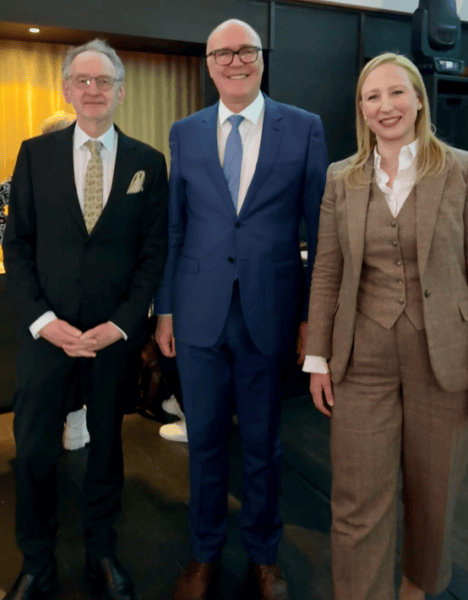
Federal Councillor Martin Pfister, Head of the Federal Department of Defense, Civil Protection and Sport (DDPS), assessed the role of the media in the unstable geopolitical situation. The information space has become a security policy arena in which hybrid forms of conflict such as targeted disinformation are intended to undermine trust in institutions. "Anyone who destabilizes a country's information space weakens its security," warned Pfister.
Artificial intelligence in particular acts as an accelerator, as it makes disinformation more credible and cheaper. This makes classification by quality journalism all the more important, says Pfister: "A healthy media system is part of our security architecture." Media provide the necessary facts and create orientation in an increasingly manipulated information environment.
Artificial intelligence: fair remuneration must be enforced
VSM President Andrea Masüger criticizes the free use of journalistic content by tech platforms: "We provide the raw material for their business model free of charge." Masüger cited the Gössi motion, which obliges the Federal Council to enforce copyright law against AI services, as a key political lever. His conclusion: "Publishers must receive remuneration for the raw material that others are gold-plating."
Against this backdrop, the central question is how journalism and artificial intelligence can coexist in the future. The international focus of the conference made it clear that national solo efforts are not enough in the face of globally active platforms. World Publisher President Ladina Heimgartner and Karen Rønde, CEO of the Danish media collecting society DPCMO, agreed that clear legal guidelines and consistent enforcement of the rules are needed.
At the end of the conference, Prof. Dr. Miriam Meckel and Dr. Léa Steinacker pointed out that AI touches the core of the democratic public sphere. They warned against a flood of AI-generated content with a high susceptibility to errors and emphasized the central role of journalistic media as places of classification, trust and democratic discourse in an information world shaped by AI.
Promoting media literacy and the advertising market: levers for the future
The Epiphany 2026 conference then focused on promoting media literacy - using the example of Amedia in Norway, which had made over 100 publications accessible to young people free of charge, as Group Executive Board member Marte Ingul pointed out. fög Director Professor Mark Eisenegger used the new fög study "Media Use 2035" to explain that young people's willingness to pay for online news increases when they have a higher level of media literacy.
The focus was also on the importance of journalistic media as an advertising environment: according to the fög study, the mass of AI-generated online articles and thus the trust gap will continue to increase. "Advertising in the environment of credible, fact-checked Swiss media works much better than in the fake news environment of social media. This is confirmed by the consumer study by gfs-zürich," says Pia Guggenbühl, Director of the VSM.
Easier media bookings thanks to cooperations
Dr. Markus Wirth, Chairman of the Board of Directors of OneLog and COO of Ringier Media Switzerland, and Jan De Schepper, President of the SWA-ASA, took part in a discussion at an advertising market panel. According to De Schepper, collaborations such as OneDSP can make a significant contribution to making bookings with media companies easier and therefore more attractive for advertisers. Every franc that is taken away from the media by platforms is ultimately lost for the sustainable financing of quality journalism.