
SRG television: The "Idée suisse" is not far behind
Although SRG television’s programming covers a wide range of topics, the language regions still have little interaction with one another. The proportion of women featured in reports is particularly high on French-Swiss television.


These are two main findings of the latest content analysis by the Federal Office of Communications (OFCOM), which was published on Tuesday. Overall, the SRG slightly expanded its information offering last year, mainly thanks to a restructuring at the French-speaking Swiss channel RTS Deux.
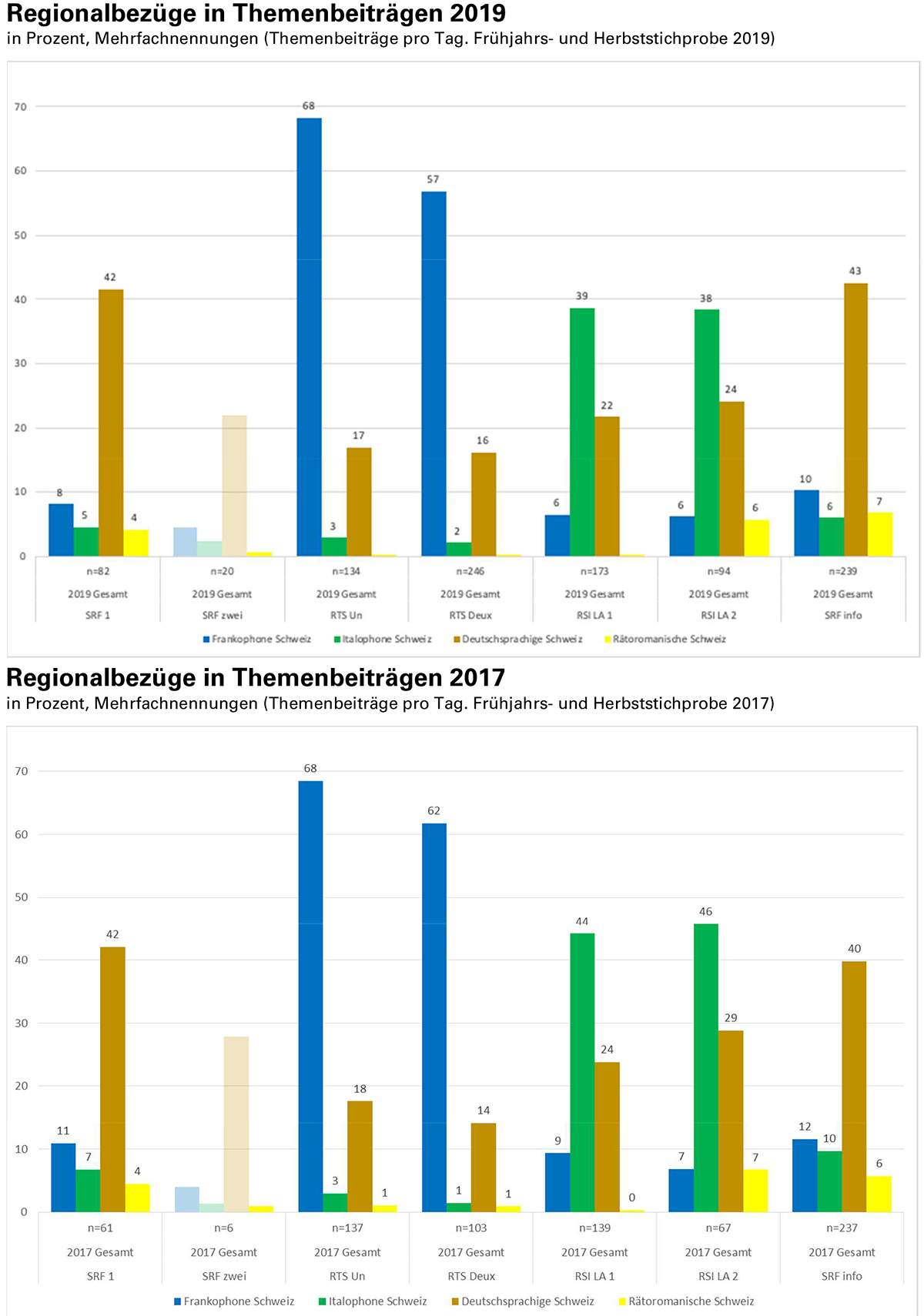
The variety of topics covered by SRG television stations remains high, according to the study. Migration and integration topics are also "identifiable to a quantitatively clearly recognizable extent," according to Bakom's statement on the study. Likewise, the view beyond the language-regional edge of the plate is present, but this is not expanded, according to the study authors. In particular, western and southern Switzerland reported little about each other.
Almost radio silence between southern and western Switzerland
It is true that all the programs examined include programs that focus on the Swiss language regions. Repetitions and program takeovers between the language regions had also increased in comparison to earlier years. But overall, the thematization of the other language regions was rather modest and was not expanded. In particular, the references between Ticino and French-speaking Switzerland are "very low". On the whole, the other parts of the country are also featured in the programs - "but at a consistently low level.
There is praise for the appropriate representation of the sexes in the journalistic offering, especially for the French-speaking Swiss television station RTS. At 64 percent (RTS Un) and 56 percent (RTS Deux) respectively, the proportion of female actors in the journalistic thematic contributions is above average.
At SRF 1, women have their say in 45 percent of the reports, while the corresponding figures for the two channels for Italian-speaking Switzerland are 29 and 33 percent. According to the study's authors, however, a structural assessment of these values will only be possible in the coming years. SRG has only been obliged to strive for appropriate gender representation in its journalistic offerings since 2019.
SRG must also take people with a migration background into account in its offerings. According to the study, the corresponding proportions vary between 2 percent (RTS Un) and 9 percent (SRF 1), depending on the program.
2352 program hours examined
The study also found that the structures of SRG's TV channels have remained largely stable since the last survey in 2017. The only major change was seen at RTS Deux. There, the information service had been increased by almost half with the introduction of the "RTS Info" format. On the other hand, the entertainment area was sharply reduced.
The study was conducted by the German company Göfak Medienforschung GmbH on behalf of Bakom. The study examined two average program weeks each of SRF 1, SRF zwei, SRF info, RTS Un, RTS deux, RSI LA 1 and RSI LA 2. These accounted for a total of 2352 program hours on balance. According to Bakom's statement, the publication of the analyses is intended to stimulate public discussion about programming performance. The analysis is carried out every two years. (SDA)


