Do chatbots belong in the 2020 marketing budget?
Chatbots are no longer a passing hype topic. Sophie Hundertmark from Ai-Zürich and Paixon talks about the role of chatbots in marketing in her guest article.


Chatbots are conversational interfaces that enable the target group to have a conversation with a computer via chat, and are a fixed component on the website or in the Facebook Messenger channel for more and more companies.
The fields of application for chatbots are becoming ever broader. They support customer service, handle internal processes within the company, answer the most frequently asked questions of website visitors, and support marketing by means of storyelling. Consequently, it is not always clear which department within the company pays for the chatbot's budget. If chatbots are used to support marketing or branding activities, the resources usually come from the marketing or communications department.
But should chatbots now receive a separate line item in the 2020 marketing budget? This question cannot be answered unequivocally, but depends on the role a chatbot plays within marketing.
Chatbots and marketing
Why should a chatbot be integrated into marketing and communication activities at all? The fact that successful marketing activities must always be more personalized and should be developed individually for each target group member is nothing new. The fact that many successful marketing campaigns were only successful because they motivated the target group to "join in" or "interact" is also not new. Chatbots help marketers to fulfill exactly these two important criteria.
The chatbot personality
Each chatbot has its own personality, which is precisely tailored to the target audience. During the creation of the chatbot concept, the target group to which the chatbot should be directed should be defined, and then the personality of the chatbot. For example, it can be more funny and direct, or more serious and sensitive.
Depending on the complexity, the chatbot may even have multiple personalities that change from user to user, or one personality for the entire target group. With the help of the right personality of the chatbot, the desired emotions are evoked in the target group, which ideally lead to a conversion.
Compared to a billboard or landing page, the chatbot interacts with each user and draws them into a conversation. The chatbot gives the target audience the feeling of being in a personalized one-to-one communication. A landing page alone cannot motivate users to communicate, and it is often difficult to get users to interact with the website in the first place. A chatbot located on a landing page, on the other hand, has the ability to "engage" the target audience in conversation and encourage conversion in a personalized way. A conversion can be, for example, an appointment or a purchase.
Two types of chatbots in marketing
There are campaign chatbots and branding chatbots. A campaign chatbot is only developed for a specific campaign and is usually a fixed component within the overall campaign communication. A branding chatbot, on the other hand, is developed for permanent use and is seen as a fixed communication tool within branding activities.
Campaign chatbots usually have very limited functionalities and only guide the user through a dialog that is aligned with the campaign theme. As a result, these chatbots do not require too many resources, and there is usually not much maintenance involved, as the campaign usually runs for a limited period of time anyway. Possible reasons for using chatbots within a campaign are the following:
- Chatbots give the user the feeling of one-to-one communication
- Chatbots direct additional attention to the campaign
- Chatbots encourage word-of-mouth propaganda
- Chatbots take users on "a journey" and tell them about the company's products and services in an informal way
- Chatbots create a certain mood among users that motivates them to convert
It's different with branding chatbots. These are usually continuously developed and require more resources not only at the beginning, but also during maintenance and further development.
Two considerations when planning a budget
When thinking about Budget 2020, consider chatbots in two places.
- Consider whether you want to implement a chatbot as a new method within branding activities. If so, then a separate budget should be planned for this.
- If you only want to use chatbots within individual campaigns, to support the respective campaign content, then they should consider the bots within the respective campaign budgets.
Regardless of what kind of chatbots you want to use, don't forget to include the budgets in time - and better a little more than too little. Another small tip: If you still have marketing budget left over from 2019 towards the end, consider using this budget even in 2019 at least for the concept creation for a chatbot in 2020.
Chatbots in marketing campaigns
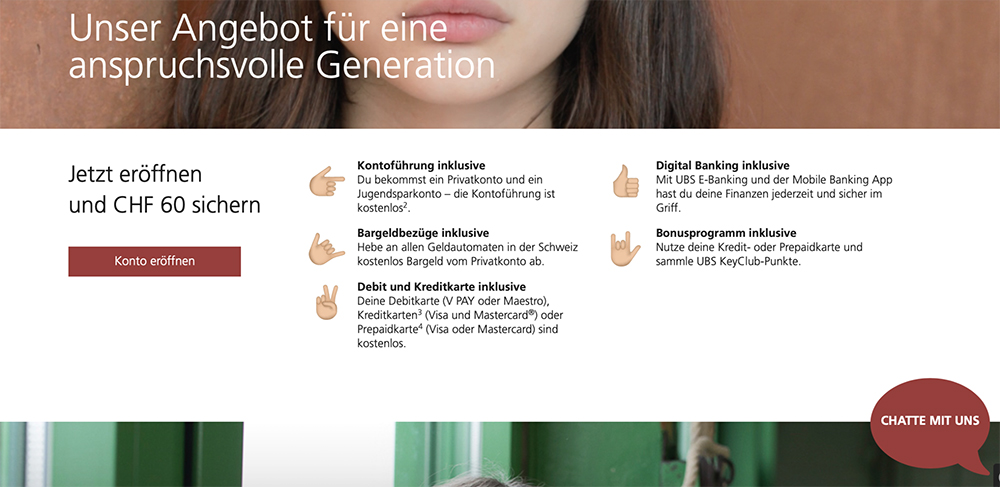
Finally, here is an example in which a chatbot was used within a marketing campaign. Fittingly for the launch of its new youth campaign, UBS introduced the digital assistant OPA in 2019. It answers all questions young people have about the UBS Generation youth offering and guides them to make an appointment to open an account.
In the case of banks and insurance companies, chatbots can be used in a campaign for accident insurance, mortgages, pension plans, travel insurance, and so on. In the case of a consumer brand, chatbots are particularly suitable for a product launch or for a targeted summer or winter campaign. Chatbots are also interesting for supporting employer branding campaigns.
* Sophie Hundertmark is founder and partner of AI-Zurich and partner of the Swiss chatbot company Paixon. AI-Zurich is the conference in Switzerland that is all about the use of Artificial Intelligence in business.