Social selling: how salespeople use the full potential of business networks
Challenger salespeople take potential customers by the hand and show them new paths. On LinkedIn, they can extend their approach online and reach many more prospects than before. Florian Hohenauer from Hotwire describes exactly how they do this in his article on state-of-the-art «social selling» in a B2B context.



If you want to sell, you have to drink a lot of coffee, right? Because there's nothing like having as close a relationship as possible with the potential buyer, right? Possibly. However, there is another approach that promises even more success: the challenger sales approach, which Matthew Dixon and Brent Adamson described in their bestseller "The Challenger Sale" and have empirically proven its success. The short version: salespeople who take their customers by the hand, show them new paths and question the old ones are more successful than the "hard workers", the "relationship builders" aka "coffee drinkers", the lone fighters and those who reactively help to solve problems.
Challengers are more successful
Dixon and Adamson identified an above-average rate of over-performers in the Challenger group. They asked companies which salespeople would belong to the top 20 percent of their team. 39 percent of the top 20 were Challenger types. Across all groups, Challengers make up only 27 percent. Challengers have a great deal of specialist knowledge and are good at communicating it. They are experts that customers trust, as the figures also suggest. With them at their side, customers embrace new approaches and technologies. Challenger sales professionals have achieved trusted advisor status.
Business networks: a stroke of luck
However, challengers have always faced a major challenge in the past: their approach takes time. They could only advise one prospective customer at a time, take them along, convince them and win them over. The success of business networks is a stroke of luck for challengers. They now have the opportunity to share knowledge and expertise via their public profile - to many people at the same time. In this way, they lay the foundations for a successful sales relationship even before the initial contact.
Customer journey in sales
"Social selling" initially only describes the approach of using social networks for sales. Social selling works completely differently in the FMCG market than in the B2B sector, which we want to focus on here. In the business context, it is often about products and solutions that require explanation, high investment amounts and long decision-making processes. The classic customer journey is still quite stable and linear here: the first step is to attract the attention of potential customers. Then companies can explain what they do in general, what they can do for the prospective customer in their very specific situation, what they do better than others and why the prospective customer should act now if possible.
LinkedIn as the ideal partner
Challengers also have to guide prospective customers through this journey. In the context of social selling, the world's largest business network LinkedIn is the ideal partner here. LinkedIn now has more than 13 million members in Germany, Austria and Switzerland and more than 15 million German-speaking members in total. This means that the network is no longer far behind Xing and also offers challengers an enormous advantage: the opportunities to publish their own content are far better on LinkedIn than on Xing. As a result, LinkedIn has developed a lively timeline with many interactions, where members can also find inspiration and look for business partners.
Find and be found
What does an optimal social selling process on LinkedIn look like? More and more salespeople are working with the LinkedIn Sales Navigator. This tool allows them to collect interesting contacts in their own timeline and see their public updates. This allows them to better assess the best time to approach them. If they then contact the contact via a LinkedIn email, for example, the following is very likely to happen: Before the person addressed replies, they will look at the sender's profile. Who is contacting me? Which company does the person work for and in which position, is this someone I should reply to?
Prepare profile check
Challengers should be perfectly prepared for this profile check. The following aspects are important: Is the profile picture professional? Does the background image support a good first impression? Is the position description generally understandable and does it indicate your own expertise? Are there three to five sentences in the profile description that provide a little more background? Are the career stages maintained and also provided with short descriptions? Are skills listed and confirmed by others? Are there perhaps even references? So much for the mandatory, now for the optional: Is the content that the salesperson regularly shares in the timeline or LinkedIn blog interesting and helpful? Does this indicate their area of expertise?
If you receive many positive answers to these questions, you can very probably expect an answer to your own query.
No time for content
The short and long content that anyone can share on LinkedIn actually plays a decisive role for challengers in particular - and this is precisely where many social selling programs are currently still failing. This is where challengers could perfectly communicate their expertise, challenge their readers to think in new ways and highlight trends and business-relevant developments. Sales employees are aware of this opportunity and have also recognized the potential - the fact that they still don't manage to share content is ultimately due to a lack of time. "I know, we've had all this training, but I can't get to it" - I've heard this statement too often.
Get PR on board
There is a surprisingly simple solution to this problem: networking with the PR department. Every day, PR works on nothing other than communicating the company's products and solutions, which require explanation, to a wide variety of target groups. PR professionals also work beyond the product level, linking their company to the major debates that shape society. PR professionals have everything that challenger sales professionals need - the story and, above all, lots of content.
Professional preparation
However, simply copy-pasting the content is not recommended. The path to becoming a challenger sales professional and successful social selling on LinkedIn is as follows:
- Identify ChallengerStart small, we'll test first. Identify five salespeople who have an affinity for social media and work in areas that your company would like to support better.
- Theme workshopBefore the profiles of the sales staff are optimized, it must be clear who stands for which topics. The sales department often specifies topics, but not always. In addition to the expertise of the sales staff, an external perspective should also be incorporated here: Which topics are currently exciting for the market? An optimal result of a workshop: We assigned sales staff to the topics that they know a lot about and that are currently attracting a lot of interest on the market.
- Theme calendarThe PR department should now develop an editorial or topic calendar for every salesperson: Which content is played out on which aspect, at what frequency and to what extent - these questions are answered in it. This way, sales staff and PR professionals know what is due when and can plan better.
- Profile optimizationThe optimization of the individual profiles can take place parallel to the creation of the calendar. The points mentioned above are important here. As profiles are particularly meaningful when third parties confirm their own skills or provide references, sales staff should not be afraid to ask colleagues or superiors for precisely these confirmations.
- Short content serviceOnce the profiles have been optimized, it is important to share good content on an ongoing basis. Short pieces of content two or three times a week, for example links to exciting articles or analyst reports with a brief classification, insights from conferences or short reports from events, etc. The PR department can prepare all of this and send it to the relevant sales representatives in daily or weekly "social sharable" emails.
- Long articleThe long articles are the supreme discipline on LinkedIn - here everyone has space and multimedia opportunities to share knowledge. PR can also have these articles prepared by ghostwriters. Once an article has been created and posted on LinkedIn, it is initially only seen by the salesperson's network. If the article is clicked on and read, the LinkedIn algorithm may notice the post and suggest it to the LinkedIn editorial team for further distribution. If this happens, very good reach with thousands of readers can be achieved.
- Lead generation content: Topics or solutions that require explanation can also be communicated well as an ebook. PR and marketing often work together on the creation and rollout of such lead generation documents, but forget about sales. If such ebooks are available, salespeople should also receive a long-form post about them and also distribute them themselves via LinkedIn - it is also possible to add PDF attachments to messages.
- Professional solutionsCoordinated social selling programs often start very pragmatically. The PR team delivers content to the first five social sellers individually by email. However, if several sales teams are then added, it is worth purchasing a professional solution to provide content for onward distribution.
- LinkedIn groupsOn LinkedIn, every member can create groups. Challengers are experts and there is a good chance that others will want to read and discuss the expert content. So why not start a group on the core topic or actively participate in other groups?
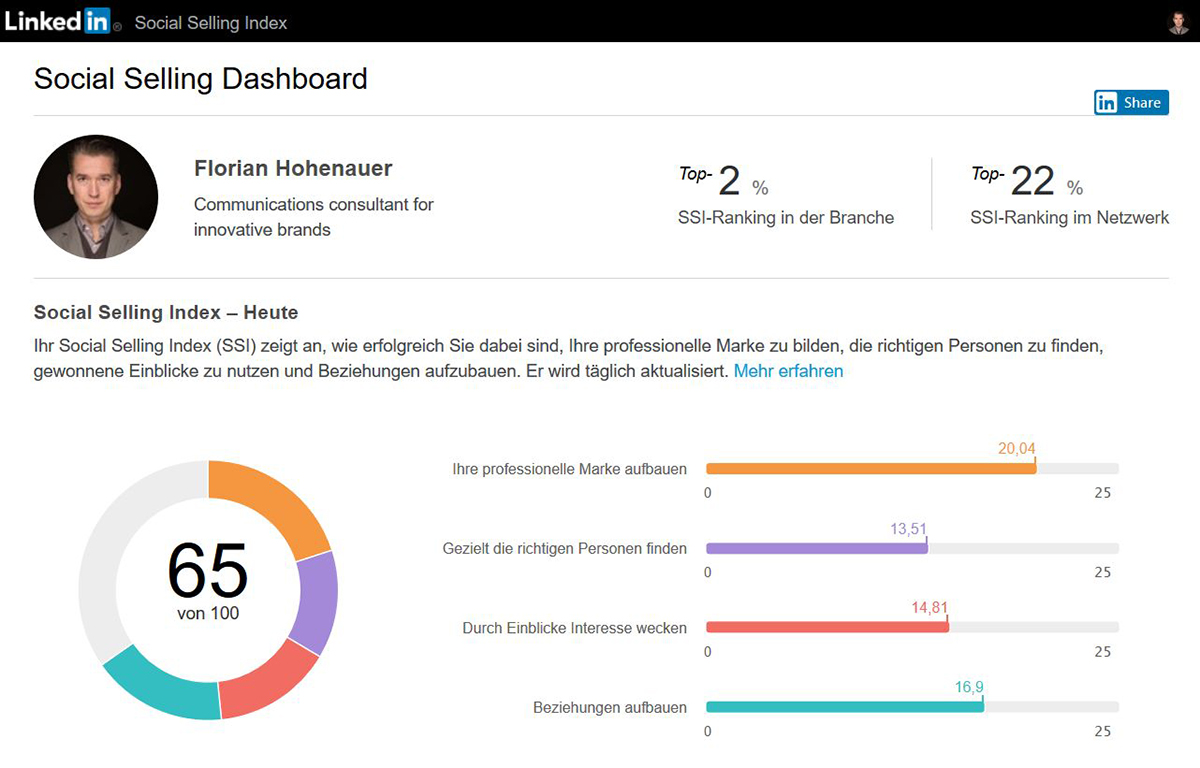
- Measuring successThe LinkedIn onboarding tools are sufficient to measure the success of your own presence and make adjustments if necessary. A nice gimmick is LinkedIn's Social Selling Index, a kind of benchmark that anyone can use to see how well LinkedIn rates them in comparison to others in terms of social selling.
LinkedIn has conducted its own study to see how social selling affects results. Here is an excerpt from the press release on the study: "Those who use social media in sales to find out more about their contacts or build a relationship with them are more successful - both in terms of achieving their sales targets and in terms of salary. According to the survey, 58 percent of respondents have achieved their targets. Almost three quarters (72%) of the successful salespeople in this group rely on social selling."
That's another nice motivation at the end, don't you think? I think so too. What's the best way to start? I would suggest with a coffee. The process clearly shows how important it has become to look beyond the silo boundaries of your own department. What position do you currently hold? In PR? In advertising? Have you already talked to your sales team and explored the possibilities of a social selling program? High time for a coffee together, I'd say. It's still the best way to bring people together and set up a successful social selling program.
* Florian Hohenauer heads the business of communications consultancy Hotwire in the DACH region. Hotwire has been supporting LinkedIn, among others, with communications in the DACH market since 2012. Hotwire also supports social selling projects and brings together sales, PR and marketing.