
From raw paper to a fine print product


After printing
After the ink has dried on the printed sheets, the next stage is postpress. This refers to the processes that take place between the printed paper sheet and the dispatch of the finished print product. These are mainly folding, creasing, perforating, stitching, perfect binding and cutting.These are all classic activities of the bookbinder, which serve to finish the printed products or give them special protection. The finishing of printed matter is aimed at making printed matter even more attractive and thus generating attention.
A refinement that works
To enhance the impact of printed products, Vögeli AG, Marketing Production & Printing in Langnau im Emmental, offers numerous finishing options. Based on the goals that customers define, the type of finishing is selected. For Renato Vögeli, a member of the management team, a printed product can have an impact above all if it stands out. Vögeli AG offers embossing, hot and cold foil stamping, relief coating, partial gloss coating (drip-off), scented coating, die cutting and special folding. As a rule, customers define what effect is to be achieved with the printed product.
Select the finishing that matches the message
The challenge is to choose the right finishing for the message to emphasize the desired message. In the application, it is then a matter of combining the right materials and processes to achieve the desired effects. Flawless processing and the sequence of work steps are just as crucial as coordination with all the partners involved.
The motif cut - cut edges printed all around
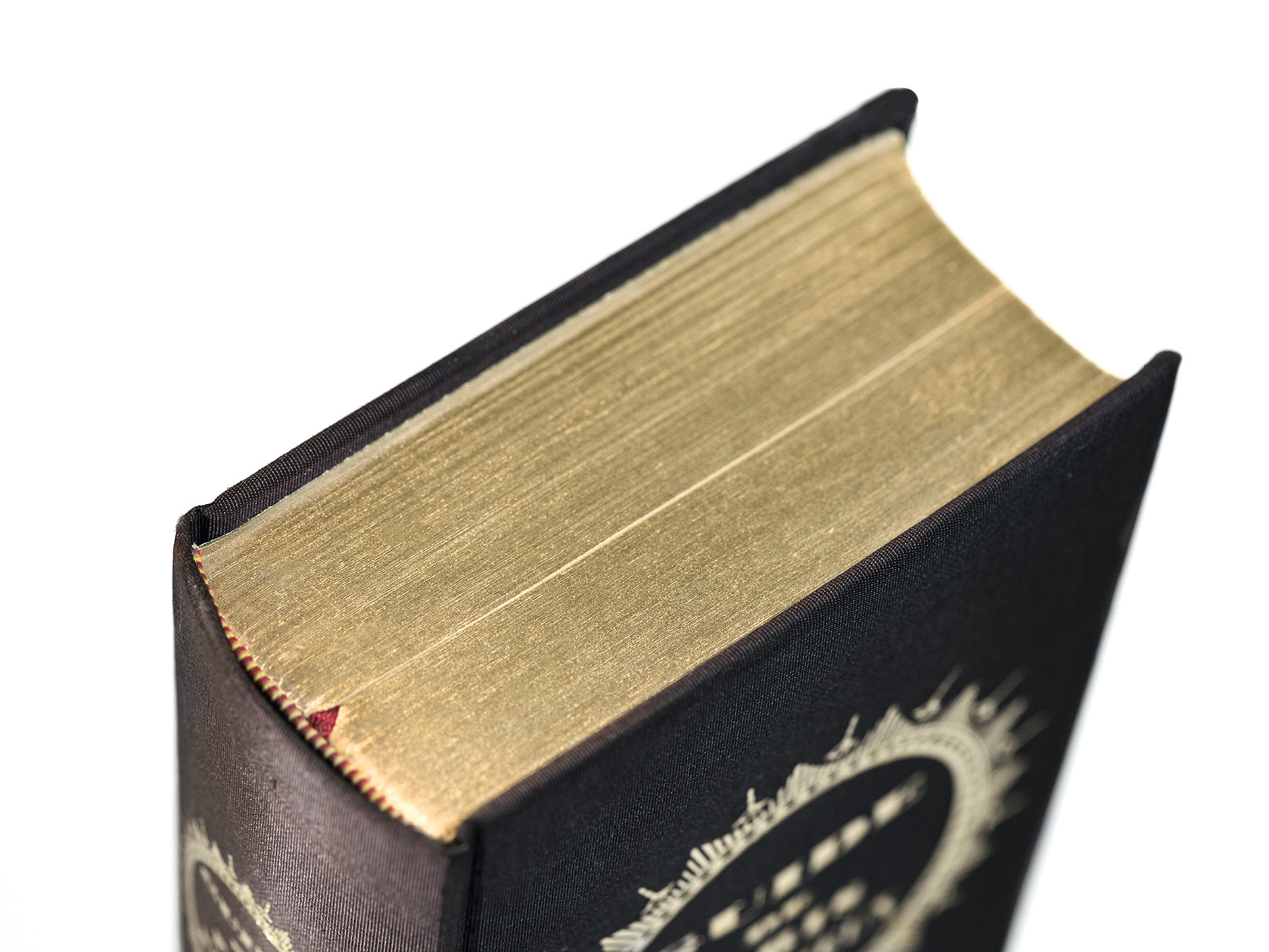 Inking or gilding the cut surfaces of a book served to protect the edges of the paper. Books with gold edges look noble and exude a touch of glamor.Before there were industrial embossing foils, gold edges were applied with gold leaf. For this purpose, the cut surface was sanded with sandpaper and primed with egg white. Then the gold leaf was applied. Sometimes the finishing process went one step further and a roller was used to emboss decorations and ornaments, so-called hallmarks, into the cut surface.Gold, silver and foil cuts are increasingly being used again today as high-quality design elements. Well-known examples of gold cuts are the Bible and church hymnals. The printed edition of the "Duden" dictionary has a blue head color cut as a distinguishing feature.
Refinement - the chance to take off
Every offer should be unique. Everyone wants and needs to stand out from the competition. This can be achieved with special printed matter that surprises. Such printed matter stands out pleasantly from the uniform digital advertising. They engage all the senses and convey a multi-layered experience. Today, printed matter stands for the unusual, the noble and the natural and thus stands out in the digital environment. Design and production require creativity and expertise. The time and financial effort is worth it, because only something that stands out makes an impact.
Multi-layered printed matter
Printed matter is more complex than the view on a flat screen. Printing is done on a material that can trigger very different reactions. Printed materials are not uniform like screens, which differ only in the degree of resolution and size. Printed paper smells, is thick or thin, smooth or rough, and invites you to touch it. Papers crackle, they shine or are matte, are thin, limp or voluminous. They are always different, but never boring. This is how printed advertising always succeeds in surprising and delighting recipients.motif cut - good to know!Circulation: The motif cut is already available from edition 1. Editions of hundreds or thousands of copies require a longer production time.Formats: All books with a maximum size of 37 cm × 28.5 cm landscape or square up to 28.5 cm × 28.5 cm are suitable for motif cutting.Products: Print products can be printed with motif cuts from a thickness of 3 mm. This means that cards, softcover and hardcover books can be finished.Binding types: Whether softcover or hardcover, perfect binding or thread stitching, motif cutting is possible with all types of binding. Rounded edges can also be printed.Data preparation: For printing, the design to be printed on the cut is required in 1:1 format as a PDF with a resolution of 300 dpi. The fonts must be vectorized.Paper choice: All papers can be printed, including coated papers.Print quality: Printing is done with a special inkjet printing system in four-color mode (CMYK). The colors are abrasion resistant and very light resistant. Even after years the color does not yellow.Cost: Motif cutting is a time-consuming production process and therefore around 30% more expensive than color cutting.More info: www.bubu.ch


