How marketers reach Generation Z with advertising


 As part of the study, attitudes and opinions of representatives of Generation Z (born between 1995 and 2010) were researched for the first time with a view to media use and advertising impact. With more than two billion people, this group is becoming massively important for marketing decision-makers. In addition, Generations Y (born 1982 to 1994, also known as Millennials) and X (born 1966 to 1981) were also studied."Generation Z is even more extreme in its media behavior than previous generations. Since their representatives have grown up in an on-demand world with almost infinite choice, they also have a different expectation of advertising. For this young generation, formats that invite participation are highly prized. Generations X and Y, on the other hand, prefer advertising that contains more in-depth information about a brand or product", says Duncan Southgate, Global Brand Director Media & Digital at Kantar Millward Brown.The study AdReaction: Engaging Gen X, Y and Z provides marketers from all industries with a guide for interacting with different target groups - especially with Generation Z, which has been little researched to date. Some key findings of the study are:
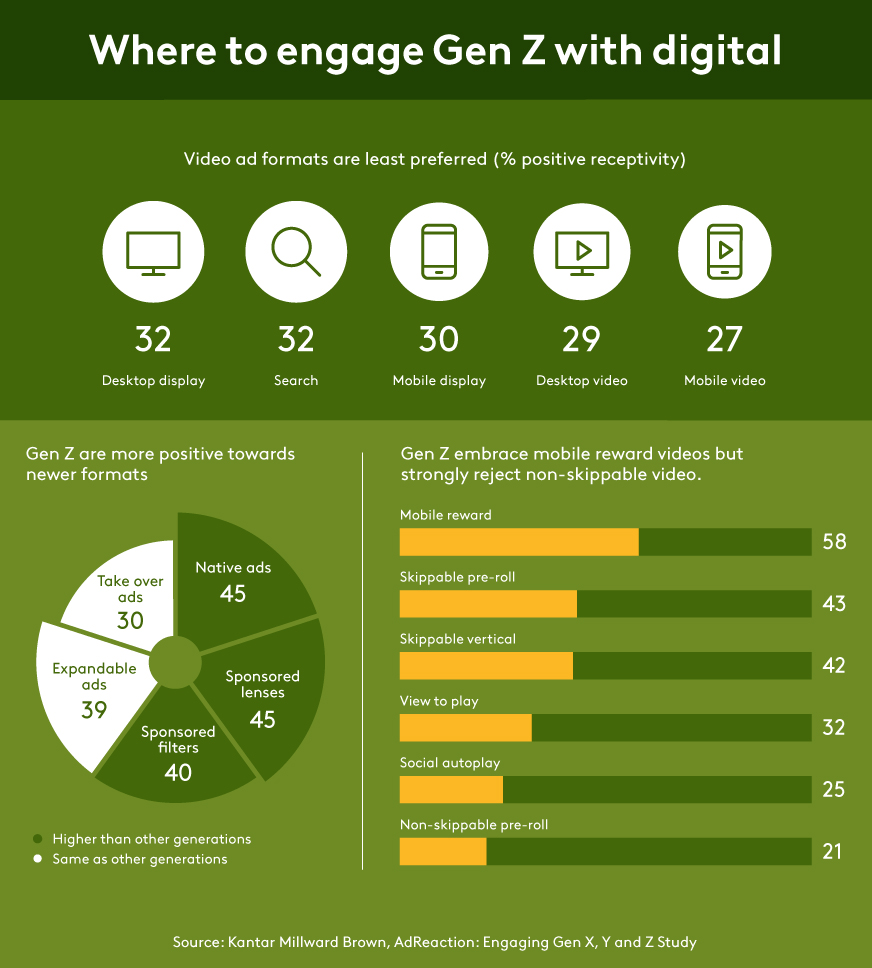
Generation "mobile-first", but traditional media are also relevantGeneration Z has grown up with mobile devices. Consequently, 74% of their representatives say they spend more than an hour a day surfing on a smartphone or tablet (compared with 66% of Generation Y and 55% of Generation X). TV consumption is correspondingly lower, with 51% of 16-19 year olds watching more than an hour of TV every day (Generation Y: 59% and Generation X: 74%). Although Generation Z's media consumption is dominated by digital channels, traditional media still have an impact: Generation Z rates advertising formats such as outdoor or print ads as well as TV and radio spots more positively than digital alternatives.Fast decision makers, but no ad blockersGeneration Z has internalized digital technologies even more than Millennials. Perhaps that's why they are quicker to decide whether they like an ad or not. Consumers from Generation Z who skip digital advertising formats do so three seconds faster on average than Generation X representatives. However, 16-19 year-olds are not generally advocates of ad blockers: 31% have one installed on desktops (compared with 30% of Millennials and 22% of Generation X), and 13% on mobile devices (Millennials: 14%, Generation X: 12%).Beware of intrusive advertising formatsWith regard to digital advertising formats, Generation Z representatives are particularly open to mobile rewards videos - e.g., rewards as part of an online game - and skippable pre-rolls. Non-skippable pre-rolls or pop-ups, on the other hand, are perceived as intrusive.Social media increasingly importantGeneration Z uses social media much more intensively than Generations X and Y, both in terms of the time invested and the number of social media platforms used. In addition to Facebook, Twitter and YouTube, Generation Z is particularly active on Instagram and Snapchat. Worldwide, 36% and 24% of Generation Z say they access Instagram and Snapchat several times a day. In Generation Y, only 21% and 10% do so, and in Generation X, only 9% and 4% do so.Enthusiasm for music and moviesIn particular, Generation Z has a strong passion for music and movies. This has an impact on the acceptance of corresponding advertising formats: Because 39% and 38% of Generation Z respondents say that music and movies, respectively, positively influence their perception of advertising (compared to only 29% and 28%, respectively, among Generation X representatives). And as many as 43% of Generation Z say they want to have continuous access to music. Among Millennials (Generation Y), this is only 30%. There are also differences between the generations in terms of the length of video formats: While Generation Z likes videos that are less than ten seconds long, Generation X is more open to videos that are up to 20 seconds long.The creative approach makes the differenceMusic, humor and celebrity testimonials increase Generation Z's receptivity to advertising. In addition, these young consumers are more open than older generations to formats in which they can help shape the development of advertising - for example, by voting (31% of Generation Z rate this positively compared to 25% of Generation Y) or choosing a specific option (28% compared to 25%).Design is importantGeneration Z is extremely design-conscious. Their representatives therefore appreciate the aesthetic qualities of an advertising format and the use of modern technologies such as augmented reality and virtual reality. Newer advertising formats such as native advertising, sponsored lenses and sponsored filters also meet with significantly higher acceptance among Generation Z than among older generations.Advertising does not work globallyGlobally uniform campaigns are not very promising due to the heterogeneity of Generation Z. Instead, local and regional characteristics should be taken into account. Instead, advertising should address local and regional characteristics. In China, for example, Generation Z always wants to hear cheerful music accompanying advertising. It's quite different in Germany: Here, younger consumers want background music that - independent of the voiceover - helps them understand the message of the commercial."Like other generations before it, Generation Z is not a conformist group. Its representatives have grown up differently, have diverse expectations and unequal access to technologies. The views and attitudes of this generation pose new challenges for marketers across all industries. The successful brands will be those that engage with and understand this critical and rapidly growing target group╗.Duncan Southgate concludes.All results of the study "AdReaction: Engaging Gen X, Y and Z." there are here.