TV awards 2017: The devil is in the detail


The table "Price development 2016/2017" shows the changes in the planned CPPs (CPP = cost per GRP) for selected channels in prime time (7 p.m. to 11 p.m.). The planned CPPs for the first half of 2017 are compared with the corresponding figures from the previous year. The evaluations are based on the pricing target groups of the channels in question and the channels marketed by Admeira Broadcast do not increase the planned CPPs for the first half of 2017. Depending on the broadcaster and time zone, they are even being reduced.Goldbach Media, on the other hand, is increasing the planned CPPs in prime time by 4 to 8% for the broadcasters under review, with the exception of RTL. Outside prime time, the picture is somewhat different: RTL, Kabel1 and Sat1 reduce the planned CPP slightly here, M6 even significantly. As many advertising clients allocate the largest share of their budgets to prime time, the price increase will nevertheless be clearly noticeable for these channels.

Price-performance ratio is not the only decisive factorHowever, a realistic assessment of the prices published by marketers is not only based on the price-performance ratio, but also takes into account their performance forecasts in the price-setting target groups. The table "Performance development 2016/2017" compares the average advertising block reach (ratings) forecast for the first half of 2017 in prime time with the previous year's forecast values, and no general trend can be discerned. It is striking that some broadcasters have significantly reduced their forecast compared to the previous year or have only made increases in the single-digit percentage range.
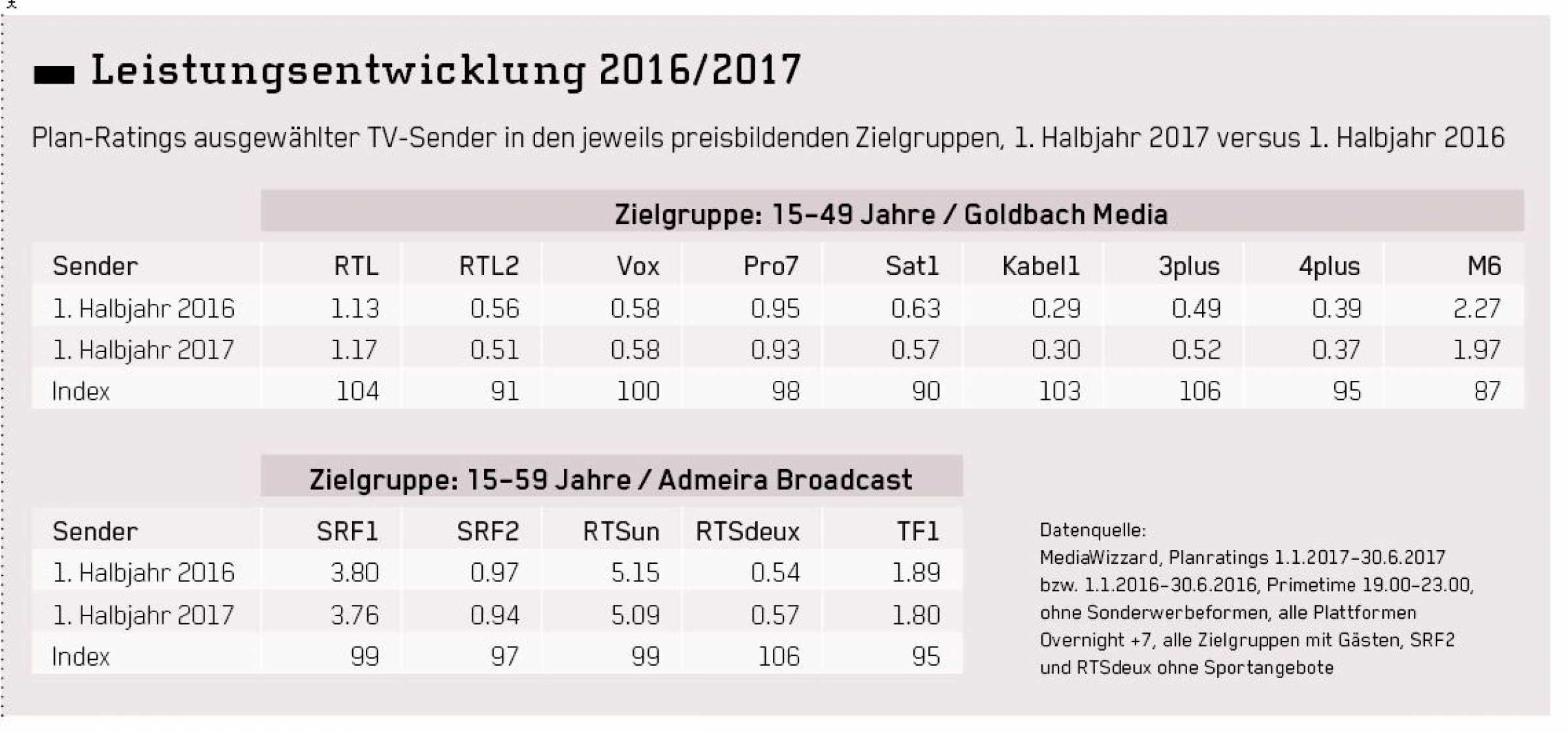
Performance forecasts not always realisticSo everything is fine? Unfortunately not. This is because the changes only partially take current developments into account. For example, SRF1 was below the forecast in prime time every month in the first half of 2016, in some cases significantly. We would have expected a reduction in the forecast for 2017 here, as the deviations did not only relate to months with major sporting events, in which SRF2 can generally make gains at the expense of SRF1. In our opinion, Sat1, 3plus and 4plus should also reduce their forecasts more sharply, as some of the channels missed their forecasts for the first half of 2016 by a considerable margin.Effective inflation is higher for some broadcastersThe effective inflation is therefore likely to be higher for some channels than would be expected based purely on a comparison of the planned CPPs. The forecast appears to be more realistic for RTL, Vox and M6, for example, as they reflect developments in the first half of 2016 well.Hidden price increases in the offer for 2017Hidden price increases also play a role in the assessment of the offer for the coming year. Next year, these will particularly affect the stations of the 3plus Group and the SRG stations. The 3plus Group is changing the so-called "spot length index" for 2017. The 100 index will now only apply to commercial lengths of 30 seconds or more; previously it applied to commercial lengths of 26 seconds or more. As a result, spots with a length of 26 to 29 seconds will be five percent more expensive in the coming year. The price indices will also be changed for shorter spots.Admeira no longer gives a performance guarantee on FreespaceThe SRG broadcasters recently announced that in future the performance guarantee will only be granted on the paid volume, but not on freespace bookings. As the SRG broadcasters grant a 100% performance guarantee for some target groups, this change is particularly significant. Admeira Broadcast says that this move is in line with the TV market and its competitor Goldbach Media, but it means it is saying goodbye to an important unique selling point. Are these the new prospects for Admeira?