Survey report on opportunities and challenges of the digital transformation


DIGITIZATION Digital transformation is a key challenge for companies worldwide. In order to gain valuable insights into the current situation on the market, E-Spirit AG conducted a survey of 200 decision-makers from marketing, IT and management in companies of all sizes. The aim of the survey E-Spirit AG was to find out how players from the field assess the digital transformation and what strategy they are pursuing in their company in order to benefit from it. Most companies see the digital transformation as an opportunity for their own economic future. 63% of respondents stated that the transformation motivates them to improve the customer experience and thus increase sales opportunities. 53% expressed the expectation of becoming more agile and responsive as a company overall. There is further potential with regard to possible process optimizations: As many as 47% assume that they will be able to increase their efficiency and reduce costs with the help of suitable measures. Impetus for digital transformation is also coming from the other side of the "store counter": eleven percent of companies feel driven by customer expectations in order to survive in a highly competitive market. Only twelve percent state that they are not currently implementing any transformation measures. Conversely, this means that 88 percent of respondents have at least started planning corresponding initiatives.

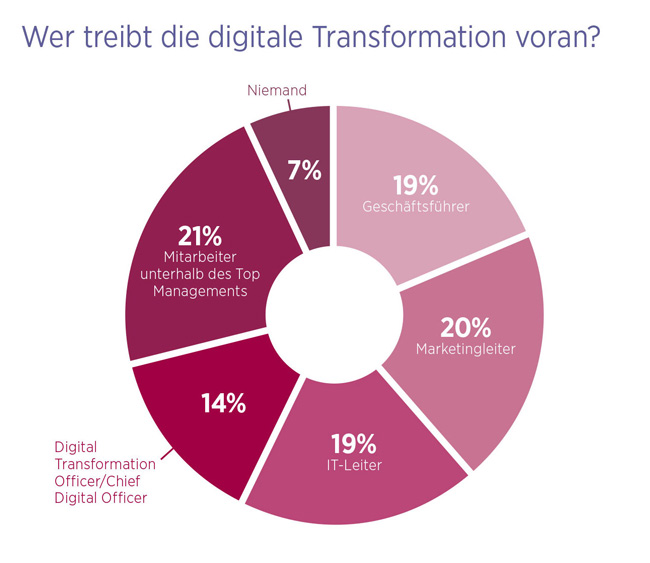
Customer requirements urge actionIn fact, the digital competence of customers and end consumers has grown so rapidly in recent years that companies need to adapt their digital strategies to the changing expectations of the sales market. It is not just marketing or IT managers who are in charge of this. In many places, digital transformation is a matter for the boss: in one in five companies, the managing director is personally behind the change. Meanwhile, 14% of respondents stated that their company has a dedicated management position, such as a Chief Digital Officer, who is driving the development forward.Integration is the key to successAs a result of digitalization, more and more applications and systems are being used in companies, but they do not communicate with each other independently. In this respect, the integration potential of the IT landscape is of enormous importance. Every second survey participant operates eight or more customer-facing applications. Ideally, these should work together seamlessly. According to the survey, many companies still have considerable room for improvement in this respect: only 30% have achieved an integration status of their customer-facing applications in the course of digitalization with which they are satisfied or very satisfied.
Picking up customers where they are on the moveDigital transformation also means covering a wide range of communication channels. Unsurprisingly, websites, email, social media and mobile are of central importance, but traditional channels such as telephone and print should not be neglected either. They are often important channels that support the digital experience and must continue to be included in the omnichannel strategy. The decisive factor here is where the customer is positioned within the customer journey. It is important for companies to create a sustainable customer experience at every touchpoint using target group-specific content.