
Standard mobile banners fail with branding


MOBILE An advertising effectiveness study by Undertone and Ipsos shows that standard banners are not very effective on smartphones. Other forms of advertising are needed.
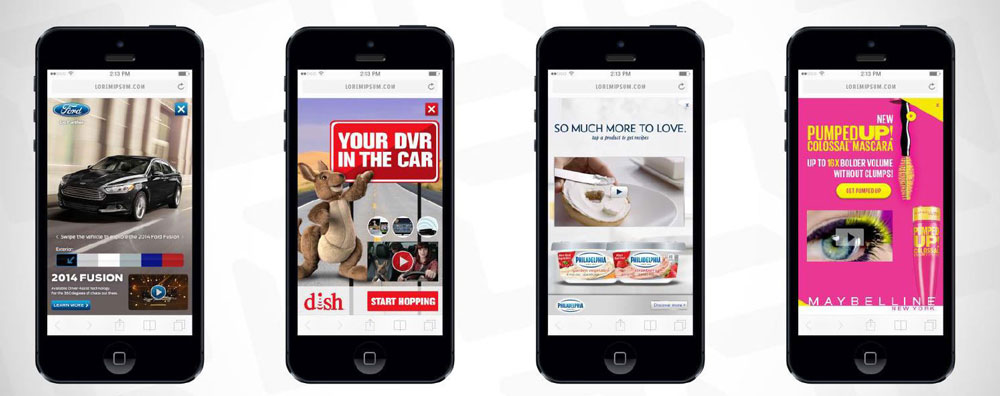
A broad-based study investigated the advertising impact of mobile ads.Standard mobile banners fail when it comes to brand advertising. Only a quarter (23%) of consumers notice a brand when it is advertised via standard display ads on smartphones. This is shown by the advertising impact study "High Impact Advertising Across Screens" by Undertone, which was conducted together with Ipsos. The aim was to investigate the branding impact of large-scale, interactive high-impact formats in contrast to standard display ads on desktop, tablet and smartphone. The four US brands Dish, Ford, Maybelline and Kraft, together with their media agencies, supported the study, in which a total of 3,600 test subjects took part.High-impact formats beat standard banners for advertising recallIn a comparison of screens, the ad recall of standard banners on the desktop is the lowest. Only a third of respondents could remember seeing the ad there. On tablets and smartphones, the figure was four out of ten (43 and 38 percent respectively). Full-screen formats, on the other hand, achieved the highest advertising recall on desktop, tablet and smartphone. While only 38% of respondents were able to recall the large-format ad on stationary devices, more than one in two respondents did so on mobile devices.Size of the ad influences brand perceptionThe larger the ad and the more interactive features it offers, the better consumers remember the advertised brand (brand impact). Just under one in two were able to name the brand in a full-screen takeover on tablet and smartphone. With the standard banner, this figure was only a third on the tablet and a quarter on the smartphone.Cross-screen increases the advertising impact of large formatsOn the desktop, standard and full-screen ads generate roughly the same values for advertising recall (33% and 38% respectively). If the advertising campaigns are played cross-screen, i.e. on desktop, tablet and smartphone, the advertising recall of standard formats remains the same, while that of full-screen formats increases by 5 percentage points to 43%.Large-scale advertising gets sympathy pointsAlthough full-page takeovers interrupt the consumer's browsing experience because the ad is superimposed over the website content, they achieved the highest likeability ratings in the format comparison. 51 percent of the study participants stated that they liked the full-screen ads shown. Standard banners were just below this at 47 percent.Brand messaging can also be effective on small screensAdvertisers can present their messages effectively on mobile devices despite smaller screens if the space and technical possibilities are used skillfully. The study participants estimate the impact of brand messages on desktop, tablet and smartphone to be similar.Mobile brand messaging is not just for millennialsThe positive advertising impact of large-scale, interactive advertising formats on smartphones extends across all age groups. Advertising recall among 18- to 64-year-olds is between 55 and 60 percent. Values for brand awareness vary between 42 and 46 percent.Jörg Schneider, Country Manager Germany at Undertone, explains: "Interactive advertising on mobile devices is a must for brands. Target groups often engage more intensively with the advertising material on tablets and smartphones because they are inherently more interactive devices and touch-and-swipe mechanisms allow for great features in the advertising material. This increases the engagement rate and branding time."___________Background information on the studyThe aim of the study was to determine the branding impact of high-impact formats compared to standard display ads on desktop, tablet and smartphone. Nine different formats were examined: standard display ads (300 x 250 pixels on desktop & tablet; 320 x 50 on smartphone); IAB Rising Stars (billboard, filmstrip, adhesion, pull, slider) and Undertone's own high-impact formats (full-screen takeover), called ScreenShift and PageGrabber X, which take up the entire or large parts of a website and offer interactive functionalities.Source: Study by Undertone and Ipsos, "High Impact Advertising Across Screens", n=3600 US-Americans between 18 and 64, period: April 2015, USA


