Germans have not yet written off print and are demanding labels for AI-generated texts
Where is digitization taking us, and what impact is it having on media consumption? A representative study has examined this question in depth. Slightly more than half of Germans believe that print products have a future.


Together with Deutsche Presse-Agentur, NextMedia.Hamburg is hosting the annual innovation conference for media in Hamburg. The latest study revealed good news for traditional media - depending on your point of view: a small majority of Germans believe that print products have a future.
- The most important findings at a glance:
- 49 percent of respondents are skeptical/critical of automatically generated messages
- Germans demand: News created using artificial intelligence (AI) should be labeled
- More than half of Germans (57 percent) believe that print media will survive
- In autonomous cars, the focus will be on entertainment and news consumption
Future especially for trade magazines
The over-30 age group in particular continues to believe that the tried-and-tested daily newspaper will continue to exist. The younger respondents, albeit by a narrow margin, are more likely to predict that they will soon be replaced by smartphones and the like. It is particularly worth taking a look at the diversity of print products. Specialist magazines in particular are still expected to be very popular with Germans in ten years' time. 53% of 18 to 29-year-olds believe that they will continue to exist; the figure for daily newspapers is still 44%. The older age groups largely agree with this forecast, but local newspapers and magazines will also remain relevant for them. All respondents agree that other print products such as news magazines, tabloids or customer magazines will probably not survive. Only 9 percent of all respondents believe that no print product will be relevant at all in ten years' time.
Good or bad news?
While the fact that 57% of Germans believe in the future of print media is interpreted by the authors of the study as "good news for traditional media", others derive a much less optimistic picture from the figures. The portal writes Meedia.comThe results should "alarm publishing managers". And "even more alarming" is the fact that the young target group is already seeing the replacement by smartphones and the like earlier.
Virtual reality desired - but not equally strong everywhere
Print media will therefore retain their raison d'être in the eyes of at least slightly more than half of Germans. However, they will have to share their target group with new media such as virtual reality. Although only 15 percent of Germans have seen news programs with VR or AR, they know exactly which media areas they would like to experience in virtual reality: 67 percent of respondents want to experience content on nature topics via VR. Among the over 50s, the figure is as high as 72 percent. Around half of those surveyed are interested in sports or science. Only a third are interested in culture or politics via VR. According to the study, nature content is best presented as a documentary (72%) or report (62%). Live formats are also well received: 56% want to be right there when something exciting happens, as the added value of VR lies mainly in the fact that it is easier to experience, according to respondents. Only 24% see no added value in VR content; among 18 to 29-year-olds, the figure is just 10%. In addition to virtual reality, podcasts and messenger services are also becoming increasingly important in (media) reporting.
Skepticism towards artificial intelligence
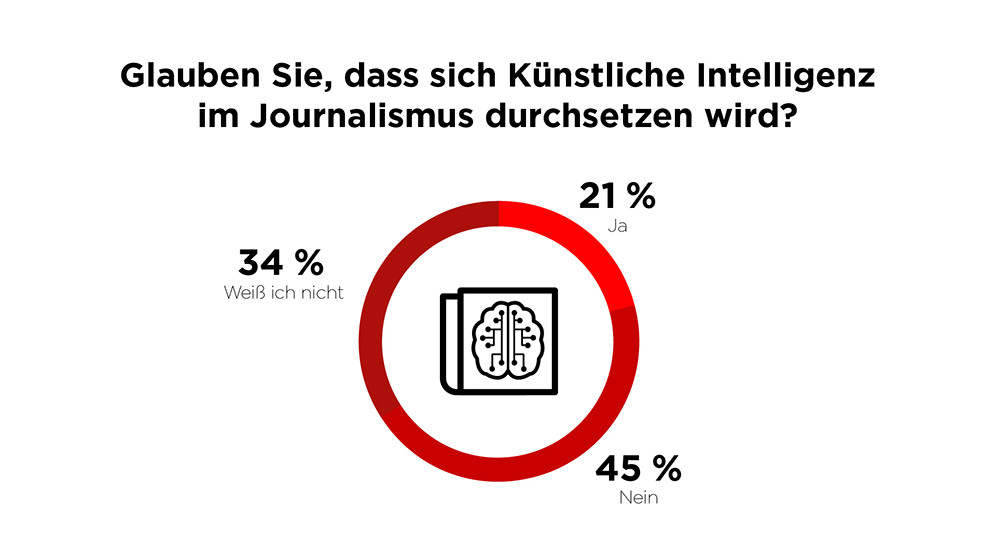
Artificial intelligence is also finding its way into journalism. Nevertheless, 45% of Germans are of the opinion that this technology will not become established. They are correspondingly skeptical about automated news: 49 percent are rather critical, 28 percent reject this news altogether. Only three percent consider robot journalism to be useful. These assessments are reflected in the evaluation of the credibility of automated news: 43% consider these reports to be untrustworthy, only 18% believe this content and the remaining 39% cannot assess its credibility at all. This is understandable: 91% of Germans are in favor of labeling automated articles.
Content at the (self-driving) wheel
One of the trending topics when it comes to the future of content is also autonomous driving. As many as 22 percent want to use the extra time that comes from riding along instead of driving themselves to catch up on the latest news. However, a third of respondents would prefer to spend their time on entertainment: Listening to music, watching series or movies or reading a book are the favorites here. Only around one in five would like to work, socialize or relax.
The representative study was conducted by Statista on behalf of NextMedia.Hamburg between May 17 and 24, 2018 in the run-up to Scoopcamp on September 27, 2018. Scoopcamp is the innovation conference for online media. Every year since 2009, Hamburg@work - and NextMedia.Hamburg since 2014 - together with DPA Deutsche Presse-Agentur has invited more than 250 experts, decision-makers and innovators from the IT and media industry to discuss trends and current topics at the interface between editing, programming and product development.