
Does negative content in advertising have a negative impact? The study «The Trust Factor—Advertising Effectiveness in the News Environments of Regional News Brands» by Score Media Group reaches a clear conclusion: It is not the content of the news that determines advertising effectiveness in a news environment, but rather trust in the media brand.
Advertising Impact in a News Context: Content Plays Hardly Any Role
A total of 3,856 internet users between the ages of 18 and 69 participated in the quantitative online survey, which was designed as an experimental study. Readers spent two minutes navigating faithful replicas of four regional news brand websites, complete with their typical ad placements, while non-readers navigated a fictional news site. They were randomly assigned to view either a negative international article, a negative regional article, or a neutral article, along with an advertisement from a real brand. The study examined ads from three FMCG brands.
Although negative posts are perceived as more unsettling and emotional than neutral ones, the study finds that this does not carry over to the evaluation of the advertised brands. The brand image remains stable in terms of professionalism, reliability, high quality, credibility, and likability. There are also no significant differences in positive brand impressions, purchase intent, or interest in information. Fifty-eight percent of all respondents say it makes no difference to them whether an ad appears alongside good or bad news.
Trust as the Most Powerful Influencing Factor
A regression model examined several influencing factors, including news context, trust in the regional media brand, use of the advertised brand, interest in the product category, as well as age, gender, and device. According to the model, trust in the media brand explains 24 percent of the variations in brand image and 23 percent of the variations in advertising effectiveness. The news context contributes only 0.2 percent to brand image, and no measurable influence on advertising effectiveness was found. Brand usage accounts for 15 percent (advertising impact: 10 percent), while interest in the product category accounts for 9 percent (14 percent).
The greater the trust, the greater the impact
When trust in the media brand is very high, ad recall and brand recognition are significantly higher than when trust is moderate or low, with differences of up to 11 percentage points. The differences are even more pronounced when it comes to activation: 77 percent of readers with very high trust report that the ad leaves a positive impression of the brand, compared to 40 percent among those with moderate or low trust. For purchase intent, the figures are 73 percent versus 40 percent; for interest in information, they are 66 percent versus 33 percent.
According to the press release, the findings are particularly relevant for regional news brands: 69 percent of their readers have high or very high trust in their regional news brand, and 70 percent view quality media as an important daily source of information.
Christian Kusserow, Chief Sales Officer at Score Media Group, comments: «Those who blanketly exclude news environments are not protecting their brand; rather, they are forgoing a key driver of impact. What matters isn’t whether the news context is positive or negative. What matters is whether people trust the media brand.»
Study Design
The study is based on an experimental online survey conducted on desktop and mobile devices in June 2026. The sample comprised 3,856 respondents, including 2,782 readers and 1,074 non-readers. Three articles and three FMCG brands were tested, rotated across four news sites of regional daily newspapers. Annalect and Trend Research served as service providers.
More information: www.score-media.de
]]>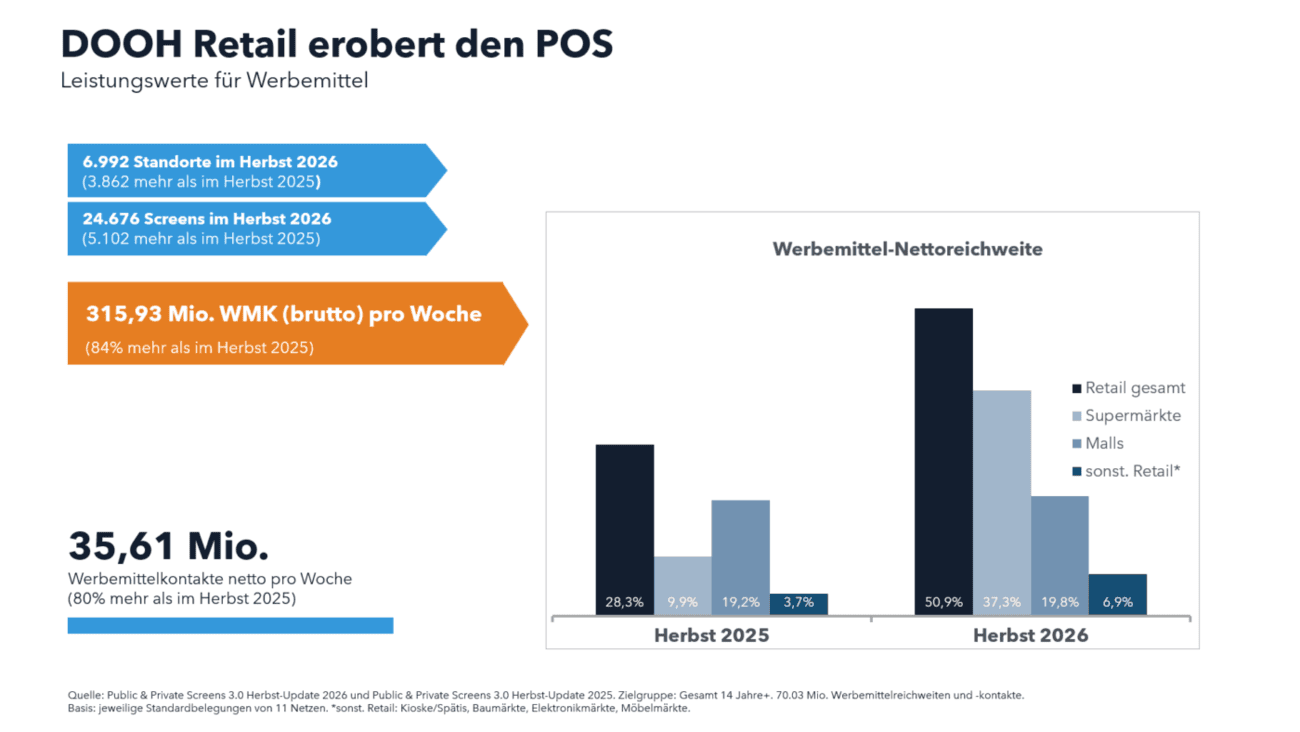
Retail DOOH is growing: The fall update of the market media study «IDOOH Public & Private Screens 3.0» (P&PS 3.0) shows how digital out-of-home advertising is evolving at the physical point of sale. The study is published by the Institute for Digital Out of Home Media (IDOOH) in Munich. Since fall 2025, the number of retail DOOH locations tracked has increased by 120 percent.
More Screens, Greater Reach in Retail DOOH
The number of screens increased by more than 25 percent, from more than 19,500 to nearly 25,000. According to the study, the reach of retail DOOH increased by 80 percent, and the number of ad impressions rose by as much as 84 percent.
The number of retail DOOH advertisers represented has also risen from eight to eleven within a year. New additions include the networks of Kaufland, Ocean Outdoor, and Rewe. Together with the portfolios of Cittadino, eisbach.media, and Ströer, as well as other POS networks in grocery retail, kiosks, late-night stores, and home improvement, electronics, and furniture stores, advertisers and agencies now have a comprehensive portfolio to choose from.
Branding and Engagement All the Way to the Checkout Counter
Digital screens reach consumers in parking lots, at the entrance to a shopping center, inside the mall, or right in the supermarket. According to the announcement, this medium is suitable not only for short-term purchase activation but also for traditional branding campaigns. Brands can showcase their messages on large-format screens and guide shoppers all the way to the checkout.
Frank Goldberg, CEO of IDOOH, says: «Retail DOOH combines the reach and branding power of a mass medium with immediate proximity to the point of purchase.»
Overall, the range is stable
Even beyond the retail sector, the update confirms the effectiveness of Digital Out of Home. Within a week, DOOH reaches 74.1 percent of the German population aged 14 and older with light inventory utilization. With full inventory utilization, approximately ten billion impressions could be delivered per week.
P&PS 3.0 is based on a big-data-driven bottom-up model that uses mobility data from approximately one million smartphones, supplemented by surveys on contacts, duration of stays, and usage patterns. The study is available free of charge in the mediMACH planning tool via the IDOOH website: https://idooh.media/marktforschung/. Anyone already using mediMACH for other studies will automatically be granted access through their existing account.
More information: https://idooh.media/
]]>
How does a successful business idea become a professional and sustainable franchise system? And what does it take to further develop an existing franchise business? These are the questions addressed in the full-day seminar «Franchise 360°—From Concept to Successful Practice» hosted by the Swiss Franchise Association. It will take place on Saturday, October 31, 2026.
Opportunities and Challenges in Franchising
Franchising offers opportunities for companies: successful business models can be replicated, new markets can be tapped, and strong brands can be further developed. At the same time, building a franchise system presents numerous challenges. From developing a compelling concept to positioning the brand and collaborating with franchise partners, there are many factors to consider.
Practice Over Theory at the Swiss Franchise Association
The seminar is aimed at potential and established franchise companies that wish to build, professionalize, or strategically develop their franchise systems. According to the announcement, the focus is not on theoretical concepts, but rather on concrete experiences and practical solutions that can be implemented directly within their own companies.
Participants will gain first-hand expertise and benefit from different perspectives on the topic. The goal is to identify factors for success, examine existing structures, and take away new approaches to apply in their own practice.
Questions about structure and further development
The seminar addresses questions such as: What are the prerequisites for a successful franchise system? How can a concept be built on a sustainable basis? What challenges might arise along the way, and what solutions have proven effective in practice? «Franchise 360°» brings these questions together in a one-day seminar. The focus is on direct benefits: expanding knowledge, sharing experiences, gaining new perspectives, and taking away concrete ideas for your own work.
This program is designed for anyone who wants to use franchising as a growth model or further strengthen their existing system. You can register online: www.franchiseverband.ch/de/angebot/weiterbildung/
]]>
The Basel-based branding and design agency Suan is the new exclusive network partner of the Startup Academy Basel and Baselland in the areas of branding and communication. This formalizes a collaboration whose roots date back to the agency’s early days. The partnership between Suan and the Startup Academy is therefore not a new beginning, but rather the continuation of a relationship that now spans nearly a decade.
From Mentee to Network Partner
Shortly after Suan was founded, the agency itself participated in the Startup Academy’s mentoring program. The program helped the founders structure their fledgling company, clarify business-related issues, and build an initial network. This early connection evolved into a long-standing partnership. Suan co-founder and Managing Partner André Konrad has been volunteering as a mentor for the Startup Academy for many years, guiding founders through strategic and business-related challenges.
«The Startup Academy supported us during a crucial phase in our company’s history. That makes me all the more pleased that we can now give something back and contribute our experience even more to the network in the future,» says André Konrad, managing partner and co-founder of Suan.
Branding Expertise for Startups and Scale-ups
Since August 2026, Suan has been an official network partner of the Startup Academy Basel and Baselland for branding and communications. As part of the partnership, the agency contributes its expertise in brand strategy, positioning, brand design, and communications to the network.
Plans include joint activities and events, as well as consulting services for startups. Companies in the Startup Academy network will, among other things, have the opportunity to schedule a free consulting session with Suan. The partnership builds on Suan’s work with young companies. Especially in the early stages of growth, startups must make key decisions regarding positioning, branding, and communication—often with limited resources and under significant time pressure.

A Dedicated Program for Ambitious Startups
In addition to its network partnership, Suan has developed its own program for ambitious startups and scale-ups. The program is designed for companies that want to strategically build their brand, refine their positioning, or take their existing brand identity to the next level. In doing so, Suan combines its own entrepreneurial experience with its expertise as a branding and design agency to help young companies build a clear and sustainable brand early on.
Suan is an internationally acclaimed branding and design agency based in Basel. The agency develops brands, from strategic positioning and naming to brand design, communication, and digital brand experiences. Its clients include companies, institutions, and organizations from Switzerland and around the world.
Startup Academy is a nonprofit organization that connects startups, scale-ups, and SME entrepreneurs throughout Switzerland with the business community and universities, and supports them in their growth. According to Startup Academy Switzerland, its support program sets it apart in the market.
Contact person at Suan: André Konrad, Managing Partner and Co-Founder
More information about Suan: https://www.suan.ch
]]>
AI in the workplace accelerates the beginning, not the end
Artificial intelligence is rapidly lowering the barriers to producing initial results. However, simply using AI in the workplace does not automatically mean that the work is complete. A study commissioned by Dropbox highlights the gap between where work begins today and the effort required to actually complete it. While AI can generate an answer in seconds, turning that output into a final result often requires moving content between applications, sharing it with colleagues, and preparing it for approval. 84 percent of respondents agree with the statement that AI helps employees create content faster than their organizations’ processes and workflows can keep up with. This highlights a new challenge in digital transformation and an unexpected bottleneck: While AI accelerates the creative process, the real challenge lies in transforming its output into trustworthy, usable, and lasting results.
Content moves through multiple tools and processes
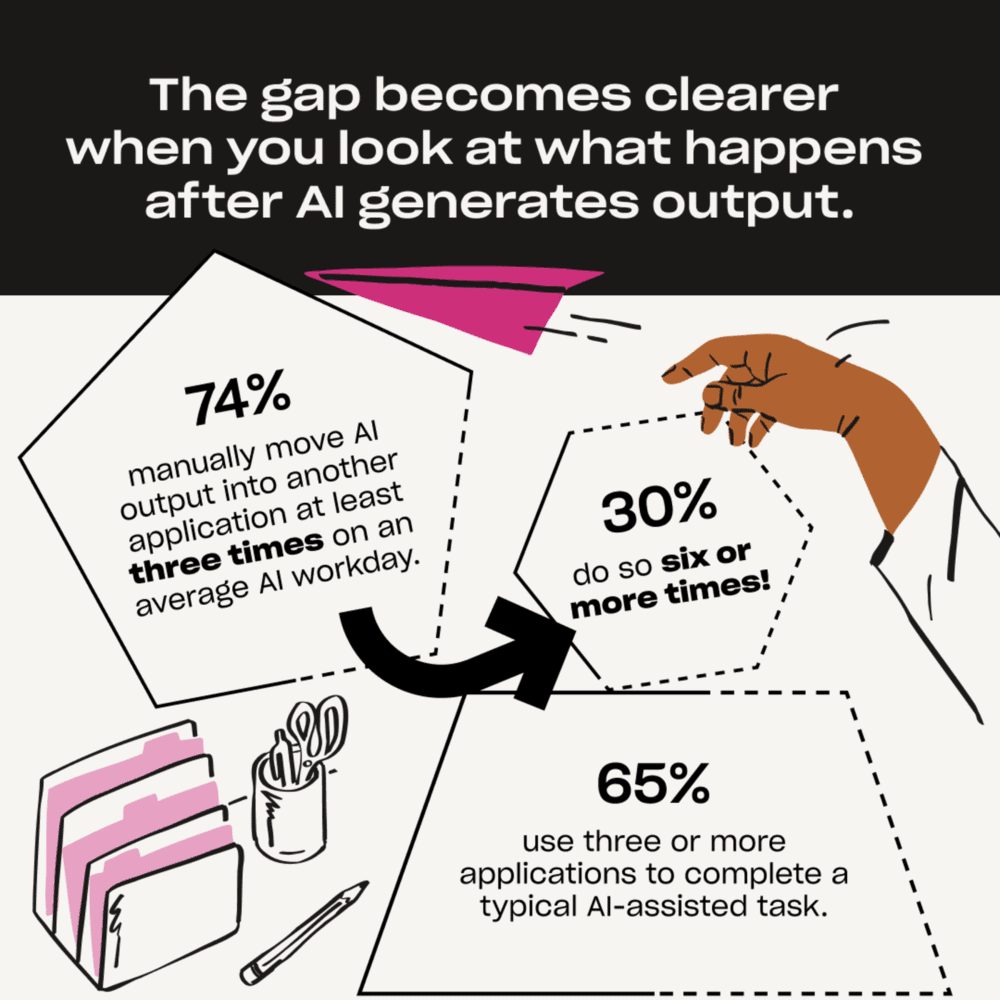
The study’s findings show that there are still numerous manual steps involved between AI-generated results and the finished work. 74 percent of respondents report manually moving AI-generated content between different applications at least three times on an average workday using AI. 30 percent do this as many as six times or more. In addition, 65 percent of respondents use three or more applications to complete a typical AI-assisted task.
More than half of those surveyed (54 percent) now say they use an AI assistant as their primary starting point for new knowledge work. This puts AI ahead of documents, emails, search engines, and project management tools. However, only 11 percent of respondents say that AI already delivers finished work products today without any further hurdles.
Participants cited the accuracy of the results (40 percent), security requirements or company policies (26 percent), as well as additional friction caused by shifting tasks between applications, approval processes, and a lack of business context.

The New «Last Mile» of Work
Generating an initial result is just the beginning. While AI can generate this result in a matter of seconds, the subsequent processing represents the new «last mile» of AI: the journey through information, people, decisions, authorizations, and workflows required to turn it into a trustworthy and usable work product.
AI-generated work is also increasingly becoming part of an organization’s long-term knowledge base. Forty-three percent of respondents report that the majority of their weekly AI-supported work ends up permanently in team documentation or shared knowledge databases.

Content that moves around needs a permanent home
According to Dropbox, to overcome the challenges of this “last mile,” it is not enough to focus solely on content generation. As work shifts between humans and AI, the associated content and contextual information must also transition seamlessly. At the same time, the resulting outputs need a permanent home where teams can further develop and build upon them.
Dropbox aims to support this by linking content and context across various AI applications and providing teams with a single, unified place where they can continue their work. According to the company, usage of Dropbox’s AI partner tools has increased 13-fold over the past four months. The company says this growth indicates that customers are increasingly integrating Dropbox into their AI-powered workflows.

About the study
From July 28 to 30, 2026, Dropbox conducted a survey of 504 U.S. B2B professionals who use AI. The respondents came from various fields, including IT, engineering, sales, marketing, finance, operations, human resources, and customer support.
For more information about the study, visit the official Dropbox blog: https://blog.dropbox.com/topics/company/ai-last-mile-work-study
]]>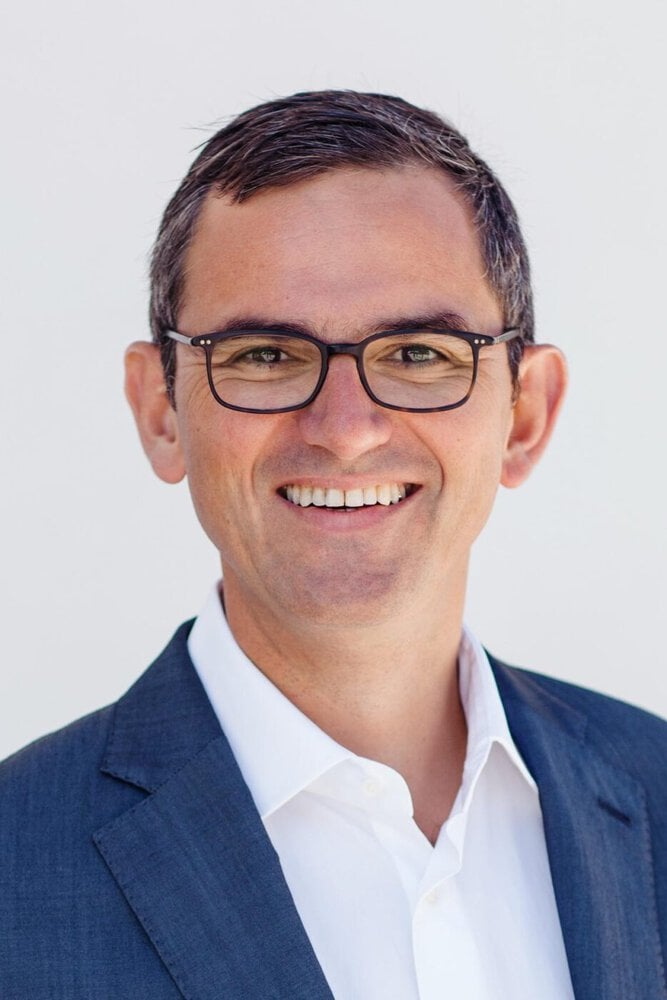
Libri’s management team is undergoing a reshuffle: Libri has appointed Hans-Peter Kübler as spokesperson for the management board. Effective October 1, he will serve as co-CEO of Libri GmbH alongside Ulrich Vollmer. Alyna Wnukowsky is stepping down from the management board after more than four years for personal reasons.
The Return of a Familiar Face
Hans-Peter Kübler is well known at Libri and throughout the book industry. He previously worked for Libri from 2011 to 2016. In the years that followed, the business graduate remained closely connected to the industry, serving, among other roles, as managing director of Taschen GmbH (2018–2022) and the Holtzbrinck subsidiary HGV (2023–2024). Since late 2024, Hans-Peter Kübler has served on the board of Sunseeker Intelligent Technology SE and has established the European subsidiary for the Chinese manufacturer of robotics products.
He is now returning to Libri, bringing with him extensive operational experience across the entire book value chain. He has extensive experience in transformation and is regarded as an expert in publishing and retail. According to the press release, Hans-Peter Kübler brings a comprehensive perspective on the book industry and will consistently continue the course set by Alyna Wnukowsky.
«I’m very familiar with Libri from my previous work. That makes me all the more pleased to be returning now and to contribute the experience I’ve gained in the various areas of my professional career,» says Hans-Peter Kübler. «Like almost no other company, Libri plays a key role in maintaining the industry’s competitiveness and diversity in the market.»
Hans-Peter Kübler will be responsible for Sales, Customer Service, Marketing, Purchasing, and IT going forward. Ulrich Vollmer will continue to oversee print-on-demand production and the logistics facility in Bad Hersfeld, as well as the administrative functions in Hamburg.
Assessment of Libri’s Management to Date
Under the leadership of Alyna Wnukowsky, Libri further expanded its position as a leading book wholesaler in Germany and Europe, according to the company. During her tenure, the company fully integrated its wholesale and print-on-demand operations, expanded its international business, and strengthened national and international strategic partnerships. Today, according to the company, Libri offers publishers, authors, bookstores, and readers a unique range of services: more than five million German and international book titles that are produced and delivered overnight.
As spokesperson for Libri’s management team, Alyna Wnukowsky was a strong advocate for the entire industry. As part of her work and as a member of the Executive Board of the German Publishers and Booksellers Association, she was particularly committed to the establishment and acquisition of owner-operated bookstores, as well as to the promotion of reading.
Contact at Libri: Hans-Peter Kübler, Spokesperson for the Executive Board; Ulrich Vollmer, Managing Director; Alyna Wnukowsky, outgoing Spokesperson for the Executive Board
]]>
The Basel-based agency kreisvier is expanding its management team: David Lübke joined as a new member at the beginning of August and will assume the role of Chief Creative Officer (CCO). At the same time, Sandro Looser, who has been with the agency for two years, will be promoted to Chief Operating Officer (COO) effective in September. Together with CEO Alexandra Vatansever, the two will form a new leadership trio in Basel’s Gundeli district.
David Lübke as Chief Creative Officer
Lübke has already achieved measurable results in a short period of time—both in terms of daily creative output and in attracting new clients. CEO Alexandra Vatansever comments: «Dave has already made a big difference in his short time with us. We see this not only in our daily output but also in the new clients we’ve acquired during his tenure.»
Sandro Looser Assumes Expanded Responsibilities as COO
At the same time, Sandro Looser’s role is growing. According to the agency, his many years of industry experience and strong network have significantly driven the agency forward. Vatansever adds: «With Sandro, we’ve had someone on board for two years now whose many years of industry experience and strong network have significantly driven the agency forward. We hope to benefit even more from all of this in the future.» According to the press release, both Lübke and Looser have settled in wonderfully in Rheinstadt.
Continuing Together on the Path of Applied Creativity
The newly formed trio intends to steadfastly continue on the agency’s current course. Kreisvier employs about 50 specialists in the fields of consulting, strategy, creative, production, and technology. According to the agency, the goal is communication that works and sticks.
]]>
Why do some brand and product names come across as high-quality, trustworthy, or dynamic—even before we’ve even encountered the product? The impact of brand names begins in a matter of milliseconds, long before we consciously engage with a product. Zutt & Partner, a neuromarketing consulting firm based in Bubikon, has explored precisely this question using its EmoCheck Phonetics method.
Sound Structure as an Emotional Messenger
The study examines the emotional effects that various brand and product names evoke based solely on their sound structure. The focus is on well-known beverage brands such as Coca-Cola, Sprite, Fanta, Rivella, and Sinalco. The results are expected to show that the sound of a name evokes emotional expectations even before consumers are familiar with the product or consciously perceive it.
According to Zutt & Partner, Coca-Cola’s sound structure primarily conveys a sense of high quality. Sprite, on the other hand, stands for energy and refreshment, while Fanta is perceived as friendly. Sinalco combines several emotional qualities at once—a distinctive feature that, according to the study, gives the name a multi-layered sound.
The Impact of Brand Names—Measurable and Controllable
The underlying EmoCheck Phonetics methodology analyzes emotional reactions to the sound of names—an approach that is gaining relevance in the branding and communications industry. After all, if a name triggers emotions solely through its sound, this has direct implications for naming processes in the development of new brands and products.
The full study, all charts, and a detailed press release providing background information on the emotional impact of brand and product names, the methodology, and EmoCheck Phonetics are available in the press kit, which can be accessed via the Zutt & Partner website.
For more information about the study and the EmoCheck Phonetics method: https://www.zutt.ch
]]>
It is one of the most consistent recommendations in management literature: Marketers must learn «the language of finance» in order to be taken seriously within the company. Anyone who wants to justify budgets must be able to think in terms of ROI, EBITDA, and contribution margins. Anyone who wants a seat at the strategy table must understand the CFO’s logic. Financial literacy is said to be the key to marketing’s relevance in corporate management.
At first glance, it’s hard to argue with that. In fact, many marketing departments lack a solid understanding of financial concepts. Brand budgets are defended by citing «awareness» and «consideration,» without being able to quantify their contribution to value creation. In such an environment, the call for financial expertise is understandable. But upon closer inspection, it becomes clear that this demand obscures a fundamental problem: it assumes that the language of finance is the «correct» language of corporate management—and that marketing must subordinate itself to it.
An Asymmetric Obligation to Deliver
The call for financial literacy implies a one-sided effort to adapt. Marketing is expected to align itself with the financial function’s way of thinking and language—not the other way around. This tacitly accepts a hierarchy in which Finance sets the standard and Marketing, at best, «supplies» it.
This asymmetry is problematic for several reasons. First, it reduces the complexity of market-oriented decisions to financial metrics. Not everything that is relevant to long-term market success can be meaningfully reflected in a quarterly P&L. The impact of brand positioning, the depth of a customer relationship, and creative differentiation from the competition—all of these factors are, to some extent, beyond the scope of purely financial logic. Second, this asymmetrical accountability reinforces an already existing power imbalance: In many companies, the CFO effectively has a veto over marketing investments—often without a substantial understanding of how brand-building, customer experience, or creative campaign development work. Third, this one-sided alignment undermines marketing’s ability to make its own case. A CMO who forces their actions into the logic of the DCF model may win the budget battle, but loses the ability to lead the company with genuinely market-oriented initiatives. «Translating» into financial language is then not a bridge, but a capitulation.
The counterquestion is asked surprisingly rarely: Why don’t CFOs learn the «language of marketing»? Empirical research shows that the presence of a CMO on the executive team significantly improves corporate performance (Germann/Ebbes/Grewal, 2015). Nevertheless, the percentage of Fortune 500 companies with a CMO fell from 71 percent (2023) to 66 percent (2024). A CFO who does not understand the mechanisms of brand building and customer loyalty focuses on metrics they can measure and neglects those they do not understand. That is not rationality—it is a blind spot.
How ERP Systems Have Cemented Financial Logic
The asymmetry between the CMO and the CFO is not merely an organizational phenomenon; it also has a systemic cause. For decades, companies have consistently aligned their go-to-market model with the CFO as the central decision-maker. The value proposition of ERP systems—transparency, control, and measurability—speaks precisely the language of the CFO. Whatever can be mapped in the ERP system is considered «real.» What cannot be represented—brand perception, emotional customer loyalty, creative differentiation—is considered «soft» and, when in doubt, dispensable.
The shareholder value doctrine and the «financialization» of corporate management have deeper roots, but ERP systems have cemented this development at the operational level—they have translated financial logic from the boardroom into day-to-day work practices. When SAP dissolved its own marketing function at the executive board level in the summer of 2024, this was also a signal: in a company whose business model is built on the dominance of financial logic, marketing as a separate executive board function is apparently dispensable. «The irony is obvious,» writes Schögel.
How the Logic of Management Systems Has Cemented the CFO's Dominance
This asymmetry is not purely an organizational phenomenon. It also has a systemic cause. For decades, companies like SAP have consistently aligned their go-to-market model with the CFO as the central decision-maker in the buying center—in line with the classic model by Webster and Wind (1972). The value proposition of ERP systems—transparency, control, measurability, «single source of truth»—speaks precisely to the CFO’s language. What can be mapped in the ERP system is considered «real.» What cannot be mapped—brand perception, emotional customer loyalty, creative differentiation—is considered «soft» and, when in doubt, dispensable (see Davenport, 1998).
The shareholder value doctrine (Rappaport, 1986) and the «financialization» of corporate management (see Lazonick/O’Sullivan, 2000) have deeper roots. However, ERP systems have cemented this development at the operational level—they have translated financial logic from the boardroom into day-to-day work practices, thereby making it the «default language» of corporate management. When SAP dissolved its own marketing function at the executive board level in the summer of 2024 (SAP, 2024), this also sent a signal: In a company whose business model is built on the dominance of financial logic, marketing as a standalone executive board function is apparently dispensable. The irony is obvious.
Earn first, then count
What would be the alternative? The real question should be: How can the CFO and CMO find a common language that serves the company? In every corporate value chain, money must first be earned before it can be counted, allocated, or optimized. At its core, the finance function operates based on the results of upstream value creation. Without revenue, there is no cash flow. Without customer value, there is no corporate value. Without a market, there is no balance sheet worth reading.
Peter Drucker clearly articulated the starting point: «There is only one valid definition of business purpose: to create a customer» (Drucker, 1954, p. 37). From this—in the spirit of a reality-oriented management theory (Ulrich/Krieg, 1972; Tomczak, 1991)—a simple conceptual framework can be derived: create customer value, monetize customer value, manage financial results. The sequence is not hierarchical but causal. Each stage depends on the one that precedes it. Anyone who starts with financial optimization without having a solid grasp of the preceding stages is optimizing in a vacuum. Those who stop at customer value without financial discipline create value that the company cannot realize. The organization needs «both hands»—one that thinks in financial terms, and one that reads markets and anticipates customer needs. In the spirit of organizational ambidexterity (O’Reilly/Tushman, 2004), the key lies in integration, not in subordinating one perspective to the other.
Hilti demonstrates what this means in practice. With its fleet management model, the Liechtenstein-based company—controlled by a foundation—has undergone a transformation that is exemplified by this sequence (see Casadesus-Masanell/Gassmann/Sauer, 2017). The starting point was a consistently market-oriented insight: Professional users don’t need a drill—they need the assurance that the right tool will be available and in working order at all times. CEO Christoph Loos drove the transformation forward over the course of fifteen years. The central challenge lay in sales: Fleet management required fundamentally different capabilities than traditional equipment sales—a consultation-intensive sales process at the executive level rather than demonstrations of individual premium tools on the construction site. A CFO who had assessed this sequence purely from a financial perspective—short-term decline in revenue due to a model change, high upfront investments—would likely have halted it.
Marketing Is a Top Priority
The value creation sequence does not establish itself on its own. It takes someone to drive this integrative framework forward in terms of content. CEOs who consistently place marketing at the center of their growth strategy are twice as likely to achieve above-average revenue growth (Brodherson et al., 2024). A CEO who takes Drucker’s ideas seriously approaches the dialogue between the CMO and CFO differently: not «Justify your budgets to me,» but «Show me how we, as a company, create customer value—and how we ensure that we do so sustainably.» The CEO’s functional background plays a role here, but it is not the determining factor. A CEO with a finance background must actively develop a market perspective; a CEO with a marketing background must ensure that financial discipline does not become a burdensome side issue. What matters most is that the CEO leads the way in terms of substance—otherwise, the stronger function will dominate the agenda, and in most companies, that is the finance function.
Emanuel Probst, who led Jura Elektroapparate as owner and CEO for over three decades, exemplified this very principle. His credo: «Marketing philosophy and product innovation are a top priority» (Probst, quoted in Handelszeitung, 2015). The strategic focus on fully automatic coffee machines—and thus the decision to move away from the broad product range of the past—was a decision of enormous significance that could only be made by a CEO who understood both market dynamics and the business implications. The partnership with Roger Federer, which positioned Jura as a premium brand internationally, was not a marketing gimmick but rather an expression of a strategic mindset: the brand as a key value driver, not as a cost center.
It is hardly a coincidence that both Jura, as an owner-managed company, and Hilti, as a foundation-controlled corporation, have been able to implement this form of long-term, market-oriented management. Both ownership structures reduce the pressure of quarterly-driven financial markets and create the space needed for a strategy consistently focused on customer value (see Thomsen/Pedersen, 2000). Where the CFO must primarily serve the capital market, this asymmetry is exacerbated not only by ingrained ways of thinking but also by institutional pressure.
No More One-Sided Translation
The question isn’t whether the CMO will finally develop financial literacy. The question is whether the CFO will finally develop market literacy. And whether the CEO is willing to bring both of them to the table—not to negotiate budgets, but to talk «business» together. The conceptual foundations for integrated performance metrics—customer lifetime value, brand equity (Keller, 1993), and return on marketing (Rust/Zeithaml/Lemon, 2004)—have long been in place. What’s missing isn’t the toolkit, but the willingness to treat both perspectives as equal. The asymmetry between the CFO and the CMO is no coincidence—it is the result of organizational power dynamics, decades of technological influence by management systems, and a sales-oriented logic that has made the CFO the central decision-maker. Anyone who wants to overcome this asymmetry must not only change the language but also raise awareness that the supposed «objectivity» of the numbers is not a neutral truth, but rather a construct with its own history.
After all, it all comes down to a simple equation: Finance × Marketing = sustainable business success. And if one of these two factors is zero, even the greatest expertise in the other area won’t help much.
]]>

What would America be without its immigrants? Economically, probably still cowboy and farmer country, culturally similarly dusty. The land of seemingly unlimited possibilities has always liked to adorn itself with the names of former foreigners, as if they were the sole creatures of the American way of life. For example, there is Henry A. Kissinger (= Heinz Alfred Kissinger), the first U.S. Secretary of State with a Franconian accent; Levi Strauss (= Löb Strauss), who dressed buttocks in blue all over the world;
Henry E. Steinway (= Heinrich Engelhard Steinweg), who elicits heavenly sounds from wood and cast iron; rocket engineer Wernher von Braun; language school founder Maximilian Delphinius Berlitz (= David Berlizheimer), psychoanalyst Erich Fromm or Wilhelm Böing, the father of aircraft engineer William Edward Boeing. All Americans, right? What does nationality have to do with ability?
D'accord, even for the Germans Wolfgang Amadeus Mozart is mostly a German, while Adolf Hitler may remain an Austrian. And with regard to the U.S., it has so far seemed more endearing than mendacious that anyone who makes a difference and has set foot on American soil at some point automatically becomes an American. People like to boast about the country's successful sons and daughters.
In the USA, it is now "the millionaire against the dishwasher".
But suddenly everything is different: In the USA, it is no longer "from dishwasher to millionaire" but "the millionaire against the dishwasher". While large parts of the population protest and it doesn't help them at all, the world holds its breath in shock and the American economy runs for cover, at least advertising reacts - at least if you are receptive to clear but well-packaged messages.
The Budweiser brewery has already posted the full-length commercial it will show at the Super Bowl finals on the Internet (Bit.ly/2knCvmh). It chronicles the journey to America of Adolphus Busch, a young German with an unshakable dream of brewing beer who eventually founds the Anheuser-Busch brewery with Eberhard Anheuser, also a U.S. immigrant. "You dont look like you're from around here, go back home," Busch has to be told as he struggles through rain, mud and fire toward his dream. Busch counters all this with just one sentence: "I want to brew a beer." Message from Budweiser: "When nothing stops your dream, this is the beer we drink."
On the one hand, Budweiser's film is a very American commercial, quoting the dishwasher's millionaire dream. But it's just as much a stretched left in the direction of the country's new most powerful man, who doesn't keep quiet about his opinion of immigrants, denying them their right to exist while the world looks on. True, xenophobia and prejudice couldn't stop Adolphus Busch in 1857 - but what would Busch's path look like in 2017? That's the unspoken question that resonates in the spot, making it an important piece of politics.
At the Tagi meeting on January 31, Philipp Hildebrand called on representatives of academia, the media, politics and the money industry to tell the truth, so that "post-factuals" and "alternative facts" - the new American way of living - don't overshadow everything. Yes, the truth. Hasn't it been self-evident to all of us until now? And yet there are people in the highest decision-making positions in the world who spread lies and yet retain their power. How can and may this be? While we try to work through these questions intellectually, the lies continue, ruining dreams, opportunities, lives.
High time for each of us to open our eyes and mouths and - in true American fashion - firmly believe that this will do some good. A spiteful tweet from Mr. Stormy's haircut commenting on the Budweiser commercial has yet to be delivered. Perhaps a good start.
Anne-Friederike Heinrich, Editor-in-Chief

When Werbewoche now goes on summer break for just under a month, it is both a farewell and a new beginning: We are saying goodbye to Werbewoche as it has been until now; to the somewhat unwieldy large format, to the newspaper look and to typography that is no longer quite modern. We are saying goodbye to an Internet presence that had become old-fashioned, that was not responsive, and that hid much of what Werbewoche offers its readers. And we're saying goodbye to outdated print-online thinking: in the future, the content, you and your "license to read" will decide on which channel and in which facets you encounter a story.
The new era of our 43-year-old trade magazine begins on August 19: From that day on, you will receive even more Werbewoche quality in the form of high-level background reporting, easy-to-use advice articles, critical commentaries and witty statements online, mobile, via newsletter and in print - depending on which "license to read" you have chosen. We have supplemented the proven bouquet of industry-moving topics and exciting opinions with fresh blossoms: new vessels and reporting forms, new minds and voices.
Our new entertainment and information program is supported by a fresh, modern layout that is easy to use, tempts you to browse and is simply fun to read.
When it comes to goodbyes and new beginnings, there is usually talk of the famous "crying and laughing eye. Not so with us: Nothing is crying in the editorial and publishing departments - everything is laughing and looking forward to the newly designed Werbewoche, which has been polished to a high gloss and still has a good grip. As a farewell, here's a little review of the past:

The Werbewoche industry report will continue to appear in the form that has now been tried and tested four times. After the issues Marketing, Digital, Advertising and Content Marketing, in the second half of the year we will offer you the Industry Report Direct and our Industry Review at the end of the year. Since the beginning of the year, these special issues of Werbewoche have already borne the face that Werbewoche will have from August. So attentive readers have already had a chance to get used to the new look and feel.
Advertising Week Summer Photo Challenge
Until the hotly anticipated day when the new Advertising Week comes to life on all channels, you can pass the time with the Advertising Week Summer Photo Challenge. Are you squatting alone in the office, agency or newsroom while everyone else is wallowing in the southern sands (crowded beaches!!) or climbing the farthest mountains (summer avalanches!!)? Then at least you should have a little fun: So, snap a photo, create a postcard from it with the PostCard Creator app and send it to the Werbewoche editorial team (see below for details). You can do this on your own, or together with the other scatterbrains still hanging out behind their desks. Either way, great prizes and a bit of fame await you! The deadline for entries is August 5. So don't delay too long with your desk selfie.
Anne-Friederike Heinrich, Editor in Chief
[email protected]
Advertising Week Summer Photo Challenge - join in, have fun and win!
Everyone but you has gone on vacation? What are you doing alone at the agency? Send us an original, surprising photo of you at work (or doing what you do instead) and show us how you survive the summer days alone in the office, agency or newsroom. Not quite alone at work? Better yet, send us an original snapshot of your summer together.

And this is how it works:
Use the PostCard Creator app for iPhone and Android to design a postcard with your picture, enter "WWSFC" in the text field, address it to "Werbewoche, Redaktion, Postfach 1753, 8031 Zürich", enter the return address and send it.
Tip: Enter "Advertising Week" in the First Name field and "Editorial" in the Name field.
The Werbewoche editorial team will select the funniest postcards from all the entries. The winners will be presented in Werbewoche 13/2016, which will be published on August 19, and will be posted with all the entries as a gallery on Werbewoche.ch.
This is what you can win:
1st prize: Advertising Week advertising credit of 1000 francs
2nd prize: 500 franc credit for a postcard mailing about the
Web application Postcardcreator.post.ch
3rd prize: An advertising week annual license to read the new advertising week from August 19, worth 295 Swiss francs.
Conditions of participation: Entries received between 18.7. and 5.8.2016 will be considered. Any person residing in Switzerland is eligible to participate. Employees of Somedia are excluded from the competition. No cash payment. The legal process is excluded. No correspondence will be entered into regarding the competition. Closing date: August 5, 2016 (stt/afh)

Advertising in independent publications and the (supposed) resulting demands on (independent) reporting - this has become an ongoing issue in Switzerland. As a reminder: If the Baz doesn't write nicely about the SVP and UBS, Blocher and Bank no longer place ads, even though these are vital for the paper's survival. And publisher and editor-in-chief Markus Somm is even understanding about it.
Now the issue is reaching the next stage of its evolution. Once again, the U.S. shows the direction in which the debate is heading. Since the topic is no longer negotiated only by editors-in-chief and publishing directors, but has reached the readers, it has the potential for more: First, the wrestling between media and advertising companies or parties has a high entertainment value, at least for those who are not financially involved in the conflict. And secondly, the media can now create a new profile for themselves through their dealings with advertisers: Do they accept any form of advertising, as long as it brings in money? Do they take a stand against anything that is ugly, foul-mouthed, sexist, tendentious, too left-wing or too right-wing? (Is it even possible to advertise at all then?) Or do they hold out their hand for all advertising formats, but try to hide the advertising measures from their readers as well as possible, key words being content marketing and native advertising? Increasingly, a company's profile no longer arises only from what it does, but especially from what it doesn't do.
A bit of smear theater from America, with the currently universally popular and completely unelectable presidential candidate Donald Trump as the leading actor: The American Internet portal Buzzfeed has just terminated a lucrative advertising contract with Trump's Republican Party in protest against the "politics" of Donald Trump. "Buzzfeed cannot publish ads for Trump's presidential candidacy because Trump is violating the civil liberties of our employees in the U.S. and around the world," said company CEO Jonah Peretti. As an example, Peretti cited Trump's proposed ban on Muslims entering the U.S., which would make it impossible for Buzzfeed employees to do their jobs. "Buzzfeed doesn't like to give up advertising revenue, which we depend on," Peretti stressed. But there are limits, he said: "We don't advertise cigarettes because they harm our well-being, and for the same reason we don't advertise Trump."
What a statement! And what an advertisement for Buzzfeed. The sympathy flash triggered by the termination was surely thought of by Peretti in his anti-reps campaign. Why else would he use Twitter to spread the news that he had canceled the advertising deal? I wouldn't be surprised if Buzzfeed were now inundated with a flood of ads and banners from all the companies and service providers who are for Hillary Clinton - or at least against Donald Trump.
This replacement advertising should casually fill the hole that the lost Republican advertising budget has torn into Buzzfeed's coffers. Although the portal did not want to give any details about its revenue losses due to the cancellation, the competitor website Politico estimated them at 1.3 million dollars (about 1.2 million Swiss francs). And even if new advertisers fail to materialize: Judging by the great media response and the many new readers Buzzfeed has gained through its Reps offensive, Peretti's clear course has already paid off. This is another way to campaign - and attract readers - at least in the US.
How many Swiss hearts would have flown to the Baz if Markus Somm had clearly opposed the SVP's course? Alone, we are not in the USA, but in Switzerland. And perhaps we would not have attested to Somm's clear line and backbone if he had given the SVP a thumbs-down, but to inadmissible partisanship for a media maker. On top of that, Somm is regarded as Christoph Blocher's mouthpiece; he has written a biography about the SVP chieftain and would probably have had a hard time authentically selling the headwinds arising in Basel. On the other hand, the attempt to show a line might have been worthwhile. After all, with Somm at the helm, the Basler Zeitung experienced the biggest drop in readership in its history. And Somm has already made many a change in his life, why not this one?
Well, further on in the American smear theater: The Republicans are said to have reacted calmly to Buzzfeed's decision, as reported by Handelsblatt. A party spokesman in Washington had said that advertising space had been reserved on Buzzfeed, but that there had been no plans to actually place ads anyway.
That would also be a strategy for the Baz, Mr. Somm: Why don't you just say, when UBS and SVP cut their budgets, "we wouldn't have printed your ads anyway! Bätsch!" That would even be good for reader advertising.
Anne-Friederike Heinrich, Editor in Chief
[email protected]