
The Winterthur "Stadi" kicked things off last September with a new layout. Now the other free weekly newspapers of Zürcher Oberland Medien have followed suit at the start of 2017: Regio, which has been published in five split editions in the Zurich Oberland since 2008, has adopted the layout previously introduced in the Winterthur area. And the Glattaler/Volketswiler, which was previously published in a large newspaper format, is now also produced as a handy tabloid.
Divided into two titles
The weekly newspaper, which serves as the official publication organ in four municipalities, has been split into two independent titles: The people of Dübendorf, Schwerzenbach and Fälland will receive the "Glattaler", while the people of Volketswil will receive their own "Volketswiler". Despite this division, however, some of the content will continue to be exchanged so that everyone can find out the most important information from the neighboring communities.
What will not change is the high quality of the content. The six-strong editorial team in Dübendorf, which is responsible for both newspapers, will prepare all the local news week after week and provide background information and analysis. The social, political, economic, cultural and sporting life of the four municipalities will continue to be the focus. The new appearance also includes a completely revised layout. As with the "Stadi", this was created by the Zurich agency "Die Werbekanzlei" under the direction of Winterthur creative director Turan Oeznalci.
New weekly newspaper combination
The format changeover of all weekly titles now also allows joint marketing. The "Züriost Print" advertising combination has been created. Advertisers can not only place ads in individual titles, but have been able to spread their ads or inserts across the entire "free newspaper family" and benefit from discounts since the beginning of 2017. This standardization makes it technically very easy for advertisers to combine advertisements (same type area) and, above all, special formats on the front pages and collective pages (adaptation of the advertising modules for all weekly newspapers).
With the new advertising combination of the weekly newspapers "Stadi", "Glattaler", "Volketswiler" and "Regio", the entire axis from the city of Winterthur via Dübendorf, Volketswil, Uster, Wetzikon to Rüti and Wald can be covered. The advertising messages reach around 164,000 households and 174,000 readers in the distribution area.
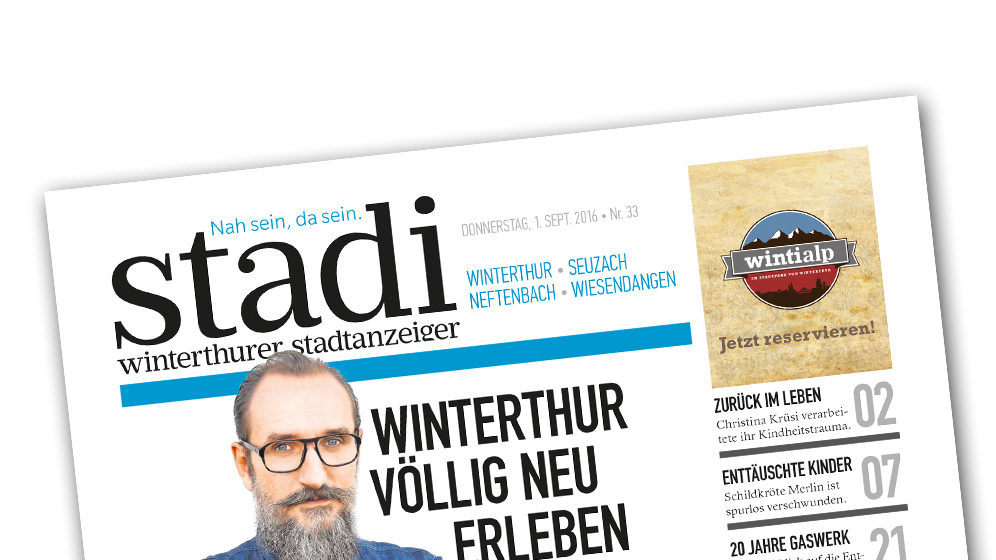
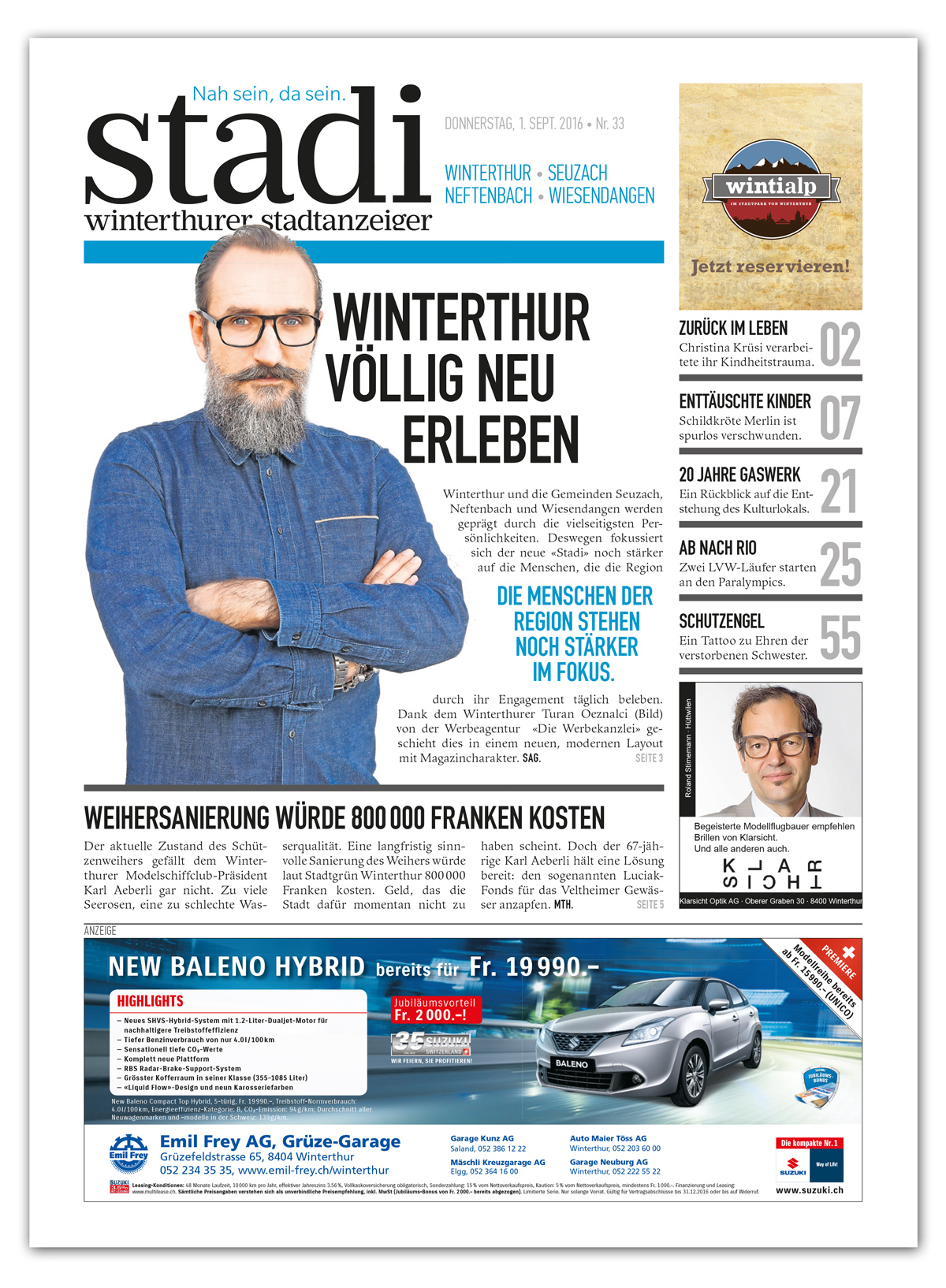
On September 1, the "Stadi" was published in a new format for the first time. The publication day is also new: in future, the traditional weekly newspaper will now be distributed free of charge to 50,000 households in the city of Winterthur and the municipalities of Seuzach, Neftenbach and Wiesendangen on Thursdays instead of Tuesdays. The Winterthurer Stadtanzeiger is reflecting on its name and in future will focus its content on what is happening in the city. The name thus becomes the program. However, three municipalities bordering Winterthur to the north will also be included. Compared to the current larger distribution area with the entire district of Winterthur and parts of the district of Andelfingen, this concentration will make it possible to report even more intensively than before on life in the city and the three core municipalities.
Being close with the "Stadi"
If readers have already been talking about the "Stadi", this name will now also be emblazoned on the title of the weekly newspaper. Those responsible at Zürcher Oberland Medien, to which the "Winterthurer Stadtanzeiger" has belonged since last year, are convinced by this move. The proximity to the readership, on which the "Stadi" has long relied, is thus further emphasized. This is also reflected in the slogan "Be close, be there".
Handy format
The most obvious and "tangible" change will be the format change. From September, the "Stadtanzeiger" will be published in a handy tabloid format instead of the current newspaper format. Instead of two newspaper bundles as before, everything will then appear compactly in one. Week after week, the "Stadi" will report on social, cultural, political and sporting events on more than 30 pages. It is also an important platform for presenting the range of products and services offered by businesses and major distributors. The new appearance also includes a completely revised layout. This includes a striking title font, a generous use of images, stronger design elements and, finally, clear visual guidance thanks to simple structures. The idea for the new layout was realized by "Die Werbekanzlei", under the direction of Winterthur creative director Turan Oeznalci.
"Stadi" on Züriost
Anyone who does not live in the new core area but would still like to receive the "Stadi" in their letterbox in future can subscribe to the newspaper for CHF 149. Above all, however, the "Stadi" will also be available to everyone online as a free e-paper in future. From September, the digital "Stadi" will not only be available every Thursday on the zü- riost.ch platform. Every day, the latest news from the districts of Winterthur and Andelfingen can also be found on the Züriost platform.
Christian Saggese takes over "Stadi" management
On September 1, the Winterthur City Gazette not only changed its look. There is also a change at the top of the editorial team. Lucia M. Eppmann will hand over the reins to her deputy Christian Saggese. Lucia M. Eppmann, who moved from the Landbote to the Stadtanzeiger in 2008 and completely redesigned and shaped the paper over the last few years, is moving to the "Tagblatt der Stadt Zürich", the city's official gazette, as managing editor-in-chief.
Christian Saggese has been working at the "Stadi" since 2010. The 33-year-old began his journalistic career at Schaffhauser Bock, where he worked as deputy editor-in-chief before moving to Winterthur. As head of the "Stadi" editorial team, Christian Saggese, who has lived in Winterthur for six years, will lead a team of five.
The editorial and publishing offices of the Stadtanzeiger will remain at Bahnhofplatz 18 in Winterthur. In addition to the editorial team, the "Stadi" team also includes a four-person sales team under the advertising management of Guido Helbling.