
The traditional advertising market closed the first quarter of 2026 with a total of CHF 865.2 million and a slight increase of 0.6%. This is due to the strong figures in January and February. Although March generated the highest gross advertising expenditure of the year to date at CHF 334.8 million, as expected, this corresponds to a slight reduction of 2.0% compared to the previous year.
Out-of-Home grows significantly, cinema slumps
Out-of-Home continues to perform strongly with significant growth of 24.1%, driven in part by Migros image campaigns. By contrast, the other traditional media categories are all in decline. Cinema was hit hardest with a fall of 54.9%, followed by print with a fall of 10.1%, then TV with a fall of 8.4% and radio with a fall of 1.5%.
Digital market dominated by search
In the digital market, gross advertising expenditure amounted to CHF 189.4 million in March. This shows a channel-driven media mix: search continues to dominate with a share of 63.5%, followed by display with 27.7% and YouTube with 8.9%.
Nine sectors with positive development
Overall, nine sectors recorded a positive development. The energy sector recorded the strongest percentage increase at 39.1%, largely driven by campaigns for Axpo Energy Image, but remains in second-last place in the ranking. Beverages also performed strongly with 35.2 percent, personal needs with 24.2 percent and vehicles with 22.5 percent. Leisure, gastronomy, tourism is in third place with a moderate increase of 3.4%.
Twelve sectors reduce advertising pressure
In contrast, twelve sectors reduced their advertising pressure compared to the previous year. The most significant percentage decline was seen in the tobacco industry with a drop of 72.2% - after the strongest increase in the previous month. The media and fashion & sport sectors also fell sharply by 31.3% and 31.1% respectively.
Despite the downward trend, the retail trade (minus 3.1%) and food (minus 3.6%) are still among the sectors with the highest advertising pressure. The service sector and cosmetics & personal care also saw a double-digit reduction in advertising pressure, falling by 14.8% and 18.0% respectively. Finance with minus 3.9%, pharma & health with minus 3.2% and telecommunications with minus 3.7%, on the other hand, only recorded slight declines.
Comparison of different industry rankings
In March, retail led the traditional market, followed by the food industry and leisure, gastronomy and tourism. The latter took first place in the digital market, ahead of the finance and services sectors. In the traditional ranking, however, these two are only in fifth and ninth place, while retail and food fall back to fourth and twelfth place respectively in the digital ranking.
The Fashion & Sports and Pharmaceuticals & Healthcare sectors are positioned in the midfield in both markets. The tobacco, energy, media and cleaning sectors are in the bottom third in both markets. Telecommunications ranks fifth in the digital market, while it is only ranked 13th in the traditional market. The opposite is true for initiatives & campaigns: Here, the sector is ranked seventh in the traditional market, but falls back to position 14 in the digital ranking.
Channel-driven image in the digital advertising market
A clearly channel-driven picture emerged in the digital advertising market in March: While search continues to be strongly performance and travel-oriented, display and YouTube are dominated by a more diverse mix of different offerings.
As in the previous month, Spusu.ch leads the ranking in the Display segment, followed by Outdoor Chef gas grill and Coffee B coffee balls. In Search, travel provider Booking.com has been at the top since the beginning of the year, ahead of Yallo.ch and Opodo.ch. On YouTube, food manufacturer Knorr is in first place with Knorr Bouillion, having been in third place in the previous month. It is followed by Digitec.ch and Axa Private Vorsorge.
Neither a product nor a service is represented in the top positions in several channels at the same time. However, the global insurance company Axa is ranked fourth on Search with Axa.ch and third on YouTube with the Axa Private Pension product.
]]>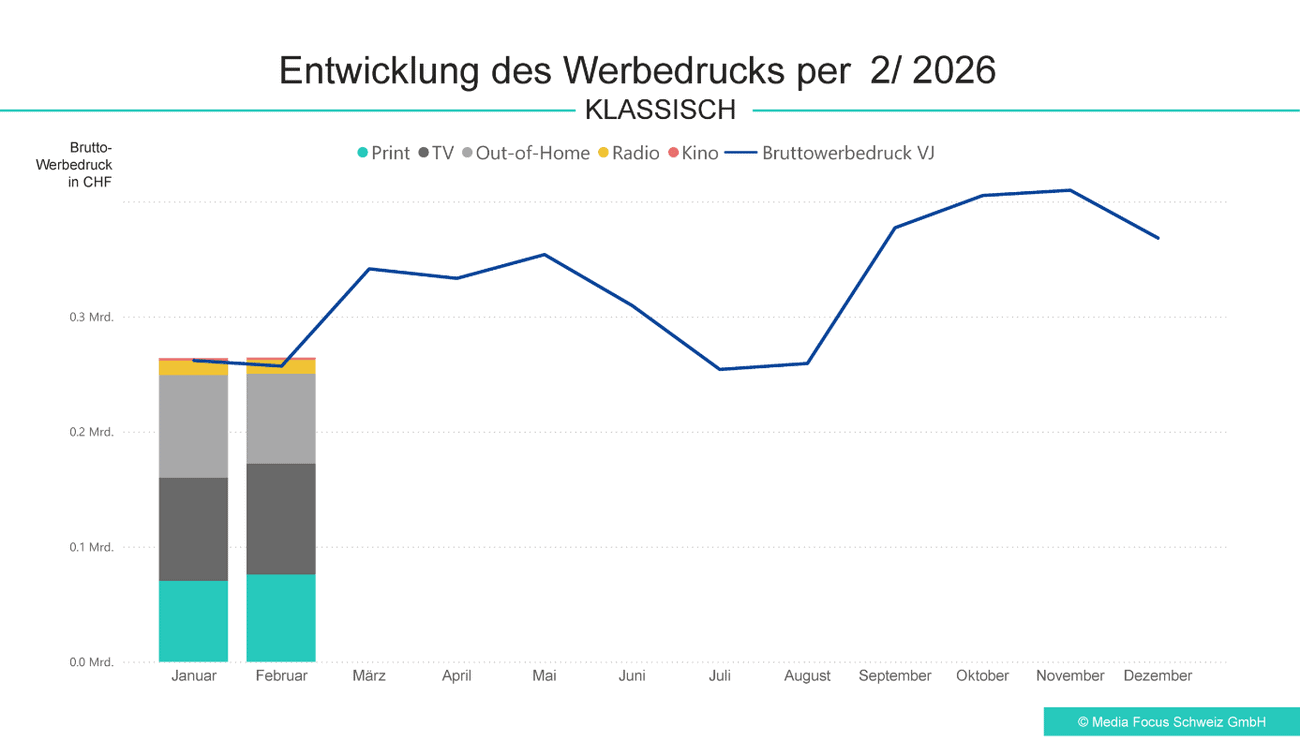
In February, the traditional advertising market continued the positive trend from the start of the year and, with an increase of 2.8%, achieved gross advertising expenditure of CHF 264.3 million. Growth was driven primarily by out-of-home (+22.8%) - including campaigns for the Sunrise Mobile subscription and Nescafé. This was followed by cinema (+12.5%), radio (+8.4%) and TV (+2.0%), while print continued to decline at -12.0%.
Digital market with a channel-driven media mix
In the digital market, gross advertising expenditure amounted to CHF 210.2 million in February. This shows a channel-driven media mix: search continues to dominate with a share of 73.5%, followed by display (19.7%) and YouTube (7.4%). The strong increase compared to the previous year (+152.3%) is primarily driven by search (+335.6%) and not organic, as technical adjustments made by Google 2025 in the first quarter led to restrictions in data collection. As a result, comparability with the previous year is limited in some areas. However, the display delivery statistics also contributed to the increase in February 2026 (+26.5%). YouTube is down slightly (-6.2%).
Positive developments in twelve sectors
The tobacco industry recorded the strongest percentage increase (+130.7%), largely driven by campaigns for Velo Nicotine Pouches and Davidoff cigarettes, but remains at the bottom of the ranking. Finance (68.5%), transportation (47.7%) and fashion & sport (41.3%) also performed strongly. Leisure, gastronomy, tourism (+25.4%) once again led the rankings in February, supported by the strong out-of-home presence of McDonald's restaurants and Swisslos Super Win For Life, among others.
Declining development in nine sectors
A total of nine sectors reduced their advertising pressure compared to the previous year. The most significant percentage declines were seen in digital & household (-32.8%), vehicles (-30.8%) and retail (-25.2%). Despite the downward trend, retail (-25.2%) and food (-10.4%) are still among the sectors with the highest advertising pressure. The telecommunications industry also saw a double-digit reduction in advertising pressure (-16.6%). Events (-3.3%), cosmetics & personal care (-2.7%), construction, industry, furnishings (-2.9%) and pharmaceuticals & healthcare (-0.8%) are only slightly in negative territory.
Traditional versus digital market
In February, the leisure, gastronomy and tourism sector was at the top of both markets. However, the ranking behind it differs significantly: retail and food follow in the traditional advertising market, while finance and services are more important in the digital market. In both markets, the automotive sector ranks 7th, while the fashion & sports and pharmaceutical & healthcare sectors are positioned in the midfield.
The telecommunications industry is ranked 5th in the digital market, while it is ranked 13th in the traditional market. The reverse is true for initiatives & campaigns: The industry is ranked 5th in the traditional market, while it is ranked 14th in the digital market. This indicates that digital channels are less important within the communication strategy.
Top products in the digital advertising market
A clearly channel-driven picture emerged in the digital advertising market in February: While search continues to be strongly performance and travel-oriented, display and YouTube are determined by a more diverse mix of different offer worlds. Spusu.ch leads the ranking in Display, followed by Tui Reisen and Brack.ch. In Search, the travel provider Booking.com has been at the top since the beginning of the year, ahead of Axa.ch and Skyscanner.ch. On YouTube, Japanese consumer electronics with the Nintendo Switch 2 console took first place, up from second place in the previous month. It is followed by Digitec.ch and Knorr Bouillon.
Neither a product nor a service is represented in the top positions in several channels at the same time. However, it is striking that various travel providers are present in both Display and Search, while online retailers appear primarily in Display and YouTube.
]]>
The traditional Swiss advertising market shows a robust picture in 2025 despite a slight decline. With gross advertising expenditure of CHF 3,930.8 million, it is down CHF 1.7% on the previous year. However, the course of the year shows a gradual stabilization: after a weak first quarter (-4.2%) and a likewise declining second quarter (-2.9%), the market is approaching the previous year's level again in the second half of the year. In the third quarter, the decline was only 0.2%, and in the fourth quarter the market even turned slightly positive (+0.1%).
TV delivered the only quarterly boost to growth in the third quarter (+0.8%), driven by campaigns in the sports environment surrounding the Women's European Championship 2025. Out-of-Home grew consistently throughout the year, achieving growth of 4.4%.
Digital advertising market: total advertising pressure at over CHF 6 billion
If we expand the view to include the display delivery statistics, the total value pressure is CHF 4,481.1 million, which corresponds to a decline of 1.4%. The turnaround is even more visible at quarterly level: the first quarter is -4.9%, the second -2.8%, while the third quarter shows growth again at +0.6% and the fourth quarter at +0.9%. With YouTube, the picture changes only marginally: classic plus display delivery statistics plus YouTube reach CHF 4,688.5 million, also a minus of 1.4%.
The entire digital advertising market - including search - results in a total advertising pressure of CHF 6,007.5 million (-2.4%). In the case of Search, it should be noted that there were strong fluctuations in the recording in 2025, particularly in the first half of the year, due to Google updates, which limited the comparability of the gross advertising pressure with the previous year.
Media mix: out-of-home continues to gain in importance
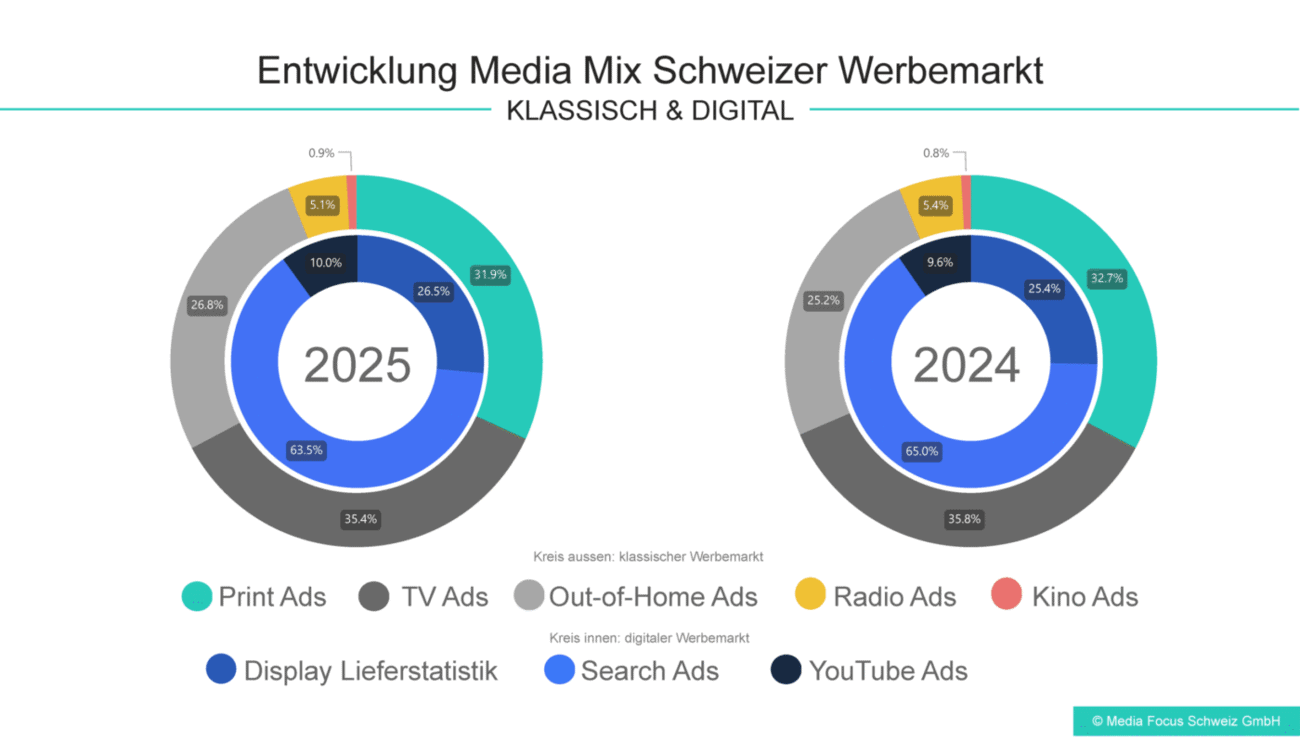
The media mix shows a further shift in favor of out-of-home in the traditional advertising market in 2025. Out-of-home advertising will increase its share from 25.2% in 2024 to 26.8% in 2025, gaining 1.6 percentage points. At the same time, print will fall from 32.7% to 31.9%, a decrease of 0.9 percentage points. TV remains largely stable as the largest media group, but is down slightly: from 35.8% to 35.4%, which corresponds to a decline of 0.4 percentage points. Radio is also down slightly, falling from 5.4% to 5.1% (-0.3 percentage points). Cinema increased slightly (from 0.8% to 0.9%), confirming its stable role as an attention-grabbing supplementary medium.
In the digital advertising market, search remains clearly dominant with 63.5%, despite volatility in the recording. Display accounts for 26.5% of advertising pressure, the channel can increase marginally (+0.6%). YouTube accounts for 10% of advertising pressure. However, the increase cannot be explained by growth within the measured values, but by the fact that less search advertising pressure could be measured.
Top advertisers: Coop and Migros remain in the lead, Swisscom and Nestlé make strong gains
At the top of the advertising client ranking, the ranking remains stable: Coop and Migros continue to occupy first and second place. Coop has a share of advertising (SoA) of 24.0% and is slightly below the previous year (-2.5%), while Migros has increased significantly with a SoA of 16.2% (+20.9%). Procter & Gamble is again in third place with an SoA of 7.7%, albeit with a decline of 19.0% compared to the previous year. The consumer goods giant has significantly reduced TV advertising pressure across several product segments.
Behind the top 3, the dynamism of individual advertisers is particularly striking: Denner grows by 20.9% and improves from 6th to 4th place, driven by a strong presence in Migros Magazin and two out-of-home campaigns at the beginning of the year and around WEURO in July. Swisscom even gains 54.5% and rises significantly from 12th place. The telecommunications provider is noticeably increasing its advertising pressure in 2025, particularly in out-of-home, but also in TV and radio. McDonald's is also growing (+7.8%).
On the opposite side, several brand players are under pressure: L'Oréal loses 25.9%, Henkel 18.2%, Beiersdorf 7.2%, Aldi 7.9% and Ikea 6.6%. The composition of the top 20 provides additional movement: Nestlé is new to the top 20 with TV Offensive and makes it straight to 11th place (previous year 23rd place), accompanied by very strong growth (+91.7%). However, Möbel Pfister, Swisslos Interkant and Verfora are no longer in the top 20.
Top products: Fast food, diapers and vacations dominate
McDonald's restaurants and Pampers diapers once again lead the ranking of the most advertised products, closely followed by trivago.ch in third place. NZZ Shop and brack.ch, two e-commerce offerings, make it into the top 10. The list is completed by other travel providers (car-tours.ch, Thurgau Travel), a credit provider (Credit Now personal loan), Poltronesofa living room furniture and Ariel All in 1 Pods.
The top new products in 2025 are dominated by technology and consumer goods: the Apple iPhone 17 Pro tops the list, followed by the Samsung Galaxy S25 Ultra. There are also strong innovations from the FMCG and beauty sectors - from Ariel with Lenor Unstoppable and Nivea Cellular Epigenetics Serum to Schwarzkopf Creme Supreme Coloration. A health product is also represented with Vicks Angimed lozenges, while Bilz Stellare 0.0, Super Bock Unfiltered and Birra Moretti Sale di Mare show that beverage innovations, especially non-alcoholic alternatives, are also being visibly pushed. Swisscom Blue Security + Service rounds off the top 10 as a service innovation.
Display, YouTube and Search: Different industry profiles per channel
The retail trade remains the clear leader in the display sector: with Coop, Migros, Aldi, Lidl and now Denner, five retailers are represented in the top 10. Behind them, the list is much broader: VW brings automotive power to the ranking, while Spusu, a price challenger from the telco environment, makes it into the top 10. With UBS and Bitpanda, both an established financial giant and a fintech are represented in the top 10. Philip Morris completes the field and illustrates that digital channels are particularly attractive for highly regulated categories.
On YouTube, a mix of entertainment and strong consumer goods brands is at the top: Nintendo leads the ranking, followed by Beiersdorf and PepsiCo. With Coop in fourth place, a retailer is once again prominently represented, while The Walt Disney Company strengthens its entertainment presence in the top 10. This shows how widely YouTube is used as a brand platform: Philip Morris enters in 6th place, Ferrero follows in 7th place and international e-commerce giant Temu has to settle for 8th place (last year 4th place). McDonald's (9th place) and L'Oréal (10th place) complete the top 10.
The comparison with TV is exciting. Only 3 of the top 10 YouTube advertisers are also represented in the top 10 on TV: Coop rank 5, Ferrero rank 3 and McDonald's rank 8. Beiersdorf (11) and L'Oréal (12) just miss out on the top 10. Others, such as frontrunner Nintendo (48th), third-placed Pepsi (60th) and fifth-placed Disney (186th), are much less visible on TV. And still others - namely Temu and Philip Morris - do not appear on TV at all.
In 2025, the topic of travel and comparison is particularly clearly reflected in Search: With booking.com at the top and other travel offers such as Skyscanner, Trivago, Opodo, eDreams as well as ab-in-den-urlaub.ch and ab-ins-blaue.ch, travel providers dominate the top ranks. As many as 7 of the top 10 advertisers are travel platforms. Comparis.ch in second place underlines the continuing high level of information and price awareness, while non-travel-related players remain visible with axa.ch (insurance) and yallo.ch (telco).
Sectors: Retail trade strengthens leading position, vehicles still under pressure
In the traditional advertising market, the vehicle sector remains under clear pressure in 2025: at -8.5%, it closed significantly below the previous year, but remains in 7th place. However, the picture behind the decline is not uniform: several brands have noticeably increased their traditional advertising pressure, including Volvo, Mercedes, BMW, Polestar and Fiat. At the same time, the decline is largely due to significant reductions by individual major players, above all VW and Cupra.
Initiatives & Campaigns (-9.8%, rank 3), Beverages (-6.6%, rank 10) and Pharma & Health (-5.7%, rank 12) are also in decline. However, there will also be winners in 2025: Retail will continue to expand its leading position and grow by 13.3%. Services also increased (+6.4%) and gained one rank (now rank 11). The growth in Personal Supplies is also striking (+10.6%), also gaining one rank (now rank 16). Telecommunications also grew significantly (+13.3%), not least due to Swisscom's advertising campaign, and is now ranked 15th.
A comparison of the industry rankings shows clear shifts between the traditional and digital advertising market in 2025. As the traditional digital frontrunner, retail remains dominant, particularly in display (rank 1), but loses significant weight in search (rank 12) and YouTube (rank 10). Food is also widely visible, but stands out above all in YouTube (rank 3), while Display (rank 10) and Search (rank 15) are clearly behind.
Conversely, other sectors have a much stronger digital impact: Telecommunications is ranked 15th in the traditional ranking, but is ranked 4th (Display) and 6th (Search) digitally. Digital & household (classic rank 14) is particularly present online - with rank 2 for YouTube and rank 4 for search. The financial sector is ranked 4th in traditional terms, but is even better positioned digitally in 2025: It retains 2nd place in Display and Search, and improves from 3rd to 1st place in YouTube, thanks in part to the YouTube campaigns of Migros Bank and Axa.
Outlook 2026: Uncertain environment and new challenges
In 2025, the Swiss advertising market shows an overall robust picture in the traditional segment: at CHF 3,930.8 million, gross advertising pressure is only slightly below the previous year (-1.7%). What is striking is the annual trend, which is gradually stabilizing on a quarterly basis. If the digital channels Display Delivery Statistics and YouTube are included, the decline in advertising pressure weakens slightly (from -1.7% to -1.4%).
One trend is clearly continuing in the traditional media mix: out-of-home continues to gain in importance and is once again increasing its share of the traditional market. Out-of-home also developed particularly consistently throughout the year, confirming its role as a stable growth driver in the Swiss advertising market. However, the ongoing discussions about a possible ban on out-of-home advertising continue to sow uncertainty. A ban could further encourage the shift of advertising budgets to international platforms - with negative effects on value creation in Switzerland.
TV remains the strongest media group despite the decline. Only in the third quarter did campaigns in the sports environment surrounding the WEURO provide a noticeable boost, while TV declined in the other quarters. Print and radio, on the other hand, remain under structural pressure, while cinema confirms its role as an attention-grabbing supplementary medium.
2026 will be particularly exciting against the backdrop of a persistently uncertain environment: geopolitical tensions, times of punitive tariffs and a global economy that is difficult to plan are increasing the pressure on budgets and making flexibility the key currency in media planning. Added to this is politics: possible advertising bans and, above all, the halving initiative are creating uncertainty. At the same time, consolidation in the media landscape is accelerating - with effects on reach, pricing logic and the availability of high-quality environments.
Last but not least, social media has become a key addition to the media mix and the migration of advertising money to the major tech platforms is continuing, albeit only partially measurable statistically to date. As in 2025, 2026 is therefore likely to be a year in which advertisers, agencies and media companies will face new challenges in equal measure. It will be all the more exciting to see how budgets continue to shift in the area of conflict between traditional reach media, digital platforms and new AI-driven opportunities.
]]>
The traditional Swiss advertising market achieved gross advertising expenditure of CHF 367.4 million in December 2025, up 3.1% on the same month last year. This increase is the strongest of the year apart from July and is also one of three positive monthly developments over the course of the year.
Accumulated over the whole of 2025, traditional advertising expenditure amounts to CHF 3,930.8 million, which corresponds to a decrease of 1.7% compared to 2024. The YTD balance thus remains largely stable compared to the previous months of October and November.
Out-of-Home with strongest growth
At media level, the monthly comparison shows a differentiated picture: out-of-home recorded significant year-on-year growth of 26.2%. Print is also slightly up on the previous year at 0.8%. In contrast, TV (-2.8%), radio (-10.9%) and cinema (-23.4%) recorded declines, after all three media categories had shown a neutral to positive trend in November.
The bookings from December 29 to 31 are only published as part of the January month-end closing and are included in week 1 (January).
Tobacco industry with strongest growth
More than half of the sectors recorded significant year-on-year increases in December. The tobacco industry recorded the strongest growth with an increase of 145.6%, which was partly due to increased advertising activity for Velo Nicotine Pouches and Davidoff cigarettes.
The telecommunications sector (124.3%), driven by Swisscom's increased advertising commitment compared to the previous year, as well as the media (48.5%), transport companies (24.1%) and leisure, gastronomy and tourism (22.4%) also recorded significant growth.
Other clear winners in December included beverages (15.0%), pharmaceuticals & healthcare (9.2%), finance (9.0%) and construction, industry, furnishings (8.4%). The services (6.8%) and digital & household (5.9%) sectors also recorded moderate but stable increases.
Retail trade with declining development
Although the retail trade continues to occupy a leading position in 2025, it is down -8.8% compared to the previous year. This development is due in particular to the lower advertising volume of the major distributors Coop, Migros and Denner.
The food industry (-3.2%) and initiatives & campaigns (-9.0%) also saw a decline, despite their strong positioning in second and third place within the annual spendings. The cleaning industry recorded the most significant decline at -26.9%. Cosmetics & personal care (-14.9%), fashion & sport (-11.7%) and energy (-8.3%) were also well below the previous year's level.
Vehicles (-3.5%), personal requirements (-2.0%) and events (-0.7%) developed less strongly, but also declined.
Digital advertising market at a high level
The digital advertising market reached CHF 234.8 million in December, up 32.2% on the same month last year. Although digital advertising pressure declined slightly compared to the previous months, it remained at a high level overall. The cumulative digital market amounted to CHF 2,076.7 million in December, which corresponds to a decline of 3.8% over the course of the year.
For better comparability with the previous year, the traditional advertising market and the digital channels (search, YouTube, display) are reported separately. Fluctuations in online revenue can be exacerbated by external influences - in particular technical updates from major platforms such as Google or YouTube.
Different industry positioning
In the traditional advertising channel, the retail, food and initiatives & campaigns sectors lead the ranking. In contrast, the digital channel is dominated by leisure, gastronomy and tourism, followed by finance and retail. While food and initiatives & campaigns are only in the bottom half of the digital table, leisure, gastronomy, tourism and finance are ranked fourth and sixth respectively in the traditional channel.
The automotive sector is consistently positioned in seventh place in both markets, confirming its stable presence throughout the year. Fashion & sport, pharma & health and beverages are in the middle of both markets. At the lower end of the traditional ranking are media, energy and tobacco products - the latter despite the strong growth in the tobacco sector. In the digital market, events, tobacco products and the cleaning industry bring up the rear.
]]>
After two months of positive development, the "traditional" advertising market recorded a decline again in September. With gross advertising expenditure of CHF 376.7 million, the result is -4.2% down on the same month last year. The market is thus losing some of the upward momentum gained in July and August.
The traditional advertising market trend is at CHF 2,747.3 million gross YTD so far this year, representing a percentage decline of 2.5% compared to 2024.
Within the media groups, the picture in September is mixed. Radio was the only group to remain in positive territory with growth of +3.6%. All other media groups recorded declines: print was hit hardest with -7.2%, followed by cinema (-6.4%), out-of-home (-6.0%) and TV (-1.1%).
Digital advertising pressure in September was significantly higher than in the previous year. The driver is Search. The channel closed with a clearly positive result, while Display (-3.5%) and YouTube (-3.8%) recorded slight declines*.
Less than half of the sectors are convincing
Overall, only 8 out of 21 sectors were able to escape the negative trend in September. Although the retail trade is still in the lead in YTD, with growth of 14.4%, it is outperformed by the food industry (CHF 44.5 million) in terms of September spending (CHF 35.0 million). In percentage terms, the media sector recorded the most significant growth, although it is still in the bottom third of the ranking. Other winners included tobacco products (+35.2%), digital & household (+17.0%), services (+14.4%) and events (+7.8%).
Vehicle sector collapses
In September, 13 sectors recorded declining trends. The biggest losers include the automotive sector (-27.8%), transportation companies (-19.9%) and fashion & sports (-19.4%). Although the finance and telecommunications sectors also both recorded declines (-6.9% and -0.5% respectively), they are above the previous year's level in a cumulative year-on-year comparison. Initiatives & Campaigns (-1.4%) and Beverages (-0.9%) are also only just in negative territory.
The whole report on mediafocus.ch
]]>
The advertising market in Switzerland remains in reverse gear in March 2025. Gross advertising expenditure in traditional media amounted to CHF 340.7 million, which corresponds to a decline of 4.0% compared to the same month last year. A decline of 3.2% was already recorded in February.
None of the traditional media groups were able to achieve a positive result compared to the previous year. However, the ranking within the media mix remains stable: TV is still ahead of print, followed by out-of-home, radio and cinema.
Accumulated gross value added for the first quarter amounted to CHF 859.5 million, which corresponds to a year-on-year decline of 4.3%.
The digital advertising market is also showing declining trends in the areas of search and display. With a share of 52.3%, search nevertheless remains the leader, ahead of display with 33.1%. Only YouTube recorded growth, with a market share of 14.6%.


Retail trade dominates - but with moderate growth
Only eight out of 21 sectors saw growth in the traditional advertising market. With gross advertising expenditure of CHF 36.2 million in March, the retail trade sector remained in the lead, but only recorded an increase of 5.8%. Stronger growth was recorded by the media (+18.2 %), cleaning (+17.6 %) and digital & household (+17.0 %) sectors, among others.
Leisure, gastronomy, tourism (+6.4 %), pharmaceuticals & healthcare (+4.4 %), transportation (+13.7 %) and personal care (+2.1 %) also developed positively.
13 sectors showed a downward trend. Nevertheless, the food industry is in second place with a decline of 6.9%. Other sectors affected include construction, industry, furnishings (-9.6 %), vehicles (-9.1 %), initiatives & campaigns (-3.7 %) and finance (-1.1 %). At the lower end of the scale are energy (-58.8 %) and tobacco products (-29.1 %).


In the digital market, the leisure, gastronomy and tourism sector is at the top of both the monthly and annual rankings, while the retail sector leads the traditional market.
The rankings of individual sectors show parallels between the two markets: Beverages is ranked 14th in each case, while Pharma & Health and Cosmetics & Personal Care are in the midfield. While tobacco products bring up the rear in the traditional market, the cleaning sector occupies this position in the digital sector.


In the Display segment, mobile phone provider Spusu.ch is once again in first place. Booking.com remains at the top of the SEO rankings, while the nicotine brand Zyn achieved the top position on YouTube. The Swiss Airlines flight offering and the Swiss.com platform both appear in ninth place in both areas.


The advertising market in Switzerland also closed down in February 2025. Advertising pressure from "traditional" media amounted to 255.8 million gross francs, which corresponds to a decline of 3.6% compared to the same month last year. Print, TV, radio and cinema were particularly affected, while out-of-home was the only media category to increase, with growth of 8.7%. Nevertheless, the ranking in the media mix remains unchanged, with TV ahead of print, followed by out-of-home, radio and cinema.
After the first two months of the year, cumulative traditional advertising expenditure amounted to CHF 517.3 million, which corresponds to a decline of 4.8% compared to the previous year.
Digital advertising: Search remains ahead, YouTube continues to grow
Search continues to hold the top position in the digital advertising market with a share of 45.4%, although Google adjustments led to a decline in advertising pressure. Display advertising follows with 35.5%, while YouTube is the only category to record a positive development with 19.1%.

Retail trade dominates the traditional advertising market
Of the 21 sectors analyzed, only seven were able to escape the general negative trend. Retail led the ranking with growth of 32%, further extending its lead. The telecommunications sector (+15.6 %), financial services (+13.6 %) and the energy sector (+38.4 %) also showed a positive trend.
The tobacco industry recorded the largest losses (-84.3 %), which is attributable to the new advertising bans. Food (-8.5 %), leisure/hospitality/tourism (-24.7 %) and pharmaceuticals/health (-17.2 %) also suffered significant declines.


Digital vs. traditional advertising: a comparison of sectors
The leisure, gastronomy and tourism sector leads the digital advertising market, followed by retail and financial services. In the traditional advertising market, however, the retail trade is in the lead, while the financial services sector is only in fifth place.
Tobacco products, events and cleaning products occupy the last places in the digital advertising market, although some of them were able to make year-on-year gains. In the traditional market, the tobacco industry remains in last place, directly followed by the energy, media and transportation sectors.


Most popular products in February
In the display area, spusu.ch is at the top, while booking.com has the highest advertising presence in search. On YouTube, the Audi A6 E-Tron is in first place. Tui Reisen and Tui.ch also made it into the top 10 digital advertising campaigns.


The importance of social media in the marketing mix is constantly growing - but until now there has been a lack of neutral comparative data on advertising activities on the major platforms. Media Focus closes this gap and provides a new data source with "Social Ad Insights". Since January 2025, advertising activities and user behavior on Facebook, TikTok, Instagram, YouTube, Pinterest and LinkedIn have been recorded on a daily basis.
To this end, Media Focus relies on on-screen tracking of 1,000 Android smartphones in Switzerland. The method reads app usage directly from the participants' cell phone screens and thus provides detailed insights into users' everyday contact with social ads.
"With this innovation, we are creating comparability in the social media advertising market for the first time and obtaining neutral data on the advertising behavior of over 1,000 companies on the six relevant platforms," explains Ueli Weber, CEO of Media Focus. The combination of tracking and targeted user surveys also enables a more precise classification: "This allows us to recognize how active companies are and which target groups they reach with which messages."
The surveys are conducted in collaboration with the market research institute Intervista. Based on the tracking data collected, users are specifically asked about their perception, motivation and opinion. This gives advertisers not only quantitative but also qualitative insights into the effects of their campaigns.
Among other things, the new analysis tool enables benchmarking and cross-channel analyses, more precise target group segmentation and data-driven targeting. With this methodology, Media Focus provides a comprehensive basis for decision-making for companies that want to further optimize their social media strategies.
]]>
CHF 6.12 billion - that's how much was generated in the Swiss advertising market in 2024. This was announced by Media Focus in its recently published annual résumé. The CHF 6.12 billion corresponds to an increase of one percent compared to 2023.
The market owes the increase in total advertising pressure primarily to the digital business. This is because the so-called traditional advertising market - which includes print media, cinema and out-of-home - shrank by 0.9% overall. The only exception: out-of-home (+4.9 percent) and cinema (+4.4 percent) benefited from a moderate increase, writes Media Focus.

By contrast, revenue in the digital advertising market increased by 4.6% and amounted to CHF 2.1 billion in 2024. The majority of this (66%) - or over CHF 1.4 billion - was generated by advertising on search engines ("Search" segment). This is followed by display advertising with a share of 25.7% (CHF 547 million). The last and smallest segment is YouTube - with a share of 8.2% and sales of CHF 175.1 million.

The ratio between the three segments remained largely stable compared to the previous year. In percentage terms, YouTube saw the strongest growth, with an increase of 9%. In the search segment, the increase was 5.5% and in display advertising 1%.
FMCG (Fast Moving Consumer Goods) products and retailers dominate the rankings of the most advertised brands and products, according to Media Focus. The Apple iPhone 16 Pro was the most advertised new product. Telco Swisscom secured a place in the top 10 most advertised brands in the Display Ads category, while rival Sunrise appeared in 3rd place in the Search Ads category. Temu, the Chinese online store, is also one of the most advertised brands and ranks in the top 10 lists for display ads and YouTube. (René Jaun/dwi)
]]>

It was a good year for the German advertising market and 2025 is also expected to be a good year - according to the JOM forecast. Despite the weak overall economic situation, net advertising expenditure in Germany is set to rise by around 3% this year. Even though the economic outlook for the coming year will not be much better, the JOM Group, an agency for hybrid marketing communication, is forecasting continued positive development in the advertising market. According to the JOM experts, growth is expected to be around 3.2 percent. This means that the market will reach a total volume of just over 30 billion euros.
Video advertising and retail media push the market
Two major trends are expected to contribute significantly to this growth. Firstly, the opportunities in the field of digital video advertising are continuing to develop rapidly. The reach of platforms such as YouTube, Amazon, Netflix or media libraries such as RTL+ or Joyn is increasing significantly. In addition, supposedly young platforms such as Tiktok are becoming increasingly popular as advertising environments.
On the other hand, retailers are continuously expanding their range of advertising space in the retail media sector. This offering is also one of the growth drivers in the market because it offers a high level of proximity to sales and combines the advertising display with the data of the respective retailer.
Outdoor advertising will also be a winner in 2025
Out-of-home advertising has been pursuing the path of digitalization and data-based targeting of advertising with great success for years. Not only is the media category growing at a double-digit percentage rate this year, but JOM expects this trend to continue in 2025.
According to the media experts, advertising expenditure for TV is likely to remain largely constant in 2025. Print media revenues will continue to decline slightly in 2025.
Uncertainty factors remain
Despite all the positive signals, the foundations of the upturn are not particularly stable. A possible change of government in Germany and an already certain one in the USA are just two new factors that could influence the advertising economy in Germany, alongside the conflicts in Ukraine and the Middle East. If German companies' prospects for 2026 do not improve significantly by the middle of next year at the latest, marketing budgets are likely to come under greater pressure again.
]]>
 In its year-end forecast for the current year 2024, the ZAW expects the advertising industry to grow to a total of EUR 50.21 billion (+2.90%). Investments in advertising will increase to around EUR 38.36 billion (+3.73%), while the media's net advertising revenue will rise to EUR 27.03 billion (+4.48%). For other forms of commercial communication, the association is forecasting slight growth of +0.3% or EUR 11.85 billion in 2024. However, the ZAW forecast assumes that advertising investments will not collapse in November and December. Due to the high weighting of these months, noticeably lower growth is otherwise to be expected. ZAW will publish the final data together with the first annual forecast for 2025 next spring.
Supersport year, inflation
The ZAW's assessment from spring 2024, according to which further increases in all three core measurement points are possible this year compared to 2023, has been realized. There are a number of specific reasons for this: After the German advertising economy had fallen significantly in comparison to other advertising markets over the past two years, advertisers invested more heavily in their brands this year and apparently found convincing reasons and causes to do so despite cost pressure, a weak overall economy and veritable uncertainties. 2024 was a super sports year, inflation has fallen. The weak consumer sentiment was countered with an increased commitment to market communication and the resulting added value, particularly in the first three quarters.
Digital driver
The disproportionately high growth of digital advertising also remains a key driver of the comparatively positive development of the advertising market in the context of the overall economic situation. The picture for the other main categories (print, TV/moving images, direct mail, out-of-home advertising, radio and cinema) is mixed: moderate losses, black zeros and selective growth - with out-of-home advertising standing out positively. The trend that a few platforms within the digital advertising media are growing at an above-average rate and that investments from other sectors are flowing into this sector also remains unchanged.
With regard to the other forms of commercial communication, positive (sponsoring) and negative forecasts (catalogs | printed advertising, promotional items) in the individual disciplines almost balance each other out overall, which means that only a slight increase is to be expected here on balance.
Mood at its lowest point
The ZAW trend barometer conducted in November 2024 shows that the mood in the advertising industry has reached a low point. A large majority of ZAW member associations (86%) consider the political situation in particular to be threatening. With an overall score of just 2.3 points (3.1 points in the spring), the mood has never been worse in the past ten years (see chart).
ZAW members were also asked which factors had the greatest negative impact on the economic situation in 2024. Almost 90% of respondents stated that bureaucracy in Germany was an extreme burden, followed by the poor consumer climate (86%), high energy and raw material costs (72%) and the uncertain economic outlook in the country (71%). The shortage of skilled workers is also perceived as an even greater problem than in the spring survey. In spring 2024, 48% of respondents still classified the issue as a major problem; in November, this figure had risen to 62%. Insolvencies are feared by a total of 57% of respondents in 2025 - another slight increase compared to spring (55%). Looking ahead to the first half of 2025, around 60% of the members surveyed expect economic development to remain the same. Just over 20% expect a deterioration in the first half of the year and less than 20% expect an improvement. Compared to the previous trend surveys, the optimist camp has decreased.
]]>
 Dentsu publishes its Ad Spend Report and provides an outlook on the development of net advertising investments for 2024 and the coming year. The semi-annual study is based on data from 56 markets in North and South America, Asia-Pacific and EMEA.
According to the study, global advertising investment could increase by 5.9% in 2025. This would correspond to an expected net investment sum of 817.7 billion US dollars. In retrospect, the forecast global growth for 2024 has also been revised upwards - from 5.0% to 6.8%, which corresponds to USD 772.4 billion. Major sporting and political events have had a greater impact here than initially assumed in May of this year. In addition, the outlook in the USA, the UK, Brazil and France has improved once again.
A closer look at the development for 2025 shows that the pace of growth is likely to slow somewhat, as there will be no major global events such as the UEFA European Championship and the Olympic and Paralympic Games in the new year to boost investment.
Signs of growth
Nevertheless, the signs continue to point to growth and the assumed figure of 5.9% will exceed the growth rate of the global economy by 2.7 percentage points. In terms of advertising growth in the strongest regions of the global market, the American continent is once again the leader in terms of advertising expenditure (8.0% for 2024 / 6.3% for 2025). In Germany, a cautiously positive trend in advertising expenditure is emerging. The Dentsu analysts assume a figure of 3.1% for 2024. However, growth would have been significantly higher had it not been for the slump in Q4 of the current year. The conspicuously weak Q4 thus overshadows what was actually a good 2024. These could already be the first negative harbingers for 2025.
High tariffs on US imports, an already weak growth forecast for Germany and a general election with potential problems in forming a majority are causing noticeable uncertainty and restraint. In this respect, the forecast 3.3% growth in advertising expenditure in Germany is currently the best case scenario and offers a lot of hope. Looking at the forecasts for 2024 in comparison to the other major European economies, Germany is in fifth place behind the equally rising growth prospects in the UK (7.5%), France (5.6%), Italy (6.2%) and Spain (4.8%).
