
The lights in the Pathé Spreitenbach auditorium dim, and the soft rustling falls silent. A compilation of award-winning international films begins on the monumental screen. No push notifications, no thumb swiping reflexively upward, no second screen that reduces the action to background noise.

It was precisely this magic of the silver screen that provided the perfect setting for the traditional Cannes trend report by marketing agency Weischer. Christof Kaufmann, CEO of Weischer.Cinema Switzerland, opened the event with a clear statement: Cinema remains the leading medium for uncompromising impact and reach. Director of Sales Juliane Fankhauser-Merz took the stage with enthusiasm and introduced the keynote speaker: Clara Katharina Wesselhoeft, Director of Creative Platforms & Partnerships at Weischer Hamburg. Together with Weischer CMO Moritz Weischer, she has officially represented the festival in Switzerland and Germany for years.
Before moving on to the trends, Wesselhoeft provided an overview of the 2026 Cannes Festival: 93 countries, 20,000 entries—a decline in volume due to stricter integrity rules against fraudulent AI cases (’scam scandals«) and Omnicom budget cuts, but the event’s prestige remains unchanged. With a rigorous award rate of just 3.2 percent, the Cannes Lion remains the most coveted accolade in the advertising world. And Switzerland had reason to be proud: Four Lions went to the Swiss Confederation in 2026—three for On (»Shape of Dreams« in Film Craft) and one Lion for the IOC’s »Olympic Wing Pasta.«.

Wesselhoeft organized the lessons learned from the Croisette into a precise three-part structure: What brands TODAY moves her, what she TOMORROW will challenge—and what a look into the GLASS BALL holds promise for the future of consumer behavior.

1. TODAY: The Foundation of Credibility
Trust – The New Hard Currency
In an age of algorithmic information overload, AI-generated disinformation, and endless interchangeability, trust is becoming the key driver of growth. Recent Edelman figures underscore this point: For 88 percent of consumers, trust in a brand is a key factor in purchasing decisions—on par with quality and value for money.
Craft as a sign of trust: Trust is built through genuine craftsmanship (Craft), attention to design detail, and verifiable integrity.
Case «Results with Venezuela»: After the 2024 presidential election, the opposition set up a parallel verification system using QR codes on the ballots. 600,000 volunteers secretly recorded and scanned the ballots. Eighty-five percent of the election results were published transparently, refuting the regime’s narrative—campaigning as a tool for democracy and unshakable truth.
Mercado Libre Case Study («Scratch Your Data»): Latin America's e-commerce giant is fighting identity theft through packaging waste (Dumpster Diving). Customers are rewarded with discount coupons if they scratch off the address labels on their packages before disposing of them, thereby destroying their personal information themselves.
Human Creativity – The Luxury Good of the AI Era
The faster, cheaper, and more automated the production of content via generative AI becomes, the more interchangeable the noise becomes. Relevance doesn’t come from endless output, but from substance, attitude, and empathy. Marcel Marcondes, Global CMO of AB InBev, summed it up:
«Technology is a great enabler, but everything has to begin and end with people.»
Apple TV+ Case (Rebranding): For the rebranding, Apple didn't rely on generative prompts, but rather on classic, tactile craftsmanship: glass art, handcrafted light sculptures, cinematography, and custom music by Finneas. An analog masterpiece that stands out unmistakably in the digital space.
Case Claude (Anthropic): During the Super Bowl, the AI platform promoted its ad-free model with—of all things—humorous and absurd commercials in which chatbots offer bizarre advice («Find an emotional connection with roaring cougars on Golden Encounters») —human storytelling at its best, explaining technology in a way that’s likable and relatable.
Fandom First – From Target Audience to Fan Culture
Sports and live events are the last remaining campfires of our culture. Scott Galloway put it aptly in Cannes: Sports have taken on the status of a modern cultural religion. For advertisers, this means that those who limit themselves to logo sponsorship on perimeter boards will remain interchangeable. Brands must become an active part of fan culture.
Case KFC («Kyle Connor» / «KFC»): KFC seamlessly tapped into the excitement of Winnipeg’s NHL fans, who were chanting for their hockey star Kyle Connor—and turned that adoration into branded chicken buckets and viral stadium moments.
Uber Eats Case Study (Super Bowl): Instead of spending millions on a traditional 30-second commercial, Uber Eats transformed the entire app into an interactive Super Bowl experience. Users could «order» their own commercials using cinematic elements and unlock exclusive deals—which led to 3.7 million new app visits and over $36 million in additional revenue.
A Shift in Roles—Brands Become Communities
Creators and consumers are no longer merely distribution channels. They are media entrepreneurs and co-creators. Any brand seeking relevance must relinquish control and engage with them as equals.
Case Study: McDonald’s («The Filet-O-Fish Facebook Society»): McDonald’s UK discovered a Facebook group founded in 2012 with just six die-hard fans of the often-ridiculed Filet-O-Fish. Instead of launching its own campaign, the brand joined the group, interacted with members on an equal footing, and responded to the community’s request: The «Double Filet-O-Fish» was permanently added to the menu at 1,400 locations nationwide—a triumph of organic fan culture.
Case Tecate («The Fandom Comeback»): After the brand Tecate Titanium After it had been discontinued six years earlier, its loyal customer base persistently demanded its return. Tecate heeded their wishes, staged the comeback as a tribute to its fans, and sold 1.2 million cans in just three weeks.
2. TOMORROW: Strategic Leverage for the Coming Years
Brand Building Is Back – Prioritizing Brand Substance
Pure performance hacks and short-term social buzz campaigns have run their course. Cannes introduced the «Creative Brand Lion,» a category that recognizes brand strategy and long-term business growth. The credo is: First, build an unshakable brand identity; then, capitalize on cultural moments.
Case Study: Burger King («The Bite»): BK CEO Tom Curtis responded radically to the accusations that the burgers were cold and subpar: He published his cell phone number for customer complaints, tweaked the Whopper recipe, and, as part of a wide-ranging campaign, demonstratively took a bite out of the new product himself.
Case Columbia Sportswear («Expedition Impossible»): Columbia issued a challenge to flat-earthers: Anyone who could prove that the Earth is flat and photograph its «edge» would receive ownership of the entire company. CEO Tim Boyle was standing by with the keys. The campaign generated 80 million in earned audience reach—with the unmistakable message that Columbia outdoor clothing can withstand any extreme conditions.
B&B Together to C – The Power of Ecosystems
Channels, target audiences, and platforms are converging. Lone players are losing out; collaborative platform ecosystems are winning. Brands are joining forces to collectively gain cultural authority.
Case Brahma x Zé Delivery («Unwatched Goals Cashback»): The Brazilian beer brand Brahma and the delivery app Zé Delivery created an automated system: If a fan missed a goal scored by his team while the delivery person was at the front door, Brahma would refund the entire order amount. The risk became a purchasing incentive.
Case Study: Maple Leaf Foods («Look for the Leaf»): In response to U.S. tariff threats and annexation rhetoric, 50 Canadian food brands joined forces under the leadership of Maple Leaf Foods to specifically promote the purchase of domestic products during the NHL playoffs.
3. THE GLASS BALL: The Post-Scroll Brand Trend
What's happening the day after tomorrow? The phenomenon of «Scroll Fatigue» is growing rapidly. Between AI-generated junk content (AI Slop), digital fatigue, and algorithmic arbitrariness, the impact of passive social media feeds is declining dramatically.
Consumers long for authentic, social, undivided moments. The brands of the future don’t just buy «impressions» in the feed—they become enablers of physical and communal rituals.
Heineken Case («Could Have Been a Heineken» / «The Boring Phone»): Heineken rewarded users for putting away their smartphones and enjoying the moment with friends over a beer—for example, by exposing endless voice messages as a reason to meet up in person.
A Movie Theater Instead of Scrolling with Your Thumb: The Return of Undivided Attention
After the flurry of trends, Ismail Wicki, Senior Manager of National Sales at Weischer.Cinema Switzerland, brought the discussion back down to earth with a focus on advertising planning. His message to the marketers and agency representatives in attendance was clear: Cinema is not a “winter” medium, but a year-round stage for emotional brand storytelling.

With an increase of +24 percent Compared to the previous year, the Swiss movie market in 2026 continues to show unflagging vitality. Whether it's a record-breaking summer or major events, phenomena such as «Barbenheimer» or blockbusters like «The Odyssey», «Spider-Man: Brand New Day» or the Michael Jackson biography «Michael» demonstrate that audiences are willing to invest time and money in compelling stories.

Whereas content on social media is swiped away after three seconds, moviegoers willingly sit in front of a 100-square-meter screen for over two hours—without a second screen, without a skip button, but with measurable recall rates and shared emotions within the community.

During the concluding Q&A session, a conversation between the audience and Clara Katharina Wesselhoeft summed it up: Topics like sustainability and diversity haven’t disappeared from the trends at Cannes—they’ve simply become a conditio sine qua non. The focus is now on how brands can once again create meaning, build trust, and tell authentic stories in a world shaped by AI. And there’s no better place for that than a darkened theater when the projector kicks in.

The third day of Cannes Lions begins for m&k on the terrace of the press center at the Palais. There, Anna Kohler meets the current “Advertiser of the Year,” Jan Kempter, for an exclusive video interview. Twelve years after his first visit, the Wirz creative returns to the Croisette—to a festival that has changed significantly in the meantime.
For Kempter, the change is undeniable. Amazon, Meta, Apple, and other tech giants dominate the scene along the Croisette today more than ever. At the same time, he notes that outstanding work continues to thrive on something that cannot be automated: craftsmanship, skill, and attention to detail.

While nearly half of the talks on stage focus on artificial intelligence, Kempter has so far seen only limited evidence of this trend in the award-winning works. There, the focus remains on ideas, staging, and creative excellence. It is precisely these works and the encounters with creative professionals from all over the world that make Cannes so valuable to him.
Kempter owes his presence there entirely to Weischer.Cinema. The company has a long-standing tradition of sponsoring the “Advertiser of the Year” to travel to Cannes, thereby building a bridge between the Swiss creative scene and the world’s most important festival in the communications industry.
Swiss BBQ: The Swiss Hangout on the Beach
Shortly after noon, the action shifted to OK Beach. There, Weischer.Cinema was already hosting its ninth Swiss BBQ—now a fixture on the Swiss Cannes calendar.
Host Christof Kaufmann, CEO of Weischer.Cinema Switzerland, expressed his pride in how the event has evolved. What once began as a gathering place has now become a sort of Swiss base camp on the Croisette. Agencies, clients, creatives, marketers, and media professionals gather here away from the hustle and bustle of the official festival.

What particularly struck Kaufmann this year was the strong presence of marketing executives. Whenever CMOs and marketing leaders took the stage, the auditoriums were packed. He sees this as a positive sign, noting that Cannes is not just a creative festival, but is increasingly becoming a marketing festival once again.


Kaufmann takes a relaxed view of the dominance of the major tech platforms. His motto: «If you can’t outspend them, you have to outthink them.» Smaller, more agile markets like Switzerland, in particular, can leverage their strengths through speed, creativity, and simplicity.
And where does a longtime Cannes regular look for inspiration? In the basement of the Palais—where print and out-of-home ads are on display. Works that have to speak for themselves without lengthy explanations. Kaufmann raves about campaigns like Dunkin‘ Donuts or De’Longhi’s multi-award-winning Tiny Coffee House. His recommendation: don’t follow the hype so much, and instead roam through the exhibition more often like a truffle-sniffing pig. That’s where you’ll still find great ideas.
Rapper Keynote on the Go
Some moments in Cannes just can't be planned.
On her way back from OK Beach along the Croisette, Anna Kohler suddenly heard a voice that sounded familiar. One glance through the floor-to-ceiling windows of a restaurant was enough—there he was, the producer, entrepreneur, and creative director.

What followed was an impromptu keynote speech on artificial intelligence and music that could hardly have been a better fit for the festival's overall atmosphere.
Will.i.am traced a historical arc from Gutenberg to Beethoven to the music industry. His central message: New technologies do not destroy creativity. They create new industries. The printing press made classical music possible. Recording devices gave rise to the music industry. And AI, in turn, will give rise to something new that we don’t even know about yet.
The true task of creative people, therefore, is not to defend the past, but to develop new imaginations. AI can reproduce existing patterns, but it cannot truly dream. «Now is the time for dreamers, not for those who regurgitate yesterday’s fantasies,» was one of his key statements.
It’s an idea that’s currently being discussed in many places in Cannes—though rarely with such stage presence and rock-star attitude.
Go, Switzerland! at Jung von Matt
The day finally ended the way creative festivals often do: with good food, cold drinks, and soccer.


Jung von Matt hosted a barbecue high above Cannes. The photos show less of a traditional agency event and more of a residence with a view of the bay. While the party continued down on the Croisette, the guests watched the Swiss national team play.

Switzerland may have had a break this Wednesday with the Lions. In soccer, however, fans were hoping for more good news.
After all, Cannes Film Festival week is still a long way off. And sometimes the best stories don’t happen on stage anyway, but somewhere in between—on the beach, on a terrace, or by chance in front of a restaurant window on the Croisette.

From June 22 to 26, the world’s top creative minds will gather in Cannes for the International Festival of Creativity. The lineup for Cannes Lions 2026 Switzerland is complete: Five up-and-coming teams will represent Switzerland in the Young Lions Competition, and two jury members will evaluate the best international creative work as part of the shortlist jury.
Five teams, courtesy of Weischer.Cinema Switzerland and ADC
Weischer.Cinema Switzerland will continue its partnership with the ADC in 2026. This year, the cinema advertising agency is enabling five teams to participate in the Cannes Lions Young Creatives competition. The teams qualified through the ADC Young Creatives Awards. The teams are competing in the Digital, Film, Media, Print, and PR categories.
The Media category has now been integrated into the ADC Young Creatives Award. Christof Kaufmann, CEO of Weischer.Cinema Switzerland, comments on this move: «The integration of the Media category reflects the reality of modern communication: today, media and creativity are inextricably linked. At the same time, talented individuals benefit from a strong, centralized platform—an important signal for the industry and for fostering the next generation of talent.»
The Swiss Young Lions 2026 at a Glance
In the Digital category, Michael Winnicki of Serviceplan Suisse and Noam Josué Dal Bosco of Family are competing. Josephine Jeanguenin of Wirz Group and Patricia Schneider of thjnk are representing the Film category. Šejla Husić and Nadina Tharuman, both from Sir Mary Media, are competing in the Media category. The Print category features Ioana Marinescu and Lea Scherz, also both from thjnk. The PR duo consists of Corinne Bischof and Elhan Abduli, also from thjnk.
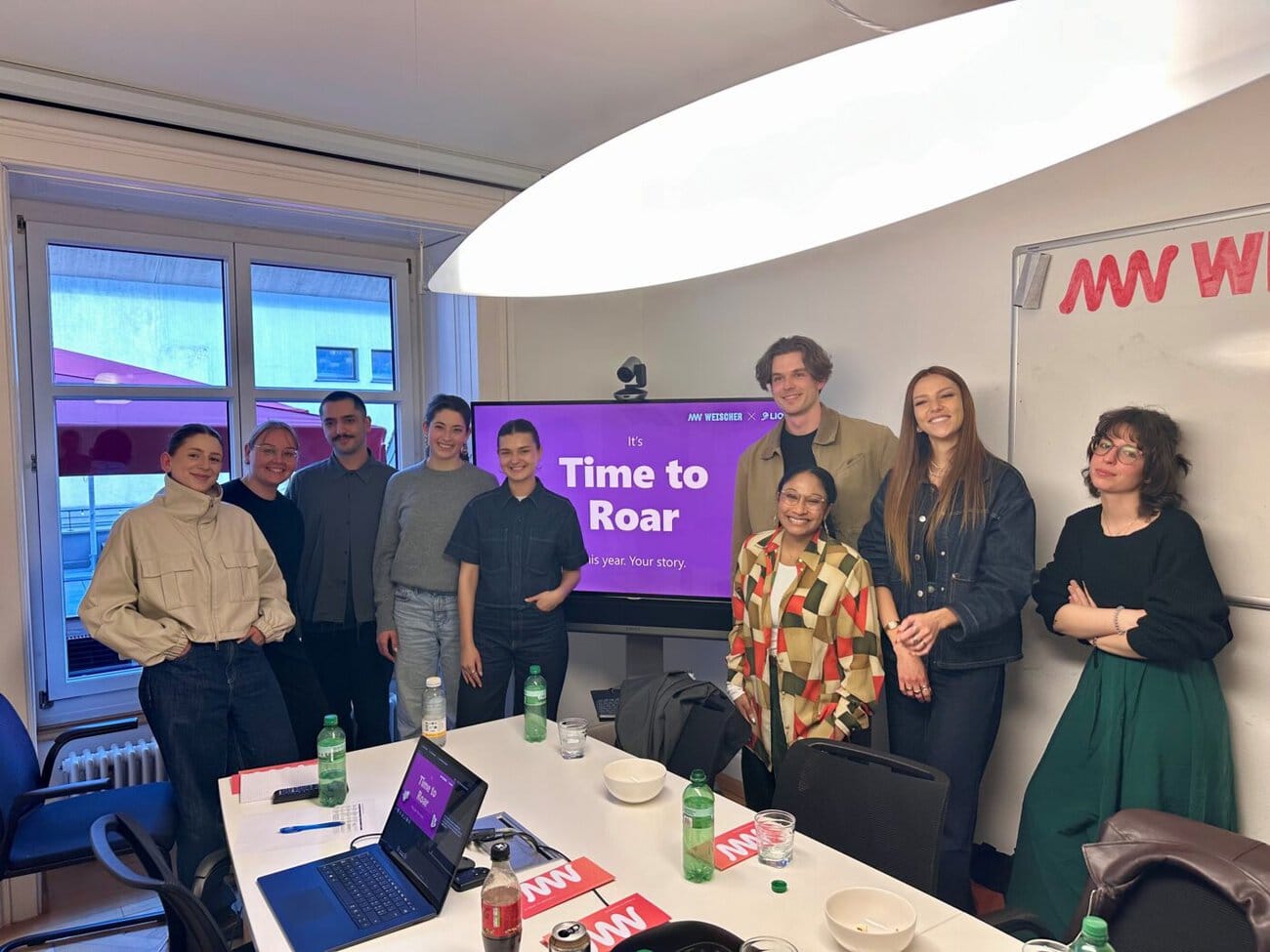
In the run-up to their trip to Cannes, the Young Lions gathered at the Weischer.Cinema Switzerland offices for their traditional roundtable discussion. The meeting served as an opportunity to get to know one another, warm up on the topic at hand, and get a first taste of the Cannes Lions atmosphere. The participants were particularly excited about networking internationally, meeting new industry colleagues from around the world, and drawing inspiration from ideas, work, and people.
Swiss Jurors for the 2026 Cannes Lions Switzerland
Two Swiss nationals were selected this year to serve on the shortlist jury at the Cannes Lions International Festival of Creativity. David Fischer of Scholz & Friends will serve on the jury for the Design category, while Silvia Lenberger of Nestlé will judge the PR category. The jury members will evaluate the submitted entries from home over a period of five to six weeks leading up to the festival and will then be invited to attend the festival. There will be no on-site representation on the awards jury this year.
The Cannes Lions jury consists of the Shortlist Jury and the Awarding Jury and evaluates the best international creative work in various phases. The jury members are selected by the festival management based on nominations from the national representatives and each country’s creative track record from the previous year.
168 Swiss submissions—up 19 percent from 2025
A total of 168 Swiss entries were submitted to the Cannes Lions International Festival of Creativity this year. Compared to 141 entries in 2025, this represents an increase of about 19 percent. «We are very pleased with the increase in submissions, which demonstrates the consistently high level of creativity and commitment of Swiss agencies and advertisers in international competition,» said Christof Kaufmann.
Halfway through the festival, Weischer.Cinema Schweiz is organizing the traditional Swiss BBQ to foster personal interaction among members of the Swiss delegation. The event will take place on Wednesday, June 24, at 12 p.m. at O’Key Beach in Cannes.
]]>

Weischer.Cinema Switzerland is expanding its leadership team in the Local Sales division. Effective July 1, 2025, Roger Mazenauer has assumed the role of Team Leader for Local Sales D-CH, overseeing regional sales at the leading cinema advertising agency.
The 52-year-old from Eastern Switzerland has many years of industry experience: Most recently, he worked at Swiss Regiomedia AG as Profit Center Manager for Eastern Switzerland and Head of the St. Gallen Region. Prior to that, he held the position of Regional Manager for Eastern Switzerland at Publicitas. Mazenauer is considered a proven expert in the regional advertising market and brings extensive expertise in marketing and client management to the role.
In his new role, Roger Mazenauer is responsible for leading local sales, with a focus on Eastern Switzerland, the City of Zurich, Central Switzerland, Aarau/Olten, the Basel area, Bern, and Ticino. In addition, he will drive the development of new commercial products within the marketing organization and, together with his team, further expand market development and the marketing of cinema operators’ advertising inventory.
«Movies evoke emotions like almost no other medium. I look forward to working with my team to harness this potential for our customers and further boost local sales,» says Roger Mazenauer about his new responsibilities.
Juliane Fankhauser-Merz, Director of Sales at Weischer.Cinema Switzerland, emphasizes: «With Roger Mazenauer, we are gaining a strong leader with a keen understanding of regional markets and our clientele. His many years of experience and his network are a great asset for Weischer.Cinema Switzerland, the sales teams, and the continued expansion of our local business.»
Weischer.Cinema is the market-leading cinema advertising agency throughout the D-A-CH region. The owner-managed company has more than 60 years of expertise in the cinema industry and ensures the comprehensive and customer-oriented advancement of cinema as a moving-image medium. Weischer.Cinema is a subsidiary of Weischer, one of Germany’s leading advertising agencies specializing in cinema, outdoor, and online advertising, with offices in Hamburg, Frankfurt, Cologne, Munich, Zurich, and Vienna.
For more information, visit www.weischer-cinema.ch
]]>Around 110 representatives from media, marketing and advertising gathered at Arena Cinemas Sihlcity on September 3, 2025 to gain new impetus, exclusive data and exciting perspectives on the topic of attention in moving image communication. Thanks to the support of the Interessengemeinschaft elektronische Medien (IGEM), the event gained additional visibility in the Swiss media community.
Seven Schögel theses
In his keynote speech, Prof. Dr. Marcus Schögel from the Institute for Marketing and Customer Insight at the University of St. Gallen focused on the importance of attention as a scarce commodity. Under the title "Attention between algorithm and distraction - seven theses for effective communication", he showed how brands can free themselves from short-term performance optimization and achieve sustainable impact through the right mix of brand and activation. Using scientific principles, he explained that communication is ineffective without attention. He introduced the "attention economy", in which information overload and distraction dominate, and emphasized that cinema has a unique attention monopoly here: shielded from second screens, highly emotional, socially amplified and with creative freedom for longer formats. His conclusion: Cinema is a premium touchpoint in the customer journey that anchors brand messages for the long term.
LUMEN Attention Study
The second part of the morning was followed by a presentation by Christian Tingler, Director Research Weischer.GeoConsult, together with Frank Senger, Head of Marketing & Communications / Managing Director Weischer.Cinema Germany. They presented the key findings of the new LUMEN Attention study. The study commissioned by Weischer enables an objective performance comparison of all moving image channels - including cinema - for the first time. The results provide groundbreaking insights into the effectiveness of media investments in the context of real attention.
Together with research partner Lumen Research (UK), eye tracking studies were carried out in real movie theaters. 215 test subjects watched 20 advertising motifs over eight screenings - the eye movements were recorded and analyzed using the latest technology. The results:
- Cinema achieves up to 4 x higher attention scores than other moving image channels.
- The attention CPM is up to 3 x lower.
- In combination with TV, Kino increases the number of "Attentive Contacts" by up to 26 % - without any additional budget.
Conclusion of the study
The research thus impressively proves that cinema is the most attention-grabbing and at the same time most efficient medium in the media mix. In an inspiring overview, they also outlined the relevance of attention in the modern media world according to the concept of the attention economy. Their message: Attention is not a buzzword, but the indispensable basis of effective brand communication.
Christof Kaufmann, CEO of Weischer.Cinema Switzerland, emphasized the relevance of the results: "Attention is the new currency in the advertising market. The LUMEN study impressively shows that cinema is the place where brands can have a real impact - far beyond the moment. Cinema is your best seat in media."
Significance for the advertising market
Whether as a stage for strong brand presentations or as an efficiency booster in the moving image mix - cinema remains the medium with the greatest impact. Attention has come to stay. And cinema delivers it in its purest form.
]]>Switzerland is once again sending talented young creatives to the Young Lions Competitions as part of the International Festival of Creativity, the Cannes Lions 2025 (June 16 to 20). This is made possible by the partnership with Weischer.Cinema Switzerland. According to Christof Kaufmann, CEO of Weischer.Cinema SwitzerlandIt is a pleasure to be active on behalf of Swiss creatives. Juliane Fankhauser-Merz, Director of Sales at Weischer.Cinema Switzerlandalso underlines the importance of this support.
The trip to Cannes was traditionally preceded by a roundtable event that brought together the winning teams of the ADC Young Creatives Awards 2025. Juliane Fankhauser-Merz described this meeting as a "warm welcome", which served to get to know each other, team building and mutual support. She emphasized the importance of supporting the Young Creatives for Weischer.

The young creatives at the roundtable were motivated and excited about Cannes. Many emphasized the opportunity to learn from international colleagues. The idea of teamwork and the support from Weischer were considered important.
In addition to today's roundtable, a boot camp with the German colleagues is planned. On site in Cannes, Weischer will offer support with questions and organization. Dedicated platforms such as the Swiss Barbecue will enable an exchange with the press and industry players.

Juliane Fankhauser-Merz is delighted about the participation of a film team that was already there last year, which creates a special dynamic. She emphasizes the pleasure of accompanying and supporting these constellations.
The young Swiss creatives are therefore well prepared for the Young Lions Competition in Cannes. Their enthusiasm and the support of Weischer.Cinema Switzerland give hope for a successful participation.

The judging of the ADC Young Creative Awards is an intensive process every year. Jurors from the advertising industry discuss and evaluate the work of creative teams under the age of 30 who develop innovative campaign ideas based on a real client brief. This year, the focus was on the Blick brand. The brief: to bring Blick to life and position it as an everyday companion for a young target group.
Max Boerke, Head of Marketing at Ringier Media Switzerland and client of the briefing, emphasized: "We want Blick to attract more attention and play a relevant role in young people's lives again." The work submitted showed a variety of approaches, particularly in the areas of cyber and out-of-home. Boerke made it clear: "There are some exciting ideas, some of which definitely have potential for implementation."

The process: discussions, trends and favorites
Philipp Skrabal, Vice President of the ADC and Partner at Team Farner, described the dynamics of the judging process: "We have three categories: Outdoor, Film and Cyber. Each is judged separately, finalists are chosen and then the final decision is made." Trends become apparent time and again. Skrabal observed an increased integration of AI: "AI has found its way in and is increasingly influencing creative solutions." Ultimately, the decisive factor is whether an idea has potential: "I give preference to the better, unfinished idea if I have the feeling that it can be worked on further."
Rob Hartmann, Executive Creative Director at Publicis, emphasized the quality of the U30 creatives: "I am always surprised at how well the young talents work. The combination of smart tech and existing ecosystems is particularly exciting." His focus in the evaluation: "Anything that makes me curious, surprised or makes me envious because I didn't think of it myself."
The standard was also high in the film category. Dominique Magnusson, Creative Director at Jung von Matt Limmat, commented: "The finished films have reached an impressive level. But for me, it's primarily the idea that counts." The discussions within the jury were intense: "Sometimes it was 50:50 for a long time before a decision was made."

The verdict: Courage and creativity as key factors
Courage is a key criterion for many jurors. Rob Hartmann appealed to the young creatives: "Be brave. In a loud world, you don't always have to shout. Sometimes the quiet tone is also convincing." Katrin Espelage, Creative Director at SiR MaRY, emphasized the importance of a strong insight: "An idea without a good insight remains pale. Conversely, a good insight can carry a mediocre idea."
Sandy Pfuhl, Creative Director, emphasized that the jury always looks at the creative potential: "It's not about whether an idea has already been perfectly implemented, but whether it surprises, inspires and shows new paths. Young talents are allowed to think unconventionally, because that's what makes the industry exciting."
The standard of this year's submissions was high, even if trends have shifted. Manuel Wenzel, Chief Creative Officer at TBWA\Switzerland, summarized: "The quality of implementation increases every year. Creatively, it was not the strongest year, but there was strong and worthy work."
The ADC Young Creative Awards act as a springboard for young talents who want to prove themselves beyond national borders. Those who impress here can qualify for the Young Lions Competition in Cannes - and perhaps soon set international standards.
Award ceremony as the grand finale
The intensive judging phase will now be followed by the awards ceremony, where the winners of the ADC Young Creative Awards 2025 will be officially announced. An evening that not only honors outstanding creative talents, but also underlines the importance of bold ideas and innovative storytelling in the advertising industry.


Nadine Koch has been on board as Manager National Sales since the beginning of October 2024 and completes the existing sales team. She previously worked for a Swiss media company. Koch has extensive media experience and a deep understanding of the needs of advertisers. In her new role at Weischer.Cinema, she will further develop the strengths and emotional experiences of cinema advertising and market them in a targeted manner.
"No other medium offers such intensive contact as the cinema. Not only the screen, but also the attention of the visitors is huge," Koch is convinced. "The 100% contact guarantee gives advertisers the certainty that their advertising will actually be shown to the audience present. That's what makes cinema advertising so unique."
Thomas Estermann joined the team as Sales Business Development Manager in September 2024. The newly created position focuses on the development of the "DOOH-Cinema Programmatic" product and the expansion of the areas of employer branding and recruiting campaigns in cinemas. Thanks to his many years of experience, including with (D)OOH providers, he has the necessary expertise to successfully establish these innovations.
Thomas Estermann sees great potential in targeting young talent and professionals at the cinema touchpoint and is committed to establishing this opportunity on the market. Since November 2024, over 700 screens in the cinema foyers can also be booked fully programmatically. "DOOH cinema programmatic opens up innovative ways to generate additional advertising francs," says Estermann.
]]>
Thanks to the cooperation between Weischer.Cinema Switzerland and One Tech Group, access to Dooh Cinema screens in over 40 cities is now simplified through the SSP1 platform and opens up programmatic booking opportunities. These portrait and landscape screens in movie theater lobbies offer advertisers precise targeting by reaching consumers where they spend at least 15 minutes. Leading DSPs such as Splicky, The Trade Desk and Active Agent are already connected and enable the target group to be addressed in a high-quality content environment.
Christof Kaufmann, CEO of Weischer.Cinema Switzerland, emphasizes the benefits: "By connecting our Dooh-Cinema screens to the SSP1 platform, we enable advertisers to address their target groups flexibly and with high quality in the cinema - our premium touchpoint." Daniel Siegmund, founder of the One Tech Group, also sees the potential: "With Weischer.Cinema Switzerland, we offer extended access to moviegoers who are keen to consume via SSP1."
Imaculix AG, whose digital signage system Cingerine supports the seamless integration and precise playout of programmatically booked campaigns, is responsible for the technical implementation. "We are delighted to be able to offer Swiss cinema operators new opportunities through this cooperation," adds Andy Bohli, CEO of Imaculix. Programmatic playout in cinema foyers complements a broad SSP1 inventory that already includes screens in shopping centers, sports venues and public transport.
]]>Fabrice Studer and Manuel Silva from TBWA\Zurich are competing in the Digital category. With their motto "Let's get it! Yes!", they are particularly looking forward to the international inspiration and the exchange with other Young Lions. A valuable takeaway from their preparation is the realization that complete and well thought-out ideas count.
Luisa Jentzsch and Sandro Schmocker from Jung von Matt Limmat and Jung von Matt Impact will be competing in the Print category. Their motto "Let's win this thing" has motivated them since winning the ADC Young Creative Awards. Sandro is particularly looking forward to the keynotes and the energy of the festival, while they have learned to give honest feedback and always strive for the best idea.
Francesca Kleinstück and Emil Maeder from Marty-Trezzini are representing Switzerland in the film category. Their motto "Emil and Francesca sinds gsi" is based on their winning claim from the YoungADC. Francesca expects international perspectives and creative exchange and hopes to take home new ideas and a relaxed approach to challenges.
Natalie Friederich from Jung von Matt Limmat and Joséphine Ducret from Publicis have qualified in the Direct category. As this is their second time in Cannes, they are aware of the emotional rollercoaster ride that awaits them and advise the other teams to enjoy the experience, be inspired and not drive themselves crazy.
Franca Boeglin and Gabriela Oetliker are competing in the Media category and share the motivating motto "Let's get it! Yes!". They are looking forward to the whole experience and emphasize the importance of surprise and touch in creative work. They want to take away a certain "something" from Cannes that will enrich their work.
The support of Weischer.Cinema Switzerland, represented by CEO Christof Kaufmann, Senior Marketing Manager Julia Koch and Director of Sales Juliane Merz, is of great importance to the teams. Kaufmann emphasizes the commitment to creative talent and the joy of promoting the Swiss delegation. One highlight will be the traditional Swiss BBQ on O'Key Beach, where the entire Swiss delegation will meet.
The participants prepare intensively for their competitions and share a common anticipation of the inspiring atmosphere of the festival. They emphasize the importance of creativity, teamwork and openness to new perspectives. The video interview provides an even deeper insight into their motivation and expectations.
You can find out more about the Roundtable and the Young Creative Teams at Reporting from last Wednesday, May 22.
]]>
The Swiss festival representative Weischer.Cinema and the ADC are continuing their partnership to enable young Swiss creatives to take part in the Young Lions Competition 2024. The film, print and digital categories have once again been selected via ADC Young Creatives Awards qualified. The media team was determined in a selection process by Weischer.Cinema. The team that won the ADC Young Creative Award in the Direct category will also be in Cannes, but without taking part in the Young Lions Competition.
The Swiss Young Lions 2024 at a glance
- Digital: Fabrice Studer and Manuel Silva from TBWA\Zurich
- Film: Francesca Kleinstück and Emil Maeder from Marty-Trezzini
- Media: Franca Boeglin from Jung von Matt Limmat, Gabriela Oetliker from Jung von Matt Impact
- Print: Luisa Jentzsch and Sandro Schmocker from Jung von Matt Limmat
- Direct: Natalie Friedrich from Jung von Matt Limmat, Joséphine Ducret from Publicis
On Wednesday evening, the Young Lions teams met at the premises of cinema advertising marketer Weischer.Cinema Switzerland for the Young Lions Roundtable to get each other in the mood for the upcoming Young Lions Competition. Christof Kaufmann, CEO of Weischer.Cinema Switzerland, is delighted: "Thanks to the partnership with the ADC, we have created a sustainable solution to promote young Swiss talent and ensure access to the international advertising stage. All Young Lions teams are highly motivated and determined to defend last year's Swiss success."
The Young Lions competition will once again take place alongside the festival this year. From June 17 to June 21, the teams will compete live on the Croisette against the best young creatives in the world.
3 Swiss jurors travel to Cannes
The Cannes Lions Festival has also appointed three Swiss jurors for 2024. "We are delighted that Switzerland is participating in both the Shortlist Jury and the Awarding Jury. We are particularly proud of Switzerland's renewed presence on the Awarding Jury," says Christof Kaufmann.
The Cannes jury consists of the Shortlist Jury and the Awarding Jury, both appointed by the festival management. They evaluate the works of the global creative elite at various stages. The jurors are selected on the basis of nominations from the country representatives and the festival management. The number of jury places per category depends on the country's creative achievements and awards in the previous year.
This year, Dominique Magnusson from Jung von Matt Limmat will be judging for the shortlist jury in the Industry Craft category. Patricia Corsi from Bayer Consumer Health in the Titanium category and Sama Al-Naib from BCW in the PR category have been nominated for the Awarding Jury.
Comparatively few Swiss submissions
This year, Switzerland recorded around 108 submissions. Compared to 157 submissions in 2023, Weischer.Cinema Switzerland is also surprised. "We have noticed that the number of submissions from advertisers has decreased, while the number of agency submissions has remained constant," comments Kaufmann. "We will try to find out in discussions how we can better support the submissions. Ultimately, however, the decision to compete with the advertising elite lies with the advertisers."
Swiss delegation meets again at the Swiss BBQ
Once again this year, Weischer.Cinema Switzerland invites you to the Swiss BBQ at the halfway point of the festival. On Wednesday, June 19, starting at 12 noon, the Swiss delegation will meet for a networking event at O'Key Beach in Cannes. Interested parties can here log in.
Good to know: The m&k Werbewoche.ch team will be reporting live from the Croisette again this year. Take a look and subscribe to the newsletter!
]]>
The 83 screens in the 12 Blue Cinema cinemas in German-speaking Switzerland and the broadcasting of advertising messages on the DOOH cinema screens in the cinema foyer will continue to be marketed by Weischer.Cinema Switzerland.
"We have been a well-established team with our advertising partner Weischer.Cinema Switzerland since 2012. We both firmly believe in the magic of cinema and are committed to taking the movie-going experience to a new level," says Ophélie Doebler, Chief Officer at Blue Cinema, on the extension of the partnership.
"The contract extension has a special significance, because Blue Cinema made the very first contract possible for Weischer.Cinema Switzerland and thus made a significant contribution to gaining a foothold in Switzerland," adds Christof Kaufmann, CEO of Weischer.Cinema Switzerland.
Weischer.Cinema Switzerland has thus secured all major cinema partnerships for the next contract cycle.
]]>