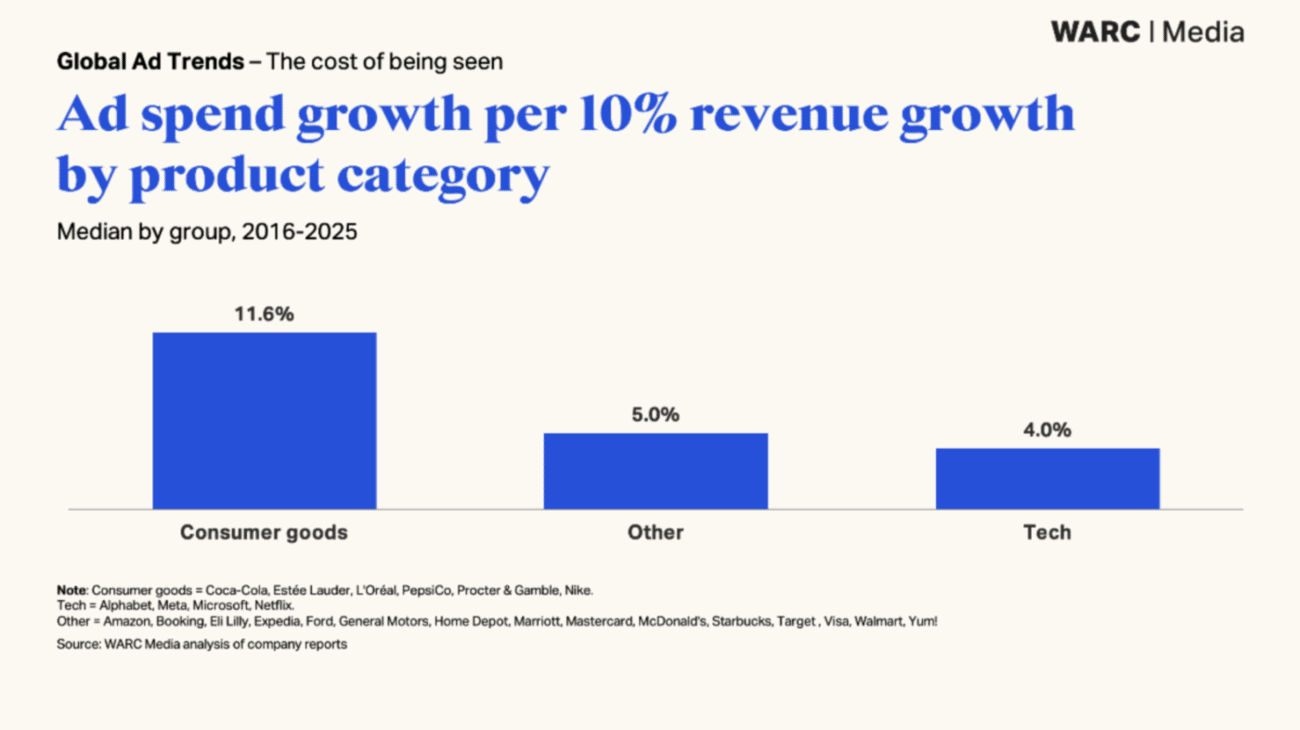
Ad spending by global brands is growing more slowly than their revenue. This is according to the report «Global Ad Trends: The Cost of Being Seen» by WARC Media. The study examines how advertising intensity has changed among 25 of the largest advertisers and to what extent major brand owners are driving the growth of the global advertising market. Consumer goods manufacturers are an exception to this trend.
Advertising Expenditures by Global Brands: Share of Revenue Declines
WARC Media forecasts that global advertising spending will grow by 11.9 percent this year to 1.34 trillion U.S. dollars. Adjusted for inflation, this represents a 61.3 percent increase over 25 years, driven by new channels such as retail media and platform advertising. However, advertising intensity has declined in recent years.
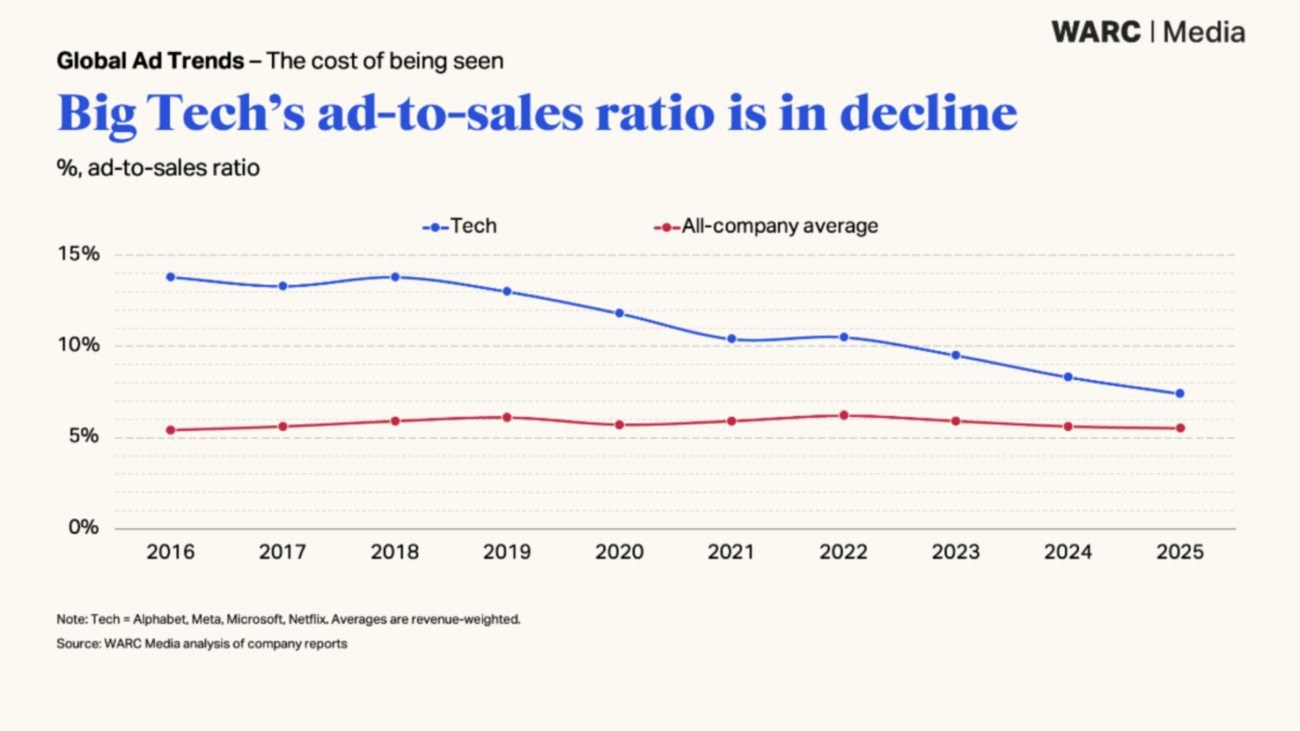
Among 25 major U.S. advertisers, the combined ratio of advertising spending to revenue fell from 6.1 percent in 2019 to 5.5 percent in 2025. This does not mean a retreat from advertising: Advertising spending rose by a combined 56 percent, while revenue rose by 73 percent.
Big Tech is driving down the rating
For Alphabet, Meta, Microsoft, and Netflix, the combined ratio fell from 13.0 to 7.4 percent between 2019 and 2025. Their combined revenue grew by 146 percent, from $379 billion to $931 billion. If the companies had maintained their 2019 spending rate, they would have invested $121 billion in 2025, according to WARC—$52 billion more than they actually did.
The consumer goods industry is taking the opposite approach
The six consumer goods brands analyzed—Coca-Cola, Estée Lauder, L’Oréal, Nike, PepsiCo, and Procter & Gamble—showed divergent trends. Five of them increased their ratio between 2019 and 2025, while PepsiCo’s remained largely stable. Due to weaker revenue growth, the combined ratio rose from 11.6 percent in 2023 to 12.5 percent in 2025. Their advertising spending grew by 36 percent from 2019 to 2025, while revenue grew by 29 percent.
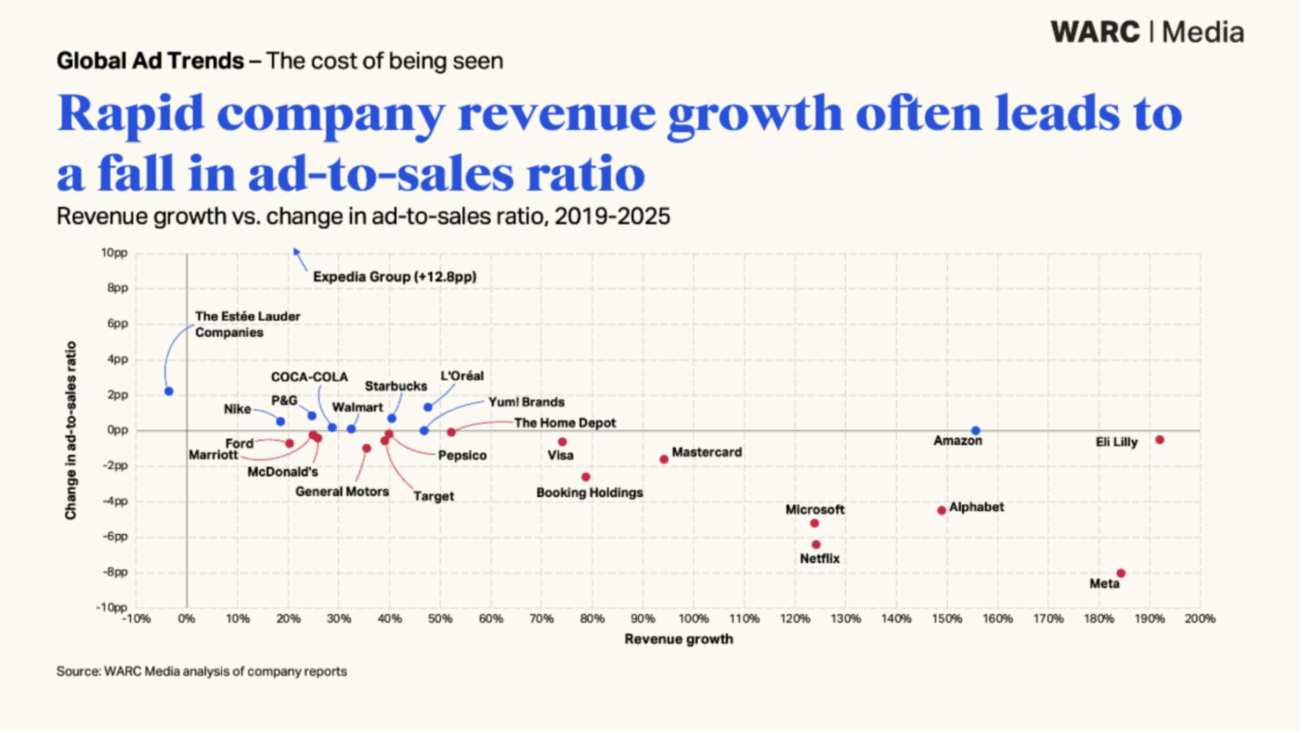
The picture is mixed for the remaining 15 advertisers. The revenue-weighted average remained the same or rose slightly, but ten companies saw their share decline. Ford fell from 2.3 to 1.6 percent, General Motors from 2.7 to 1.7 percent, Visa from 4.8 to 4.2 percent, Mastercard from 5.6 to 4.0 percent, McDonald’s from 1.7 to 1.3 percent, and Target from 2.0 to 1.4 percent. Marriott, Booking Holdings, Eli Lilly, and The Home Depot also saw declines. Amazon and Yum! Brands remained largely unchanged, while Walmart, Starbucks, and Expedia saw their shares rise.
Three Factors Behind the Divide
WARC identifies three factors that influence advertising intensity. First, weak sales: Companies that maintain their advertising spending during difficult market conditions may see an increase in advertising intensity. Second, budget shifts: Funds that used to be allocated to sales teams for trade and shopper marketing are now flowing into retail media and, consequently, into advertising placements. Third, ownership of attention: Companies like Alphabet and Meta own an audience and can grow without having to pay for attention.
Alex Brownsell, Head of Content at WARC Media, says: «The global advertising market is growing rapidly, yet companies ranging from Meta to Mastercard and McDonald’s are spending a shrinking share of their revenue on advertising.» Only consumer goods companies, which were suffering from slowing revenue growth and saw their trade budgets shift to measured media, increased their advertising intensity. The expansion of platform spending by smaller companies and cross-border e-commerce providers is far outpacing the growth in advertising investment by major brands. This has major implications for the ecosystem of agencies and service providers in the enterprise market.
Methodology
WARC analyzed annual SEC filings from 25 large publicly traded U.S. companies. The ratio is calculated by dividing annual advertising spending by revenue and multiplying by 100. Since some companies report only combined sales and marketing expenditures, WARC supplemented the data with industry figures from Schonfeld & Associates and its own ROI benchmarks. WARC Media subscribers can read the full report. A podcast discussing the findings is scheduled to be available starting November 17.
]]>
The The Future of the Strategy Those directly affected view it with cautious optimism. This is according to the report «The Future of Strategy 2026,» published by Warc. The study is based on a global survey of 489 strategists conducted in August 2026. The majority of respondents work at agencies.
Greater influence with customers
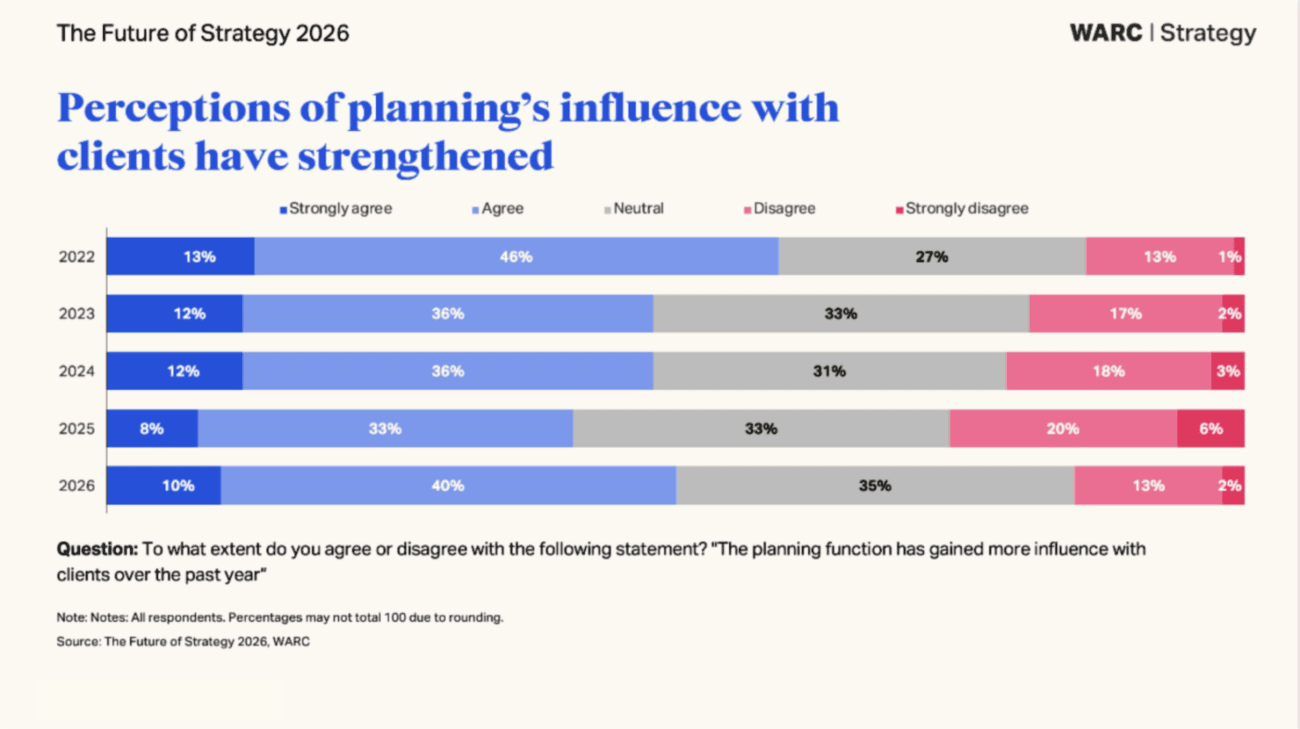
According to Warc, 66 percent of strategists agree that there are clear reasons for optimism. Lena Roland, Content Director at Warc Strategy, says: «Last year’s report painted a gloomy picture of agency-side strategy. Twelve months later, the mood has shifted, with 66% of agency-side strategists agreeing that there are clear reasons to be optimistic.» The influence of strategy on clients rose to 50 percent, up from 41 percent in 2025. Internal influence remained unchanged at 46 percent.
The Future of Strategy: Demonstrating Added Value Remains Key
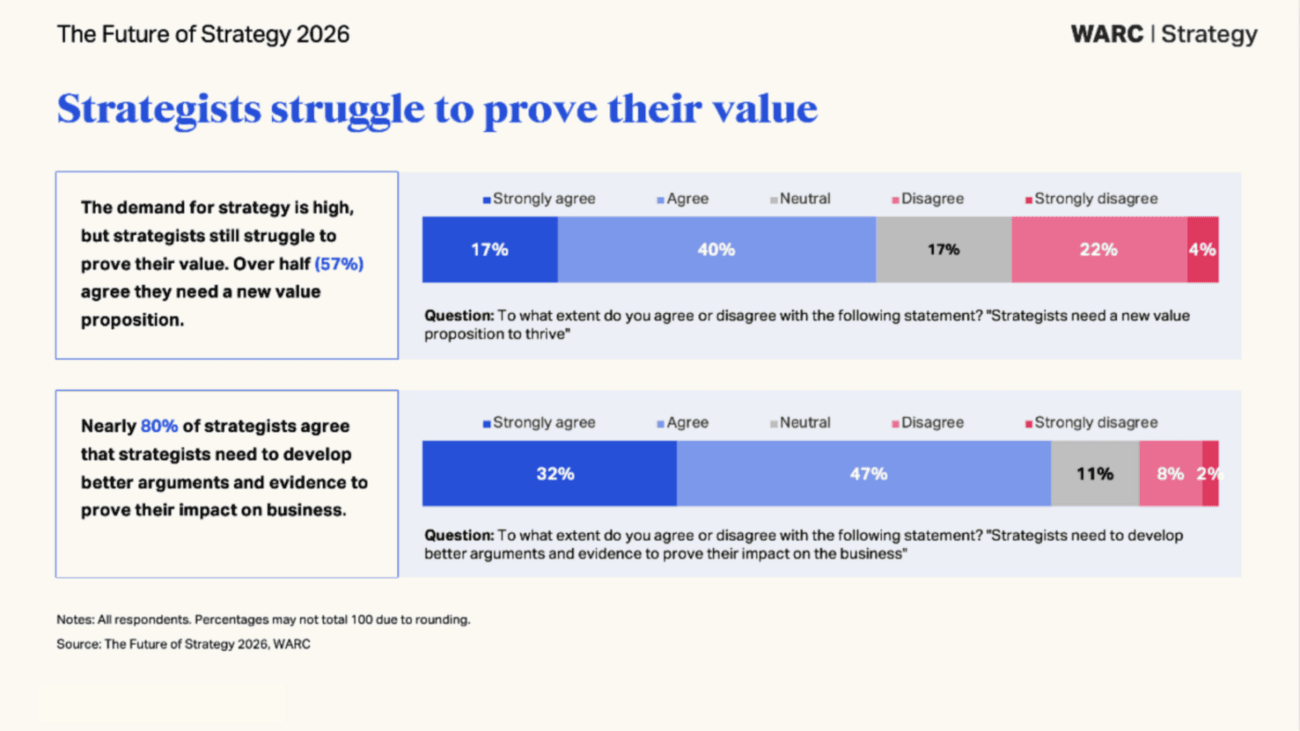
Despite high demand, demonstrating value remains a challenge. 57 percent of strategists say they need a new value proposition because compensation models need to improve. Just under 80 percent believe the profession needs to develop stronger arguments and evidence of its impact on the business. Nikita Walia, a partner at Unamed, says: «The strategist who only understands the “front stage” of a brand—messaging, insight, positioning—will quickly hit their ceiling. The strategist who understands the backstage—how things are made, distributed, and measured—will become indispensable.» Strategists can demonstrate their value by linking recommendations to business results and speaking the language of senior management.
AI as an Opportunity and a Threat
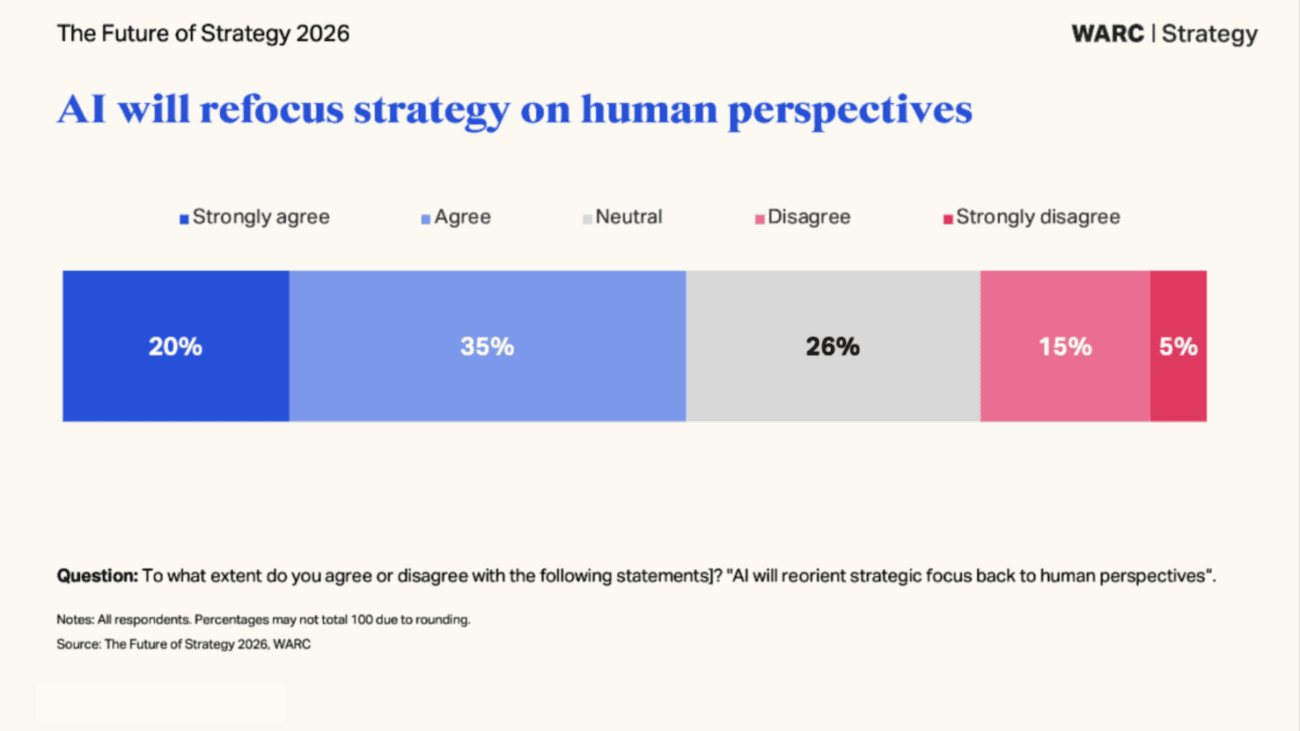
56 percent of strategists fear that AI will replace their roles. That is 15 percentage points more than in 2025 (41 percent), making it the most commonly anticipated threat. At the same time, AI frees up more time for reflection: 65 percent use the time saved for more nuanced, strategic work, and 55 percent believe that AI will align strategy more closely with human perspectives. Respondents cite banal results, a lack of cultural nuance, and a lack of emotional resonance as AI’s greatest weaknesses.
At the same time, qualitative field research is on the decline: 23 percent conduct in-person research at least once a month, down from 35 percent in 2025. Elizabeth Paul, Chief Brand Officer at The Martin Agency, says: «AI should not give strategists permission to do less human research. It should give us the time to pursue more extraordinary truths with greater depth.»
Strategists Are Moving Closer to Corporate Leadership
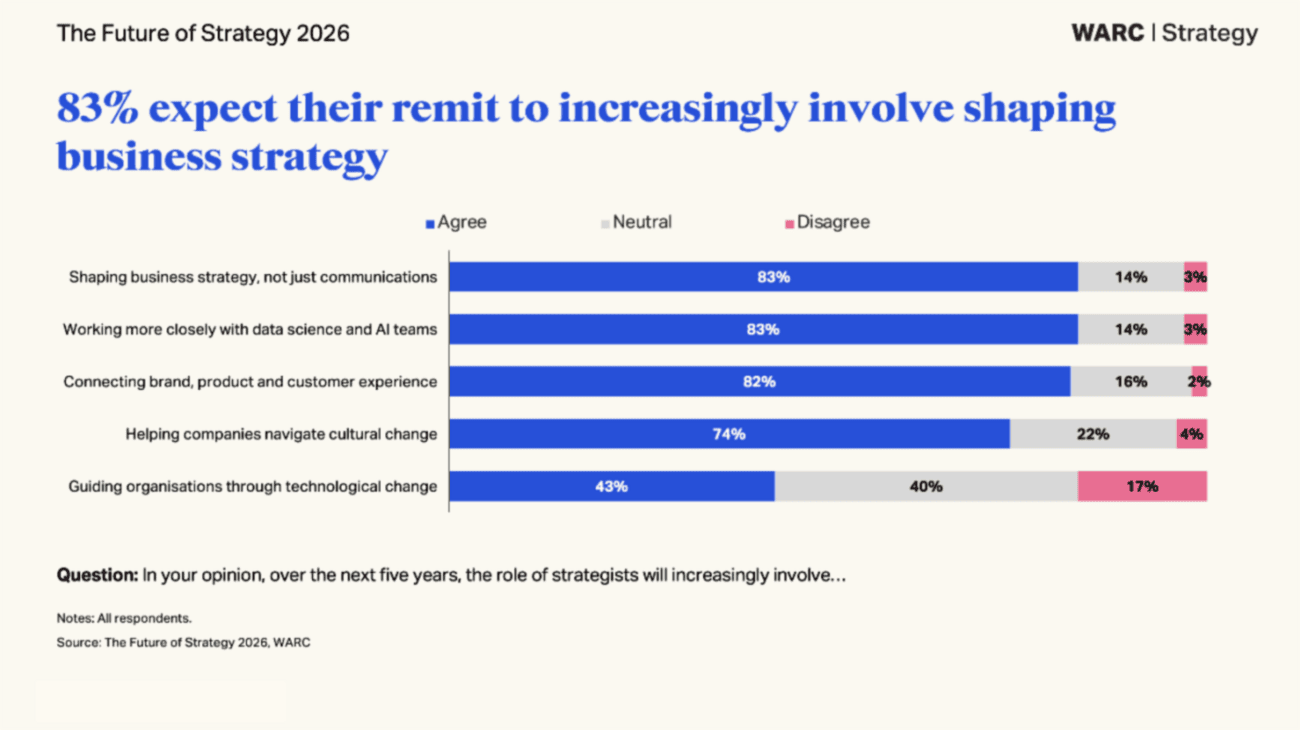
83 percent of strategists expect that their responsibilities will include shaping business strategy in the future, rather than just communication. A key issue is the «two-audience problem»—that is, addressing both people and machines. This is leading strategists into fields such as CX, PR, and agentic commerce. Other tasks include identifying new «demand spaces» and frameworks that reflect media trends.
]]>
B2B Marketing Study Shows: Trust Is the Deciding Factor in Purchases
A new B2B marketing study by Warc, LinkedIn, and Lions Advisory takes a close look at the emotional factors that shape B2B purchasing decisions today. B2B purchasing processes have changed: buying cycles now last 272 days and involve 22 stakeholders, with social and emotional factors playing an increasingly important role. In addition, artificial intelligence is changing how B2B buyers discover, research, and validate brands: According to the study, 94 percent of B2B buyers will use LLMs during their buying journey by 2025.
An analysis of more than 700 award-winning B2B campaigns shows that the most effective creative work not only captures attention but also strategically helps build confidence in decision-making. According to the press release, the most impactful campaigns consistently helped buyers feel more confident in their brand choices.
The Three Rs of Purchase Readiness: Recommendations, Relationships, Relatability
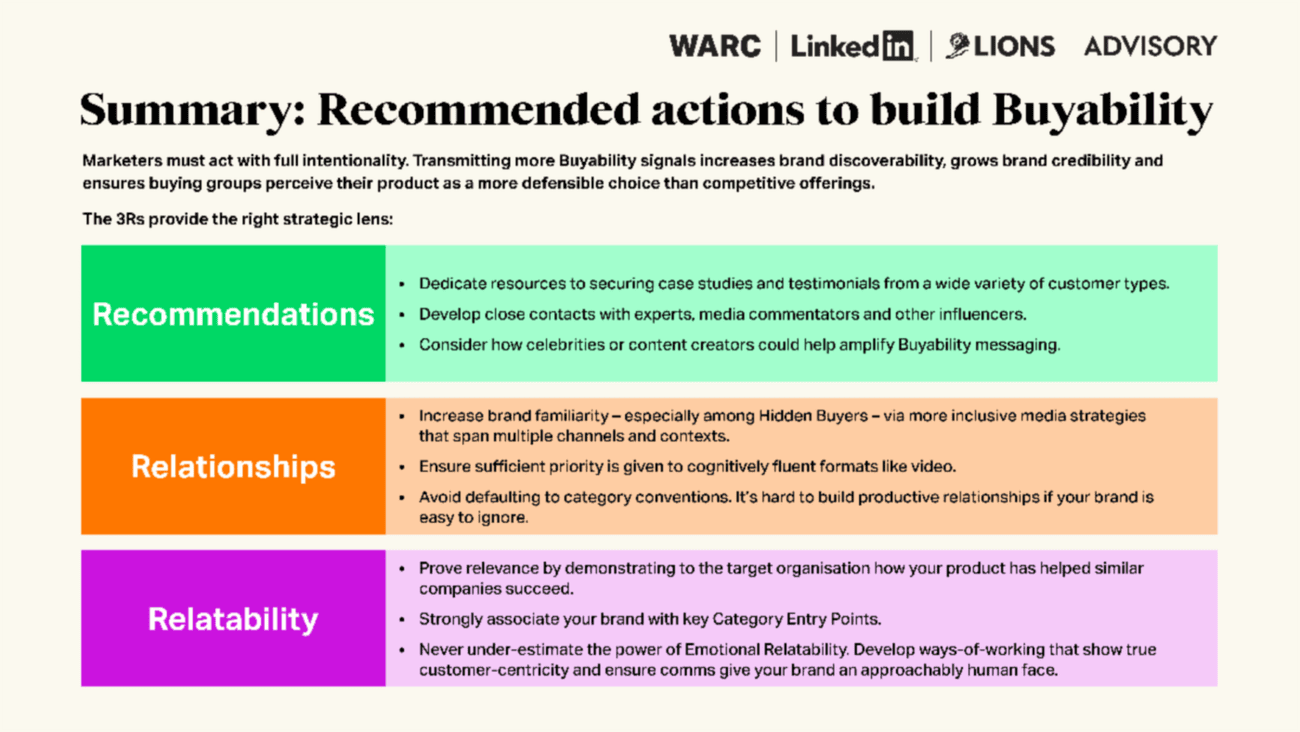
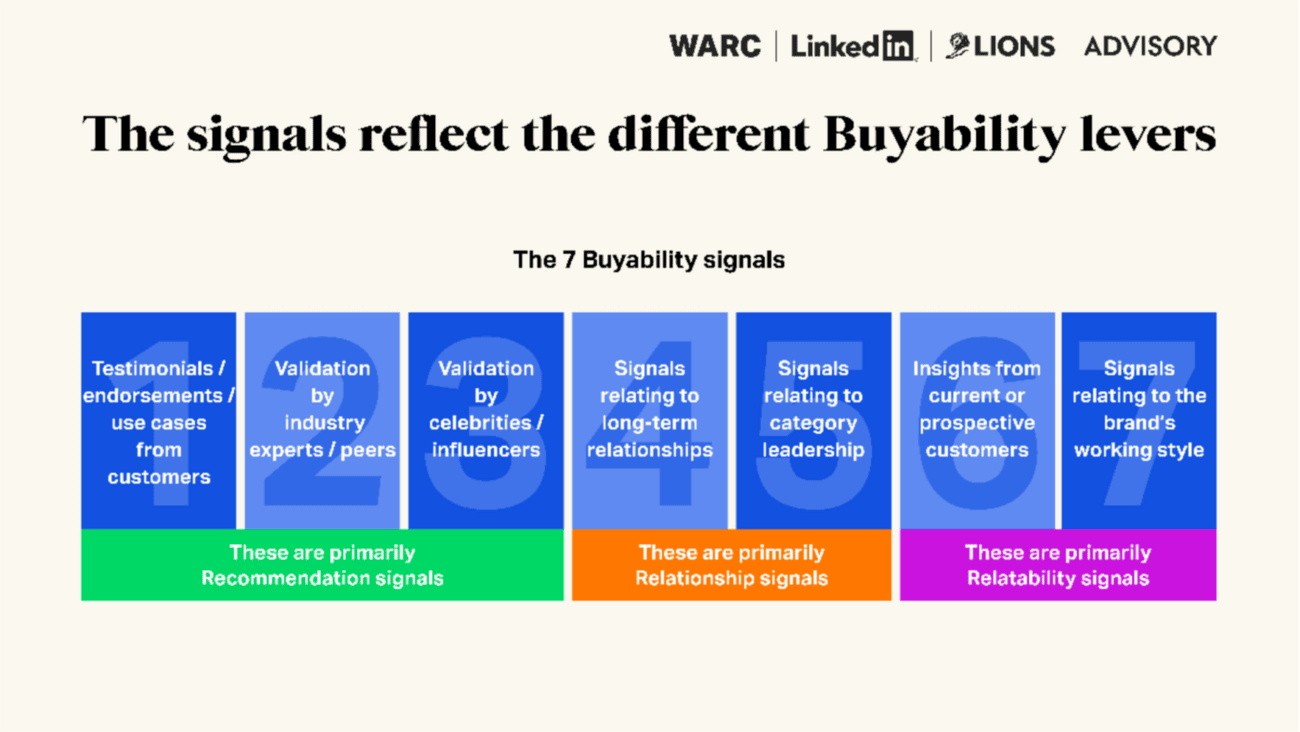
The study builds on existing research by LinkedIn and Bain & Company on the concept of «buyability» and identifies seven signals that boost buyer confidence. At the heart of the study are the so-called 3Rs: Recommendations, Relationships, and Relatability.
Recommendations include evidence and validation from customers, peers, experts, or trusted voices. Relationships signify long-term partnerships and existing familiarity. Relatability refers to real customer situations, use cases, and experiences that buyers can relate to. According to the study, personal experiences and trustworthy recommendations drive vendor selection more than performance or price, and messages referencing «similar customers» are said to outperform «market leader» claims.
Imaad Ahmed, Thought Leadership Director at Lions Advisory and Warc, is quoted in the press release as saying: «The Buyability model has been very well received throughout the B2B industry. This new study aims to demonstrate the impact of Buyability using real-world case studies. The goal of our research was to measure how frequently buyability signals appear in B2B campaigns and whether more signals lead to better results.»
Mimi Turner, Head of Marketplace Innovation at LinkedIn, adds: «Buyability provides us with a framework of seven signals that marketers can use to strategically improve campaign results, because it’s based on insights into what gives buyer groups confidence when making a purchase. The campaigns that succeed are those that make purchasing decisions easy to justify.»
Seven Signals as a Framework for Marketing Professionals
The Buyability Framework describes seven signals for future campaigns, each of which is assigned to one of the 3Rs. These signals are intended to make brands discoverable in AI models, make them appear credible to various stakeholders, and position them as a justifiable, low-risk option. According to the study, it is no longer enough for B2B marketing to increase awareness and consideration—it must demonstrate that it directly generates sales.
The key findings of the study: Buyability signals are clearly underutilized, with an average of just 1.6 signals per campaign. Nearly one-third (30 percent) of campaigns use only a single signal, while 22 percent use none at all. Less than one-quarter of all campaigns use three or more signals.
According to the study, campaigns with stronger buyability signals improve relevant brand metrics significantly more often: High-buyability campaigns are reported to show improvements in brand awareness 24 percent more often and improvements in mid-funnel metrics—such as consideration, preference, and purchase intent—91 percent more often. There are also commercial benefits: Compared to low-buyability campaigns, high-buyability campaigns are 63 percent more likely to result in increased ROI and 110 percent more likely to result in increased incremental revenue.
For the study, 700 B2B campaigns from the Warc database spanning the years 2010 through 2025 were analyzed, including entries and winners from the Cannes Lions B2B category, the Effies, and the Warc Effectiveness Awards, across various regions and industries. The dataset was independently classified using the B2B Effectiveness Ladder developed by Warc, Lions, and the B2B Institute, and evaluated for buyability signals. High-buyability campaigns (three to seven signals) were compared with low-buyability campaigns (zero to two signals).
The full report, «How to Build More Buyable Brands: How Recommendations, Relatability, and Relationships Drive Campaign Success,» is available online at https://www.warc.com/en/article/how-to-build-more-buyable-brands-0c41b00d9bd14e189955507d7b6b7c76.
]]>
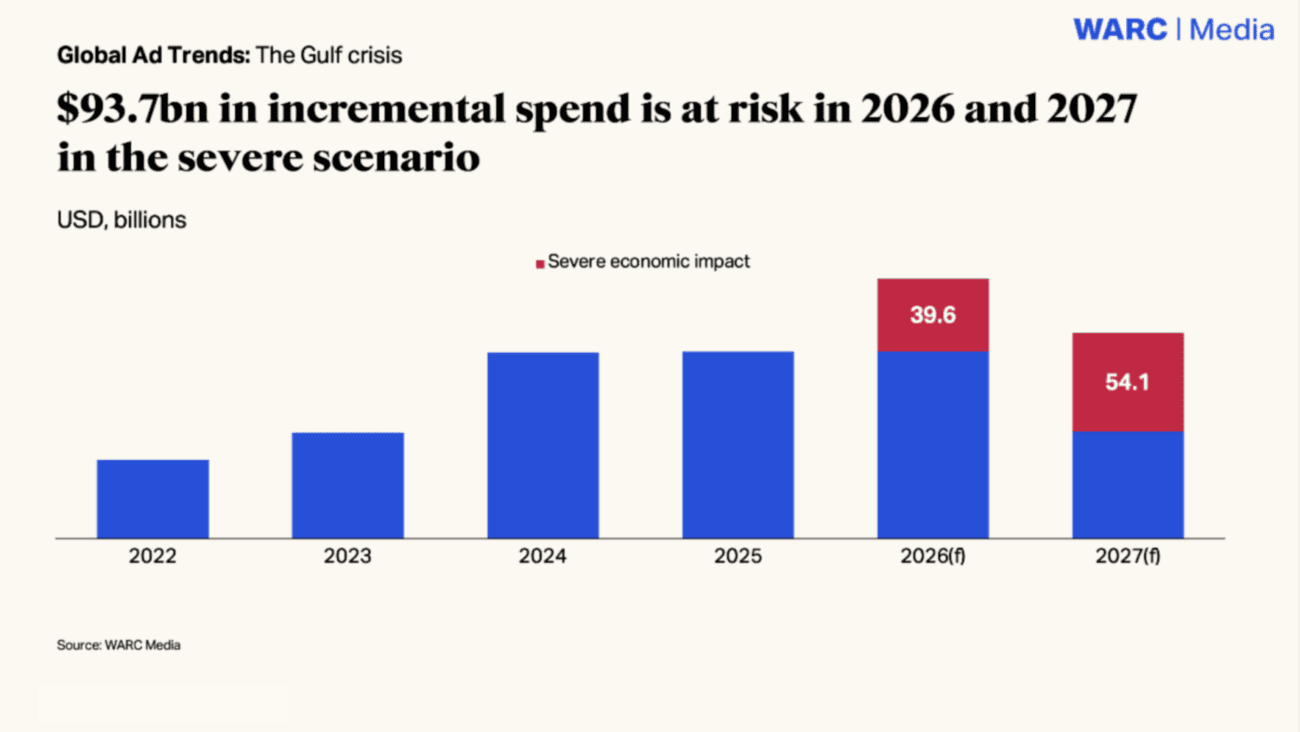
Global advertising spending is under pressure: According to a recent forecast by WARC, the ongoing Gulf crisis could wipe out up to $93.7 billion in expected global advertising growth by the end of 2027. The analysis is based on data from 100 markets and a proprietary neural network that evaluates more than two million data points.
Global Advertising Spending in 2026: Base Forecast Revised Upward
In its baseline scenario for the current year, WARC forecasts global advertising growth of 11.5 percent—an upward revision from the March forecast of 10.6 percent, driven by a strong first half of the year for online platforms. Global advertising spend would thus rise to $1.39 trillion. For 2027, WARC expects growth of 8.2 percent to a total of $1.50 trillion.
However, the baseline scenario is subject to change: If the conflict in the Gulf region—particularly the blockade of the Strait of Hormuz—were to escalate further, up to 3.2 percentage points, or $39.6 billion, could be deducted from growth in 2026. In 2027, the figure would be an additional $54.1 billion.
James McDonald, Director of Data, Intelligence & Forecasting at WARC and author of the study, assesses the situation: «The blockade of the Strait of Hormuz acts like a tax on consumers, driving up prices and eroding real purchasing power. If the conflict persists or intensifies further, the risks will shift toward stagflation, with sectors such as travel, automotive, and food being particularly hard hit by higher production costs and weaker demand.»
Regional differences: Latin America shows the biggest swing
The impact of the crisis is unevenly distributed. While Southeast Asia and Latin America have high baseline growth rates, they are also the most vulnerable. For Latin America—led by Brazil and Mexico—WARC forecasts growth of 12.8 percent to $27.8 billion in the base scenario. In the severe scenario, this figure shrinks to just 3.4 percent—a decline of 9.4 percentage points, the largest swing of any region.
China is facing rising energy and shipping costs, which are weighing on industrial margins and export competitiveness. The baseline forecast for Chinese advertising spending is 7.9 percent growth ($223.1 billion); in the worst-case scenario, this drops to 5.3 percent growth—a loss of $5.3 billion.
The U.S. is proving to be relatively resilient: Core growth stands at 9.5 percent, reaching $452.6 billion; even in the worst-case scenario, growth remains at 7.2 percent, representing a loss of just $9.8 billion. The FIFA World Cup and the midterm elections are providing additional support to the market.
The Gulf Cooperation Council (GCC) markets—including Saudi Arabia, the United Arab Emirates, Kuwait, Oman, Qatar, and Bahrain—are already under pressure from weakened demand from global advertisers. In the worst-case scenario, the GCC advertising market will contract by 0.2 percent.
Travel, Automotive, Food: The Three Most Vulnerable Sectors
At the sector level, travel & transportation, automotive, and food are particularly vulnerable. The travel sector is the only major category that is already shrinking on a global scale: advertising spending is expected to decline by 3.5 percent to $34.4 billion. According to WARC, airlines with operations in the Middle East are already reviewing their budget allocations.
In the automotive sector, the dual pressure of rising manufacturing costs and subdued demand for consumer credit is evident. Germany—one of the world’s largest automakers—is projected to see growth of just 1.9 percent in automotive advertising spending under the base scenario. Should the crisis escalate, this would result in a contraction of 4.2 percent, corresponding to a swing of 6.0 percentage points.
In the baseline scenario, the food sector is still growing at a solid rate of 10.3 percent to $99.8 billion—but rising costs for fertilizers, grain, fuel, and packaging mean that the full impact will not be felt until the second half of 2026 and will become more pronounced in 2027. In the United Kingdom, for example, food advertising spending would decline by 0.2 percent in the severe scenario, whereas the baseline scenario still projects an increase of 4.9 percent.
Media Channels: TV and Print Under Pressure, Global Advertising Spending Shifts
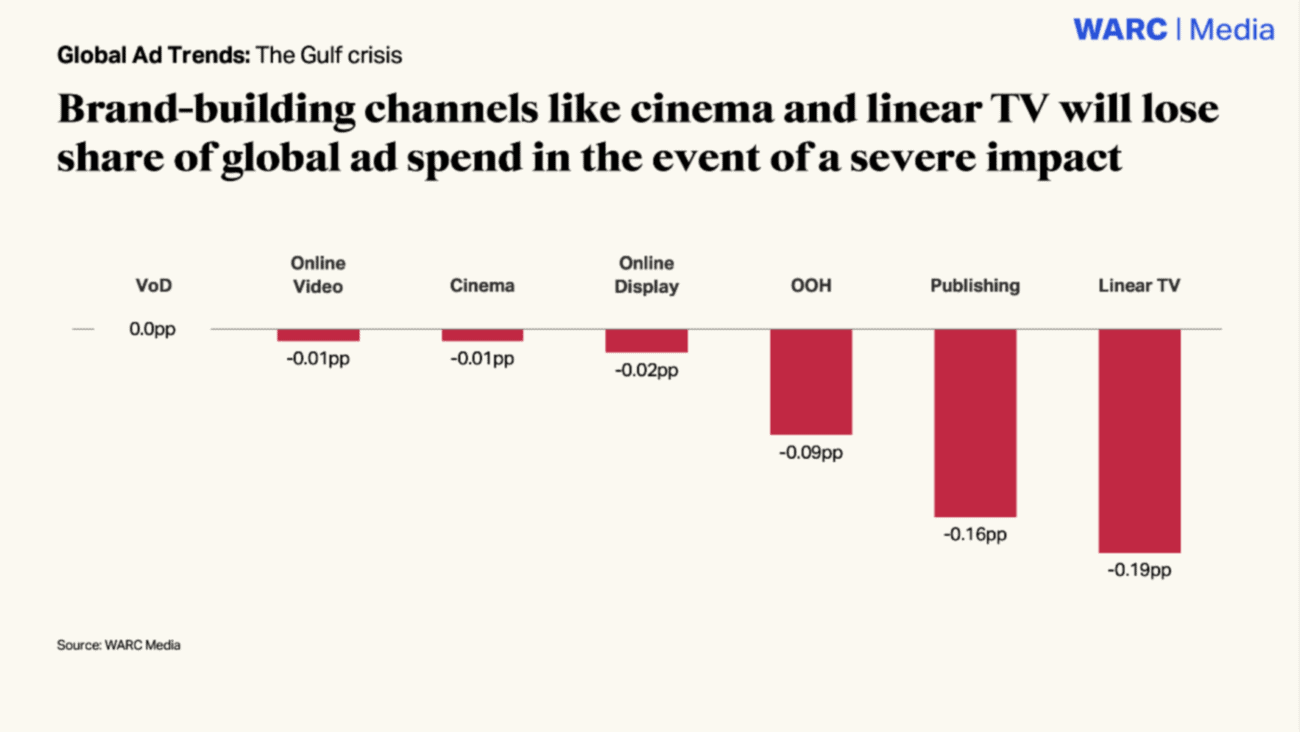
The crisis is affecting brand-oriented and performance-oriented media channels differently. Linear TV is already losing 2.7 percent in the base scenario—a decline that widens to 7.3 percent in the severe scenario. The combined TV market share (linear plus video-on-demand) falls from 12.7 percent in the baseline scenario to 12.5 percent in the severe scenario. The FIFA World Cup partially cushions the decline in the base scenario, but this buffer diminishes as the situation escalates.
In the severe scenario, publishing shrinks by 8.5 percent (compared to a decline of 0.8 percent in the baseline scenario), while the movie theater sector loses 4.0 percent—compared to projected growth of 6.3 percent in the baseline scenario. Cinema, along with publishing, is considered the least resilient channel in the dataset, as it is directly linked to discretionary leisure spending and movie theater attendance.
In the base scenario, social media grows by 20.0 percent; in the severe scenario, by 17.9 percent—a decline of 2.1 percentage points, which corresponds to a loss of 7.8 billion dollars. However, WARC points out that the advertising base for social media is heavily concentrated among small and medium-sized enterprises (SMEs), which could cut their marketing budgets as household demand declines.
Paid search—including generative AI—is proving to be the most stable channel: Even in the worst-case scenario, it is still growing by 11.0 percent, just 3.3 percentage points below the baseline scenario of 14.3 percent. Together with social media and retail media, search platforms are expected to account for two-thirds of global ad spending even in the most extreme scenario modeled.
The full WARC report will be available to WARC Media subscribers starting June 15. A podcast discussing the findings will be available starting June 18.
More information: https://www.warc.com/media
]]>
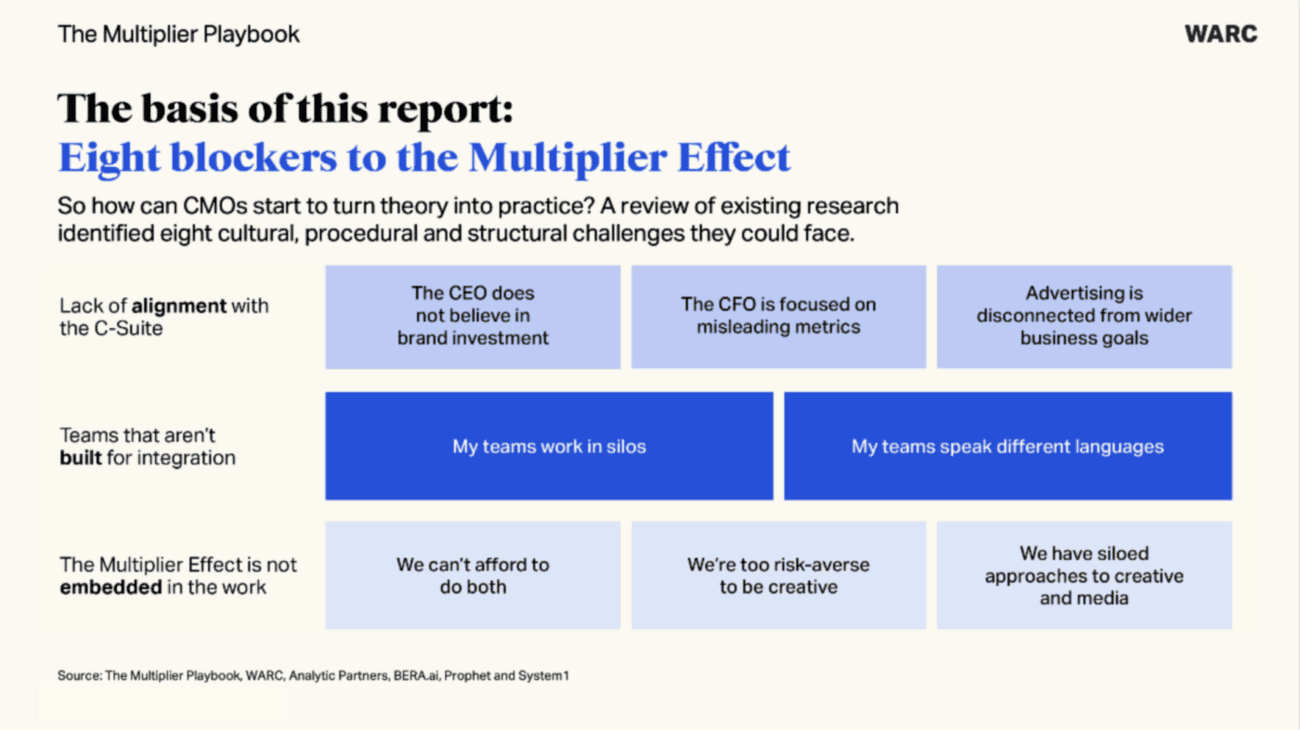
Most marketing professionals are familiar with the theory of advertising effectiveness—but there is a wide gap between knowledge and implementation. This «say-do gap» is the starting point of the new report The Multiplier Playbook, published by Warc in collaboration with Analytic Partners, Bera.ai, Prophet, and System1. The report focuses on why the integration of brand and performance fails in so many organizations—and how CMOs can overcome the biggest obstacles.
Eight Obstacles to Brand and Performance
The report builds on the findings of the study published last year The Multiplier Effect At the time, Analytic Partners used the ROI Genome to demonstrate that brands that shifted from a pure performance approach to a blended strategy combining brand and performance achieved an average uplift of 90 percent in revenue return on investment. Nevertheless, implementation in practice regularly fails due to cultural, procedural, and structural misalignments.
For the Playbook, more than 200 senior marketers were surveyed in a joint study conducted by Warc and the Association of National Advertisers (ANA) between December 2025 and March 2026 in the United States. The results were combined with existing data and frameworks from the partner organizations.
David Tiltman, Chief Content Officer at Warc and SVP of Content at Lions Intelligence, sums it up: «What’s needed is a playbook—a combination of data, frameworks, and real-world examples that help marketing professionals identify the key obstacles and take concrete steps.»
C-suite executives have little understanding of brand and performance
One key finding concerns alignment with senior management. While about two-thirds (67 percent) of the marketers surveyed agree that their CEO considers the brand to be important, However, only 19 percent said that the C-suite regularly demonstrates the connection between brand strength and concrete business results. Even more concerning: Only 21 percent of respondents strongly agreed that their advertising goals are aligned with the C-suite’s objectives.
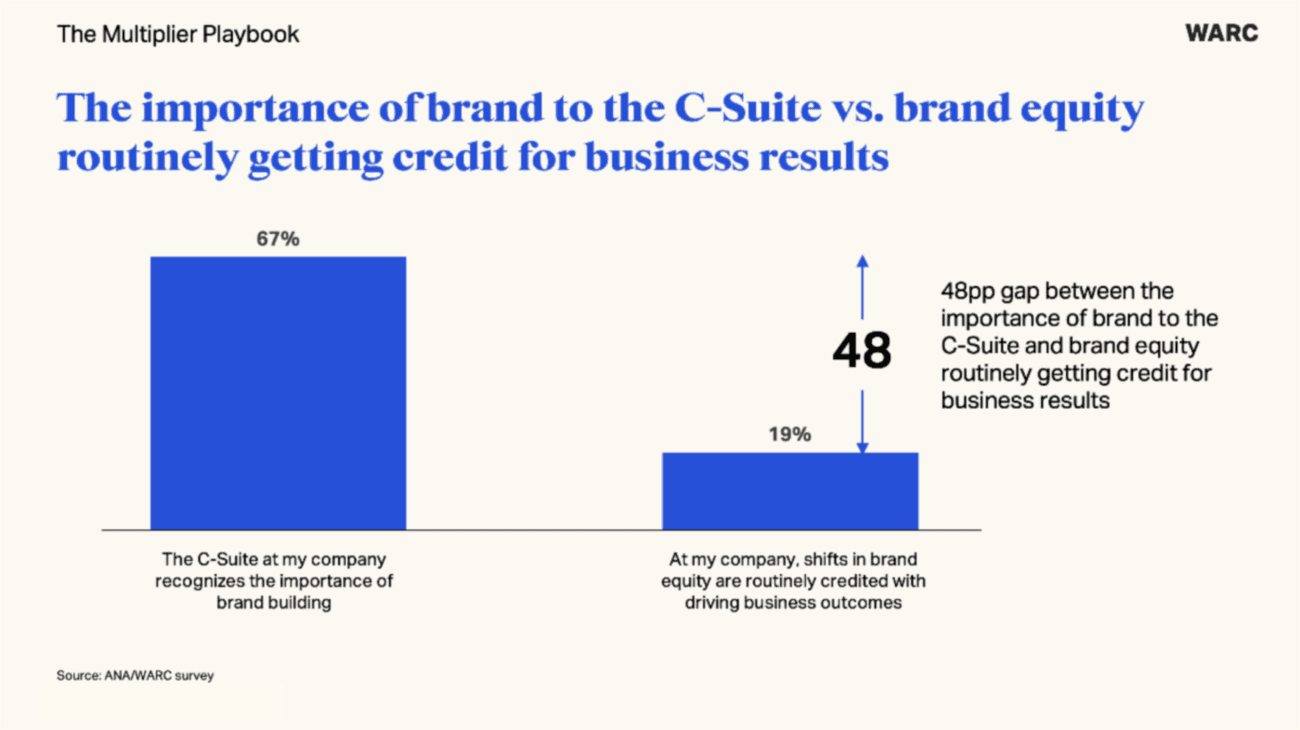
In addition, 60 percent of respondents feel that the C-suite does not fully understand the role of advertising in achieving commercial goals. The report states that the dominance of efficiency-based metrics such as platform-specific ROAS exacerbates this problem. As a result, advertising is viewed as a cost center rather than a value-creating investment.
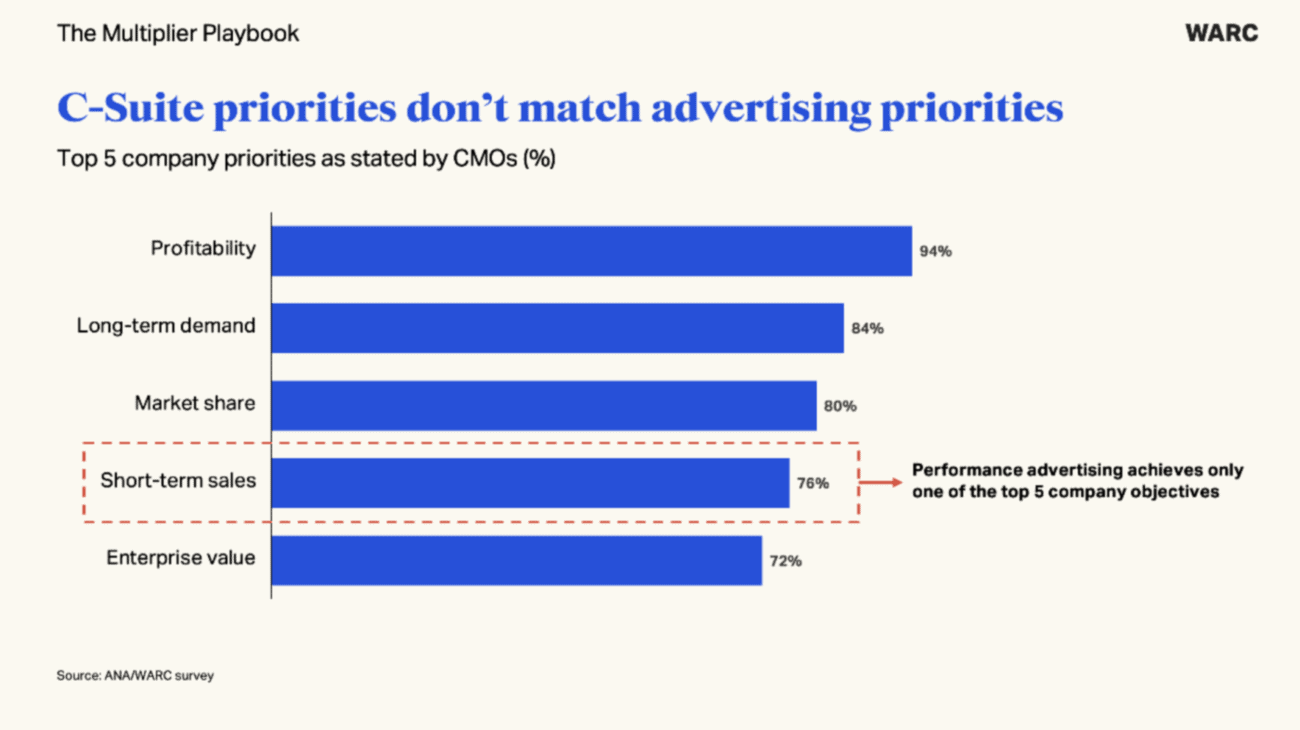
Silos hinder integrated thinking
The survey also reveals significant structural shortcomings within marketing departments. In 49 percent of the organizations surveyed, brand and performance teams operate separately; only 25 percent have fully integrated teams. 65 percent maintain separate budgets for brand and performance. Only 44 percent of respondents say their teams share a common language or a common understanding of which target audiences offer the greatest growth potential.
The report recommends developing shared goals based on specific behavioral changes among consumers and deliberately creating moments in the annual calendar that require cross-team collaboration. Laura Jones, Chief Marketing Officer at Instacart, is quoted in the report as saying: «We have to »make our own weather.’ We need to create events and campaigns where we’re all rowing in the same direction and getting more out of our collective efforts.”
Creativity as an Underestimated Lever
Another finding from the Playbook concerns the approach to creativity. According to a survey by System1 and Effie Worldwide, 41 percent of marketers view creative advertising strategies as a risk. More than half (52 percent) stated that they do not have sufficient confidence in the effectiveness of advertising. Compounding this issue is the fact that, according to data from Analytic Partners’ ROI Genome, 90 percent of advertising materials are not used long enough to achieve their full impact.
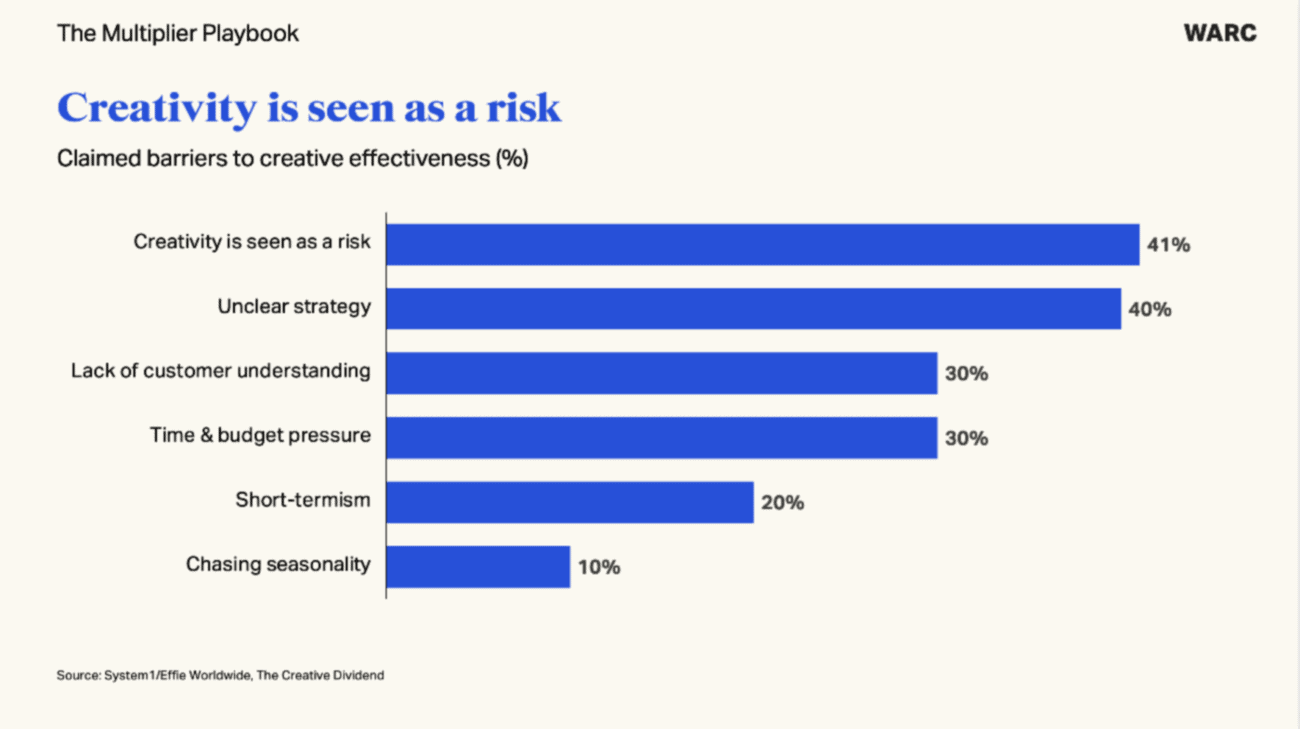
The report recommends a «Fewer, bigger, longer» approach to creation, as well as closer integration of media, creative development, and measurement. To minimize risk, the Playbook proposes a four-tier «Creativity Stack»: Consistency, showmanship, distinctiveness, and emotion. Mike Cessario, founder and CEO of Liquid Death, is quoted in the report as saying that creativity is particularly crucial for smaller brands: «If you’re a small business, it’s literally reckless to play it safe.»
The full report is available free of charge at: https://bit.ly/4eOaWxP
For more information about Warc and its studies, visit www.warc.com.
]]>
The first quarter of 2026 has yielded a clear picture: Big Tech’s advertising revenues are trending in very different directions. Meta and Google Search significantly exceeded expectations, Amazon met forecasts, while YouTube once again fell short of projections. This is shown in the latest Earnings Debrief analysis by Warc Media, which compares the actual advertising revenues of the major tech companies with the company’s global advertising spend forecasts.
Methodology: Two million data points as a basis
Warc Media’s benchmarks are based on a proprietary neural network comprising more than two million data points. This allows the platforms’ reported quarterly results to be accurately compared against projected growth rates. The three companies analyzed—Alphabet, Meta, and Amazon—together account for 58 percent of all global advertising spending outside of China.
James McDonald, Director of Data, Intelligence & Forecasting at Warc, comments: «The next phase of growth is likely to favor those who can turn AI from a buzzword into a measurable commercial advantage. As always in advertising, rhetoric is plentiful; revenue is indelible.»
Meta Exceeds Advertising Forecasts with Extensive Use of AI
Meta generated $55.0 billion in advertising revenue in the first quarter of 2026—compared to a forecast of $54.1 billion. This represents a 2.3 percentage point outperformance relative to the Warc benchmark. According to the analysis, improved targeting mechanisms, automated purchasing behavior, and faster optimization cycles are helping Meta translate its AI infrastructure into measurable results.
CFO Susan Li reported that improvements in Instagram rankings during the first quarter had led to a 10 percent increase in time spent on Reels. CEO Mark Zuckerberg pointed to strong trends across all Meta apps and an all-time high in engagement with video content. According to the press release, the results indicate that Meta is becoming increasingly effective at capturing, monetizing, and capitalizing on user attention.
Google Search: Big Tech's ad revenue 5.4 points above target
Alphabet was the true standout of the quarter: Total advertising revenue rose 19.1 percent to $60.4 billion—5.4 percentage points above the Warc benchmark of 13.7 percent growth. CEO Sundar Pichai explained that AI «illuminates every aspect of the business,» and that products like AI Overviews and AI Mode are bringing users back to search more frequently.
However, performance within Alphabet’s advertising portfolio was mixed this quarter. YouTube’s advertising revenue of approximately $9.98 billion was about $72 million below the projected figure of $10.05 billion—marking the second consecutive quarter in which YouTube fell short of Warc’s expectations. This suggests that strong engagement does not always translate into corresponding advertising revenue. Google’s Display Network also posted a steeper decline than forecast: down 3.9 percent compared to an expected decline of 2.3 percent.
Amazon: Advertising business in line with expectations
Amazon’s advertising services revenue of $17.2 billion was largely in line with expectations for the first quarter (down 0.4 percentage points from the Warc benchmark). During its earnings call, the company emphasized its full-funnel approach and positioned itself as a platform for brands of all sizes. According to the analysis, the retail media business continues to benefit from attributes that are attractive to advertisers: purchase intent, closed-loop measurement, and inventory in close proximity to the transaction. Streaming inventory and AI-powered creative tools are also expected to expand Amazon’s reach beyond the lower funnel.
Platforms with first-party data and automation have the edge
An overall look at the quarter shows that advertisers are increasingly turning to platforms that combine reach, first-party data, and automation. Amazon’s growth rate significantly exceeds Warc’s forecast for global retail media spending in the first quarter of 2026 (up 12.3 percent). Meta also noticeably outperforms Warc’s benchmark for social media (up 20.3 percent). In contrast, growth in traditional channels remains modest: According to the Warc forecast, total TV spending is growing by just 1.2 percent, while the overall market is growing by 11.1 percent.
The analysis underscores that AI is no longer viewed merely as a strategic promise in the advertising industry, but increasingly as a measurable driver of growth—at least in areas where it simultaneously improves engagement and monetization.
The full earnings debrief for the first quarter of 2026 is available at Warc Media: https://www.warc.com/media
]]>
WARC has published the Effective 100 Rankings 2026, the ultimate global benchmark of the world's most awarded campaigns and companies for marketing effectiveness. The rankings aggregate the results of the most important global and regional effectiveness awards of 2025.
Dove campaign leads the rankings
The most awarded campaign for effectiveness is "Real Beauty: How a Soap Brand Created a Global Self-Esteem Movement" by Ogilvy London and Mindshare New York for Dove. Over 20 years, the campaign has continuously redefined global perceptions of beauty and evolved into a holistic brand platform that is now purchased by 37 percent of the world's population.
In second place is "Caramelo: Brazil's beloved mutt now has pedigree" by Almapbbdo São Paulo for Pedigree. The dog food brand turned Brazil's beloved Caramelo into an official dog breed, which led to an increase in adoptions and a 23.3% year-on-year rise in sales.
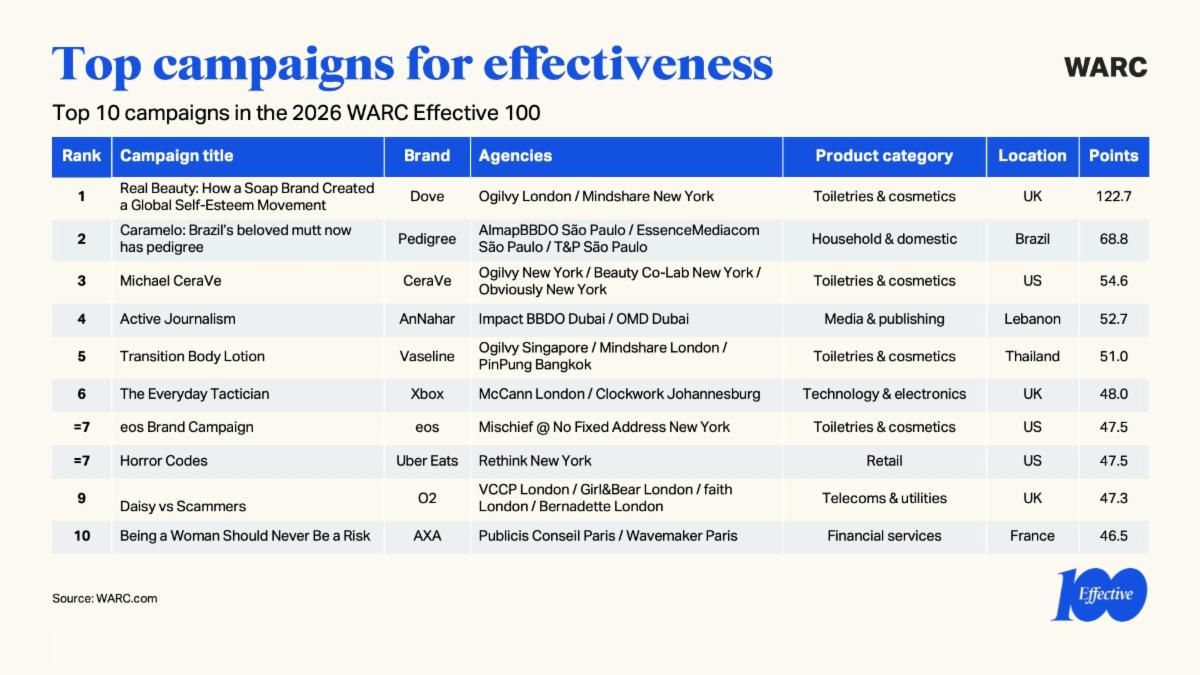
Third place went to "Michael CeraVe" by FCB New York/160Over90 for the skincare brand Cerave. The campaign relied on a playful "Michael CeraVe" conspiracy theory and used influencer stunts and PR kits for a successful Super Bowl appearance. The result: a 25 percent increase in sales and 5 percent audience growth.
Three central trends
Amy Rodgers, Head of Content at WARC Creative, says: "The WARC Effective 100 rankings are the pinnacle of marketing excellence and showcase the campaigns and companies that have made a real difference and delivered measurable impact."
Three themes stand out from this year's Effective 100: Reach for good - big brands like Dove, Pedigree and Vaseline show how they can use great reach to both do good and create value for their business. Fans at the center - brands like Xbox, Eos and Whirlpool put their fans at the center of their campaigns and created authentic, shareable content. Effective use of AI - the growing use of AI in marketing can be seen in effectiveness case studies for brands such as O2, Volkswagen and An-Nahar.
Agencies and networks
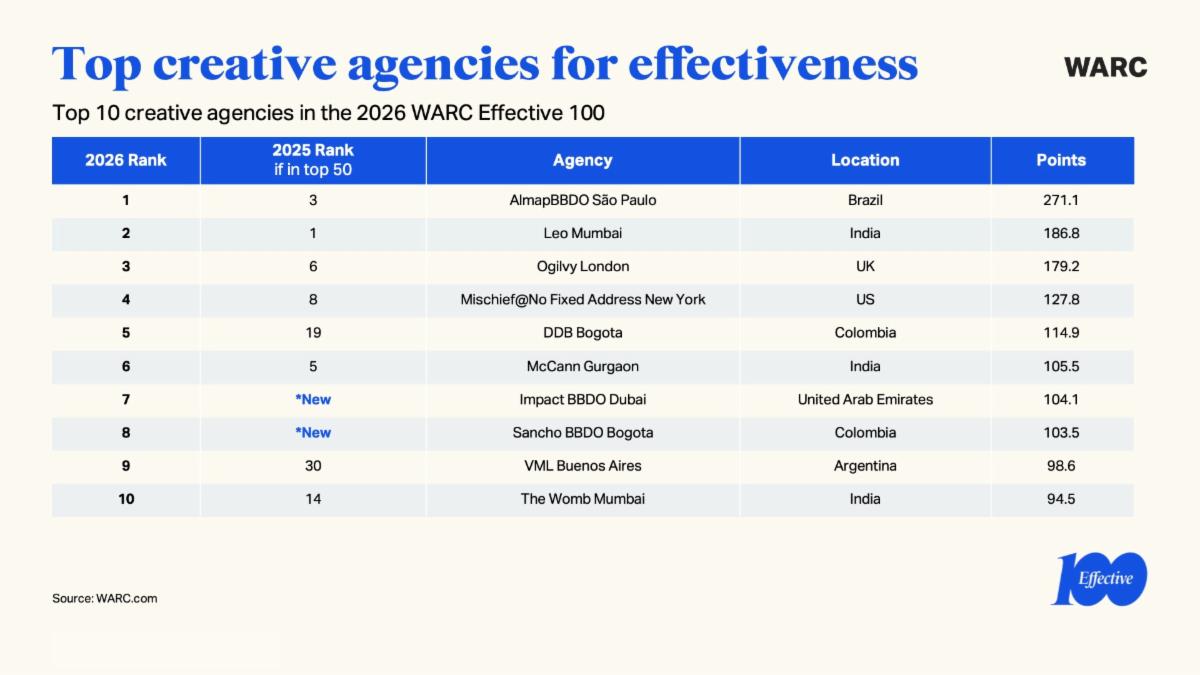
Almapbbdo São Paulo leads the creative agency ranking for effectiveness for the first time with six campaigns in the top 100. Filipe Bartholomeu, President and CEO of Almapbbdo, explains: "Being recognized as the world's most effective creative agency by WARC is an extremely proud achievement that reflects our belief in creativity as a key driver of growth and results for our clients."
Starcom Chicago once again took first place in the Media Agencies category after 2018. Shelby Saville, CEO of Starcom US, comments: "This honor reflects our teams' focus on delivering real business results for clients." The top spots for independent media agencies go to Streetwise São Paulo, Media-tique Bucharest and Media1 Vienna.
Ogilvy leads the network rankings for effectiveness for the fourth year in a row with 13 campaigns in the top 100. Mick McCabe, Global Chief Strategy Officer at Ogilvy, says: "To be recognized as number one for four years in a row is testament to Ogilvy's enduring culture of strategic thinking, which is alive and thriving in every office and discipline worldwide." In independent networks, Gut leads for the second time with five campaigns in the top 100.
McDonald's and Unilever dominate
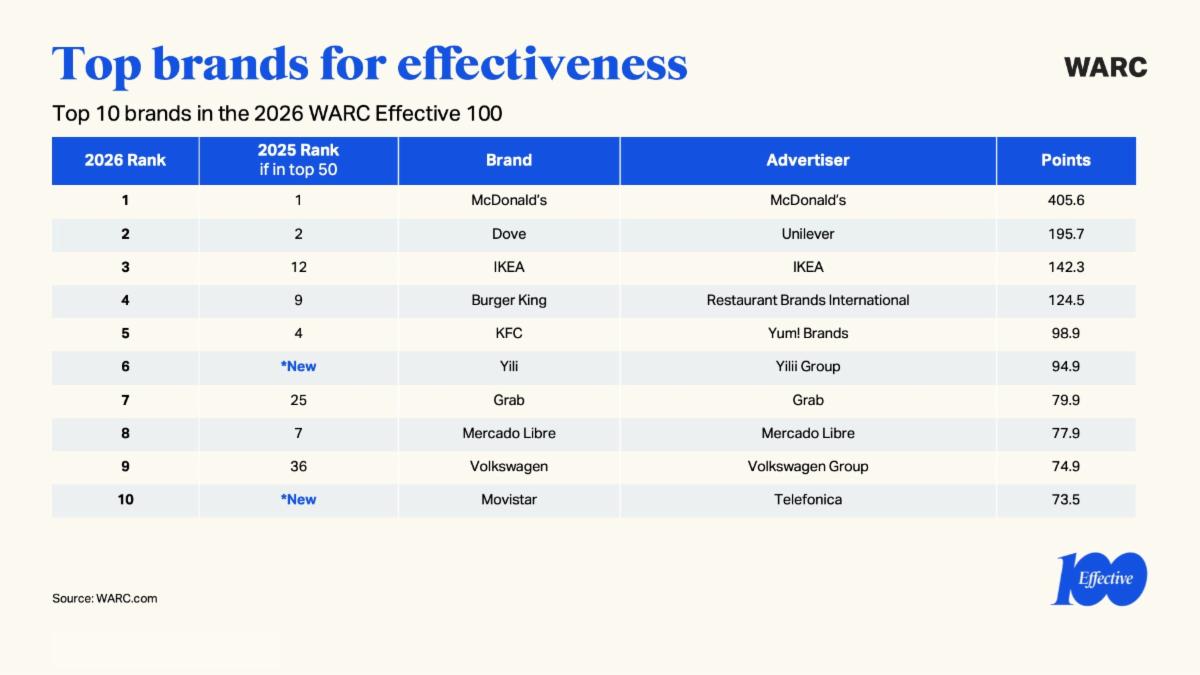
McDonald's is now the Most Effective Brand for the seventh consecutive year - a testament to the fast food giant's global reach and commitment to creative effectiveness transformation. Morgan Flatley, Global Chief Marketing Officer at McDonald's, explains: "Recognition like this is never about a single campaign or moment, but about years of our marketers around the world building something bigger together."
Dove retains second place, Ikea climbs to third place with three campaigns in the top 100 and 18 more campaigns in the complete database.
Unilever returns to first place among advertisers after several years, marking a hat-trick across all three rankings - the first advertiser ever to achieve first place in Creativity, Media and Effectiveness in the same year. Leandro Barreto, Chief Marketing Officer at Unilever, commented: "Achieving the number one ranking in Creativity, Media and Effectiveness is an extraordinary endorsement of our marketing transformation. Proof that purpose-driven creativity combined with first-class media creates impact at scale."
Among the holding companies, the pendulum swings back in favor of the Omnicom Group, which leads by less than 200 points and is represented by nine different networks in the top 50. WPP is in second place, followed by Publicis Groupe in third.
The WARC Effective 100 rankings can be viewed in full on the WARC website can be viewed.
]]>
The WARC Media 100, the world's leading independent benchmark for the most awarded campaigns and companies in media, was published on March 13, 2026. The ranking aggregates the results of the most important global and regional media awards in 2025 and is compiled in collaboration with the WARC Rankings Advisory Board and an annual global panel survey.
Amy Rodgers, Head of Content at WARC Creative, explains: "The rapid evolution of the media landscape, driven by technology, changing consumer behaviors and new platforms, is fundamentally changing how brands and their partner agencies interact with audiences in meaningful and impactful ways. The WARC Media 100 celebrates the most awarded campaigns and companies at the forefront of these changes and will create inspiration and new opportunities for the industry."
Three central trends
This year's top 100 campaigns are characterized by three defining themes: Targeting fans in their language and reaching customers where they spend their time has become a core principle of effective marketing. With thousands of advertising messages every day, brands are increasingly relying on hidden advertising that attracts attention through surprise and curiosity. Campaigns also show how brands are driving social change through innovative media ideas - whether for women, the LGBTQ+ community, people with disabilities or young people.
Campaign of the year: "Beauty Test Stops With Me" for Dove
The most awarded campaign for Media Excellence 2025 was "Beauty Test Stops With Me" for Dove, created by Mindshare Mumbai. Activated through a multi-channel approach, the campaign empowered mothers as key agents of cultural change by challenging beauty biases in the Indian matchmaking process.
Ailsa Lochrie, Client President at Unite, WPP Media, says: "To be at the top of the WARC Media 100 rankings with the Dove campaign 'Beauty Test Stops With Me' is a remarkable achievement and we are very proud of our partners at Hindustan Unilever who have brought about real change in India. Even more impressive is the approach. We take great pride in combining cultural nuance, strategic thinking and innovation to create measurable, profound impact."
In second place is "If you're into it. It's in the V&A" by PHD London. The campaign for the Victoria & Albert Museum in London used mass-reach channels, contextual channels and grassroots activations to appeal to younger target groups. In third place is "The Redditor Edit", also by PHD London for the car manufacturer Skoda. The campaign utilized the passionate fan base on Reddit and turned them into brand ambassadors.
PHD London tops the list of agencies for the first time
With four campaigns in the top 100, PHD London leads the media rankings for the first time, having previously reached third place in 2022. Paul Knight, CEO of PHD UK, comments: "To be ranked as the global number one agency in the WARC Media 100 is testament to the creative media skills and ingenuity of everyone at PHD UK, the clients who put their trust in us and the media owners and agency partners who have been instrumental in the success of our award-winning work."
Mindshare Mumbai rises from sixth place in the previous year to second place. In addition to the leading campaign for Dove, the agency has two other campaigns in the top 100. Mediaplus Munich achieves third place and leads the ranking of independent agencies for the fourth time in a row - with five campaigns in the ranking.
Max Schöngen, Global Chief Creative Officer & Partner of Mediaplus Group, said: "To see Mediaplus as the world's leading independent agency for four consecutive years in the WARC Media 100 is a testament to teams pushing boundaries with work that delivers real impact and growth for our clients. To also be ranked third overall sets the benchmark for creative media - and makes me incredibly proud of our teams, partners and clients."
Rethink Toronto and GUT São Paulo came second and third in the ranking of independent agencies.
Mindshare Worldwide best network for the fifth time
Mindshare Worldwide was named the most awarded media network for the fifth time. The network had fifteen campaigns in the top 100, with seven agencies worldwide contributing to the ranking: Mumbai, New York, London, Shanghai, Sydney, Warsaw and Jakarta.
Prasanth Kumar, CEO South Asia at WPP Media, says: "The work our clients and teams do to achieve these WARC recognitions takes exceptional courage and relentless ingenuity. Together with our clients, we are focused on accelerating business growth and inspiring our entire industry to embrace true transformation."
PHD Worldwide takes second place, followed by OMD Worldwide in third place. The Serviceplan Group leads the ranking of independent networks for an impressive ninth time in a row.
Alexander Schill, Global Chief Creative Officer & Partner of Serviceplan Group, comments: "To be ranked as the number one independent network in both the WARC Creative 100 and the Media 100 for the second year running means a lot to us and makes me really proud of our teams. It proves that creativity grows strongest where different disciplines and perspectives come together."
The new entry Cossette is in second place, with GUT in third.
WPP defends top position with holding companies
There has been no change at the top of the holding companies. WPP has held its leading position since 2018, when the Media 100 was launched.
Brian Lesser, Global CEO of WPP Media, said: "Topping the WARC Media 100 for the ninth consecutive year is an honor and a testament to the incredible clients, people and innovative work across the WPP network. In a world where media is truly everywhere and in everything, these awards are a powerful demonstration of how we create compelling work that is strategically brilliant, culturally relevant and deeply impactful."
Omnicom Group is in second place for its performance before the merger. Publicis Groupe ranks third.
Dove leads among brands, Unilever among advertisers
Dove is at the top of the brands for the third time in a row. The Unilever personal care brand has four campaigns in the top 100 and 14 in the complete Media 100 database. McDonald's is close behind in second place, up from fourth place last year. Coca-Cola jumps from ninth to third place. Newcomers to the top 50 include the British Heart Foundation, Heinz, Vaseline and Skoda.
Unilever has been the leading advertiser in the Media 100 for seven years in a row. The FMCG group is represented by 24 different brands in the full Media 100 database, with Dove, Vaseline, Knorr and OMO making it into the top 50 brands.
Leandro Barreto, Chief Marketing Officer at Unilever and Beauty & Wellbeing, says: "We are reshaping how our brands are present in people's lives - in the moments that really matter - and I couldn't be prouder of the way our teams are raising the bar in media. By combining precision, cultural expertise and bold thinking, we are achieving impact at scale, both commercially and culturally."
McDonald's climbs to second place, Volkswagen moves up to third place.
USA maintains leading position among countries
The US retains its first place - a position it has held since 2018, when the Media 100 was launched. 16 of the top 100 campaigns came from the US, including two of the top 10. The UK generated 11 of the top 100 campaigns. India remains in third place. Canada and Germany follow in fourth and fifth place.
]]>
The Warc Rankings 2026 have recognized the world's leading campaigns and companies in the field of creativity. Published on March 10, 2026, the rankings are compiled annually by Warc and aggregate the results of the top global and regional creative awards of 2025. The selected competitions are determined in collaboration with the Warc Rankings Advisory Board and through an annual global panel survey.
Three key trends are shaping the creative industry
Amy Rodgers, Head of Content at Warc Creative, explains: "The Warc Creative 100 celebrates the award-winning campaigns and companies that are shaping the future of the marketing industry by harnessing the power of creativity to drive differentiation and change." Three main themes emerge in this year's ranking: Creativity Across Media Channels, Advocacy through Creativity and Creative B2B Marketing as a Differentiator.
The most successful campaigns demonstrate creative innovation across various media types. Particularly noteworthy: two B2B campaigns made it into the top 10 of the Creative 100 ranking - "Spreadbeats" for Spotify and the sales promotion of outdoor advertising space for JCDecaux. This underlines the growing importance of creativity as a differentiating factor in B2B marketing.
"Three Words" honored as most creative campaign
The most awarded campaign in 2025 was "Three Words" for the AXA insurance brand, developed by Publicis Conseil Paris. AXA added three words - "and domestic violence" - to its insurance policies in France to give victims of domestic violence immediate access to relocation cover under their policy.

Marco Venturelli, CEO and Chief Creative Officer of Publicis Conseil, explains the success: "I think the reason why this idea resonated with so many people is the contrast between its simplicity and its exponential impact. In just three words, we are changing millions of home insurance policies to make them more inclusive for a risk that affects women more than fires or floods."
In second place is the B2B campaign "Spreadbeats" by FCB New York for Spotify. The music streaming service changed the perception of its advertising opportunities among media planners. Third place went to "Lap of Legends" by FCB New York and 160over90 New York for Michelob Ultra, in which the beer brand collaborated with Formula 1 and staged a real versus a virtual F1 race.
LePub Milan takes over top position with agencies
LePub Milan rises from second place in the previous year and leads the creative ranking for the first time. The agency placed two campaigns for Heineken in the top 100, as well as numerous other campaigns that contributed to the overall result. Bruno Bertelli, CEO and Chief Creative Officer of LePub Worldwide, comments: "LePub Milan is honored to be ranked #1 in the Warc Creative 100. This award recognizes our visionary clients and exceptional team who inspire bold, culturally relevant ideas."
The independent agency Serviceplan Munich jumped from seventh place in the previous year to second place. Publicis Conseil Paris takes third place with another strong year. Serviceplan Munich also leads the ranking of independent agencies, followed by Rethink Toronto and Klick Health Toronto.
Ogilvy defends top network position

Ogilvy is the most awarded network for the sixth consecutive year. The network has 15 campaigns in the top 100, with seven offices from around the world contributing to the ranking: Ogilvy New York, Singapore, Mumbai, Ogilvy Health New York, David Madrid, New York and Circus Grey Lima.
Liz Taylor, Global Chief Creative Officer of Ogilvy, says: "Six years at the top of the Warc Creative 100 is more than a milestone - it's a testament to how our network presents itself. The best work, for the biggest brands, in every market worldwide." DDB Worldwide, which will soon be disbanded, is ranked second for its work in 2025, followed by VML in third place.
Serviceplan leads the ranking of independent networks for the second time in a row. Alexander Schill, Global Chief Creative Officer and Partner of the Serviceplan Group, explains: "I believe that in our competitive, technology-driven industry, creativity remains the true differentiating factor. That's why it means so much to us to be ranked number one again in the Warc Creative 100 - both as an independent network and as an agency."
WPP remains leading holding company
WPP has defended its position at the top of the holding company rankings for the fourth year in a row. Three networks feature in the top 50: Ogilvy and VML at number one and three and AKQA at number 28. Rob Reilly, Global Chief Creative Officer of WPP, comments: "Our continued recognition in the Warc Creative 100 is a testament to WPP's incredible talent and the hard work of our dedicated teams worldwide."
Omnicom Group ranked second and Interpublic Group third for their pre-merger performance.
Heineken most creative brand for the first time
After being one of the top ten brands for the last four years and coming second last year, Heineken has now achieved the position of most creative brand for the first time. Heineken has two campaigns in the top 100 and a further 19 campaigns in the full Creative 100 database from 12 different countries worldwide, underlining the global reach of the brand.
Nabil Nasser, Head of Global Heineken Brand, says: "We are incredibly humbled and proud that Heineken has been recognized as the number one global brand in the Warc Creative 100 for the first time in our history. The Warc rankings are one of the industry's most respected benchmarks, recognizing work that achieves business results and cultural impact."
Apple takes second place, McDonald's climbs to third. Vaseline is a new entry in the top 50 this year, driven by the "Vaseline Verified" and "Transition Body Lotion" campaigns in Asia.
Unilever takes the lead among advertisers
Unilever achieves the position of leading advertiser in the Creative 100 for the first time. The FMCG giant is represented by 15 different brands in the full Creative 100 database, with Vaseline and Dove making the top 50 brands in ninth and tenth place respectively.
Leandro Barreto, Chief Marketing Officer of Unilever and Beauty & Wellbeing, explains: "This recognition is a powerful validation of the bold, culturally relevant work that our teams are bringing to the world - work that inspires, connects and creates real impact. Creativity is one of our strongest competitive advantages."
Anheuser-Busch InBev falls back to second place, Heineken moves up to third.
USA defends country ranking
The USA retains its first place - a position it has held since 2006. 30 of the top 100 campaigns came from the US, the same number as in 2025. The UK in second place generated 11 of the top 100 campaigns. Brazil moves up one place and secures third place.
The Warc Creative 100 was compiled using a rigorous, unbiased and transparent methodology. The full ranking includes the 100 most awarded creative campaigns, the top 50 creative agencies, agency networks, brands, advertisers, countries and leading holding companies. The case studies and summary report are available to Warc members. The Warc Media 100 will be announced on March 13 and the Warc Effective 100 on March 18.
For more information https://www.warc.com/creative/rankings/creative-100
]]>