
When moving images suddenly appear out of thin air in response to a prompt, the real bottleneck becomes apparent: strategy, methodology, and content direction. «The Video Content Playbook» The book by Jürg Steudler and Bart Wasem provides a pragmatic framework for this—and serves as a reminder that, in the age of AI, creativity is less about magic and more about solid craftsmanship.
There’s that moment when a tool spits out a video that „somehow“ works. The editing is right, the look is just right, and even the music fits. And yet the question remains: What is this actually for? What is it meant to trigger, what does it go well with, what does it contribute—and how can we prevent the new “moving-image democracy” from turning into a directionless flood of content? This is exactly where Steudler/Wasem . Not as tech gurus, but as experienced professionals who have been shaping the world of moving images for decades across advertising, film, and television—and who are now presenting a playbook designed to bring order to the creative chaos.
A book that doesn't argue against AI—but in favor of leadership
The authors, co-founders of Regardez! in Zurich, write from the perspective of people who are familiar with the stress of production: unclear briefings, unrealistic expectations, too much gut feeling in the wrong places—and, in the end, a film that is „beautiful“ but fails to make an impact. Their diagnosis: Many companies lack a structured foundation of knowledge about moving-image communication. And those who don’t close this gap won’t get results any faster—even with AI—but will simply be off the mark more often.
From this, they derive a conclusion that sounds almost reassuring in the context of AI: What matters most are overarching competencies—technological, strategic, creative, and analytical. AI can simplify implementation. It does not replace leadership.
The Video Content Framework: Mindset, Resources, Process, Creativity
At the heart of the book is a Video Content Classification System, which views moving images as a repeatable, learning process—not as a single work of art. Four elements are meant to work together: Mindset, Resources, Process and Creativity.
When it comes to mindset, the authors emphasize „video first,“ „story first,“ and „mobile first“—not as a mantra, but as a consequence of the fact that video is the most direct path to evoking emotions. And this is precisely where the book takes a distinctly business-oriented approach: a systematic approach is a driver of efficiency. Those who take reuse, content stacking, and standardization seriously not only save money but, above all, spare themselves a lot of stress.
It gets specific in areas where many textbooks often skirt the issue: resources and processes. Personnel, technology, budget, and management tools are described as levers for change—including a down-to-earth recommendation: Buy standard equipment that is used every day; rent specialized equipment. The process itself is designed to be iterative and is divided into the following phases: Perspective, Design, Stories, Application – with the goal of continuously refining the system rather than simply „implementing“ it once.

People outperform machines when it comes to building trust and fostering emotional connections
The Playbook becomes particularly relevant in the second major area of tension: Storytelling and Authenticity – precisely because deepfakes and synthetic images are eroding the credibility of moving images. The authors, on the other hand, rely on documentary elements, real protagonists, and true stories—not out of nostalgia, but as a strategic response to a media climate in which „seeing“ no longer automatically means „believing.“.
Storytelling is discussed here as a vehicle for emotion—using classic models such as the three-act structure and the hero’s journey, but without an overload of theory. One pithy sentence sticks with you: Stories are remembered up to 22 times better than mere facts. According to the book’s logic, impact arises from the interplay of narration, staging, argumentation, and association—that is, in areas where AI can make suggestions, but the final decision remains in human hands.
Creativity is also demystified. The authors distinguish between different levels—from “mini-c” to “Big-C”—and emphasize the mechanics that make film so powerful: the big idea, enhanced by lots of little ideas in rhythm, editing, color, and sound. At the same time, they advocate for guidelines: Guidelines should not stifle creativity, but rather focus it—serving as a guide, not a cage.
Tools and Scenarios: From the Canvas to a Bakery Chain
In practice, the book comes with the Video Content Canvas: a tool that serves as a plan, checklist, and notepad, translating the methodology into everyday practice. In addition, there are fictional but realistically constructed scenarios from various business worlds—ranging from startups to bakery chains. They demonstrate how the methodology applies differently depending on size and context, without losing its core principles.
And here's another point that's often underestimated in day-to-day content work: serial formats. Series, miniseries, and recurring storylines are not only better for viewer engagement and brand presence, but also more efficient to produce—because reused elements lower the cost per episode.
Conclusion: The Playbook as a Rock—Not as an Antidote
«The Video Content Playbook» is not a book that downplays AI. On the contrary: It addresses the areas where AI is ramping up the pressure—because suddenly so much more is possible. That is precisely why its central message feels so timely: If you want moving images, what you need first isn't tools—it's clarity. Strategy, structure, and craftsmanship—these are the bedrock of stability when content is being created all around us at a rapid pace.
The book is available at bookstores (Amazon, Exlibirs, Buch.ch) or can be ordered directly from Springer.com.
]]>
In the video: Patrick "Karpi" Karpiczenko, a filmmaker who spoke at the Communication Summit 2024 at ETH, presented examples of his creative work. His Heidi trailer went grotesquely viral in July 2023 with 20 million views on his channel alone. He generated the video in one day using AI video generation software. Additionally, he mentioned a children's book project that was created from a joke demo and achieved 100 pre-orders within 24 hours. Karpi also discussed the challenge of "whitewashing" poor AI generation and emphasized Switzerland as predestined for developing its own AI tools. His vision for the advertising industry is extremely disruptive, and he sees the future as a mix of utopia and dystopia, while being aware of the potential dangers of new technologies.
]]> Having recently honored Filmgerberei, Maybaum Film, Pumpkin Film, Stories, Wirz and Georg Fischer, among others, at the U.S. International Awards, the award enters its next round for 2024. As a platform to honor outstanding creativity and
Innovation in Business Films and Documentaries, the U.S. International Awards honor exceptional storytellers, filmmakers and creatives alike - projects can apply now; the call for entries runs through Feb. 16, 2024.

Film producers, agencies, commissioners and students can submit their creative works and be part of more than 100 categories within the main categories: Corporate Videos, Online & Social Media, Documentaries & Reports, Independent Videos, Student Videos and additional Production Art & Craft categories. The jury will evaluate the submissions based on their concept, objective, creative and technical excellence, and innovation.
Winners will be officially announced during an online winner announcement in June 2024. Further information on the categories, submission fees and the regulations are available at www.usinternationalawards.com to find.
]]> The Swiss start-up Fehh discloses all ingredients in its care products and thus wants to create transparency and trust. Now, appropriately, there is the first commercial, which is deliberately not intended to be a classic beauty advertisement - but shows beauty in the feeling of self-acceptance.
Fehh stands for Femme Étoile Homme Humain - for gender-free skin care. The message: beautiful skin is healthy skin, in which the person feels good. Filmgerberei has now translated this message into a commercial that, instead of cosmetics in the studio, is intended to capture moments of self-confidence and a sense of well-being. Instead of products, people are shown with self-expression and tenderness. Instead of dermatological jargon, a poem pays homage to love for oneself and healthy beauty from within. The film tannery has deliberately not cast actors:inside, but has approached people from different environments directly.
Responsible at Filmgerberei: Alun Meyerhans (Concept/Direction); Azra Djurdjevic (Producer/Copywriting); Pamela Polanco (Line Producing); Flavio Gerber (Executive Producer); Silvio Gerber (DoP); Lea Filadoro (Editing/Dramaturgy); Tereza Caballero Hernández (Production Design); Svenja Steurer (Styling); Manuela Porcelli (Hair & Make Up); Jürgen Kupka (Grading); Pablo Nouvelle (Composition). Responsible for Fehh: Cecilia Etterlin (CEO); Gian Grundböck (Innovation); Florian Grundböck (Developer).
Here go to the video.
]]>
 The 57-year-old Stefan Nägeli thus takes over from Daniel Sager and Jürgen Törkott, who previously managed the two channels TV Südostschweiz and Radio Südostschweiz.
Nägeli is currently deputy editor-in-chief of Zürcher Oberland Medien, where he is responsible for the digital-first strategy including video. Previously, he was overall head of Tele Top for 13 years.
Nägeli will be responsible for the newly conceived joint Audio/Video division and thus for the audio and video productions that the Südostschweiz media family currently distributes on social media, on several online channels and still via TV Südostschweiz and Radio Südostschweiz. The audio/video division is now also working according to the digital-first principle.
]]>The Vein Center Baselland of the Cantonal Hospital Baselland (KSBL) performs examinations and interventions in modern and friendly premises. The removal of varicose veins or spider veins is performed on an outpatient basis in our own rooms, far away from an operating room. With the video, we want to give potential patients an understanding of the procedure and the environment of the Baselland Vein Center and allay their fears of a possible intervention.
Production: Mosaiq communication agency and visual storyteller Joël Karlin. Client: Cantonal Hospital Baselland (KSBL), Coordination: Jacqueline Waldmeier, Marketing & Communication KSBL.
]]>
Because existing employees are the most credible ambassadors for new ones, they gave personal statements on short videos about their motivation to work at Mazzei. The nine videos have an authentic effect and make the company's philosophy and friendly team spirit tangible. Employees posted daily quotes about the company spirit and videos on social media and via their personal WhatsApp contacts. In one month, more than 40,000 contacts were reached, leading to 31 qualified applications and ultimately three hires.
On a Landing page interested parties could inform themselves about the company and the job profiles and watch all videos of the employees. Accompanying job advertisements appeared in print and online media, dialect posters in the area emphasized the proximity of the employer Mazzei.
The campaign can be considered a success on three levels: The involvement of the staff strengthens internal identification and team building, Mazzei finds the competent employees it is looking for and at the same time strengthens its image as a regional painting company; as a result, new customers have also been acquired.


Responsible at Mazzei painting color concepts: Claudio Mazzei & 8 employees. Responsible at Basel West: Thomas Aerni (consulting and conception).
]]>
In addition to design, consulting and copywriting services for the bilingual annual report, the communications agency is responsible for the conception of the image video. This was realized in cooperation with the Bernese photo and video production company Atelier Ubezio.
In the video clip, Christof Zürcher (Chief Executive Officer), Caroline Meli (Head of Marketing and Sales) and Sandra Thoma (Vice Chairwoman of the Board of Trustees) talk about the challenges and highlights of the past year and highlight the advantages of "SmartCare". With the launch of the product in September 2021, Atupri will enable its customers to receive specialist medical advice worldwide and around the clock via smartphone.
"We were thrilled by the staging idea for the annual report with the video statement," praises Michael Wüthrich, Head of Corporate and Marketing Communications.

More about the Annual Report.
]]>The new film provides a fascinating insight into the manufacture of ceramic products. It shows how high-quality ceramic products are created from the combination of high-tech manufacturing with passionate craftsmanship. Seed developed and realized the film in close cooperation with Geberit. Filming took place at the ceramics plant in Ekenäs, Finland as well as in the studio. The film was directed by Simon Koller.
The film will be used on Geberit's website, social media and as part of training courses, events and presentations.
The Geberit Group is the European market leader for sanitary products. The brand stands for high-quality sanitary technology that is largely invisible - installed behind the wall. Ceramic products such as WCs, bidets or washbasins - products in front of the wall - have only become part of the product range since the acquisition of a number of traditional ceramic brands. Geberit is continuously working to raise awareness of this.
Seed is a communications specialist with a focus on audiovisual media. The Zurich-based company creates and produces films for external and internal communications. Seed's clients include BKW, ETH Zurich, Geberit, Läderach, Mibelle, On, Die Post, Raiffeisen, SBB, Swiss Life and Vontobel.
Responsible at Geberit: Stefan Kaufmann, Roman Sidler, Cyril Stutz. Responsible at Seed Audio-Visual Communication AG: Simon Koller (writer, director), Roman Linder (camera, color grading), Wolfgang Weigl (editor), Niko Eriksson (digital twins), Matthias Müller (music, sound design, mixing), Bettina Frymerman (production manager), Felix Courvoisier (producer).
]]>The children say thank you in their own language, or in their own dialect or baby talk. The videos and their actors are one hundred percent real, with the exception of the names, which have been changed by Librio for data protection reasons.
Out of 100 submissions, 12 spots were created: They are the first TV spots in Switzerland to feature all national languages. 12 short spots with 6 seconds length and an explanatory spot for pre- and post-split ads, which lasts 15 seconds. Accompanied by somewhat longer Versions for social.
The main target group is online affine parents who are looking for a between 25-45 in Switzerland who are looking for a Christmas gift for children.
Librio was founded in Zurich in 2017. The company's goal is to combine art and technology in such a way that unique children's books are created.
The short clips in different languages
More about Librio on librio.ch
]]>

You can take part in Spotlight 2021 from the comfort of your own home: From March 14 to 21, 2021, the public will have the opportunity to cast their vote on the creative year 2020. Psychologically, the past year has left its mark and partly changed the tonality of moving image communication, the organizers say. For example, the pandemic acted as a catalyst for a development that had already become apparent in previous years: advertising messages are tapping into the major social discourses of our time. The social and ecological take up a lot of space. Stories are becoming longer and more narrative. The creatives are not shying away from controversial topics: war, displacement, domestic violence, human rights, loneliness and isolation.
Web and mobile outperform TV and cinema
Two other, technological trends also seem to have accelerated as a result of the Corona experience: In the competition categories, the weights are shifting in favor of web and mobile over the ancestral kingpins of TV and cinema. The number of submissions in the animation category has also increased significantly - possibly a consequence of the more difficult filming conditions under Corona. With 285 submissions, the fifth-best result in its history was achieved. The organizers are particularly pleased that the new Influencer competition category met with great interest right off the bat.
The awards will be presented on Saturday, March 27. More about the festival on spotlight-festival.com
After the expert jury meeting on March 25, the Spotlight Forum Change will take place the following day in cooperation with the MFG Academy:, Five top creatives report on idea generation, motivation and new paths in special times: Björn Bremer (Ogilvy, Frankfurt), Jo Marie Farwick (Überground, Hamburg), Helmut Hartl (Embassy of Dreams, Munich), Michael Preuss (Preuss und Preuss, Stuttgart/Berlin) and Tom Schwarz (Prosiebensat.1, Munich).
]]>
In Switzerland, the range of audio and video streaming offerings is growing. The Streaming Media Monitor 2017 counts 490 offers for online audio and 227 offers for online video. The density of offerings per inhabitant is thus higher than in Germany or Austria. This is the conclusion of the study presented by the Federal Office of Communications (OFCOM) at Swiss Radio Day 2017.
The survey of the Swiss online audio and video market is based on a survey of all providers based in Switzerland. In addition to online surveys, the Goldmedia consulting and research group also conducted expert interviews with industry representatives.
22 percent of web radio stations also broadcast via DAB+
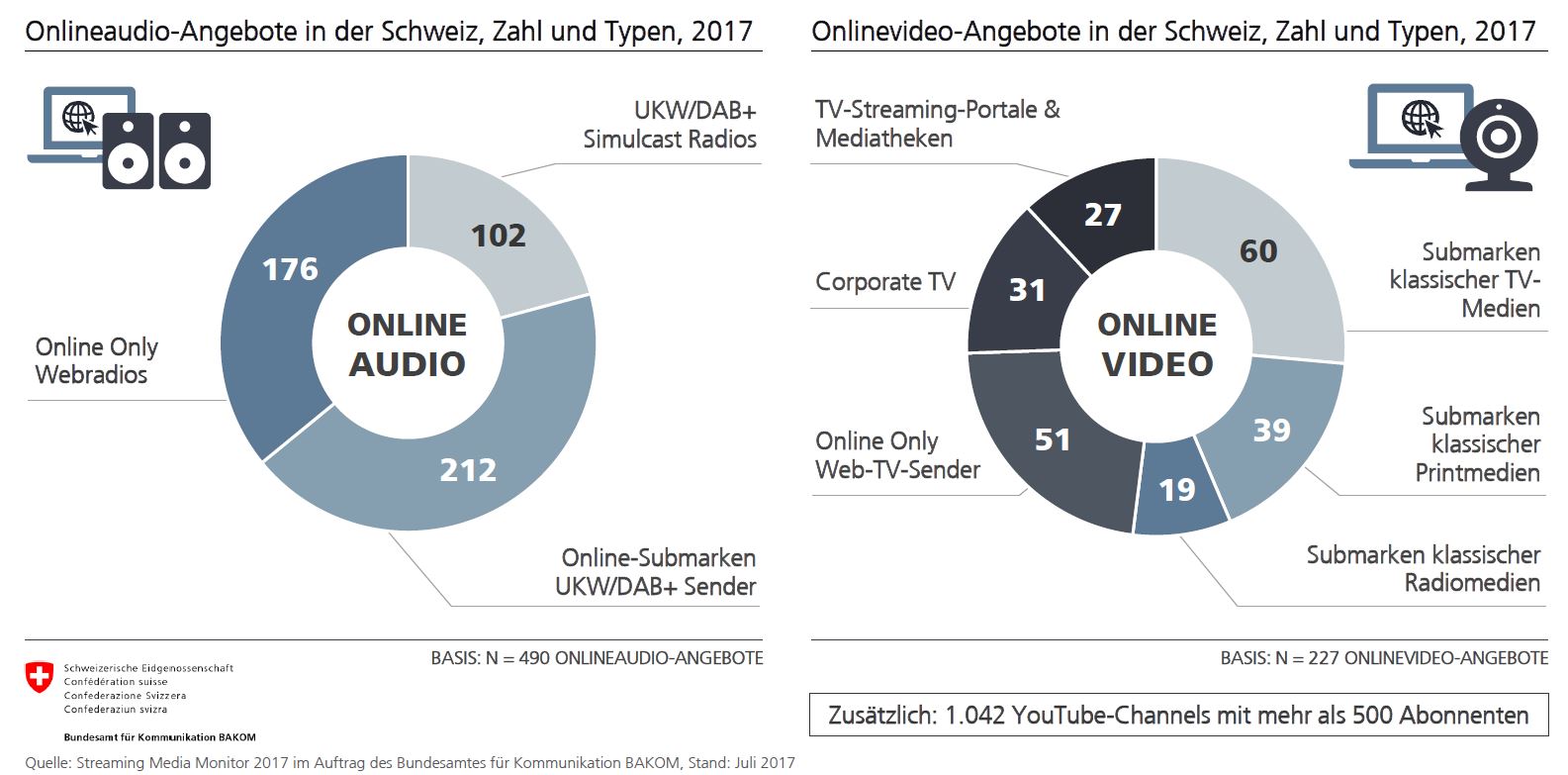
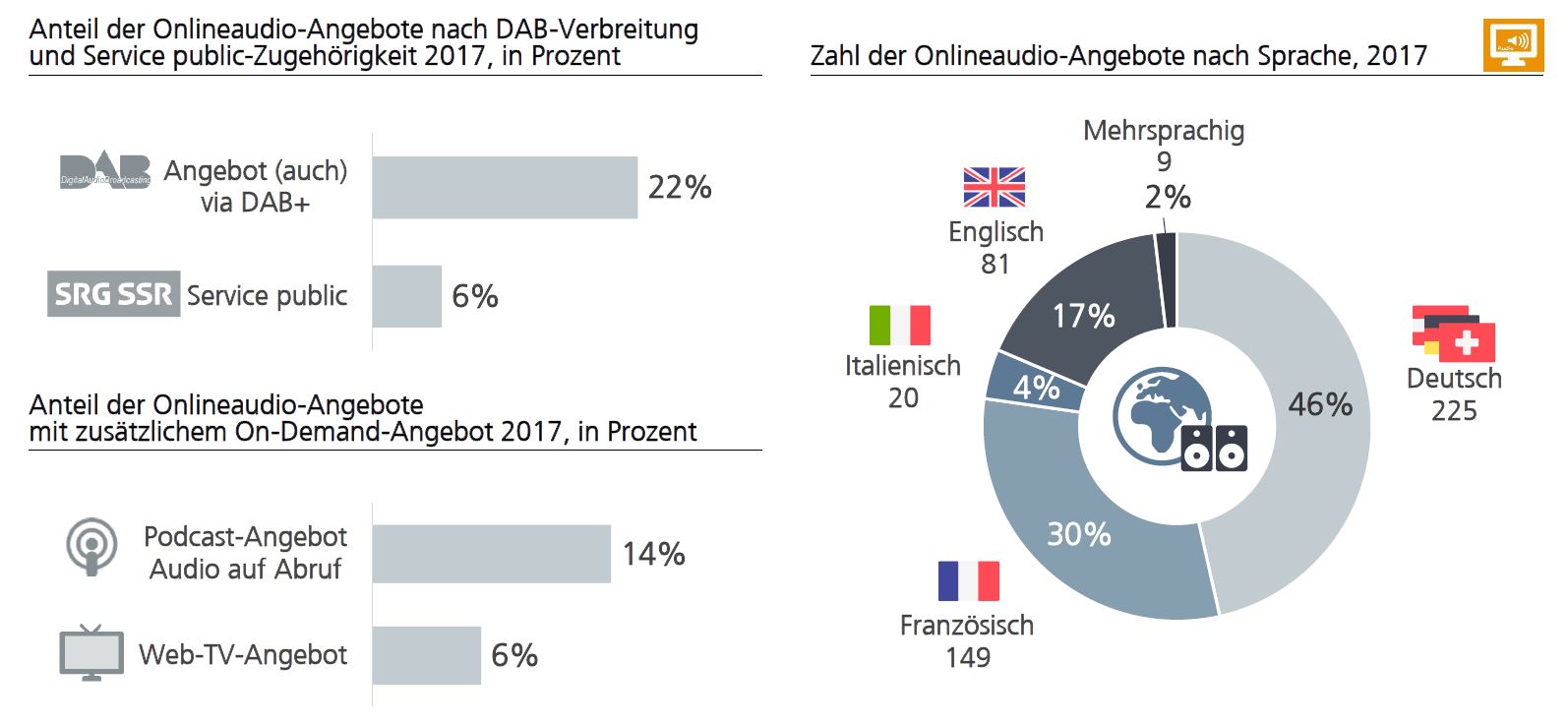
Just under two-thirds of the 490 online audio offerings (64 percent) come from classic FM/DAB+ brands. 22 percent of all web radio stations also broadcast via DAB+, 14 percent also offer podcasts or audio-on-demand content, and 6 percent also offer videos. Unsurprisingly, there is also a wide variety of languages in the Swiss online audio market: 46 percent broadcast in German, 30 percent in French, 17 percent in English and 4 percent in Italian.
36 percent of online videos are available as livestreams
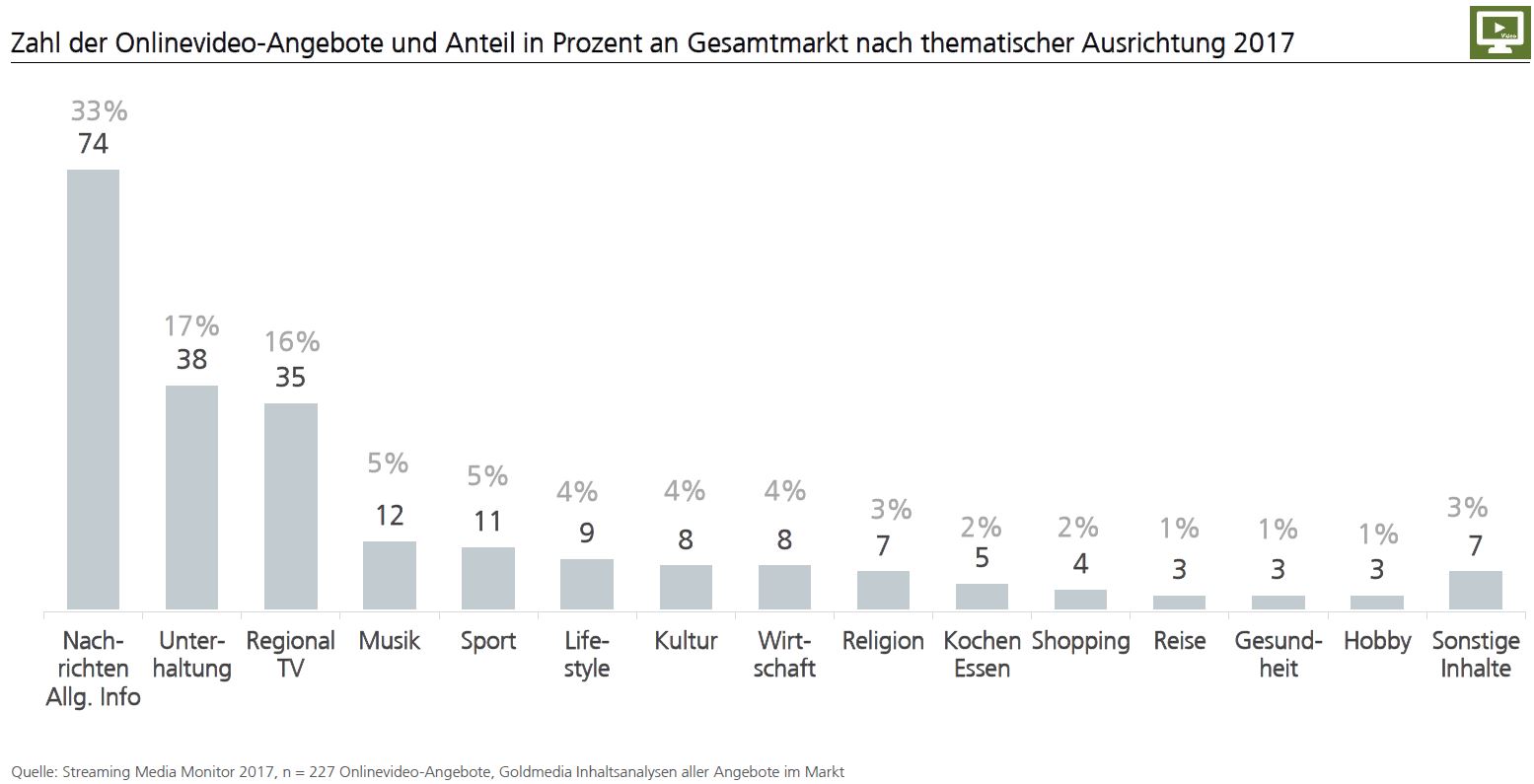
188 providers are behind the 227 online video offerings. More than half are sub-brands of classic TV, radio or print brands. The rest are online-only web TV stations, corporate TV, and TV streaming portals and media libraries. More than one-third of online video offerings (36 percent) are provided as live streams. 64 percent broadcast in German, 17 percent in French and 14 percent in Italian. One-third of Swiss online video offerings provide broad information, while 16 percent have a predominantly regional focus. The survey also covered 1042 YouTube channels with more than 500 subscribers. The leader among the viewing figures is ESC with around 2.5 billion video views.
A look into the future shows: The online audio providers surveyed expect strong annual net advertising market growth of 37 percent through 2019, and online video providers 13 percent.
Mobile retrieval on the rise
According to the study, almost two-thirds of online audio providers are satisfied or very satisfied with the use of their offerings. According to their estimates, mobile use will increase sharply in the future. The providers also expect average usage time per call to double from 80 minutes today to 150 minutes in 2019.
Among online video providers, around half are satisfied or very satisfied with usage. Here, too, providers see an increase in mobile usage. For average monthly video views, providers expect annual growth of more than 16 percent by 2019.
For the 2017 Streaming Media Monitor, Goldmedia also asked about advertising forecasts through 2019, with respondents predicting strong annual net advertising revenue growth of 37 percent on average for online audio, from CHF 719,000 in 2017 to CHF 1.13 million in 2019.
The forecasts of the online video providers are more restrained. They see average annual net advertising market growth of 13 percent and an increase from CHF 13 million (2017) to CHF 16 million ( 2019).
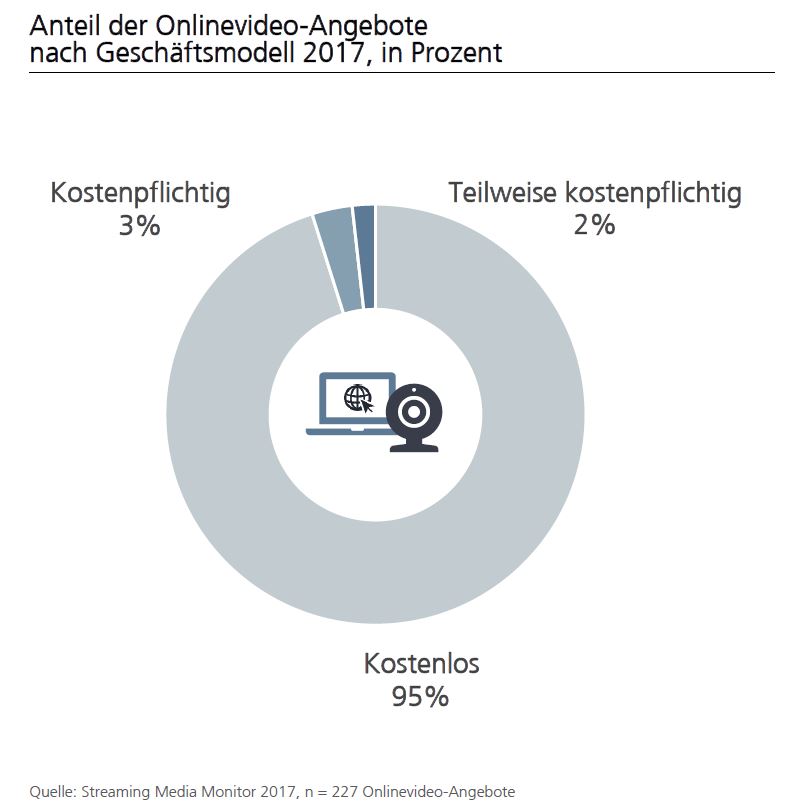
Asked about important growth factors, 31 percent of online audio providers see unlimited use of audio streams as the key point. 20 percent see audio streaming in the car as the most important driver.
Among online video providers, 40 percent say that unlimited streaming is the most important thing for positive market development. 21 percent see the further spread of smartphones as particularly relevant and 19 percent the greater spread of public WLANs.
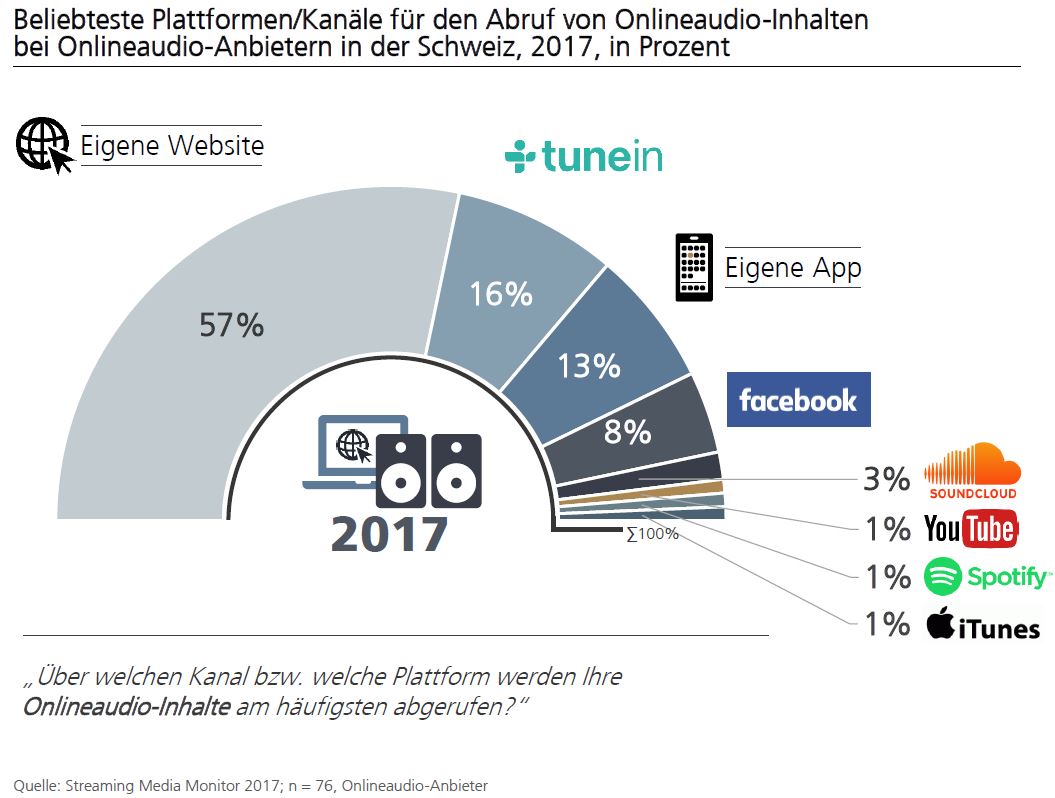
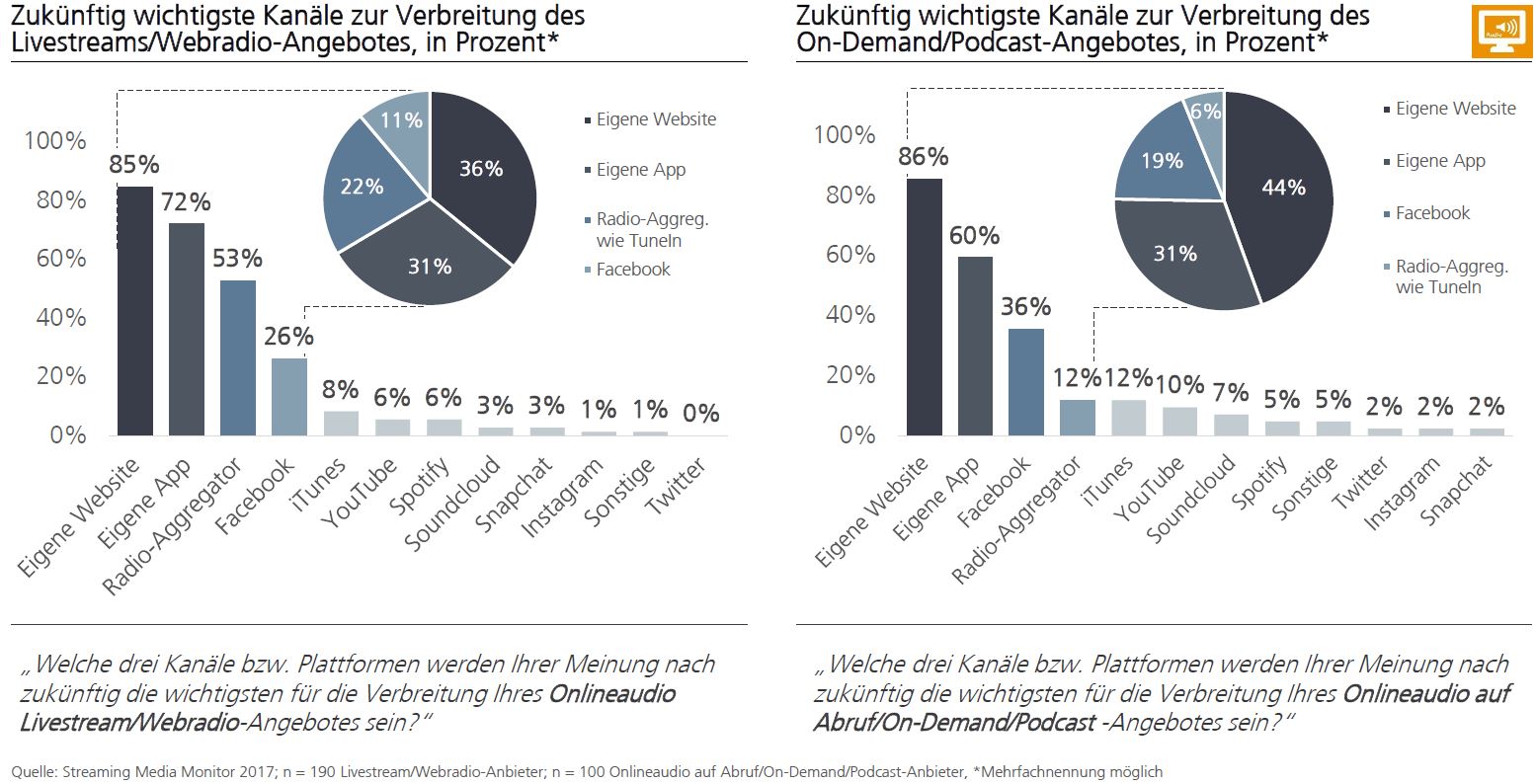
Where we prefer to listen to online audio content
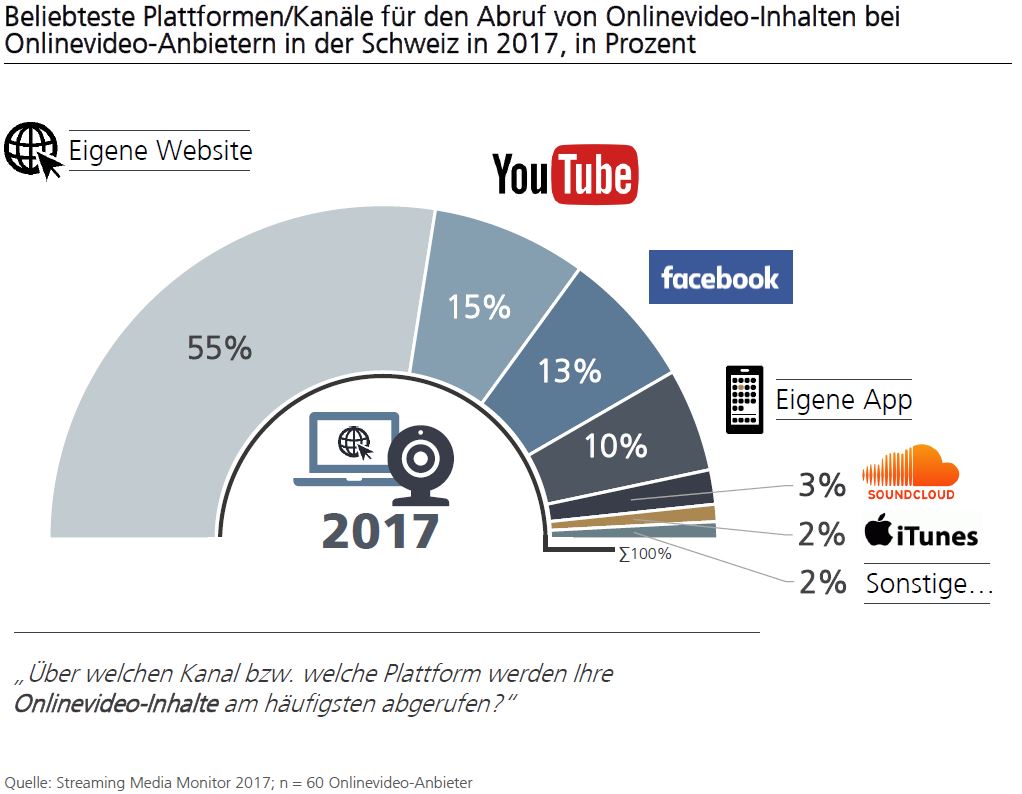
Where we prefer to watch videos online
(pd/aks)