Three questions that get under your skin
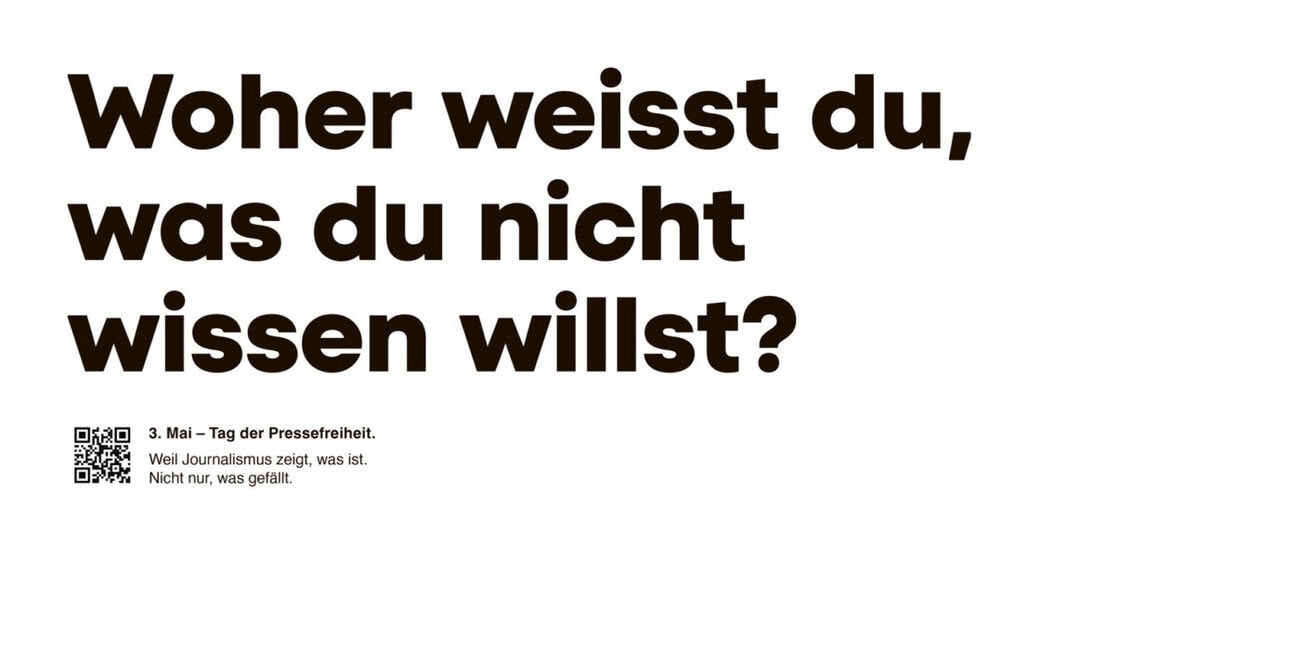
To mark Press Freedom Day on May 3, 2026, the Swiss Media Publishers Association is launching a campaign that asks uncomfortable questions - and thus raises awareness of the social importance of a free press. The campaign was created by Ringier Advertising.
Freedom of the press is considered a cornerstone of democracy. The media must be able to work freely and without censorship in order to fulfill their social mission of providing independent information - this is the position of the Swiss Media Publishers Association (VSM), which is responsible for the campaign. «A functioning democracy needs a free press,» says VSM President Andrea Masüger. «Restrictions on press freedom are a current global issue - Switzerland is relatively privileged compared to other countries. But freedom of the press is also under increasing pressure in this country.»
Swiss media sets an example for unrestricted freedom of the press
VSM Vice President and World Publishers Association President Ladina Heimgartner emphasizes the international dimension: «We demand that existing hurdles be removed and no additional ones erected.» The association is committed to unrestricted freedom of the press worldwide and in Switzerland, according to the press release.
The campaign, which was created by Ringier Advertising, works with three pointed questions that are intended to establish a personal connection to media freedom: What happens when you only hear what you want to hear? What is the most uncomfortable question you can be asked? How do you know what you don't want to know? The questions are intended to make you think, reflect on your personal relationship to the media and their role and motivate you to form your own opinion based on your trust in independent media.
Campaign in the media of VSM members
The campaign ultimately poses the question of what will happen to us if we are no longer allowed to ask critical questions. The campaign subjects will be published in the media by members of the VSM from April 27, 2026 until Press Freedom Day.
The campaign subjects are available at www.schweizermedien.ch/tagderpressefreiheit2026.
]]>
After more than 30 negotiating sessions, Swiss journalists, represented by impressum and syndicom, together with the Swiss Media Publishers Association (VSM), have succeeded in formulating a draft industry agreement. In March, the impressum delegates approved this agreement in principle. However, two key points initially remained controversial: the remuneration of freelance journalists and the conditions for the industry agreement to come into force.
Remuneration must reflect effort and multiple use
In particular, the impressum delegates« meeting maintained that freelancers» fees must correspond to the time spent and the scope of use. "Freelancers' fees today are often disproportionate to the actual amount of work involved," explains Fabienne Sennhauser, Co-President of impressum. In addition, freelancers are being asked for ever more extensive rights of use without the fees being increased accordingly.
Whereas freelance journalists used to be able to sell an elaborately researched background story to several newspapers such as the Aargauer Zeitung, St. Galler Tagblatt or Südostschweiz, today all of these newspapers share a cover - but the fees for freelancers remain the same. Tamedia and Ringier are also increasingly swapping stories between their titles without increasing the fees for freelancers for texts that are used several times. Texts are now even exchanged across publishing house boundaries: the Tages-Anzeiger obtains texts from the Süddeutsche Zeitung, and a text sold to the NZZ can end up translated in Le Temps.
VSM leaflet as a positive signal
Instead of compensating freelancers for such multiple uses, they are pressured into contractually assigning all usage rights to the publishers without any compensation. In fact, various titles have even adjusted their royalties downwards in recent years. Now that the VSM itself is campaigning for copyright in connection with ancillary copyright and AI regulation and for Google, Facebook and AI providers to pay something for the use of journalistic works, impressum believes it is only right that freelancers should finally be adequately compensated for the use of their works.
Accordingly, impressum is pleased to note that the VSM has now published an information sheet for freelancers to guide its members. In it, the VSM states the following principle: «The fee for freelancers is determined by the agreement concluded with the media company. The agreed fee should be based on the reasonable effort required to produce the media product, its value for the media company and the copyrights transferred.»
Impressum Co-President Fabienne Sennhauser speaks of a positive signal for journalism: «We are delighted with this concession from the publishers» association."
Path clear for industry agreement
The VSM still maintains that the industry agreement will come into force when three quarters of the media professionals working for VSM members with qualifying activities sign up to it. Meanwhile, the impressum delegation wanted to ensure that at least two-thirds of VSM members signed up to the agreement - i.e. not only the four large publishers, but also the majority of small publishers, who were taken into consideration when setting the minimum wages in the current industry agreement.
However, the VSM is now publicly confirming that the association wants to ensure that the agreement is adopted by as many members as possible. Under these conditions, impressum sees the way clear to conclude the industry agreement with syndicom and the publishers« association. »Taking into account the latest concessions made by the VSM, we believe that the industry agreement is a good compromise and a first and important step towards a binding and long-term social partnership," explains Fabienne Sennhauser.
The industry agreement creates regulated minimum working conditions for media professionals in German-speaking Switzerland and Ticino for the first time in over 20 years. Subject to approval by the syndicom industry conference on April 28 and the members of the VSM on May 7, the industry agreement will be valid for three years after it is signed. Impressum will support the implementation of the agreement and continue to vigorously represent the interests of media professionals. The long-term goal remains a genuine collective labor agreement (CLA).
More information: https://www.impressum.ch
]]>
The conclusion of an industry agreement (BV) with the syndicom trade union offers a further opportunity for media professionals working for private publishing houses to obtain favorable minimum working conditions. Potentially around 4,000 journalists will benefit from the agreement, which will apply to both large and small publishing houses in German-speaking Switzerland and Ticino.
Minimum wages and continued payment of wages
The monthly starting salary for permanent journalists should now be at least CHF 5,300 (for publishers with fewer than 500 employees) or CHF 5,800 (for more than 500 employees), and CHF 5,000 or CHF 5,300 for technical editorial staff. Employees will receive 100 percent of their salary for the first 30 days after the end of the probationary period in the event of illness, and 80 percent of their salary for the following 690 days.
Additional days off and vacation entitlement
Employees who work on at least 15 Sundays or public holidays within the meaning of the Labor Act are granted five additional days off. The same applies to employees who work 25 or more nights at night. The vacation entitlement comprises five weeks' vacation, and six weeks' vacation from the age of 50.
Maternity and parental leave
In addition to the statutory maternity leave, the daily allowances of the EO are supplemented to 100% of the salary for the duration of the leave and the leave is extended by two weeks, whereby at least 80% of the salary is paid during the extension. At her request, the employee can also take an additional month's unpaid leave following the maternity leave. The daily allowances of the EO during the leave of the other parent are supplemented to 100% of the salary for two weeks. The other parent can also request additional unpaid leave of up to one month following the leave.
Voting and information sheet for freelancers
Subject to the adoption of the BV by the syndicom industry conference on April 28, 2026, the members of the VSM will decide on its adoption at the general meeting on May 7, 2026. At the same time, a leaflet for freelancers is to be acknowledged - this aims to provide guidance for members. At the same time, the VSM maintains that freelance journalists should continue to be regulated by tried-and-tested individual contractual agreements.
Willingness to engage in dialog with impressum
impressum is still free to sign the BV after a possible conclusion. The Swiss Media Publishers Association is maintaining its willingness to engage in dialog. As the BV states, it will come into force when three-quarters of the media professionals working for VSM members with BR-authorizing activities support it. The association will work to ensure that the agreement is adopted by as many members as possible.
In view of the current situation for publishers, the willingness of media companies to take on BV is all the more important. The challenges include declining media consumption, advertising money flowing abroad to big tech companies and the unsolicited and unpaid takeover of content by AI providers. This makes the BV all the more important as a symbol of social partnership.
]]>
Image: Unsplash.
The Swiss Media Publishers Association regrets that, after 30 rounds of negotiations, the impressum delegates have rejected an industry agreement for media professionals that had been negotiated over several years. The social partnership agreement would have meant advantageous minimum working conditions, particularly with regard to minimum wages, additional days off, vacation entitlement, continued payment of wages as well as maternity and parental leave, for around 4,000 employed journalists in Switzerland. The employment relationship with freelancers should continue to be governed by individual contracts.
Missed opportunity for media professionals
According to the publishers' association, impressum's rejection of the industry agreement is a missed opportunity for employees working for private media publishers. Media professionals would have benefited in many ways from the agreement, which would apply to both large and small publishers in German-speaking Switzerland and Ticino.
The monthly starting salary for permanent journalists should now have been at least CHF 5,300 (for publishers with fewer than 500 employees) or CHF 5,800 (for more than 500 employees). For technical editorial staff, it would have been CHF 5,000 and CHF 5,300 respectively.
In the case of sick pay, employees would have received 100 percent of their salary for the first 30 days after the end of the probationary period and 80 percent of their salary for the following 690 days. Additional days off would have been granted to employees who work on at least 15 Sundays or public holidays within the meaning of the Labor Act or who work 25 or more nights at night.
The vacation entitlement would have been five weeks, and six weeks from the age of 50. In addition to the statutory maternity leave, the daily allowances of the EO would have been supplemented to 100 percent of the salary and the leave would have been extended by two weeks, whereby at least 80 percent of the salary would have been paid during the extension. The leave of the other parent would also have been supplemented to 100 percent of salary for two weeks.
Criticism of maximum demands
In the view of the publishers' association, it is regrettable that impressum wanted to regulate the situation of freelance journalists in the industry agreement. This has always been regulated by tried and tested individual contractual agreements. According to Schweizer Medien, the impressum delegates' demand that at least two thirds of the members of the publishers' association should sign up to the agreement is also incomprehensible.
The industry agreement stipulates that this will come into force when three quarters of the media professionals working for the members of the Publishers Association with qualifying activities have signed up to it. This would have benefited around 4,000 employed media professionals in German-speaking Switzerland and Ticino.
With its maximum demands, impressum is closing its eyes to the challenges facing publishers, criticizes the publishers' association: declining media consumption, advertising money flowing abroad to big tech companies and the unsolicited and unpaid takeover of content by AI providers. Against this backdrop, the willingness of media companies to enter into the industry agreement is all the more important, according to the association.
Willingness to engage in dialog remains
The Swiss Media Publishers Association is maintaining its willingness to engage in dialog and is not ruling out a return to the negotiating table. This includes the fact that the offer of an industry agreement made to the employee side - subject to acceptance by the members of the Publishers Association - is currently still valid. impressum and Syndicom have it in their hands to contribute to strengthening Switzerland as a media center with minimum working conditions for around 4,000 affected employees.
]]>
In its latest yearbook, *Quality of the Media 2025*, the Research Center for Public Sphere and Society (fög) presents some explosive findings: AI chatbots such as ChatGPT and Perplexity make extensive use of journalistic content as sources—without compensating the media companies.
Journalism as the Primary Source for AI Systems
When it comes to questions about current events and news, journalism is the most important type of source: ChatGPT relies on journalistic sources 73.2 percent of the time, and Perplexity 66.5 percent of the time. Local media play a central role, particularly when it comes to Swiss topics—they account for 36.7 percent of ChatGPT’s sources and as much as 47.1 percent of Perplexity’s sources.
Call for Mandatory Regulation
«The fög results are explosive and underscore our call for binding AI regulation,» emphasizes Andrea Masüger, president of the Swiss Media Publishers Association (VSM). VSM Director Pia Guggenbühl adds: «AI providers are doing this without authorization and without payment, without compensating publishers for their work.» Particularly problematic: One in ten AI responses contains incorrect information.
Increasing News Deprivation as a Social Challenge
The yearbook also documents a worrying trend: The proportion of news-deprived individuals in the Swiss population has risen to 46.4 percent by 2025. VSM Vice President Ladina Heimgartner nevertheless sees reason for optimism: «The 46 percent who are news-deprived are offset by 54 percent of people who continue to use and value professional media—in other words, there are still a great many who deserve our full commitment as media professionals.»
]]> Google itself admits that the answers provided by its AI are prone to error and depend on reliable sources. This is precisely why the US company is increasingly relying on journalistic articles without compensating their authors. This loophole in Swiss copyright law - excerpts of journalistic content are currently not protected - plays into the hands of Google and other tech giants.
Billions in sales - at the expense of the media
According to studies, around 50 to 70 percent of all Google searches lead to so-called "zero click searches": users receive their information directly on Google and do not click on the source. While Google generates over one billion Swiss francs in advertising revenue per year in Switzerland in the search sector alone, publishers are continuously losing reach and revenue. A study conducted by FehrAdvice with economists from the University of Zurich and ETH came to the conclusion that Google owes the Swiss media at least CHF 154 million per year.
This damage is likely to increase further with the new AI mode. The more Google prepares content itself, the less likely readers are to visit the websites of media companies.
Legal loophole
In the summer of 2025, the Federal Council presented a proposal for an ancillary copyright that would ensure fair remuneration for publishers. The National Commission for Transport and Telecommunications (KVF-N) is currently discussing this. Google and other platforms reject the regulation - although international examples, for example from Germany, show that journalistic content makes a decisive contribution to the quality of search results.
"News is the food of search engines," emphasizes Microsoft President Brad Smith. It is precisely this "fodder" that has so far been supplied free of charge - at the expense of media diversity.
AI use as a new challenge
In addition to traditional searches, generative AI systems such as chatbots also access journalistic content without paying for it. A motion by Councillor of States Petra Gössi wants to clarify this misuse of intellectual property. The National Council has already given its approval and the bill is now before the Council of States.
VSM's conclusion: With the new AI Mode, Google is further exacerbating the imbalance between tech giants and media companies. Swiss journalists make a key contribution to the democratic supply of information - they should finally be fairly compensated for this.
]]>
At the General Meeting on Thursday, the members of the Swiss Media Publishers Association elected Christoph Nussbaumer as a member of the Presidium. He succeeds Gilbert Bühler, who died in May 2022 after a short, serious illness. Christoph Nussbaumer has been CEO of Freiburger Nachrichten AG, the German-language media house in the Canton of Fribourg, since October 2022. Previously, he spent 17 years as Editor-in-Chief of the regional newspaper Freiburg News worked as a journalist. He gained further journalistic experience at Radio Fribourg and the news agencies Schweizerische Depeschenagentur SDA in Bern and ATS in Lausanne.
The VSM Assembly also saw Hanspeter Kellermüller leave the presidency. Kellermüller, who is currently General Secretary at Neue Zürcher Zeitung, will take up his post as CEO of the Keystone-SDA news agency on September 1, 2023. With his departure, a personality with many years of commitment is leaving the publishers' association: from 2003 to 2009, he worked for the VSM, first as legal counsel and later as managing director. In 2017, he was elected as a member of the Presidium and was Chairman of the Department of Journalism. His succession to the VSM Presidium will be arranged at a later date.
The VSM Presidium is now composed of: Andrea Masüger (President; Somedia Press AG), Peter Wanner (Vice President; CH Media Holding AG), Ladina Heimgartner (Ringier AG), Dr. Beat Lauber (Meier + Cie AG Schaffhausen, Schweizer Bauer), Christof Nietlispach (Freiämter Regionalzeitungen AG), Dr. Ursula Nötzli (TX Group AG) and Christoph Nussbaumer (Freiburger Nachrichten AG).
]]> This gives the media ethics body time to find solutions for longer-term funding. The lifeline was made necessary by the rejection of the media funding package by the electorate in February, as the Press Council announced on Wednesday at its annual media conference. As a result, urgently needed funding for the complaints body has become a distant prospect.
The one-time CHF 100,000 was granted by the board of trustees of the six sponsoring organizations, which is responsible for financing, in order to be able to maintain the free services of the Press Council in the accustomed quality. According to the Press Council, the Swiss Media Publishers Association and SRG SSR made significant contributions to the solution.
Fundraising and Benefactors Association
Foundation Board President Martina Fehr explained that the search for funds for a sustainable financial foundation is continuing. To this end, the Press Council is pushing ahead with fundraising and a patrons' association is being set up. The aim is to use the funds generated in this way to realize projects for which the regular budget is not sufficient and thus to strengthen the work of the Press Council.
The Press Council's financial and personnel resources are designed for 80 complaints a year. Since 2017, however, it has sometimes been confronted with twice as many, as its president Susan Boos showed. In 2021, for example, it dealt with 197 complaints, a record.
Support for the Press Council was part of the uncontroversial part of the heavily criticized media promotion bill. Up to 23 million francs more than the current 5 million would have been earmarked for the Press Council, training and continuing education, news agencies such as Keystone-SDA and media IT projects, among other things.
Broadly supported
The Press Council is broadly based. The sponsoring organizations of its foundation are the journalism professional association Impressum, the media unions Syndicom and Syndikat Schweizer Medienschaffende (SSM), the Conference of Editors-in-Chief, the Swiss Media Publishers Association and SRG SSR. The number of representatives is determined by the amount of the contribution.
In addition, Vice President Max Trossmann announced his resignation on Wednesday after 23 years on the body. The Press Council also recalled that almost exactly 50 years ago - on June 17, 1972 - the "Declaration of the Duties and Rights of Journalists" was adopted. The work of the ethics body is based on these guidelines.
On the occasion of the annual media conference, the Press Council also presented its new Yearbook presented. It contains the annual report with leading decisions as well as facts and figures from the past year. Another article answers the question of whether it was permissible to conduct undercover research inside a group of opponents of the Corona measures.
]]>
Pietro Supino will hand over the office of President of the Publishers Association at the General Meeting on September 13, 2022. He wants to focus his attention on his tasks as publisher and President of the TX Group. Pietro Supino has shown great commitment to the Publishers Association since 2008 as a member of the Presidium, since 2010 as Vice President and since 2016 as President.
The Presidium proposes Andrea Masüger as his successor. He has been the Delegate of the Board of Directors of Somedia Press since 2018 and works as a journalist. Previously, he was CEO of the Graubünden-based media company for eight years and editor-in-chief of the Bündner Zeitung/Südostschweiz. Andrea Masüger has been involved in the Presidium of the Publishers Association since 2016. He is also Vice President of the Swiss School of Journalism Maz and was a long-standing member of the Federal Media Commission Emek until August of last year. For outgoing President Pietro Supino, Andrea Masüger is the ideal successor: "From the point of view of the Presidium, Andrea Masüger has recommended himself as the future President of the Publishers' Association with his personality, his competence and his wealth of experience, as well as through his active involvement in the referendum campaign on the media package."
Ursula Nötzli, Chief Communications & Sustainability Officer and member of the Group Management of TX Group, and Ladina Heimgartner, Head Global Media Ringier and CEO Blick Group, will also be proposed for election to the Association's Presidium at the General Meeting on September 13, 2022.
The planned changes are intended to initiate the rejuvenation and increase in diversity in the Presidium of the Publishers Association announced in January at the Epiphany meeting by Pietro Supino. "This will enable us to achieve a broader understanding of our media's audience and greater credibility. This is important for the future-oriented positioning of our association," outgoing President Supino is convinced.
]]> "Despite - or precisely because of - the crisis, the three teams have broken new ground with a great deal of creativity, great professionalism and, above all, a clear commitment to the needs of the readership, and have won the coveted industry award." is how the Q-Award jury explained its decision.

Plant lover: Successful relaunch after 119 years
In the Print category, the Plant lover a magazine that can look back on a long history: Founded in 1900, the magazine was for many years purely a customer magazine of the Meier garden center in Dürnten. Three years ago, the publisher decided to turn it into an independent, critical magazine.
The implementation was not easy. It meant convincing the readership with a clear concept, consistent implementation and, above all, high-quality editorial content. In the view of the Q-Award jury, this was achieved across the board: The Plant lover has positioned itself as an independent and critical magazine with a clear stance on sustainability. To this end, the haptic and visual aspects of the product have also been enhanced, and the range of products for readers has been expanded to include travel, courses and excursions, as well as the online presence.
An overall concept that fully convinced the Q-Award jury. The success of the "Readers first" strategy proves it right: Subscription circulation has been rising steadily since the relaunch.

UFA Review: Focused on the readership
The second winner in the Print category is also a magazine that was founded as a customer magazine. In recent years, the editorial team has emancipated itself considerably and reports in a more balanced and utility-oriented way. The relaunch last year is a logical consequence of this development. Credibility was strengthened thanks to the clear focus on the readership.
The Fenaco cooperative, the publisher of the UFA Review, is owned by farmers. To remove any doubts of deception or dependency, in-house content is clearly labeled to distinguish it from the appearance of trade content. In addition, all advertisements and PR contributions are transparently labeled. This gives the editorial specialist content more credibility. All in all, a successful relaunch that convinced the Q-Award jury not only in terms of content, but also thanks to the new layout and feel.

thephilanthropist.ch: Passion for good content
How do you pay attention to over 13,000 foundations in Switzerland that are primarily analog? The strategy of the online platform thephilanthropist.ch aims to pick up analog readers with a meaty print publication and lead them into the regular online magazine. This is also intended to reach a younger readership. The basis is a service platform built on a comprehensive database of all foundations domiciled in Switzerland.
The goal is achieved with a web presence that is not only convincing in terms of content, but also in terms of design, user guidance and the skilful integration of LinkedIn, Twitter, Facebook and newsletters. What's special about it is that there are no expensive systems behind the entire digital concept, but rather work is done with inexpensive programs such as Teams, Adobe, Google and WordPress. In addition, the editorial team is distributed decentrally in various cantons and all processes were set up digitally from the very beginning.
The overall concept as well as the perfect implementation in terms of content and visual appearance convinced the Q-Award jury to give the Digital Award 2021 to thephilanthropist.ch.
The trends of recent years
For 17 years, the Q-Award has been taking the pulse of trade or special interest publications. A few clear trends have emerged in recent years: For example, trade media have caught up with the often higher-circulation special interest titles. In general, professionalism has increased enormously and is hardly inferior to the very big publishing houses in our country, even if they have to work with much smaller budgets and teams. And last but not least, it is evident that success is primarily to be found with the readership. Pure PR publications have less and less chance of being noticed. On the other hand, independent and critical editorial teams show how new readers can be won over and how they can be tied to a media brand, even in this day and age.
]]>
Photo: Twitter@publishers association
It is necessary to make an even more consistent distinction between reporting and opinion, Supino said on Wednesday at the Epiphany Conference of the Association of Swiss Media (VSM) in Zurich. The media must increase the utility value for the readership by presenting what institutional news actually means for them.
Media must create added value
"We need to select more independently, drill deeper and give more space to different points of view," Supino continued. The focus on real added value, the use of new technologies and the ability to cooperate are prerequisites for paid media to survive, he said.
The digital transformation of the subscription model is the biggest business challenge of the new decade. Prices for digital subscriptions would be half to two-thirds lower than existing print and combined online/print subscriptions. The advertising market will remain under pressure.
Dramatic price collapse
Under the optimistic assumption that the digital transformation will succeed, the revenues of traditional media brands are likely to decline at the same rate as prices over the next decade. That would be dramatic. The balancing act between content work and cost management will be even more challenging in the new decade.
Rising revenues in the digital business are far from being able to compensate for the declines in print. It is remarkable that the media offering in Switzerland remains excellent despite this dramatic development, said the publisher president.
Digital revolution
The breakthrough in technology is still to come. The keywords here are automation in journalism, computer-human interaction, and the broad field of data analysis. Beyond data journalism, user data would help to better tailor offerings to their interests and needs.
The development of digital competence requires high investments. At the same time, the large cost blocks remain, especially in the distribution of printed newspapers. Against this background, Supino believes it is urgently necessary to expand indirect press subsidies, including early delivery.
Increase in funding urgent
"Without expanding indirect promotion over the next three years, one-third of today's newspaper titles could not survive," Supino said. For this reason, he said, the association has been working with Swiss Post and Bakom in recent months to develop the technical basis for including early delivery in the promotion.
The association senses support from DETEC. In the coming months, the VSM will work to ensure that Parliament creates the necessary legal basis. In the short and medium term, this dossier has absolute priority in the publishers' association.
Development of media competence
In the long term, the promotion of media competence remains the most important concern. The next generation's understanding of media quality will determine future media offerings. That is why the importance of media literacy cannot be overestimated. (SDA)

As early as this fall, the readership figures of MACH basic will no longer be calculated on the basis of the last two semesters but on the basis of the last four semesters! This means that the published readership figures for all newspapers and magazines will then be based on values that are up to two years old. According to WEMF calculations, the reach of around 250 titles will increase by an average of two percentage points. However, individual titles will "gain" up to eight percentage points with the changeover. The Swiss Advertisers Association (SWA) and Leading Swiss Agencies (LSA) are not at all pleased about this extension of the survey period. In times when media usage is changing significantly, the two associations are all the more demanding that readership figures be calculated as up to date as possible, as they wrote in a statement on Monday.
Readership figures and advertising revenues have declined steadily in the press in recent years. Large titles in particular have suffered many losses in readership. Nevertheless, print media remain an important source of information and thus also an important advertising channel. Last year, advertisers still invested a good CHF 1.1 billion in newspapers and magazines. That is why current readership figures are still very important for media planning. The planned cost-cutting measure by WEMF is regarded by SWA and LSA as a "dilution" of research. The associations have understanding for the pressure in many publishing houses, nevertheless one would have wished for other measures here.
At the same time, the associations are willing to talk about future changes in print research. To this end, however, the bodies designated for this purpose should be consulted and changes coordinated with the advertising industry, according to Monday's statement.