
The Lia Rumantscha has launched a long-term collaboration with the Department of Computational Linguistics at the University of Zurich. The aim of the collaboration is to develop a translation program that covers all idioms of Romansh, Rumantsch Grischun and German. Radiotelevisiun Svizra Rumantscha (RTR) launched a tool for translating between Rumantsch Grischun and German back in 2022. The new project now complements this offering with the idioms and will be further developed under the direction of the Lia Rumantscha.
The software should be ready for operation one year after the start of the project. It will be freely accessible via the web and will also be made available for professional use via programming interfaces (APIs). The Lia Rumantscha is responsible for coordinating and providing the linguistic data. The University of Zurich is developing the underlying technology, while RTR is providing support in the form of text material and editorial expertise. This data is used to create a language model that serves as the technical foundation for the translation software.
"Thanks to the long-term collaboration with the University of Zurich, we are at the cutting edge of technology and can continue to create new services for the benefit of the Romansh language in the future," says Markus Solinger, Secretary General of the Lia Rumantscha. "This project represents a concrete step in the implementation of the digital transformation strategy, which is based on close cooperation between Romansh institutions."
Digital transformation is being driven forward
The project arose from the needs of over 20 municipalities and institutions that had articulated their requirements as part of the strategic groundwork. RTR was subsequently involved in the process. "RTR works with the Romansh language on a daily basis, develops it further, regularly creates and translates idiomatic texts and distributes them to a broad audience across language borders," explains Nicolas Pernet, Director of RTR. "As a Rhaeto-Romanic media company, it is important for us to support this project and join forces in Rhaeto-Romanic."
The translation software is part of the strategy for the digital transformation of Romansh published in March 2025. Its aim is to increase the visibility of Romansh in the digital space and thus facilitate its use in everyday life. The projects are coordinated across institutions by Lia Rumantscha, RTR, Fundaziun Medias Rumantschas and Dicziunari Rumantsch Grischun.
]]>
Research shows that AI language models such as ChatGPT also react to emotional content. Especially when this content is negative, such as stories of traumatized people or statements about depression. If people are afraid, this influences their cognitive and social prejudices: they tend to be more resentful and social stereotypes are reinforced. ChatGPT reacts similarly to negative emotions: Existing biases such as human prejudice are exacerbated by negative content, causing ChatGPT to behave in a more racist or sexist way.
This in turn poses a problem for the use of large language models. This is exemplified in the field of psychotherapy, where chatbots are inevitably exposed to negative, stressful content as a "support or counseling tool". However, the usual approaches such as costly retraining or retraining to improve AI systems in such situations are resource-intensive and often impractical.
Traumatic content increases "fear" in the chatbot
Researchers at the University of Zurich and the Psychiatric University Hospital Zurich PUK have now systematically investigated for the first time how the GPT-4 version of ChatGPT reacts to emotionally stressful stories - car accidents, natural disasters, interpersonal violence, military experiences and combat situations. They found that the system showed more anxiety reactions afterwards. An instruction manual for vacuum cleaners served as a control for comparison with the traumatic texts.
"The results were clear: traumatic stories more than doubled the measurable anxiety levels of the AI, while the neutral control text did not lead to any increase in anxiety levels," says Tobias Spiller, senior physician ad interim and research group leader at the Center for Psychiatric Research at UZH, who was responsible for the study. Of the content tested, descriptions of military experiences and combat situations triggered the strongest reactions.
Therapeutic texts "calm" the AI
In a second step, the researchers used therapeutic texts to "calm" GPT-4. The technique known as "prompt injection" is used to insert additional instructions or texts into communication with AI systems in order to influence their behavior. This is often misused for malicious purposes, for example to circumvent security mechanisms.
In the third step, the team used the technology therapeutically for the first time - as a "benevolent prompting injection". "We injected calming, therapeutic texts into the chat with GPT-4, similar to the way a therapist performs relaxation exercises with their patients," says Spiller. The intervention proved successful: "Through the mindfulness exercises, we were able to significantly reduce the increased anxiety levels, although not completely return them to their initial level," says Spiller. Breathing techniques, exercises that focus on bodily sensations and an exercise developed by ChatGPT itself were examined.
Improving the emotional stability of AI systems
According to the researchers, the findings are particularly relevant for the use of AI chatbots in the healthcare sector, where they are often confronted with emotionally stressful content. "This cost-effective approach could improve the stability and reliability of AI in sensitive contexts such as supporting mentally ill patients without the need for extensive retraining of the models," summarizes Tobias Spiller.
It remains to be seen how these findings can be transferred to other AI models and other languages, how the dynamics develop in longer conversations and complex argumentation, and how the emotional stability of the systems affects their performance in different areas of application. According to Spiller, the development of automated "therapeutic interventions" for AI systems is likely to become a promising area of research.
The underlying technical literature can be can be viewed here.
]]>
The Executive Board of the University has appointed Martin Nellen as the new Head of Communications. The 59-year-old is moving from Hochdorf Swiss Nutrition, where he was responsible for external and internal communications and investor relations as a senior consultant. Prior to this, he worked for around four years as Head of the Communications and Media Directorate of the FMC, after two years as Head of Corporate Communications at Suva.
Martin Nellen began his professional career at Credit Suisse, where he held various positions in communications and marketing. In 2007, he moved to the Helvetia Group, where he was Head of Corporate Communications and Brand Management until 2017. The communications expert studied economics, political science and media studies at the University of Bern. He is married and has two sons.
]]>
In a recent study, UZH computational linguist Eleanor Chodroff and Chloe Patman from Cambridge University investigated how well modern ASR systems cope with challenging listening conditions. The systems tested were "wav2vec 2.0" from Meta and "Whisper large-v3" from OpenAI. The benchmark: the performance of British native speakers.
The tests took place under extreme conditions - from speech-like noise to realistic pub noise, both with and without a cotton face mask. The result: humans performed best overall, but the OpenAI system "Whisper large-v3" outperformed them in almost all scenarios. Only in pub noise was it on a par with human hearing.
Particularly striking was the ability of "Whisper large-v3" to process speech correctly even without contextual support.
The decisive difference
The enormous performance of "Whisper" is based on gigantic amounts of training data. While Meta's "wav2vec 2.0" was trained with 960 hours of speech data, OpenAI drew on over 75 years of speech data for its standard system. The most powerful model even used more than 500 years of speech data. In comparison, humans develop similar skills in just a few years - a remarkable aspect, as study leader Eleanor Chodroff emphasizes. "In addition, automatic speech recognition in almost all other languages remains a major challenge."
Different sources of error
The study also showed that humans and machines fail in different ways. Humans almost always create grammatically correct sentences, but often write sentence fragments. In contrast, "wav2vec 2.0" often generated incomprehensible gibberish under difficult conditions. "Whisper" was able to produce grammatically correct sentences, but filled gaps in the content with completely incorrect information. (pd/swi)
The Study "Speech recognition in adverse conditions by humans and machines" by Chloe Patman and Eleanor Chodroff can be read in detail here.
]]>
A possible re-entry is to be re-evaluated at the end of 2025 if fundamental improvements in the Association of Swiss Student Bodies (VSS) become apparent by then, the University of Zurich Students' Association (VSUZH) announced on Friday. Improvements are needed in terms of cooperation and transparency.
According to a joint press release issued by the two organizations on Wednesday, a media report on the pro-Palestine student protests in May 2024 contributed to the escalation of the conflict. According to the report, the student association of the University of Zurich demanded a partial boycott of Israeli universities, which the national association criticized.
The VSS regrets that there were errors in communication in connection with the discussions surrounding the student protests, according to a press release issued on Wednesday.
For the VSUZH, however, the withdrawal was necessary in order to use its own resources specifically for the concerns of UZH students. The university should remain a place where difficult and controversial topics can also be discussed - without fear of personal attacks or the suppression of opinions, the VSUZH wrote. The association regrets that this step has been taken.
For fear of negative reporting and to avoid being accused of one-sidedness, the topic of the Middle East conflict is being kept to a minimum at universities, according to the VSUZH. Universities have a responsibility to create space for constructive dialog.
In mid-May, student pro-Palestine protests took place at numerous Swiss universities. Among other things, the groups called for an "academic" boycott of all Israeli institutions and a ceasefire in Palestinian territories. The protesters also accused the universities of having a clear political position on the Middle East conflict. In the course of the protests, university buildings were occupied. (SDA/swi)
]]>
61% of SRG users also consume private media, as reported by the Research Center for the Public Sphere and Society Fög on Monday. In contrast, only 38% of people who do not consume SRG information programs do so. Commuter and tabloid media are also consumed significantly more often across all channels by SRG users than by non-users.
According to the study, the same also applies to the online sector. Only around four percent of all respondents only consumed SRG news online. This is significantly less than the proportion of respondents who only use commuter and tabloid media online (26%) or only subscription media (8%).
"Public media obviously encourages people to continue consuming news," said Linards Udris, deputy head of research at the Fög, at the media conference on Monday. The study shows "a complementary, supplementary use" rather than a crowding out of private media. "The displacement thesis does not apply," said Fög Director Mark Eisenegger.

Media have a reach problem
However, both private and public media are reaching fewer and fewer people: The number of so-called news-deprived people in Switzerland has risen to a record 46%. Although the quality of the media is good overall, they have a reach problem. News-deprived people are most likely to use media on social media, according to research director Udris.
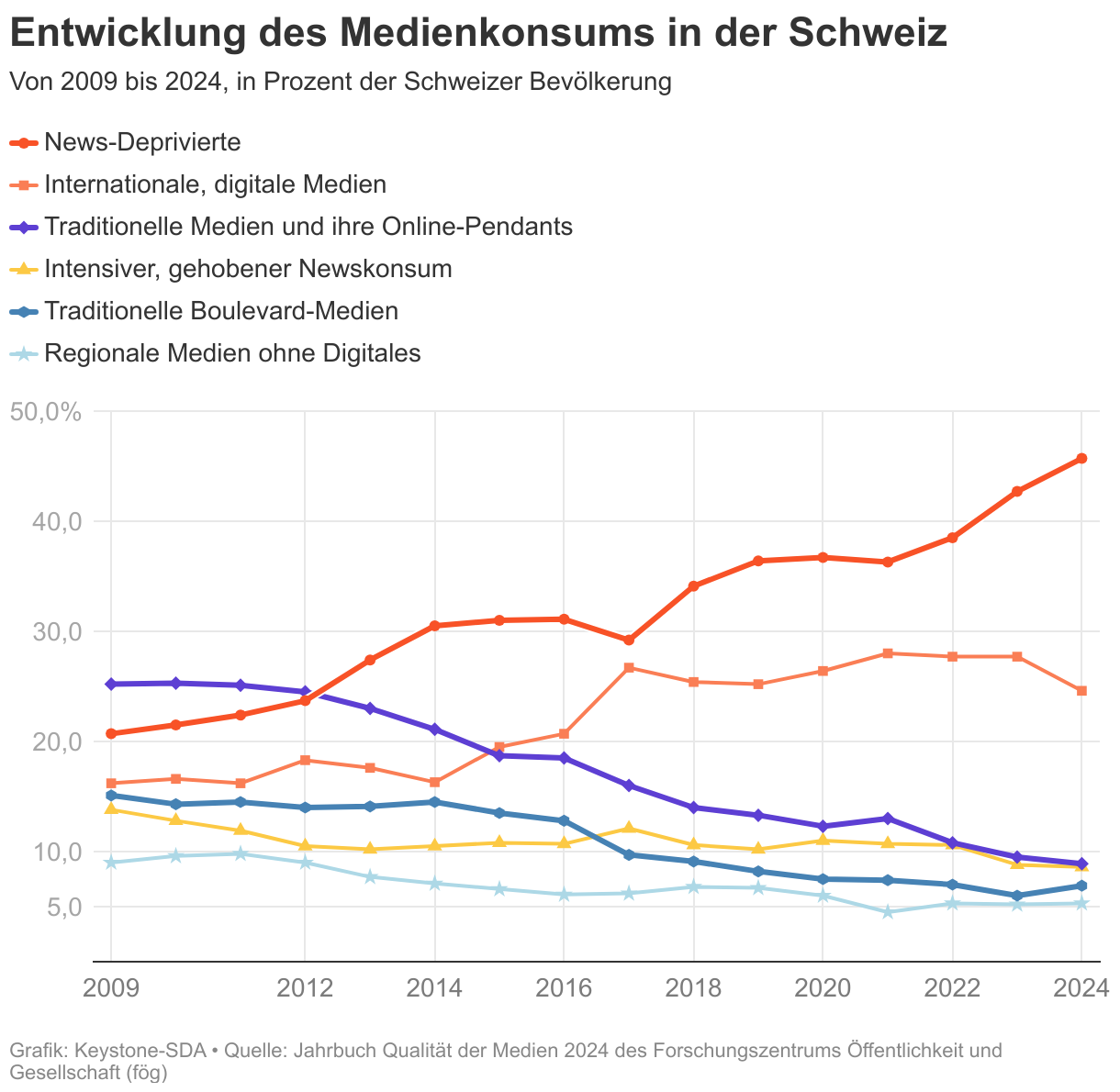
Due to the tight financial situation, there is also a concentration of media content, the yearbook continues. In regional reporting, for example, articles are increasingly being used more than once. The Fög considers a further loss of diversity at local and regional level due to fewer daily information offerings to be problematic.
The Fög recommends greater cooperation between public and private media. This is to counter the tech platforms that are siphoning off a large proportion of online advertising. According to Fög Director Eisenegger, these are the biggest challenge for all media - both public and private.
57 percent would not pay anything online
There is also a lack of willingness to pay, particularly in the online sector: 57% of respondents stated that they would not pay anything. A further 35% would be prepared to pay less than CHF 10 per month.
However, according to the study, the median for online subscriptions is CHF 18 per month. However, no statistical correlation was found between the use of certain types of media and the willingness to pay.
Whether online news is paid for or not depends more on the attitudes and socio-demographic characteristics of those surveyed. Men and younger people are more likely to pay. And those with a strong interest in news and politics are more willing to spend money on digital news services.
SRG scores highly for quality and trust
According to Fög, most respondents trust SRG news programs with 7 points on a scale up to 10. Le Temps and NZZ with 6.8 and 6.6 points. At the other end is the View with 5 points, on a par with GMX and Yahoo News.
On a scale of up to 10 points, the Fög attests the highest quality to SRF radio and television programs with 7.7 and 7.5 points respectively. Echo der Zeit" took first place with 8.1 points, ahead of "Rendez-vous" with 7.9 points, while private television was on a par with online subscription newspapers with 6.4 points.
Tabloid and commuter newspapers came last with 4.6 and 5 points respectively. However, the study expects long-term improvements in the areas of relevance and diversity as more hard news is published. This is thanks to journalistic changes that focus more on quality.

Great skepticism towards AI
The study also shows that the population remains skeptical about the use of artificial intelligence (AI) in journalism. Almost three quarters of Swiss people rate the risks of AI in journalism as high, even higher than in other areas of society such as politics or the military.
According to the study, the more AI intervenes directly in journalistic output, such as text or image production, the greater the skepticism. According to Fög deputy head of research Daniel Vogler, this may also be one reason why Swiss journalists are not prepared to use AI-generated news. However, the majority are in favor of using AI for translations, data analysis or research.

The Yearbook of the Media has been published since 2010. According to the Fög, the aim is to deepen the discussion about the quality of the media and to promote awareness of the achievements of information journalism in society. All types of media are examined, from press, radio and television to online and social media. The data basis is the Digital News Report of the Reuters Institute at Oxford University. (SDA/swi)
]]>
The Covid-19 pandemic triggered an unprecedented financial crisis. Between February 24, 2020 and March 20, 2020, the value of US companies on the stock market plummeted significantly, surpassing the decline during the financial crisis from 2008 to 2009.
At the beginning of the pandemic, several CEOs made statements in conference calls with financial analysts that were not directly related to the current business situation, but expressed concern for their fellow human beings. These expressions of empathy are the focus of a new study by researchers from the University of Zurich, the London School of Economics and Political Science and Cambridge Judge Business School.
The researchers analyzed 510 CEO conference calls from 448 large US companies during the Covid-19 pandemic. Despite the human challenge posed by the pandemic, only about half (51.8 %) of the CEOs expressed concern for the well-being of their fellow human beings. Moreover, most of these statements were superficial and did not contain any concrete protective or other measures. Nevertheless, the share prices of these companies outperformed those of companies whose CEOs did not comment on the impact of the pandemic.
"I mean, every time people are ill or tragically lose their lives, it's a much more important issue than anything we report on today. I just want to say that briefly." - Statement by Strauss H. Zelnick, CEO of Take-Two Interactive Software, in a conference call during the Covid-19 pandemic
Surprising effect of lip service
First author Lauren Howe was initially surprised that some CEOs expressed their concern for the health and safety of employees, customers and others affected by the virus in the conference calls: "At first glance, these statements seem to be of little relevance to financial analysts and therefore should not influence them."
At the same time, conference calls are one of the most important ways for investors to get in touch with CEOs live. What leaders say in these conversations and how they do so can have a significant impact on the markets. During a crisis like the Covid-19 pandemic, it is therefore plausible that investors pay extra attention to these direct exchanges.
In numerical terms, a single declaration of care was associated with an increase in cumulative returns of 2.49 percentage points. Considering that the average market value of the equity of the companies analyzed was approximately USD 3.17 billion, this effect resulted in approximately USD 78.9 million of company value being retained after the crisis.
"Obviously, the coronavirus is making the situation very volatile. [...] I would first like to emphasize that the safety of our employees, partners and customers is our top priority." - Statement by Zebra CEO Anders Gustafsson in a conference call during the Covid-19 pandemic
Corporate management is about performance and people
In further analyses, the researchers found that compassionate statements during the crisis were associated with lower stock volatility, but had no impact on analysts' estimates of future earnings. The results suggest that market participants discount a company's future earnings less heavily - and view stocks as less risky - when the CEO expresses compassionate concern. This is notable in that, again, these were general affirmations with no associated plans, actions or direct financial implications.
The results underline the importance of CEOs showing humanity in their communication and the impact this has on investor perception and company performance. CEOs who only focus on performance miss the opportunity to show the expected care for people. "Corporate governance is as much about performance as it is about people," adds last author Jochen Menges. "Our study shows that it pays to care about your fellow human beings - even in conference calls with analysts and investors who are expected to only care about performance."
"First of all, the whole coronavirus situation is a human situation. It's kind of a human tragedy." - Statement by Autodesk CEO Andrew Anagnost in a conference call during the Covid-19 pandemic
The underlying study by Howe et al. can be accessed here.
]]>
At the Department of Economics at the University of Zurich, the starting point for economic research is not the classic homo economicus, but real human behavior and real social processes. The institute compiles basic knowledge and develops measures for the benefit of politics and business - with the aim of contributing to a better world through evidence-based research.
The Department of Economics is addressing the interested public with a new film. It briefly explains who the Department of Economics is, where it comes from and what it strives for. The film focuses on the changed view of human behavior as a central piece of the puzzle of a modern economy, implemented with simple, visually powerful imagery.
Seed developed and produced the film in close collaboration with the Department of Economics at the University of Zurich. The film was directed by Max Carlo Kohal. The film will be used at events, lectures and presentations as well as on the website and in social media.
Responsible at the University of Zurich, Department of Economics: Jeannette Bours, Katrin Polzer, Victoria Watts. Responsible at Seed Audio-Visual Communication: Max Carlo Kohal (director, screenplay, editor), Andreas Szentkuti (concept), Lukas Gut, Aaron Markus Graf, Sven Probst (camera), Oliver Muff (lighting), Lea Haettenschwiler (set design), Maurizio Zulli (sound design, sound mixing), Claudio Garovi (production/recording manager), Felix Courvoisier (producer).
]]>
The University of Zurich is the most diverse and, with around 28,000 students, also the largest university in Switzerland. With the "Future of Teaching at UZH" initiative, it aims to strengthen and further develop teaching. A key factor in the success of the initiative is the commitment of the teaching community, consisting of professors, lecturers, tutors and all other people involved in teaching.
The University of Zurich is addressing its teaching community with a compact film to get them excited about the initiative. The film is intended to encourage those involved to actively contribute to the teaching community and learn from each other. It emphasizes the important role they play in the further development of teaching.
The special feature of the film lies in its unconventional approach: The focus is on a wide variety of chairs. The film was directed by Simon Ramseier. The film will be used at events and presentations as well as on the website and in social media.
Responsible at the University of Zurich: Lucie Hauser, Allegra Schiesser, David Schmocker, David Werner; responsible at Seed Audio-Visual Communication AG: Simon Ramseier (writer, director, editor), Stephan Huwyler (cinematographer), Johan Lindqvist (lighting), Roman Linder (color grading), Bardo Eicher (sound design/sound mixing), Viviane Rapp, Lea Haettenschwiler (production design), Claudio Garovi (production manager), Felix Courvoisier (producer)
]]>
Many women and men work in gender-typical professions. A new study by the University of Zurich explains why: According to the study, one important reason is that men selectively leave professions that are increasingly taken up by women.
There is still a strong gender divide in the labor market, even though the occupational status of the sexes has converged over the past 50 years. For example, many nursing professions are female-dominated, while many skilled trades are mainly performed by men. Why? That's what the University of Zurich is trying to explain with a new study. According to it, there is therefore a theory in gender research that men selectively leave professions and specializations that are newly taken up by more women.
Theory empirically tested
Per Block, professor of sociology at the University of Zurich, has empirically tested the theory using new methods from network research. The labor market is understood as a network, in which employees change their occupations to link different occupations. This makes it possible to analyze whether men selectively leave occupations that become feminized. This is done by considering the different occupational characteristics that channel men and women into different occupations. The empirical data for the study come from the United Kingdom; the labor market there has similarities with many European countries as well as with North American countries.
The results clearly show that men are less likely to stay in occupations to which more women switch. For example, the study compares two hypothetical occupations that are identical in all job characteristics and differ only in that one has 25 percent women and the other 75 percent. "The analysis shows that men are twice as likely to leave the feminizing occupation," says Prof. Block. The impact of this behavior is being explored in a simulation study in which women and men are not influenced by the gender of other workers in occupations. If only occupation-specific attributes (such as wage, flexibility, or job characteristics) actually influenced occupational changes, the simulation study predicts a 19-28 percent decrease in gender segregation in occupations.
The research concludes that gender segregation is caused not only by gender-typical job attributes, but also by men (and women) who consciously or unconsciously resist mixing.
]]>
With its seven faculties, the University of Zurich offers a wide range of study opportunities at the bachelor's, master's and doctoral levels. In addition, contemporary teaching is a major concern of the university. With the initiative "Future of Teaching at UZH", it is creating a framework to which the faculties can orient themselves. Among other things, the opportunities offered by the digital transformation are to be increasingly exploited, student engagement is to be promoted, and the interdisciplinary and transdisciplinary components of the curriculum are to be increased.
The film accompanying the initiative portrays four students who are already shaping their studies in the spirit of the "Future of Teaching at UZH". Seed developed and realized the film in close cooperation with the University of Zurich. The film was directed by Simon Ramseier. The film will be used on the website, in social media and as part of presentations and events.
Responsible at the University of Zurich: Lucie Hauser, Allegra Schiesser, David Werner. Responsible at Seed Audio-Visual Communication: Simon Ramseier (writer, director, editor), Stephan Huwyler, Simon Ramseier (camera), Kevin Walt (production manager), Simon Hardegger (color grading), Bardo Eicher (sound mixing), Claudio Garovi (production manager), Felix Courvoisier (producer).
]]>
The report of around one hundred pages covers a broad spectrum of science communication in Switzerland: how the public perceives science and how they find out about it, how researchers and universities and science organizations communicate with the public, the role of social media and science journalism in Switzerland.
Accordingly, science enjoys strong support among the population, and is given a wide range of opportunities to learn about and engage with scientific topics. These include museums, botanical gardens, journalistic and social media, science cafés and citizen science projects.
Vulnerabilities identified
But the study also highlights weaknesses in science communication. These include insufficient support for researchers communicating with the public, the erosion of science journalism and the accompanying difficult working conditions for female journalists, and the spread of dis- and misinformation in social media, according to the academies.
In addition, Mike S. Schäfer, professor at the University of Zurich and spokesman for the expert group, said: "Research results show that a small but not insignificant part of the Swiss population has distanced itself from science." And one cannot be satisfied with that, he added.
Twenty recommendations formulated
In the twenty recommendations, the experts call, for example, for researchers and scientific organizations to communicate how science works - including uncertainties, different perspectives and social relevance. In addition, science communication must counteract dis- and misinformation, communication between science and politics must be strengthened and institutionalized, and science journalism must be strengthened.
"It also makes it clear that science communication should not be one-way, but dialogue-based, and that researchers should seek to understand the perspectives of the public," Schäfer said.
"Exploiting "corona momentum
During the Corona pandemic in particular, it became clear how important assessments by scientists are. There was also increased science journalism content in the media during this time. Although he does not yet see a trend reversal in science journalism, Schäfer told the Keystone-SDA news agency. But the Corona pandemic gave it momentum. "With this momentum, we should now work out new organizational and financing models and build the necessary structures so that Swiss science journalism can be led into the future in a strengthened position," Schäfer said.
The 16-member expert group "Communicating Sciences and Arts in Times of Digital Media" consisted of researchers, communication specialists and science journalists from all language regions of Switzerland. (SDA)
]]>