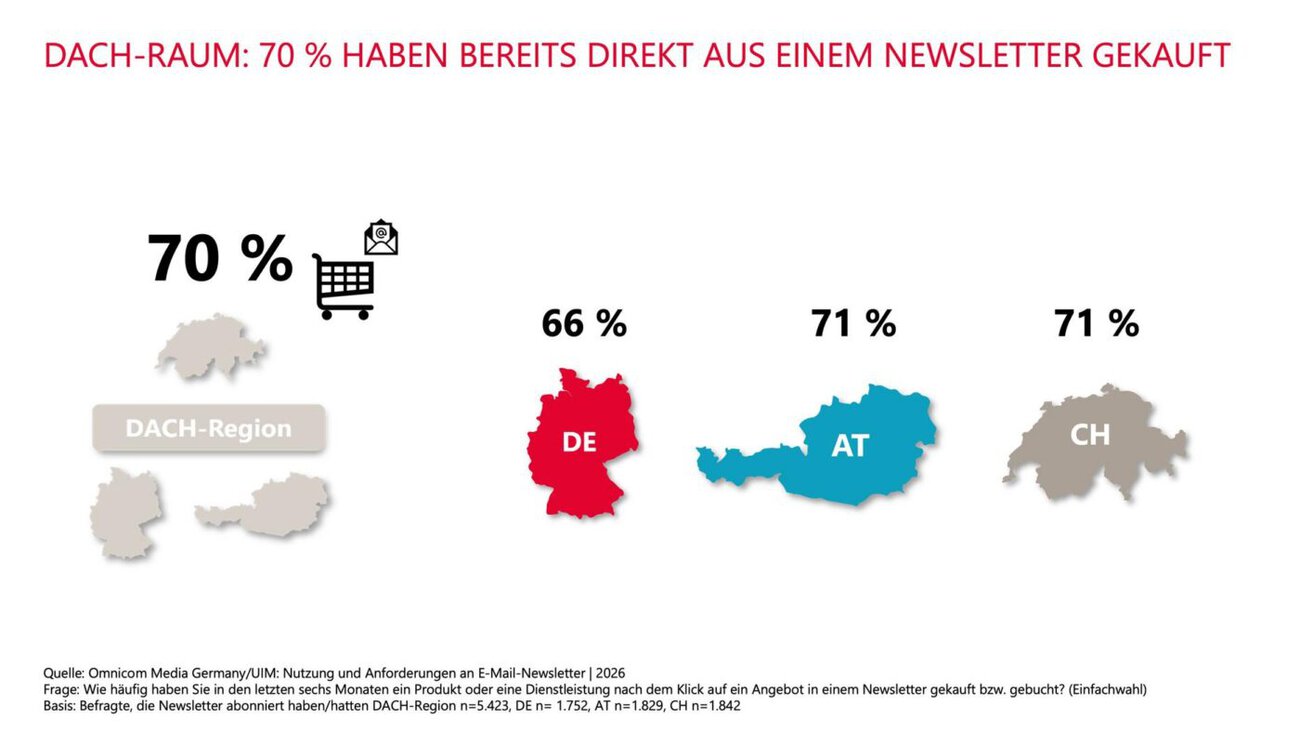
The DACH Study newsletter from United Internet Media (UIM) shows that email campaigns are much more than just a channel for information—they are a direct sales driver. In Germany, two-thirds of respondents said they had already placed an order directly from a newsletter. In Austria and Switzerland, this figure is even higher, at 71 percent in each country. For the study titled «Newsletters as a Success Factor: Usage, Expectations, and Trends,» Omnicom Media Germany surveyed 6,000 internet users aged 18 to 69 in Germany, Austria, and Switzerland on behalf of United Internet Media.
Online stores dominate newsletter usage in the DACH region
79 percent of respondents have subscribed to at least one newsletter. Internet users in Switzerland are particularly enthusiastic about newsletters: 39 percent receive six or more regular email newsletters; in Austria, the figure is 37 percent, and in Germany, 34 percent. Newsletters most often come from online stores (71 percent), followed by internet services such as comparison sites and rewards programs (49 percent), events (40 percent), and news outlets (39 percent).

Rasmus Giese, CEO of United Internet Media, comments on the results: «Newsletters are much more than just a channel for information. They are an important part of the customer journey and an effective sales channel. Combining relevant content with exclusive offers strengthens customer loyalty, drives purchases, and boosts sales.»
Exclusive offers and discounts encourage subscriptions and purchases
According to the DACH Newsletter Study, whether a newsletter is perceived as appealing depends heavily on specific content factors. For 79 percent of respondents in the DACH region, newsletters are particularly interesting when they contain offers or exclusive promotions. Special discounts are the most important reason for subscribing to a newsletter, cited by 55 percent of respondents—even more so than regular updates from the sender (50 percent). Exclusive offers are particularly effective as a purchase incentive in Austria (59 percent), as well as in Switzerland (54 percent) and Germany (53 percent). Bonus products or gifts influence purchasing decisions in all three countries (44 percent).
Trust Starts in the Inbox: 87 Percent Pay Attention to Sender Cues
For nearly nine out of ten people in the DACH region (87 percent), it is crucial that the sender information in an email appears trustworthy. 57 percent actively look for brand logos when scanning their emails. More than half (54 percent) of newsletter subscribers want a clear description of the content right in the subject line—in Switzerland, this figure is 56 percent; in Austria, 55 percent; and in Germany, 50 percent. About three in ten respondents consider trust seals particularly important for verifying the sender’s authenticity—most frequently in Austria (30 percent), followed by Switzerland (29 percent) and Germany (27 percent).
According to the study, sender logos make it easier to navigate an inbox: 72 percent recognize the sender more quickly as a result, and 70 percent perceive such emails as more professional. In addition, brand logos build trust for 65 percent of respondents and help 56 percent more easily identify scams such as phishing emails. «The study shows that trust can be built right from the inbox. Trustworthy sender signals are becoming increasingly important, especially in times of AI-powered phishing attacks,» says Giese. The trustedDialog quality standard ensures greater security and transparency in more than 40 million inboxes across the DACH region through brand logos and seals of approval.
Personalization and Design as Additional Factors for Success
Recipients also have clear expectations regarding the design of newsletters. 82 percent prefer emails with minimal text, and 81 percent value a consistent, recognizable design. Email previews featuring highlights such as new products or discount promotions, accompanied by an image, are also very well received (59 percent). 78 percent of respondents would like to decide for themselves, based on their interests, which topics or types of offers they receive. 59 percent would like dynamic newsletters that automatically adapt current offers or availability based on location and time of day.
Further information about the study and United Internet Media's offerings is available at: https://www.united-internet-media.de
]]>
For the second time, e-mail provider GMX has published facts about the e-mail market in German-speaking Switzerland. In addition to market shares, data was also collected on the e-mail usage of Swiss online users: Respondents are using the electronic mailbox more and more intensively, and e-mail communication with companies in the context of purchasing processes is also gaining in importance. These are the findings of a survey conducted by the MindTake research institute on behalf of United Internet Media.
Gmail in first place
In the ranking of mainly privately used e-mail providers, Gmail continues to lead with a market share of 30.7 percent. Second place goes to GMX.ch with 17.3 percent, Bluewin moves up to third place with a market share of 17 percent. In fourth place is Microsoft (15.3 %), followed by its own server/domain email offering (3.4 %) and iCloud (3.4 %). Sunrise (3.2 %) and Yahoo (2.5 %) bring up the rear.

Emails in communication with companies
In the past year, e-mails have gained in importance above all in communication with companies as part of the purchasing process (25.5 %). This is followed by communication with public authorities (20.5 %) and training or further education institutions (19.6 %). The role of e-mail in the dialog between companies and customers is also reflected in the use of newsletters. 9 out of 10 respondents receive weekly newsletters on their private e-mail account - one fifth of all e-mail users receive more than 20 of these regular mailings each week. Overall, 66.3 percent of those who receive newsletters also read them at least once a week.
41.4 percent of newsletter readers have already made a purchase directly from a newsletter. The main reason for direct purchases are offers or exclusive discounts (60.2 %), followed by time-limited offers (26.3 %) and a simplified ordering process via the newsletter (18.9 %).

Internet activities of the Swiss
Overall, e-mail use is also strong: Surfing the Internet (93.8 %) and reading or writing e-mails (91.5 %) are the two most frequent Internet activities of e-mail users in German-speaking Switzerland. This is followed by visiting social networks (72.8 %).
Reading and writing e-mails plays a major role for every age group: while 80 percent of 14- to 19-year-olds and 82.3 percent of 20- to 29-year-olds read or write e-mails at least daily, the figure is already 91.9 percent for 30- to 39-year-olds and as high as 93.5 percent for 40- to 49-year-olds. The proportion of those who use e-mail at least daily is even higher: 96.7 percent of those aged 50 to 59 and 98.8 percent of those aged 60 to 69. More than half of 14- to 19-year-olds (51.2 %) say they have read more e-mail in the past year. Among 20- to 29-year-olds, this figure is 39.1 percent, and among 30- to 39-year-olds, 28.5 percent read more e-mails.
]]>
Investments in dynamic e-mail marketing and target-group-specific communication and content are worthwhile. This is shown by the current DACH study "E-Mail Cross Generations" commissioned by United Internet Media. The reasons for this lie in the different use of e-mail, both at country and generation level. For the study, the market research institute MindTake surveyed over 1,000 people in Germany, Austria and Switzerland.
One core result for the DACH region across all generations: electronic mail is indispensable. If respondents can only choose one application, 24 percent opt for e-mail. Other Internet services register lower values: they are followed by instant messenger (22 percent), online banking (19 percent), search engine (12 percent) and social networks (7 percent).
In the detailed analysis at country level, e-mail is also always named most frequently when asked about the indispensability of individual Internet applications. 24 percent of respondents from Germany declared e-mail to be indispensable, which is exactly in line with the average; in Austria, the figure is 22 percent, and in Switzerland, 27 percent. The indispensability can be attributed to the high use of the digital mailbox in the DACH region: Around 90 percent of online users in Germany and Austria said they frequently or occasionally send and receive private e-mails. Among online users in Switzerland, as many as 98 percent said the same.

E-mail is the basis of Internet use
In the DACH region, e-mail serves as the basis of everyday digital life for all generations. The trend is that the younger the generation, the more varied the use of e-mail. Baby boomers use the electronic mailbox most frequently for logging into online stores (81 percent), online banking (71 percent) and online payment services (69 percent). For Gen X, the top uses are online stores (84 percent), online payment services (76 percent), and online banking and social networking (70 percent each). Gen Y uses email most for online stores (86 percent), social networks (83 percent) and online payment services (79 percent). In Gen Z, email scores highest for online shopping (88 percent), video streaming (84 percent) and social networking (83 percent).
"The cross-generation use of e-mail is impressively demonstrated by the study. At the same time, it shows the versatility and relevance of the electronic mailbox for virtually all industries. The country- and generation-specific features show that investing in dynamic e-mail marketing with content tailored to target groups is worthwhile," says Rasmus Giese, CEO of United Internet Media.
In Austria, the use of e-mail in connection with public institutions (baby boomers: 71 percent, Gen X: 70 percent, Gen Y: 73 percent Gen Z: 66 percent) is far higher than in neighboring countries. In Switzerland, on the other hand, electronic mail provides above-average support for app store activities (baby boomers: 57 percent, Gen X: 70 percent, Gen Y: 78 percent Gen Z: 86 percent). On the other hand, Germans use the P.O. box far more intensively for online auctions (baby boomers: 60 percent, Gen X: 68 percent, Gen Y: 71 percent Gen Z: 69 percent) than respondents in Austria and Switzerland.
Customer journey almost unthinkable without email
Email practically always plays a role in the digital purchasing process: Nine out of ten respondents in the DACH region use their email address during the customer journey. The individual touchpoints also register very high usage values: 90 percent are made aware of new products via e-mails such as newsletters. 91 percent use e-mail to register, and 88 percent contact retailers by e-mail with questions about the product. Another 91 percent email customer service, and 94 percent use email to track packages. Of particular importance to retailers, 73 percent of respondents buy products advertised in an email.
"Compared to other advertising channels, e-mail has an excellent price-performance ratio. And e-mail works - almost three quarters of respondents buy products advertised in newsletters. This willingness to buy can also be supported at the various touchpoints - adapted to the respective age, for example, on the basis of first-party data, if desired," says UIM CEO Giese. 
At the generational level, Gen Y and X have the highest values at the beginning of the customer journey. For example, 95 percent of Gen Y use their e-mail address to register with stores or price comparison sites. The highest value for parcel tracking by e-mail is recorded by Gen Z with 97 percent. Two trends can be identified at country level: In Switzerland and Germany, e-mail is used most intensively by Generation Y along the customer journey. In Austria, in addition to the younger generations Z and Y, Gen X also achieves the highest usage values in points such as communication with retailers and customer service.
Email is evaluated as secure and trustworthy
The study also surveys how online users in the DACH region rate the individual communication channels. In terms of "security & trustworthiness" and "reliability & usability," e-mail is ahead of instant messengers and social networks in all three countries.
The following two trends can be observed in Germany, Austria and Switzerland: The older the generation, the stronger the expectation of security and trustworthiness in private communication on the Internet. 81 percent of baby boomers consider e-mail to be secure and trustworthy - instant messengers (68 percent) and social networks (62 percent) score significantly lower. Gen Z rates the communication channels most critically across three DACH countries. But here, too, email scores far better than instant messenger (53 percent) and social networks (49 percent), at 59 percent.

To collect data on the market for e-mail providers in German-speaking Switzerland, the MindTake research institute surveyed a total of 1,010 Swiss online users on behalf of United Internet Media. A key question of the survey was which e-mail provider users mainly use privately. According to the results, GMX.ch, Bluewin and Gmail are in the top three places.
Gmail has the largest market share with 26 percent. Bluewin follows in second and third place with 18.5 percent and GMX.ch with 16.1 percent. Microsoft (12.9 %) and Sunrise (5.6 %) take fourth and fifth place. Server/domain providers for the user's own e-mail address, Yahoo and Apple's iCloud were unable to pass the 5 percent mark.
Gmail also among the top 3 in Austria
The results from German-speaking Switzerland close a gap in the market figures for the DACH region. In the spring, MindTake determined the market shares for Austria. There, GMX.at is in second place behind Gmail (32.3 %) with a share of 26.8 percent.
According to the Convios Consulting research institute, Web.de is in first place in Germany with 25.4 percent, closely followed by GMX, where 25.2 percent of German Internet users have their main e-mail address.
"GMX occupies a top 3 position among email providers in the entire DACH region. In German-speaking Switzerland, GMX.ch also boasts strong usage with 850,000 active users per month," concludes Matthias Weinelt, Head of Agency Sales South, Austria & Switzerland at United Internet Media. "This allows advertisers to play out high-reach, high-awareness campaigns in a short space of time."
]]>
The importance of artificial intelligence in digital marketing is increasing. This is a key finding of the new "Digital Dialog Insights 2019" study. Three quarters of the experts surveyed forecast a high significance of AI for advertising companies and agencies. Half are certain that intelligent technology will form an essential part of a company's marketing strategy in the future.
However, current AI concepts still need to be revised for this - only 15 percent of the study participants currently consider the technology mature enough to be used productively in intelligent marketing.
Personalization as a killer application
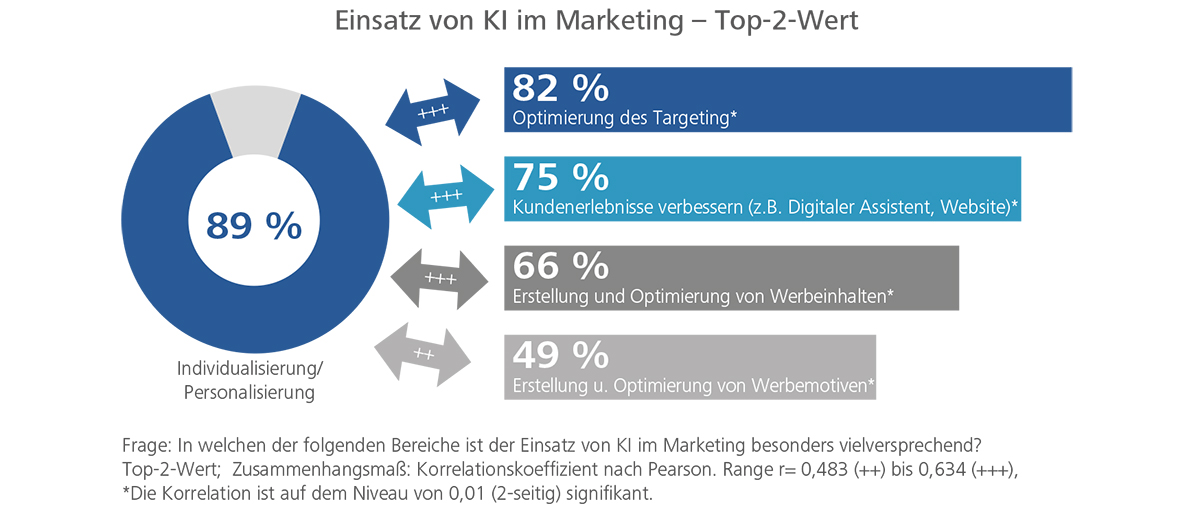
The experts agree: Artificial intelligence helps above all with personalization/individualization (89%). 82 percent of participants believe that this great potential comes from optimizing targeting with the help of smart technology. 75 percent of the experts think that improving the customer experience - for example, through a digital assistant - contributes to individualization. The respondents see great potential in the fact that messages can be personalized through automated creation as well as optimization of advertising content (66%) and motifs (49%).
Individually tailored and intelligent advertising messages
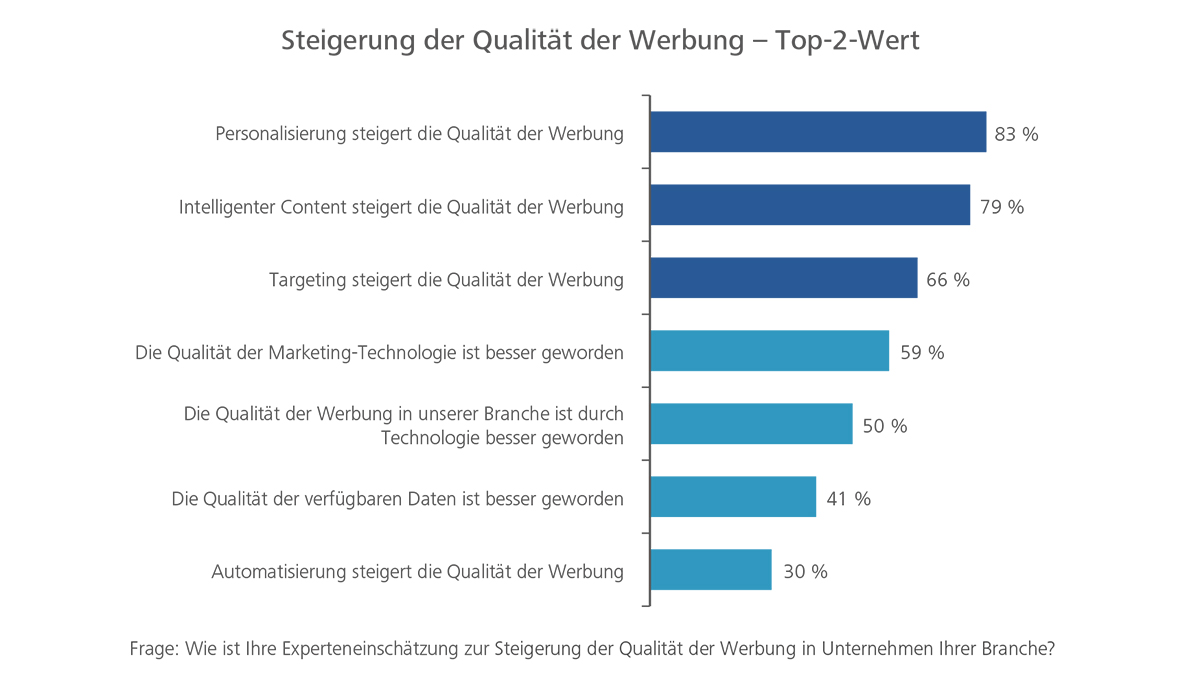
Artificial intelligence is seen as having the potential to contribute to improving digital marketing as a quality booster. This is because 83 percent of the experts surveyed are certain that personalization increases the quality of advertising messages. This is also improved by intelligent content (79%). Two-thirds of the study participants are convinced that marketing quality is additionally enhanced by effective target group addressing via targeting.
The willingness of companies to invest in promoting smart processes in marketing is correspondingly high. Almost 60 percent of the experts expect to improve existing customer experiences and individualization by investing in intelligent processes within the next two years.
Data quality as a success factor
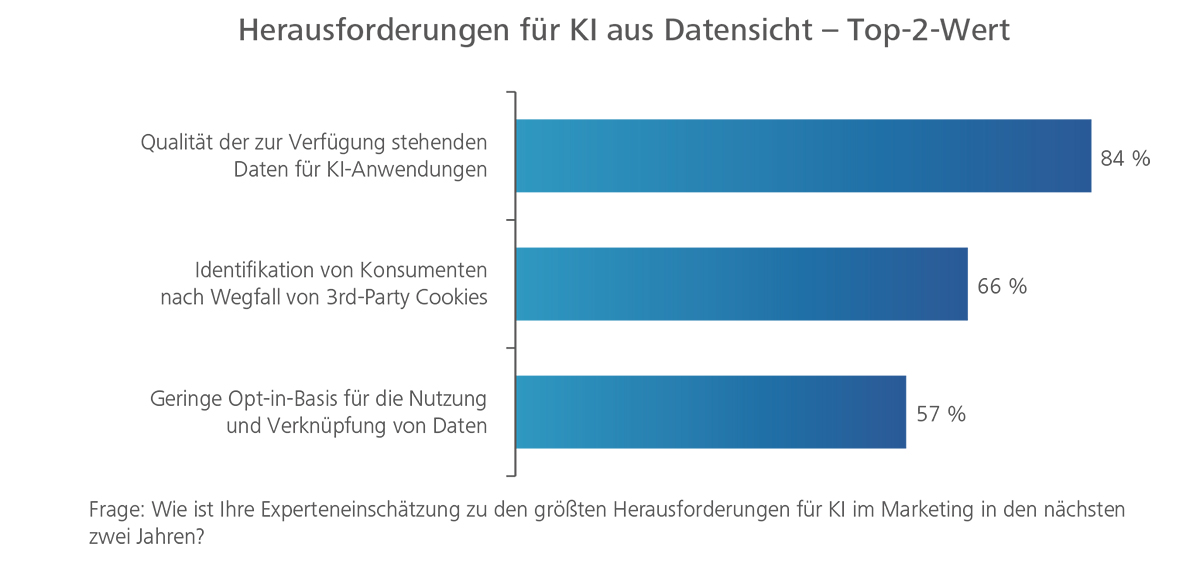
The use of artificial intelligence depends not only on the willingness to invest, but also on the quality of the available data. 84 percent of the experts see this as a major - or very major - challenge.
The experts name the identification of consumers after the discontinuation of "third-party cookies" as another top challenge (66%). More than half (57%) also consider the low opt-in basis for the use and linking of data to be challenging.
Almost 60 percent of the experts already consider the poor quality of the available data to be a high - or very high - hurdle. The study participants see the timeliness and consistency of the data as the most important quality criteria, with 96 percent and 80 percent respectively agreeing. However, the majority of experts also consider the criteria of up-to-dateness of the underlying data model (74%), documentation of data origin (73%), high degree of user identification (67%) and completeness of the data with regard to user identities (64%), as well as the type of data generation (57%) and persistence of data information (52%) to be important or very important.
Need for alternative identification methods potentially underestimated
The experts predict a high willingness to invest in the data basis due to the high relevance of data for AI applications. 65 percent believe that improving data quality for AI will be promoted in the future. A surprising figure in terms of user consent: Only one-third of respondents currently rely on opt-ins as part of their AI strategy.
However, more than half of the study participants across the industry already anticipate expanding the opt-in base to implement AI-based strategies (56%). The willingness to invest in the use of alternative identification methods as a replacement for third-party cookies (47%) is definitely there. However, it is rather weaker and the topic is thus potentially underestimated.
"As the basis of digital business models, cookies are becoming increasingly difficult to fulfill all the criteria for data quality, since browsers and adblockers, among other things, prevent them from being set and read. This makes it all the more important to look for alternative identification methods to compensate for third-party cookies, or to work with login-based solutions, as these allow persistent and privacy-compliant opt-ins to be obtained easily and quickly, as well as cross-device advertising," says Rasmus Giese (pictured below), CEO of UIM.
"Data-driven approaches are increasingly becoming the operating system in marketing communications. Our study underscores the importance of operational excellence and high-quality data," adds Professor Harald Eichsteller from Stuttgart Media University (HdM).
"Differentiating yourself through marketing AI is difficult. However, according to experts and decision-makers, investments are imperative in order not to be left behind in the competition. They are focusing primarily on personalizing their communications and improving the customer experience," explains Professor Jürgen Seitz from the HdM.

For the eighth edition of the "Digital Dialog Insights. 101 experts from the fields of production, retail and services were surveyed online in the period from May to June 2019. The questionnaire was developed by United Internet Media in cooperation with Stuttgart Media University. Participants were recruited from the HdM's network of experts and answered questions on the status quo, trends and upcoming challenges in digital dialog marketing.
new homepage more user-friendliness in conjunction with an optimization of the advertising environment was decisive, as the marketer United Internet Media explained. Functions that are essential for users, such as the login, always remain in the visible area - even when scrolling down (sticky login). Performance has been optimized, with faster loading times provided. New individualization functions for service modules such as the horoscope or the weather service are also planned for the coming months. Another goal is to expand the editorial services, such as the integration of a news ticker or a finance module.
Gmx.ch now has a clearer, flexibly assignable page structure, with modules aligned to the format of the standard Medium Rectangle advertising format. Gmx.ch promises advertisers viewport-optimized visibility and display of their ads. The advertising medium and message remain completely in the visible area at common display sizes.
Exclusive campaign for the launch
The relaunch of Gmx.ch was used by the car manufacturer Chevrolet, which is present on the website with its new Chevrolet Spark model as part of a 24-hour exclusive placement. The branding campaign, conceived by Isobar Zurich (media agency) and Commonwealth Milan (creative agency), occupies not only the new homepage but also other placements with large-scale branding display formats such as the homepage of the approximately 630,000 active digital mailboxes, the mailsent page and the logout page of the freemail service. An exclusive placement that will also be possible in the future.


"Email is a usage driver that leads to users coming to the portal several times a day. At the same time, more than 95 percent also engage with the content offering," says Nadja Elias, PR Manager at portal marketer United Internet Media. Particularly in campaigns with a short duration, in which a certain dose of contact must be achieved in a short time, the high frequency of visits pays off.
To make Gmx.ch attractive as an advertising platform, United Internet Media invests in technological development and online research. A Responsive Design ensures that the visibility of advertising media is guaranteed across all screen sizes. In addition to key figures such as ad size and ad view time (how long an ad or parts of it are potentially visible on the display), the context in which the ad is embedded is also taken into account - i.e. with which content the ad vies for the user's attention (ad clutter).
Above all, however, United Internet Media is concerned about how advertising affects the user. "Online advertising should not be annoying. If an advertising medium causes a reaction, this has a negative impact on brand sympathy," explains Michael Burst, Head of Market and Media Research at United Internet Media. In the freemail sector, Gmx.ch is therefore holding back on advertising. After all, users want to read or compose e-mails there. Burst, on the other hand, considers the log-out area to be particularly attractive. "After logging out, users are in a transition phase and are relatively open to advertising." On the log-out page, Gmx.ch therefore offers advertisers the opportunity to place a prominent, large-format advertisement exclusively.
Depending on the type, size and placement of the advertising medium, the actual contact dose achieved by a campaign is evaluated. "In our experience, an average of six to seven contacts is most effective for branding campaigns," says Burst. In the case of larger campaigns, Burst and his team use surveys to collect not only purely technical indicators such as ad size, ad visibility and ad clutter, but also qualitative factors of the advertising impact, such as brand awareness, advertising recall, purchase intention and brand sympathy.
Online must prove itself
In Germany, United Internet Media reported record results for the past year. However, the portal marketer has not yet succeeded in making the leap into Switzerland. The opening of a sales office in Zurich, as planned for last summer (Advertising week reported), has been put on hold. The decision was made to wait and see, due to the development of the Swiss online market. With an online share of eight percent in the media mix (Media Focus), Switzerland is one of the worst performers in Europe.
United Internet Media has a lot at stake in convincing Swiss customers of the value of its advertising offering. "Online must and can provide the same proof of performance as TV or print," Elias is convinced. Elias and Burst cite the implementation of cross-marketer studies as a goal, as is common in other media. Industry-wide research would not least benefit the credibility of the medium.

Bluewin.ch (1'895'000) and Msn.ch (1'858'000) (Net-Metrix Profile 2012-2).
