
On average, respondents would like to see an age limit of 15, but at the same time doubt that platforms can reliably verify the ages of their users.
Majority Sees Social Media as a Threat
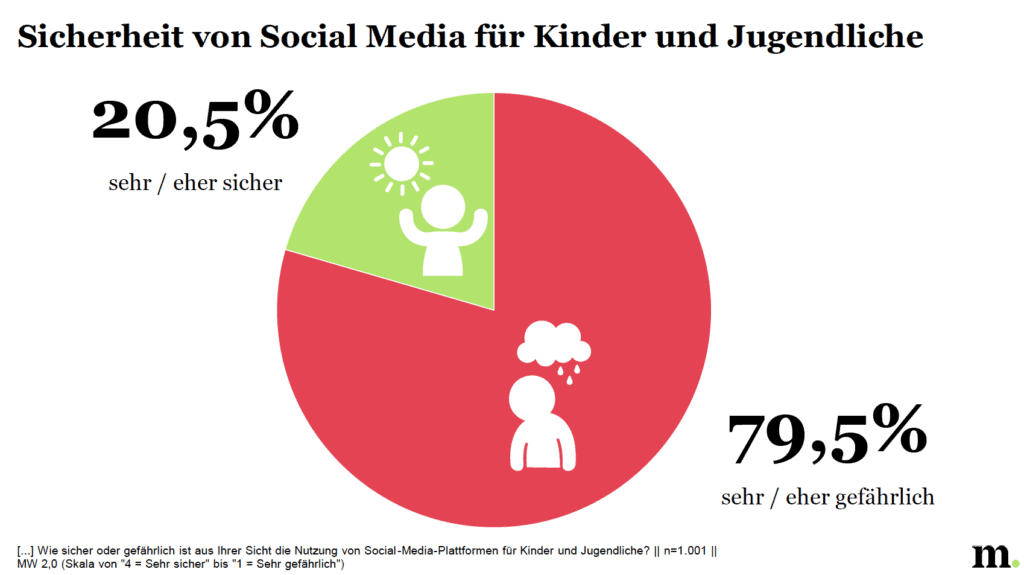
Today, children and teenagers naturally spend time on TikTok, Instagram, or Snapchat, but the Swiss public views this digital world with a critical eye. Eighty percent of those surveyed believe that social media is somewhat or very dangerous for young people, while only one-fifth consider these platforms to be safe.
The study shows that opportunities such as access to knowledge and education (37 percent), the acquisition of digital skills (35 percent), and social networking (34 percent) are certainly recognized, but they take a back seat to the perceived risks. In particular, cyberbullying (69 percent), addiction and excessive use (63 percent), and sexual harassment (62 percent) shape the public’s perception of risk.
Call for a statutory minimum age
Alongside international regulatory efforts—such as Australia’s ban on social media for children under 16 or the planned restrictions for children under 15 in France—the call for age limits is also gaining traction in Switzerland. Eighty-three percent of respondents support a legal minimum age for social media, with the desired average age being 15.
It is noteworthy that support is high across all generations: both 14- to 19-year-olds and those over 60 are equally vocal in their support for a legal age limit. For many, a minimum age is seen as a key component in better protecting children and adolescents and enabling them to use social media responsibly.
Responsibility of Parents, Platforms, and Policymakers
When considering the question of who should ensure compliance with a minimum age requirement, a nuanced picture emerges. 43 percent of respondents believe the primary responsibility lies with parents, 23 percent with the platforms themselves, and 19 percent with the government.
At the same time, a clear majority of 64 percent does not believe that social media providers can reliably verify users’ ages. The public expects parents to guide their children, set rules, and monitor their activity, while platforms and policymakers create a framework that effectively supports the protection of minors.
TikTok as the riskiest platform
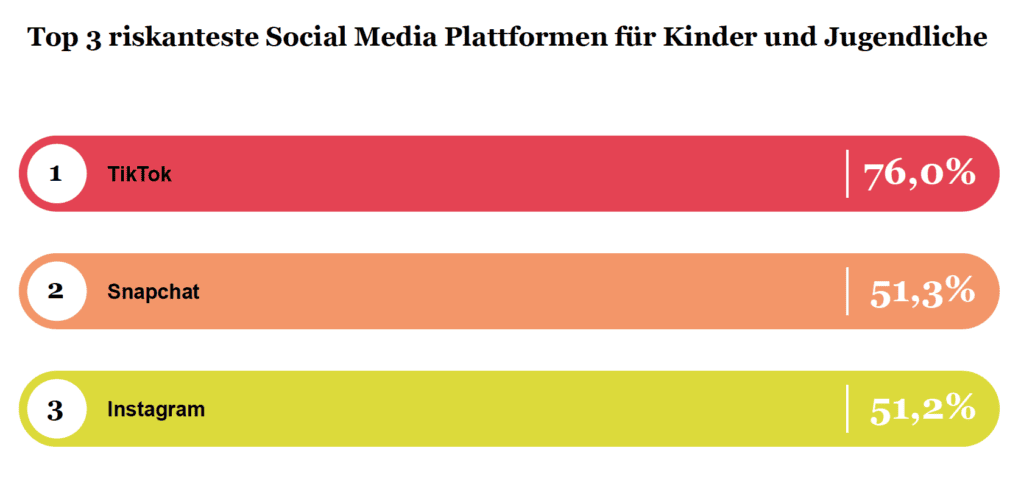
The assessment of individual platforms is also clear-cut. TikTok is rated by 76 percent of respondents as particularly risky for children and adolescents, placing it well ahead of Snapchat and Instagram, which are each classified as problematic by 51 percent of respondents.
X/Twitter and Facebook (39 percent each), as well as YouTube (24 percent), are also facing criticism, albeit to a lesser extent. It is striking that younger people in particular are more likely to perceive Instagram as risky (70 percent of 14- to 19-year-olds) than older respondents (42 percent of 60- to 69-year-olds).
]]>
In the survey conducted by the JRC Bern research institute, 67% of respondents said they were definitely or somewhat against the privatization of Swisscom. 26% were definitely or somewhat in favor of selling the Confederation's stake. 9% were undecided or gave no answer. Syndicom presented the results of the survey at a media conference in Bern on Thursday.
Rejection in all camps
The survey shows "no" majorities among supporters of all parties and in all language regions, with the clearest rejection among the Green and SP base with "no" majorities of 88% and 69% respectively. Supporters of the GLP are the least skeptical, with 57% of them voting "no".
The background to this is the discussions surrounding the financial situation of the Confederation. In this context, FDP President Thierry Burkart spoke positively about privatization in an interview with the Neue Zürcher Zeitung in May.
"We should definitely look into this. Swisscom's public service is only a small part that could be maintained with service agreements," said the Councillor of States from Aargau.
"Sale of the silverware"
The Federal Council is also currently examining how to proceed with Swisscom. The Confederation currently holds 51% of Swisscom shares.
Syndicom used the media conference to counter the arguments of those in favour of privatization. If necessary, the union will call for a referendum, the union declared.
A Swisscom privatization would be a sale of silverware without necessity, Syndicom wrote in a press release. A sale would also not make financial sense, as Swisscom pays an annual dividend of over half a billion francs to the federal government, which would not be paid in the event of privatization.
"Superfluous debate"
Lucerne SP National Councillor David Roth accused the conservatives of ideological stubbornness: "If they want to keep Switzerland busy with this superfluous debate, we regret it."
Daniel Hügli, member of the Syndicom Executive Board, emphasized the importance of Swisscom for the universal service, even in peripheral regions. As the majority owner, the Confederation guarantees Swisscom the necessary stability for investments, for example in the expansion of fiber optic networks.
A look abroad shows that private, profit-oriented companies are not doing the same, said Hügli: "Unlike in Germany and Austria, fiber optic expansion is progressing rapidly in Switzerland."
For the study, JRC Bern interviewed 1007 people by telephone from April 3 to May 4. The data was then weighted so that it is representative of the entire voting population. According to the authors of the study, the sampling error is +/-3.1 percent.
]]> A considerable proportion of Swiss SMEs have a gloomy outlook for the coming winter, although at the same time there is also a large proportion that is calmly facing the challenges. While the companies are robust in principle, some are struggling with shrinking profits and fear insolvency. This is shown by a representative survey conducted by the Yougov Institute on behalf of the B2B platform operator Visable.
The current economic and geopolitical situation is clouding expectations for the coming winter among a large number of Swiss SMEs. 37 percent of companies rate the risk of restrictions in business activity due to economic difficulties as high or rather high. In contrast, however, there are also hopes that the effects of the Ukraine war will not be so dramatic. 21 percent rate the risk of operating restrictions as somewhat low and 38 percent as low.

The biggest risk is rising energy costs
At 36 percent, rising energy costs pose the greatest risk for companies. Rising prices for raw materials and intermediate products are feared by 30 percent of SME decision-makers. Only slightly less weight is given to supply chain problems (28 percent). And closely followed by inflation is cited as a risk (26 percent). Corona is still a risk factor to be taken seriously. As many as 23 percent of SMEs expect staff absences this winter due to illness and quarantine. Skilled labor shortages and a slump in demand were mentioned by 22 percent of respondents. War sanctions (7 percent) and a lack of digitization (5 percent) are seen as the lowest risks.
Companies are not remaining idle in the face of the current challenges. When asked about the measures planned to get through the winter as well as possible, energy-saving measures are clearly in first place (29 percent). In second place with 18 percent is the hiring of new employees. After all, 15 percent are considering suspending planned investments. And 11 percent mention staff reductions or wage cuts. Short-time work is hardly relevant (7 percent). 22 percent of SMEs stated that profits will fall somewhat in 2022 compared with the previous year.
]]>