 Toyota has a rather conservative image, although the car manufacturer is committed to C02-neutral mobility. The current image campaign of Toyota Switzerland, conceived and implemented by Ringier Brand Studio, is all about boredom, or rather the opposite of it. "No more boring cars" is the claim, and with it Toyota's new self-image. The message is conveyed with two-stage headlines, where clichés are taken up and refuted at the same time.
The campaign is intended to be consistent, self-deprecating and honest. So honest, in fact, that it even raises the question of whether the new car really has to be an SUV in every case. The campaign relies on large-scale, interactive display formats, an Landing page, social and moving image. In collaboration with Shining Film, three video clips were produced in which relaxed dialogues between friends lead to a twist with the respective car model.
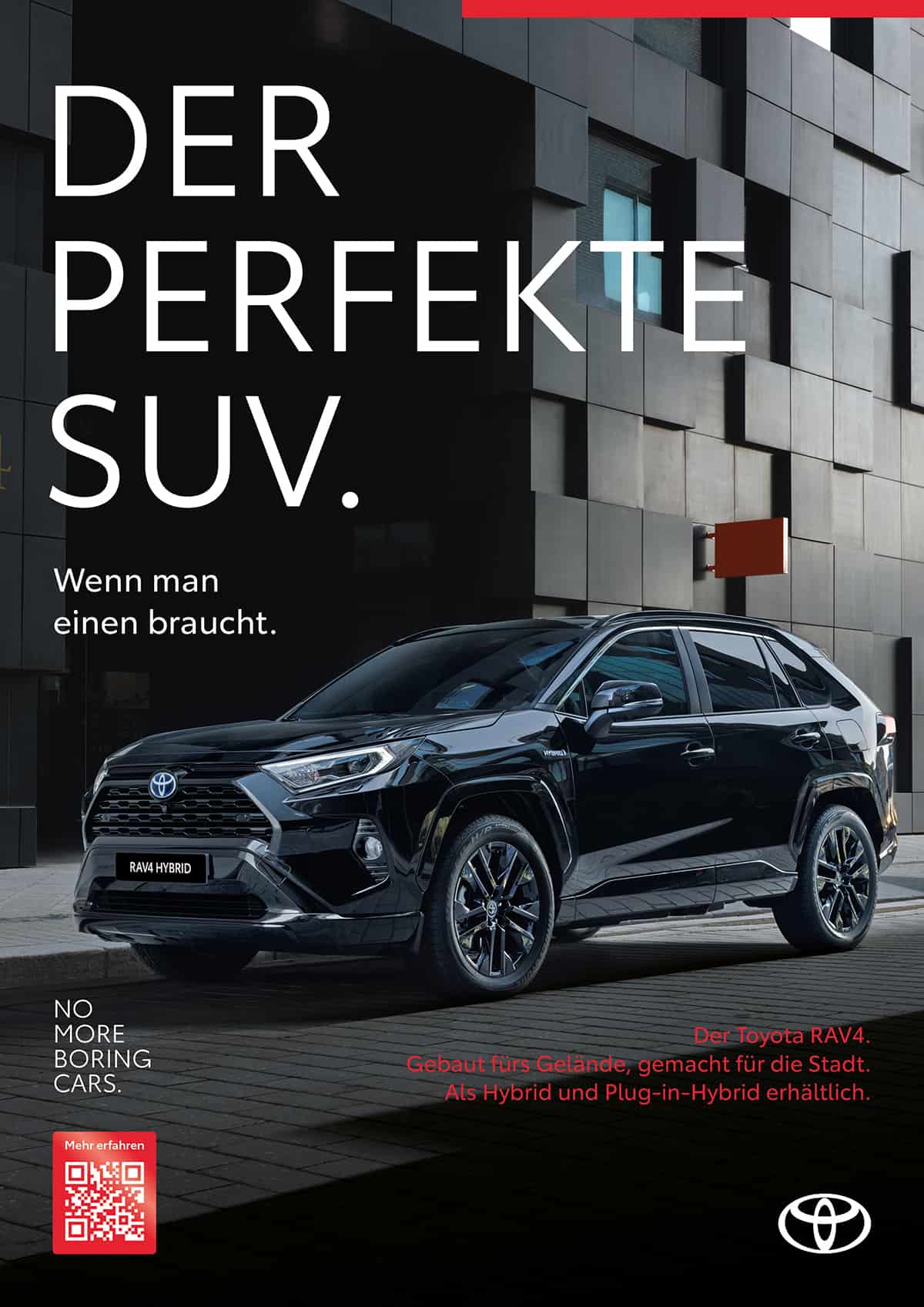
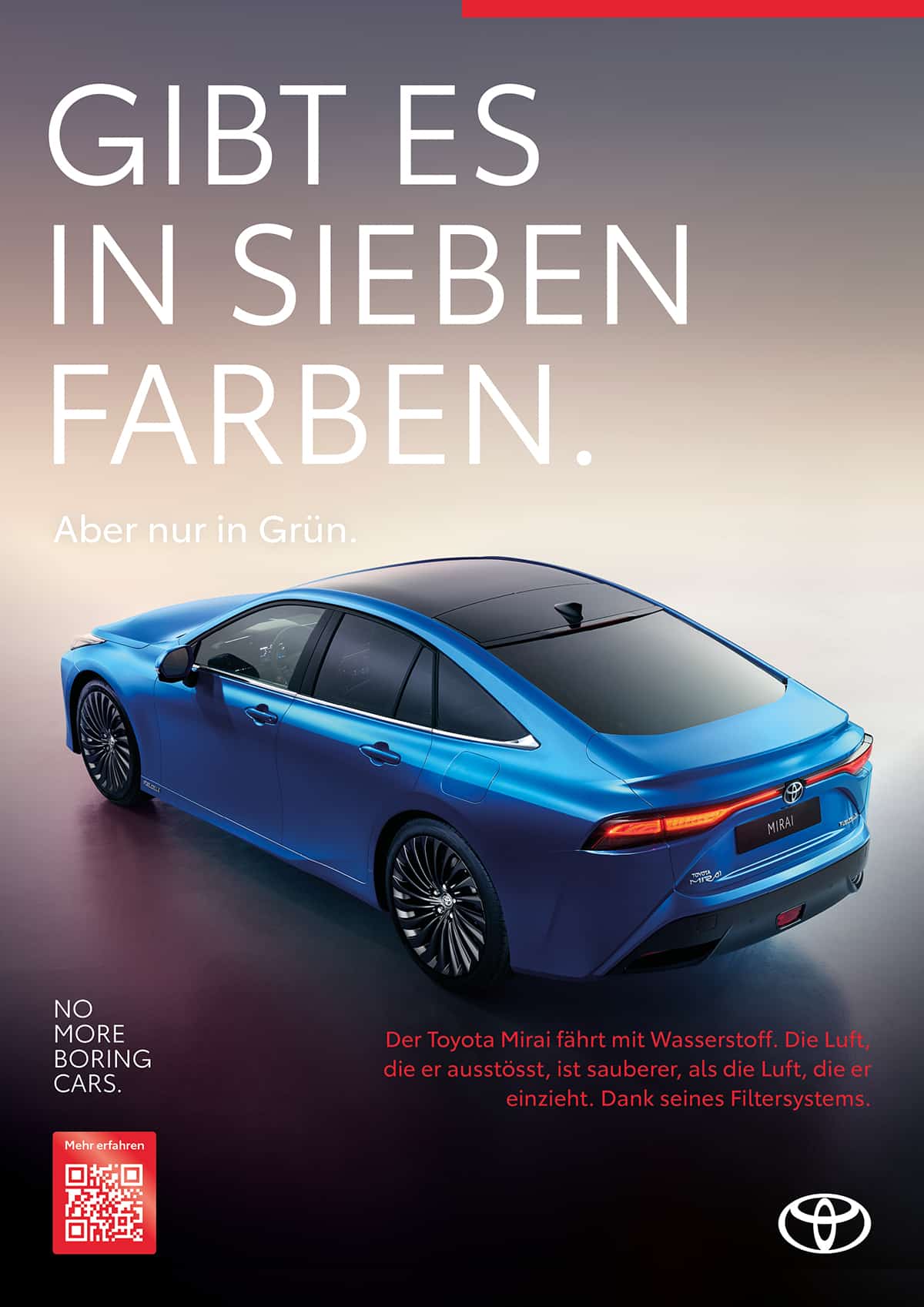
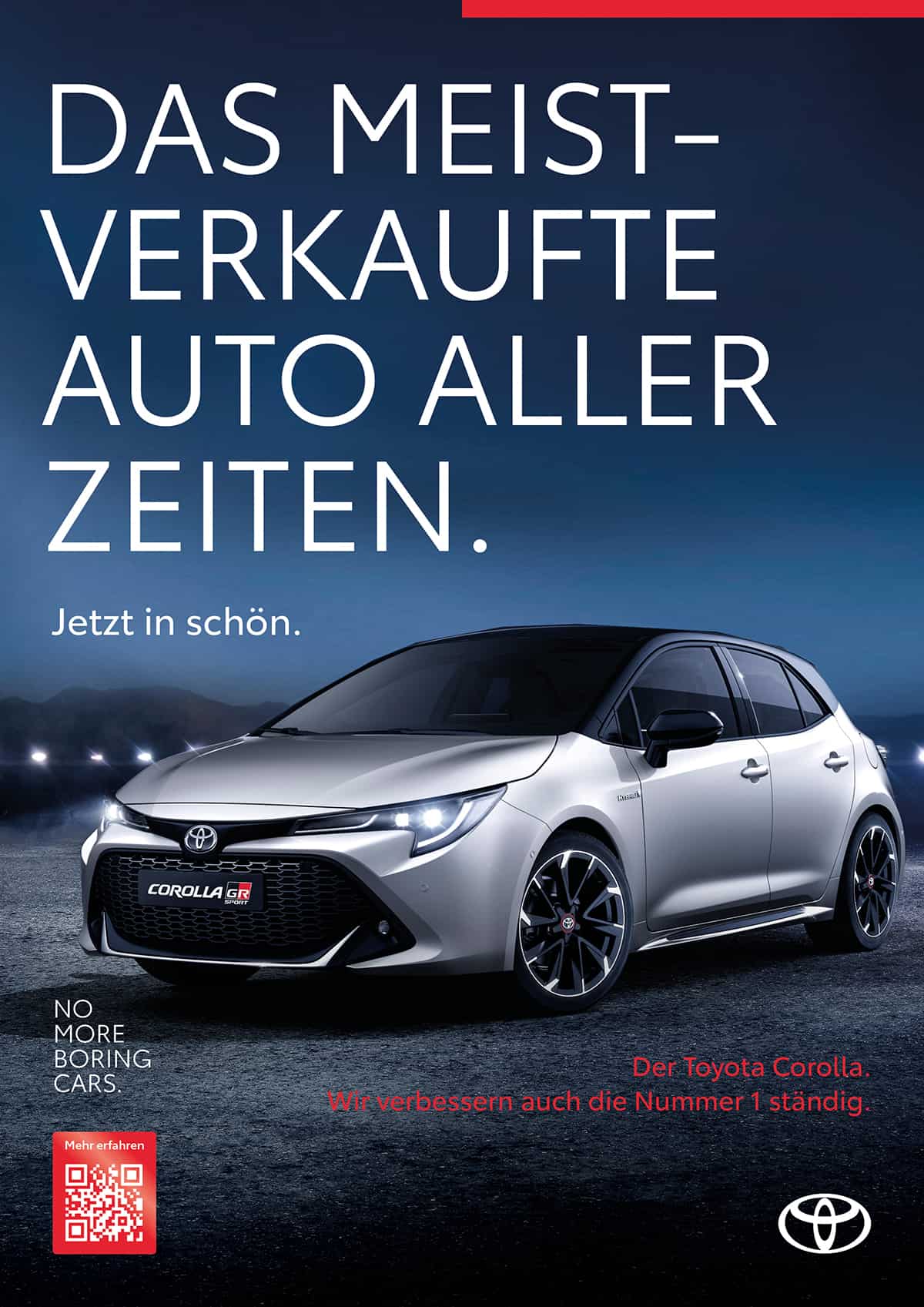
"The Brand Studio has managed to position us with "No more boring Cars" in the way we want to be seen: bold, fresh, innovative and sustainable. Because "No more boring Cars" is a promise that Toyota can keep. Toyota has incredibly good models. This message had to be conveyed in an unconventional and fresh way. That's why we relied on self-irony, humor and eye-catching advertising media. The result is an unexpected campaign that fits Toyota's models perfectly," says Anita Gerber, Toyota's marketing manager.
Responsible at Toyota: Christian Künstler (Managing Director); Anita Gerber (Marketing Manager). Responsible at Emil Frey Digital (landing page): Melanie Herbst (Project Manager; Martin Stocker (Project Manager). Responsible at Ringier Brand Studio / Ringier Advertising: Fabian Zürcher (Director Brand Studio); Iva Bozovic (Head of Strategy); Elgee Wee (Art Direction); Daniel Marx (Head of Video); Katharina Warszawska (Project Manager Content Marketing); Corinna Rota (Head of Content Marketing); Digital Team Ringier Advertising. Responsible at OMAG: Dario Frankhauser (Head of Content & Strategy); Marcel Zirkel (Business Development Manager); Andreas Schärer (Team Manager Paid Direct); Flamur Dina (Account Manager Paid Direct & TV). Responsible at Shining Film: Sophie Toth (Executive Producer), Yanik Müller (Producer), Flo Brunner (Production Manager), Manuel Flurin Hendry (Director), Filip Zumbrunn (DoP), Alessandro Biffi (Edit). Sound Designer/Mix: Jingle Jungle Sound Studios.
]]>
Are you buying a pig in a poke when you purchase a new car via an online portal? Galaxus will provide the answer. As of now, the online retailer has six models from Hyundai, Toyota, Honda and BMW on offer. Unlike common online configurators from car manufacturers, there is nothing to decide at Galaxus: Color and equipment are fixed and cannot be freely selected by the customer. The advantage: Galaxus offers the vehicles at prices that are 10 to 40 percent below the official list price. The Honda Civic 1.5, for example, is a concrete example of this: the list price is over 35,000 francs, but Galaxus sells it for just under 25,000 francs.

A "trade secret" is who imports the vehicles into Switzerland for Galaxus at this price, says Galaxus founder Oliver Herren to the SonntagsZeitung. The first car Galaxus added to its range was the VW Touareg, which also features in the new campaign (Werbewoche.ch reported). The offer - also pre-configured and considerably cheaper than on the official price list - was included in the range for a short time in cooperation with Amag at the time. As the SonntagsZeitung writes, Amag is working on its own, second attempt to launch an online store. Already two years ago, a similar project was launched, but never realized. The online offering should be up and running within the next twelve months.
Do the Swiss even want to put a vehicle costing several tens of thousands of francs in their shopping cart at the click of a mouse without having test-driven it and without being able to configure it? "We're targeting customers who already know what they want and don't want to make a big deal out of buying a car," says Herren. Thomas Lang from the e-commerce consulting firm Carpathia also gives the Galaxus project good chances: "The generation of 30- to 50-year-olds in particular has hardly any fear of contact," he says about the willingness of customers. Consultations are less and less in demand, he says, and people even want to avoid personal contact with the salesperson the longer they do so.
Tesla, for example, shows how and that it works. The U.S. manufacturer operates sales outlets, but plans to close many of them and rely even more on online sales.
The trend toward online and direct purchasing is creating a dilemma for carmakers: they have spent decades building and maintaining a dealer network. But now they also want to meet the growing customer demand for direct purchases - a conflict of objectives with the middlemen.
Galaxus cares little about that. Anyone who decides to buy a car gets it delivered to their home free of postage, just like all the other items. Fully fueled and with a highway toll sticker. The online retailer also offers rental options for the vehicles.


The Coop brand defended its top position as the most visible brand in the Swiss market sample (Visibility Earned & Paid Media) in the second quarter of 2017. However, rival Migros was able to close the gap thanks to a broad-based poster campaign. Smartphone giants Samsung and Apple as well as McDonald's made the leap from the top 20 to the top 10 in this quarter. most visible brands. Denner even makes it out of the top 30 and into 10th place, while the automotive industry continues to be represented by Renault and Mercedes, although Ford and VW leave the top 10.The discounter Aldi and the Kinder brand also just failed to make it into the top 10.

In the top 10 of the most viral brands much has changed compared to the previous quarter. Only four out of ten brands made it back into the top 10, with the two big banks Credit Suisse and UBS holding their own among the three most viral brands in Switzerland. In this quarter, Cedit Suisse is just ahead of UBS, relegating it to 2nd place. Nestlé is the first newcomer in third place, and the food group is also focusing on financial topics. With the "sweet" idea of rewarding its train drivers for stopping on time with chocolate, SBB was able to increase its virality and climb into the top 10.

Battle of Brands: Aldi vs Lidl
In the combined sector Retail + Food The two Swiss giants Migros and Coop dominate the market. Together, they account for around 55% of the total brand visibility of the entire industry. However, the other brands in the heavily paid media-heavy sector (paid/earned ratio: 90/10) are also highly visible in the Swiss market. McDonald's, Denner, Kinder, Aldi, Lidl and Coca Cola are among the top 20 brands.
Aldi and Lidl behave in line with the industry trend and buy a large part of their visibility. Aldi's paid media share is 89%, while Lidl's is as high as 92%. Overall, the two competitors are very close to each other, but their strategies differ significantly.
Lidl pursues an extensive out-of-home strategy, supplemented by regional penetration through radio advertising. Aldi, on the other hand, continues to invest a lot of money in traditional print media. However, TV remains the most important medium for both. However, this seems to be more worthwhile for Aldi than for Lidl when looking at earned visibility.
Overall, Aldi is ahead of Lidl in terms of earned visibility. The social networks are particularly noteworthy here. While Lidl is practically invisible, Aldi's strategy seems to be working better. People are talking about Aldi!
The Karaoke Karpool parody with the Aldi Chind George Clooney, the Coop Chind Gwen Stefani and the Migros Chind James Corden has been viewed over 200,000 times so far and has delighted the online community.


Battle of Brands: Samsung vs. Apple
Smartphone giants Samsung and Apple are battling it out in the industry. Digital + household are in a tough neck-and-neck race and claim the top two positions in the industry by a clear margin ahead of their rivals Sony and Nintendo.
With total brand visibility values of 13.9 and 9.6 million francs, it is not surprising that the electronics groups made the leap from the top 20 to the top 10 in Q2 2017, even across all sectors.
In the duel, it is ultimately the advertising presence that allows Samsung to emerge victorious. Thanks to the product launch of the Samsung Galaxy S8 and S8+ and the associated campaign covering all channels, Samsung has around twice as much gross advertising pressure as Apple. Samsung is advertising more aggressively in all channels.
Samsung even occupies the top position in print, TV, out-of-home, cinema and Internet advertising. Only in radio advertising is another brand - Universal Music - more present.
In the earned media sector, on the other hand, Apple is ahead on all channels with the exception of social media.
Apple's earned media visibility is around a quarter higher than that of its South Korean competitor. Topics that moved the web in this context included the launch of Samsung Pay in Switzerland, the introduction of the new iOS 11 beta version and the guesswork surrounding the new iPhone in particular and the future of smartphones in general.


Battle of Brands: Rolex vs. Omega
Rolex relies in particular on print advertising, with only 6 percent of the budget of 1.6 million invested in other paid channels. At Omega, this figure is 33 percent.
Rolex is also clearly ahead of Omega in terms of earned visibility. Whether it's theft or the Bachelorette final, the brand is visible in connection with a wide variety of topics. Could a Bachelorette finalist possibly have been unmasked before the final simply because of his Rolex? Who knows, but Rolex is grateful for the additional media presence.
The luxury brand is particularly far ahead in the social media, influencer and web channels. The Rolex brand still has quite a bit of power reserve compared to its peers in the industry.


Battle of Brands: Renault vs. Toyota
For the second quarter in a row, the French Renault takes pole position in the Vehicle industry and races past its German competitors Mercedes, VW and BMW. Toyota was still in 6th place in Q1, but only ranked 13th in the second quarter of 2017.
Renault's Total Brand Visibility value in the current quarter is more than twice as high as that of its Japanese competitor. In the first quarter of the year, Toyota still achieved a value that was around 60 percent of that of Renault.
This development is due to Toyota's more defensive advertising behavior. Toyota is reducing its print advertising by more than half, in line with the industry trend. Renault is also reducing its expenditure on print, as well as TV and radio advertising, but is investing more in out-of-home and internet advertising.
The French company is also ahead of the competition from Japan in the Earned segment - 2.5 million to around 1.5 million francs - and is therefore more visible than average across all Earned channels. Toyota, on the other hand, is only average compared to its competitors.
The same picture can be seen in the natural Google search. Renault finishes in 6th place, Toyota in 13th.
The ratio of paid and earned is more balanced at Toyota due to Renault's high advertising investments. Earned media accounts for 38 percent at Toyota and is well above the benchmark. Renault is slightly below average with 28 percent earned media.


Battle of Brands: Credit Suisse vs. UBS
Credit Suisse must, UBS may - at least as far as analysts' forecasts for new money acquisition are concerned. In terms of communication behavior, the two are almost on the same level, so the target photo will have to decide in Q2.
In the assessment of overall visibility, UBS is only just ahead of Credit Suisse with just over 7.7 million. Differences can only be identified and evaluated when analyzing the omnichannel mix.
On closer inspection, however, you don't notice anything about having to. The paid channels are used with roughly the same budgets, although UBS ultimately sets itself apart here. CS is less present on the Internet, but invests in cinema to reach its target groups, where UBS takes the lead.
Conversely, UBS can be heard on the radio with a mini-budget, which CS saves. Credit Suisse invests only a third of its competitor's money in the out-of-home channel, and part of this money goes to print, where UBS lags behind.
In the earned media segment, on the other hand, Credit Suisse benefited from news articles. Reports on the Annual General Meeting in general and in connection with the Greenpeace campaign, as well as articles on the big bank's business, ensured media coverage in the second quarter - both positive and negative.
Otherwise, the tension between UBS and CS is comparable to the Mercedes-dominated Formula 1.


Battle of Brands: Visana vs. Santias
In spring, not only does nature awaken from its winter slumber, but health insurance companies also get back into the advertising swing of things. For a long time, health insurers limited themselves to advertising only in the fall before the change window.
However, this was apparently not enough. The pressure in the extremely competitive market is steadily increasing and a second advertising peak has been observed in spring for a good five years. This strategy, which was initiated by Groupe Mutuel, has already been followed by Visana for four years, and in 2017 Sanitas also joined the ranks of the spring bloomers.
As far as the media mix is concerned, Sanitas and Visana focus on traditional media with a high reach, supplemented by online advertising. Here, search advertising predominates at Sanitas and display advertising at Visana.
With 8 times higher visibility in the paid media area, Visana is clearly ahead of Sanitas. Visana even outperformed the big banks in the out-of-home advertising channel and came fifth in the financial sector with above-average visibility.
However, Visana is unable to translate its advertising dominance over Sanitas into earned media presence. Here, Sanitas and Visana are neck and neck in 16th and 17th place in the intra-sector comparison. Sanitas is able to achieve a third of its total brand visibility via earned media, compared to only 4% for Visana.
Across all channels, paid and earned media, Visana is slightly below the industry average. Sanitas even brings up the rear.


Omnichannel Earned:


Omnichannel Paid:


Toyota's Mirai fuel cell model has a clean slate when it comes to air pollution: Only water vapor comes out the back. Good for the smog-ridden air of major American cities.
The latest Mirai campaign can make the same claim. From April 3 to May 28, 2017, 37 special billboards are helping to make the air in Los Angeles and San Francisco cleaner.
In cooperation with Clear Channel, Saatchi & Saatchi has created billboards that act like catalysts. Vinyl coated with titanium dioxide cleans the ambient air. This binds as much nitrogen oxide as 400 cars emit during an entire month.
Clear Channel now wants to make the technology developed by the company Pureti available for the OOH campaigns of other environmentally conscious customers. A sensible dual use of the poster space that is available anyway. (hae)
Source: Toyota.com
Toyota launches the Verso-S model and Goldbach Interactive developed the campaign, which introduces the so-called space miracle in more detail, involves potential customers and interacts with them. The centerpiece of the campaign is the microsite Color-your-verso-s.ch with a design competition, product information and an easy way to make an appointment for a test drive, according to a press release from the agency. For the competition, users can use the specially developed application to unleash their creativity, upload their own design proposal for a Verso-S and vote on their favorites.
Toyota's broad target group is directed to the microsite with a media campaign using banners and print material and encouraged to take part. Social media elements ensure the viral spread of the campaign. All promotional measures are consistently implemented cross-media for online, print and at the point of sale.