Since 2022, the ten-language international SRG SSR service SWI Swissinfo.ch has consistently dispensed with the use of the generic masculine.
The use of inclusive language is evaluated periodically; all published texts and photos are also evaluated with the aim of achieving gender balance. SWI Swissinfo.ch is guided by the BBC's "50:50 Equality Project," which was launched in 2017.
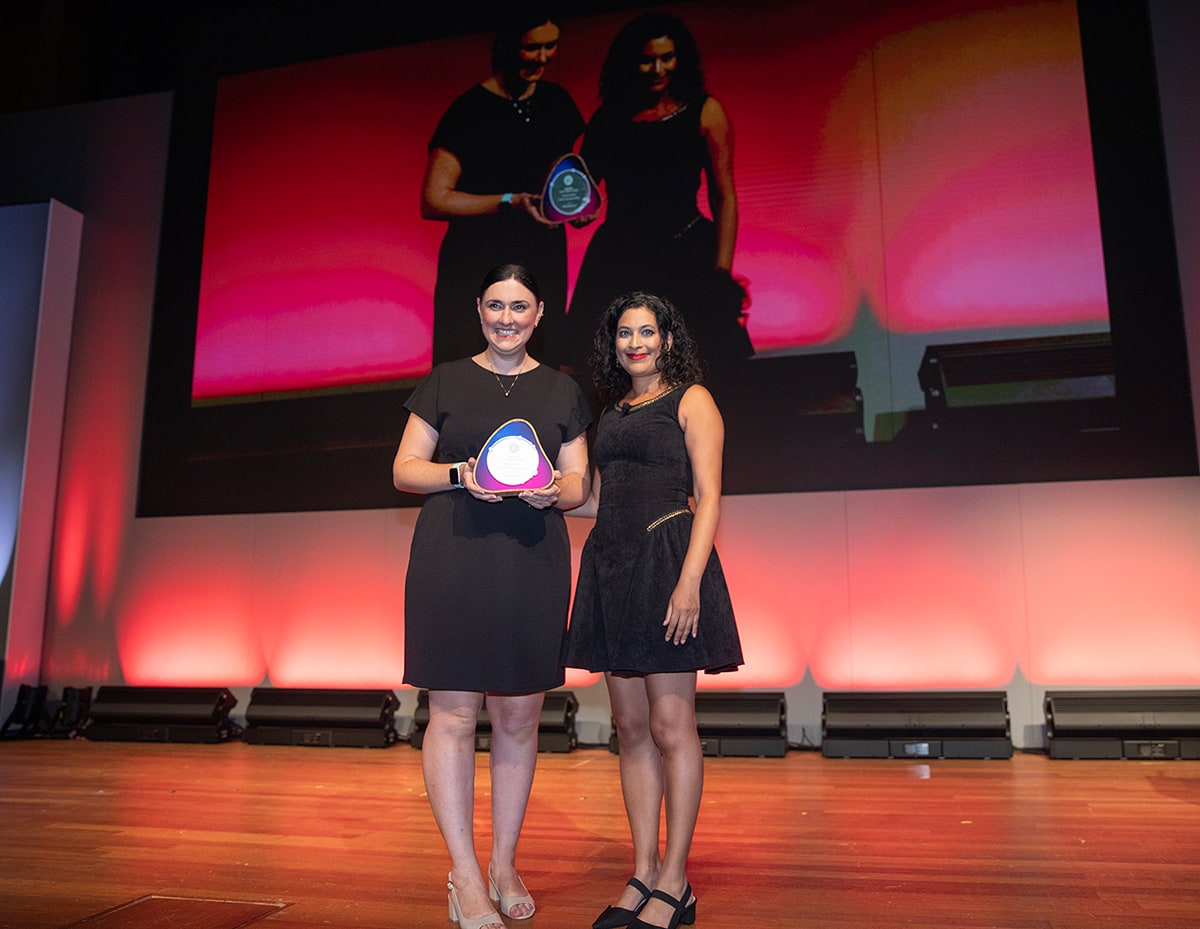
For this commitment, the International Broadcasting Convention IBC has now presented SWI Swissinfo.ch with the Social Impact Award in the Diversity and Inclusion category.
The handover took place on Sunday in Amsterdam, during the 56th edition of the media, entertainment and technology industry trade show.
"Reporting on Switzerland is not feasible at all without diversity".
"This one is a recognition of the years of hard work we've put into this project," says Jo Fahy, Head of Multimedia at SWI Swissinfo.ch. "It's a project that has demanded quite a bit of change from our multilingual and multicultural teams."
Director Larissa M. Bieler sees the use and promotion of inclusive language as a task for all media, with media with public sponsorship playing a key role: "As an international media house, we share responsibility for how the media take diversity into account in their language or not. Our job is to report on society as a whole, and in the case of Switzerland, this is not even feasible without diversity."
Counteracting underrepresentation
The idea behind this is that diversity in media content and in language has an impact on society, on patterns of thought and behavior. Inclusive language therefore means more than just "gendering.
Without an awareness of inclusion, population groups are made invisible, underrepresented, or distorted. The consequences can be stereotyping, racism, and discrimination.
Globally, women are still heavily underrepresented in media contributions. The gender ratio of men to women is 80 to 20 percent. For Switzerland, an average representation of women of 23 percent was measured (Fög/IKMZ, 2021), with the ratio varying by topic and media title. (pd/swi)
]]>
What are Switzerland's current election intentions? What political positions do the candidates take, and how pronounced is their support for the concerns of the population abroad? These and similar questions are addressed in addition to the ten-language online portal the app for swiss:abroad "SWIplus"which was revised in terms of technology and content this summer. With news, analyses, party checks, election guides and the "Let's Talk" video debate, the app bundles the relevant information for the 800,000 citizens outside Switzerland.
Promote interest and participation in Swiss democracy
The app reflects the relay function that SWI assumes between Swiss Abroad and Swiss democracy. It brings together all the content that is relevant and useful to them in a clear and concise way, so that Swiss Abroad have round-the-clock access to information that concerns them and Switzerland - in German, French, Italian and English. Those who live in another language region and would like to inform their environment about Swiss events will find the majority of the publication on the web portals of SWI in the other six languages Spanish, Portuguese, Russian, Arabic, Japanese and Chinese.
]]>
Isabelle Schrills has worked at Ringier for the last seven years. Working at the interface between business and technology and shaping digital transformation, with AI at the forefront, is an important part of Isabelle Schrills' professional life.
For the past four years, she has held the position of Head of Business Development in Ringier's Global Technology and Data Unit. There, she further developed the data strategy and proprietary data and technology products in line with the changing market environment, technology trends and internal and external customer needs. She advises various brands and business units on how to leverage technology and data, especially AI, to achieve product and process advantages.
Prior to that, she worked for three years as a project manager in the Chief Technology & Data Office, driving digital and data-driven transformation at a strategic level.
Schrills is a member of the Steering Committee at the ETH Media Technology Center, a body of tech experts, researchers and industry insiders that, among other things, leads important national AI projects involving several Swiss media.
Isabelle Schrills was born in Berlin in 1987. She holds a degree in Economics and English from the Technical University of Darmstadt and completed courses at IMD and HBS. She is married, has two sons and currently lives in the Zurich area.
]]>
As the Swiss Radio and Television Company SRG announced on Tuesday, the approximately one hundred employees of Swissinfo have been working in the building on Schwarztorstrasse in Bern since Monday of this week. This is in the city center. Previously, they worked at the headquarters of SRG's general management on Bern's Giacomettistrasse, in the east of the federal city.
Swissinfo editors will move into premises previously occupied by radio people, who will now work in the so-called "Radio Hall" in Zurich. At the end of 2019, SRG had announced that around 70 people from the newsroom and SRF 4 News would in future be working in Zurich instead of Bern.
The domestic and foreign editorial offices will remain at Schwarztorstrasse in Bern. Magazine and background programs such as "Echo der Zeit" and "Rendez-vous" would be produced there. SRG already announced at the time that the space that would become available would one day be occupied by Swissinfo. (SDA)
]]>
This was decided by the Board of Directors at its meeting on Tuesday and Wednesday, SRG announced on Thursday. Bieler complements the management with strategically important competencies in the dialogue with the audience in an international environment.
The decision confirms the importance the Board of Directors attaches to the dissemination of Swiss topics in an international context, it added. SWI Swissinfo.ch emerged from Swiss Radio International SRI and is now a purely digital Internet platform in ten languages.
Bieler is currently also SWI's editor-in-chief. She will relinquish this function as of July 2022. The succession is still open. (SDA)
]]>
Editor-in-Chief Larissa M. Bieler with Deputy Editor-in-Chief Reto Gysi von Wartburg in the foreground, the two new members Dale Bechtel (left) and Patrick Böhler (center).
"With Patrick Böhler and Dale Bechtel, SWI's product development, from the preparation to the presentation and distribution of editorial content, will be bundled and strengthened. This will enable us to focus even more consistently on the needs of our international target markets," says editor-in-chief Larissa M. Bieler in a statement explaining the move to expand the editorial team.
Canadian/Swiss Dale Bechtel has worked for SWI Swissinfo.ch for more than 25 years. Bechtel started his career at the Canadian Broadcasting Corporation, where he produced for the leading radio cultural program. In SWI's early years, Dale Bechtel pioneered online work in cooperation with BBC: live coverage of a re-enacted historic mountain expedition in the Swiss Alps. He also developed community projects when social media was still in its infancy. He expanded the English editorial team of SWI Swissinfo.ch and established it as the central production unit for international Swiss news. He also designed the online communications strategy for the Bern-based International Climbing and Mountaineering Federation UIAA.
In the SWI editorial department, Bechtel will be responsible in particular for the development of market-oriented formats and multimedia storytelling.
The team is also completed by Patrick Böhler, who joins SWI. Böhler has covered Asia for the New York Times, Dow Jones, Bloomberg News, the South China Morning Post, the Neue Zürcher Zeitung and several other media outlets. At the New York Times, he was involved in the digitization of reporting and editorial processes. His reportages have won several journalism awards. Born in Vorarlberg, he previously worked for the Austrian Ministries of Foreign Affairs and National Defense. He also taught at the Journalism and Media Studies Centre at the University of Hong Kong, Asia's leading journalism school. Böhler holds a doctorate in political science.
As Senior Editor for Audience and Innovation, Böhler's task will be to bring Swissinfo.ch's content and formats closer to the needs of international users.
Larissa M. Bieler, Director and Editor-in-Chief, is looking forward to working with the strengthened team and developing SWI further. Reto Gysi von Wartburg will continue as deputy editor-in-chief of SWI.
Marguerite Meyer will leave SWI at her own request at the end of March 2019. She had joined SWI in January 2017 as head of the new multimedia team. The editors-in-chief wish her all the best and every success in her future projects.

At the request of Director General Gilles Marchand, the SRG Board of Directors appointed Larissa M. Bieler as the new Director of SWI at its meeting on September 19, in addition to her function as Editor-in-Chief. Swissinfo.ch elected. The dual function is made possible by a new organization of the SWI management team. Reto Gysi von Wartburg is Larissa Bieler's deputy editor-in-chief, and Peter Zschaler remains deputy director.
Larissa Bieler was elected Editor-in-Chief of SWI Swissinfo.ch in June 2015 and took up her post at the beginning of 2016. Bieler has thematically sharpened the international profile of the ten-language platform - with core topics such as direct democracy, Geneva International or global Switzerland expertise. She has strengthened the relationship with specific user groups by forming global communities. Larissa M. Bieler comments: "Switzerland is strongly networked globally, shapes foreign countries, exerts influence and is dependent on foreign countries. This is where we can make our mark with an independent Swiss perspective and position ourselves strongly in journalistic terms with reliable information."
Gilles Marchand: "I am very pleased that we have been able to win Larissa Bieler, an experienced and excellently networked journalist, as our new Director. She will further develop SRG's well-established international service."
Larissa M. Bieler studied German, economics and politics at the University of Zurich. Before and after study visits to Paris and Mannheim, she worked as a freelancer for the Bündner Tagblatt and various Bündner media. In July 2013, Bieler took over as editor-in-chief of the Bündner Tagblatt, which she repositioned thanks to extensive reorganization measures.
SWI Swissinfo.ch has been fulfilling the Swiss government's mandate to provide information abroad for more than ten years, complementing the online offerings of SRG's radio and television stations. Today, the SRG service is primarily aimed at an international audience interested in Switzerland, as well as at the Swiss abroad. The platform conveys a specifically Swiss overall view as well as Swiss viewpoints on international events and developments. In addition, SWI also reflects the view of foreign countries on Switzerland and its positions. SWI's thematic focus is on politics, economics, culture, society and science. SWI Swissinfo.ch has offices in Bern (headquarters), Geneva and Zurich. Additional workstations are located at the Bundeshaus production center in Bern. (ots)

Peter Schibli says goodbye to Swissinfo. In the meantime, his deputy Peter Zschaler will be in charge of the SRG information platform.
Schibli joined Swissinfo in 2007 as project manager. After a transitional period as editor-in-chief, he became director in 2008. In this role, he expanded the multimedia offering of the international service and played a key role in shaping the positioning of Swissinfo, SRG writes in a statement.
SRG Director General Gilles Marchand thanked Schibli for his tireless, far-sighted commitment and excellent cooperation, according to the statement. Swissinfo is an important platform for SRG that enables Swiss abroad to maintain a close connection with their homeland and explains Switzerland to the international audience in ten languages.
Schibli began his journalistic career as a local journalist at the newspaper "Bund" before moving to the "Badener Tagblatt" and later to the "BaslerZeitung", where he was, among other things, USA correspondent. (SDA)

Blick.ch (+20.8 percent) consolidated its "eternal" second place and 20min.ch pushed Energy Schweiz out of the Top 3 with a remarkable increase (+55%). LikeMag still holds a commanding lead, even though the Zurich-based "Like" company once again lost more than 10 percent of its interactions.
Swissinfo continues on its rapid upward path: After the almost 200 percent in June the number of interactions for the public news portal, which is aimed at Swiss abroad and foreigners interested in Switzerland, increased by 334.1% in July. For Swissinfo, this means not only the biggest increase in the Top30 once again, but also a place in the Top10 for the first time. Among other things, the portal has the eighth most successful Posting published in July. It was about the price differences between Switzerland and neighboring border areas. The attached film was viewed over 1.2 million times on Facebook.
New in the ranking are the Ticino news portals Ticinonews.ch (entry at position 15), RSInews (entry at position 21), Corriere del Ticino Online (entry at position 25).
Hidden camera and passion tug
The post of the Monday succeeds LikeMag: The posted on Facebook Film shows with the hidden camera how men, women and couples react differently when they are flirted with offensively (and physically) from the opposite escalator.
In second place, Blick.ch already follows with its first journalistic own achievement: The now famous "tugboat with a passion" and her Nadeem broke up because the latter punched her in the face and insulted her. In the meantime, however, they are together again, as we have all learned thanks to Blick. Since the topic is a guaranteed ratings hit, the sequel will still follow.
The Austrian start-up Storyclash records social interaction with media content. Every month, the Social News Ranking shows which media providers performed how well and which were the posts with the most interactions. Werbewoche publishes the ranking exclusively in Switzerland. (hae)

Balz Rigendinger comes from the Bernese newspaper BZ, where he has worked as head of the evening editorial team and foreign editor since 2012. The 45-year-old started his career in journalism as a high school student, became a local editor after graduating from high school and then studied photography at the Zurich University of the Arts. After graduating, he worked for various media in different roles, for example as a photographer at the Sonntagszeitung newspaper, as a reporter at Facts and as head of photography at Sonntagsblick. Rigendinger took on management roles from 2007, including as a member of the management team of the Ringier newsroom and as chief producer at Blick am Abend. Balz Rigendinger is the father of three children and lives in Biel.(ots)
Photo: obs/SWI swissinfo.ch/Balz Rigendinger

Marguerite Meyer studied history and political science at the University of Zurich and then completed a part-time master's degree in "Journalism & New Media" at the University of Applied Sciences Vienna. After editorial positions at AWP Finanznachrichten and Austria Presse Agentur APA, she worked as multimedia editor at SRF News in Zurich from 2014-2016.
At the beginning of this year, the 31-year-old became editor-in-chief of Joiz Switzerland and was also an interim member of the management board in this role. Until the youth channel was liquidated, she had overall journalistic responsibility for TV, online, mobile and social media at Joiz. She also organized special shows, thematic focuses and was responsible for the strategic development of community management. In addition to her management role in multimedia at SWI, Meyer will also take over operational management of the production room of the international SRG platform at the beginning of next year.

Christian Burger, 40, already a "Researcher and Media Analyst" at SWI Swissinfo.ch, will become SWI's new Head of Communications and Marketing as of January 1, 2017.
He succeeds Amr Huber, who left SWI in spring 2016. Christian Burger studied organizational and media psychology and computer science at the University of Bern, graduating with a master's degree. He then worked as a consultant and research associate at the "Center for Human Resource Management and Organizational Design," focusing on social research and management consulting. Via SWI, his path initially led him to Admeira (formerly Publisuisse), where he was responsible for advertising effectiveness research and continued to develop it.
Since 2013, back at SWI, he was responsible for measuring and analyzing online traffic in the K+M division and was involved in various strategic projects. Christian Burger already has a deputy function at K+M. SWI's management is looking forward to welcoming the new colleague and is convinced that he will make an important contribution to SWI's communication and promotion with his experience in media research and his understanding of how the digital media world works.