Simon Osterwalder, CEO of Suissedigital, told the media on Monday that he was proud to lead such a committed and pioneering association. "We are now naming what will become all the more important in the future: That our members, who have been building digital Switzerland for more than 20 years, can drive the necessary basic services for everyone in Switzerland and thus strengthen their role in the digitization of society."
The new association name points to the future: the majority of services today run over the Internet connection (all over IP). As enablers of the digital future, the communications networks are very close to customers throughout the country thanks to their regional and local roots. The moment of the new name is also symbolic: it comes at the time when analog television is becoming history. Suissedigital will be appearing in TV and print advertisements over the next few weeks.
Suissedigital is the trade association for Swiss communications networks. It is made up of 200 private and public companies that supply around 2.6 million households with radio, TV, HDTV, Internet, telephony and other services.
]]>The degree of innovation, market suitability and the potential to prevent a digital divide in Switzerland are assessed. The prize is endowed with 20'000 Swiss francs and will be awarded for the first time in 2015.
Identify and tap potential
According to Swisscable, the success of cable network companies in infrastructure competition to date, which is a key driver of developments in telecommunications, should also motivate others. With the award, the association wants to ensure that promising developments are recognized and exploited. "The award is intended to encourage innovations around digitalization to be brought to the market," president Pierre Kohler was quoted as saying in a statement Thursday. The inaugural announcement was made June 19 at Swisscable's general assembly in Bern. Companies from Switzerland can participate.
Criteria and jury
Anyone who wants to win the Swisscable Innovation Award must be able to demonstrate how novel and marketable submitted projects are in the area of digitization. In addition, a submission must contribute to preventing a digital divide in Switzerland. The prize is awarded
by a six-member jury consisting of four members from the fields of telecommunications, education, research and politics, as well as two members of Swisscable's Board of Directors. The jury decides on the award in a two-stage process. The deadline for entries is September 30, 2015. Applications for the award are being accepted now at [email protected].
In addition, cable telephony increased by 31,500 (plus 5 percent) to 660,700 customers. The trend towards cable internet continues unabated. This is shown by Swisscable's industry figures for the third quarter of 2014, which show that Swiss cable networks gained 112,700 Internet customers compared to the previous year, corresponding to growth of 10.9%. At the end of September 2014, a total of 1,145,300 customers were using internet access via cable socket. This means that cable internet has grown by around 34% (+288,200 subscribers) in the last three years.
More and more people are using streaming services
One reason for this growth is the fact that more and more people in Switzerland are using the internet for streaming activities such as watching videos and listening to the radio. While there were 3 million streaming users in 2011, this user group already numbered 3.8 million in 2014.
112,400 new subscribers
The latest figures from Swisscable also show growth in cable telephony. At the end of September, 660,700 customers were using fixed-line telephony via the cable network, which corresponds to growth of 30,900 (+5%) compared to the previous year. The number of cable television customers declined slightly (-1.2%). Overall, the cable networks were able to acquire 112,400 new subscribers for their services (+2.6%).
Customer figures for the third quarter:

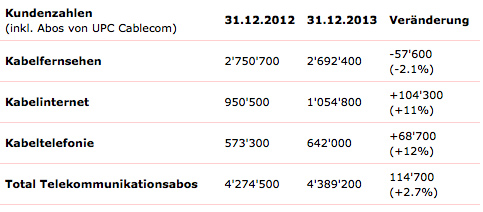
The transformation of cable network companies into full-service entertainment providers continues to be successful. Last year, the 220 Swiss cable networks broke through the one million household barrier with cable internet. In terms of telecommunications subscriptions, the sector recorded robust net growth of 114,700 (+2.7%).
"The cable connection is and remains the first choice for television in Switzerland. Cable networks are also benefiting from this in terms of broadband internet, as our latest figures show," said Simon Osterwalder, Managing Director of Swisscable since March 1, 2014, in a press release. At the end of 2013, 2,692,400 households received their TV and radio signals from their cable network company. This is still almost twice as many as all other providers combined (see chart below). According to the press release, television via the cable connection has become even more attractive with the increasing expansion of digital offerings over the past year. Another particular advantage is that cable network companies can offer the fastest broadband Internet, consistently high picture and sound quality and digital television without additional equipment (set-top box). Many customers also appreciate these advantages because they can use fast Internet and several TV sets in one household at the same time.
More than one million Internet customers
In broadband internet and fixed-line telephony, the cable networks recorded strong growth of almost 11% (+104,300 customers) and 12% (+68,700 customers) respectively. At the end of 2013, 1,054,800 customers were using the internet and 642,000 customers were using fixed-line telephony via the cable network companies. The growth in broadband internet is particularly pleasing, as more and more services are being distributed and used via the internet. Osterwalder: "This shows the advantage of the very good presence of the high-performance cable networks in all parts of Switzerland." In terms of telecommunications subscriptions, the cable network companies recorded net growth of 114,700, which corresponds to an increase of 2.7%.
Graphic: TV market Switzerland (as at the end of 2013, multiple uses possible)

Teaser image: UPC Cablecom
]]>
In the broadband Internet and telephony markets, the cable networks recorded growth of just under 12 and 15 percent respectively compared to the previous year. This was stated by Swisscable in a press release on Tuesday. Despite strong competition, the Swiss cable networks succeeded in maintaining their leading position in the TV market in the second quarter of the current year. With 2,706,700 cable TV subscribers, the cable networks have more than three times as many customers as their second-placed competitor (see chart below).
Solid growth in cable Internet and cable telephony
In broadband Internet and telephony, the cable networks recorded solid growth of just under 12 and 15 percent, respectively. As of the end of June 2013, around 1'013'000 customers were thus using cable Internet and over 600'000 customers were using cable telephony. Internet growth is particularly important for the industry, Swisscable writes in the statement. It said it is convinced that the potential is far from exhausted. "Cable Internet will continue to grow because the demand for fast Internet connections is increasing," says Claudia Bolla-Vincenz, managing director of Swisscable.

Swisscable is the trade association of Swiss cable TV companies. It is made up of 225 companies, both private and public, supplying more than 2.7 million households with radio, TV, HDTV, Internet, telephony and other services.
Since the vast majority of the Swiss population uses digital offerings, the analog broadcasting obligation will only apply in the digital area from 2015, according to the Federal Office of Communications (OFCOM). The abolition of the so-called "must-carry programs" will take place in two steps. As of June 1, 2013, the must-carry obligation for foreign channels (ARD, ORF 1, France 2, Rai Uno, ARTE, 3 Sat, TV5, Euronews) will be eliminated. From January 1, 2015, analog distribution of domestic must-carry TV channels can also be waived (SRG channels, regional licensed channels). In the medium term, cable network operators will therefore be able to decide fully for themselves which channels they distribute via their analog networks.
If a cable network operator offers its customers a free digital/analog converter for the reception of an equivalent digital basic offering, it is released from all analog must-carry obligations even before this point and is free to compose its analog TV offering. With a converter, a digital basic offering can also be watched on older tube TV sets. Only the youth program Joiz must continue to be broadcast in analog until March 21, 2015, due to a decision by the Federal Administrative Court. The provisions on the digital offering of cable network operators remain unchanged. This means that the must-carry channels mentioned must continue to be broadcast there.
Analog dissemination obligation caused capacity problems
Cable network operators offering analog and digital radio and television programming were previously obliged to broadcast certain domestic and foreign programs in both technologies. With the expansion of digital offerings, they are increasingly coming up against capacity limits. This is because the distribution of one analog TV program requires the same amount of bandwidth as the distribution of ten digital TV programs in standard resolution or four programs in HD resolution. On August 1, 2012, the Federal Council therefore gave the Federal Department of the Environment, Transport, Energy and Communications (Uvek) the authority to lift the obligation to broadcast must-carry TV channels in analog as soon as they are received digitally by an overwhelming majority. Since TV programs are now received digitally in around 85 percent of all households, the Uvek made the corresponding adjustment to the Ordinance on Radio and Television.
Satisfaction at Swisscable and UPC Cablecom
Swisscable is pleased with the decision. The time is ripe for a complete switchover to the digital network, the association for communication networks said in a statement on Monday. "The various cable networks will switch to digital TV individually, taking into account customer needs," said Claudia Bolla-Vincenz, managing director of Swisscable. "The fact that the cable networks have leeway here is very positive and allows them to take local conditions into account."
UPC Cablecom also "welcomes the decision" in a statement. Customers had already been brought into the digital age free of charge when basic encryption was lifted last November. The company still maintains an analog network, but will "make adjustments to it in the near future and thus respond to the sharp decline in customer interest. (hae)
Image: Keystone
According to a Swisscable press release issued on Thursday, this means that digital TV will finally prevail. It is foreseeable that analog TV will only occupy a niche by the end of the year. Yesterday's Swiss premiere - the complete switchover to digital cable television in Aarberg and other municipalities in this region - is characteristic of the rapid growth of digital cable television in the last 12 months.
It was not only digital cable television that recorded strong growth last year: While cable Internet grew by 10 percent, cable telephony increased by 18 percent.

Teleclub has recently started offering subscribers television in HD quality. However, only customers who watch TV via Swisscom or Sunrise can benefit from the new offer, as the NZZ am Sonntag reports in its current issue. Swisscom has a stake in Teleclub.
The industry association of cable network operators Swisscable accuses Teleclub of uncooperative behavior in talks and negotiations. Nicolas Perrenoud, head of the cable network Quickline, comes to the same conclusion in an interview with NZZ am Sonntag: "The will for a mutual partnership is simply not there."
However, the current HD debate is just one of many examples that show the poor relationship between Teleclub and the cable network operators, according to the article. Customers watching TV via cable would be forced to purchase a second set-top box, while Swisscom and Sunrise customers could access the offer via their existing box. Swisscom TV customers would also have price advantages with Teleclub offers and would be given preference in the selection of sports broadcasts.
Teleclub rejects the accusations. Teleclub boss Willy Heinzelmann told NZZ am Sonntag that the HD service had also been offered to cable network operators. Negotiations are underway, which is confirmed by Cablecom. Heinzelmann attributes the politics surrounding the set-top boxes and the different prices to technological reasons. However, Swisscable boss Claudia Bolla-Vincenz does not want to hear about the technology argument: "Technology is just being used as an excuse here.
According to NZZ am Sonntag, the Competition Commission (Weko) is aware of the problems surrounding HD broadcasting and intends to make a decision on the matter by the end of the year.
Hajo Leutenegger has decided to step down as President of Swisscable, according to a press release issued on Friday. He stepped down at today's General Assembly. In him, the cable network industry has lost a personality who has rendered outstanding services to strengthening and raising the profile of the industry over the past 17 years with great commitment, sound expertise and openness.
Hajo Leutenegger took over the management of the association at the General Assembly on March 31, 1995. According to the press release, his goals of strengthening the industry in the face of national competition and encouraging the cable networks to cooperate have been fulfilled and continue to be fulfilled. His political experience as a former member of parliament has also been of great benefit to Swisscable.
National Councillor Filippo Leutenegger (pictured), who was elected as the new President of Swisscable at today's General Assembly, stands for continuity. Under the new President, the cable network industry would continue to rely on its proven network infrastructure, maintain it and develop it further. The policy of cooperation between the cable networks will also be continued. In addition, the new President, who like his predecessor is committed to fundamental liberal values, will work to ensure that the entrepreneurial freedom of cable network companies is not curtailed. In Filippo Leutenegger, however, he is also a personality who stands for the change in the industry towards more proactive communication. This is logical, as there is now intense competition in the distribution of radio and TV programs and in telecommunications. This poses new challenges that need to be mastered, such as the convergence of the Internet and television, the growing demand for on-demand content and the increasing complexity of TV and telecommunications offerings. In this situation, the Board considers the experienced media entrepreneur and communicator Filippo Leutenegger to be the ideal Chairman for Swisscable.
(Image: Keystone)
]]>Hajo Leutenegger has decided to step down as president of Swisscable, the company wrote in a statement on Friday. He will step down at the annual general meeting on March 16, 2012. With him, the cable network industry is losing a personality who has rendered outstanding services to strengthening and raising the profile of the industry over the past 17 years with great commitment, in-depth expertise and openness.
The board of Swisscable is proposing National Councilor Filippo Leutenegger for election as his successor, according to the statement. The election will take place at the General Assembly on March 16, 2012 in Bern. Swisscable is the trade association of Swiss cable TV companies. It is made up of around 240 companies, both private and public, which supply more than 2.8 million households with radio, TV, HDTV, Internet, telephony and other services.
The trend towards digital cable television continues unabated, as Swisscable writes in a press release on Wednesday. The Swiss cable networks were able to gain almost 300,00 customers within a year (+42 percent). In total, around 1,014,800 households were using digital cable television at the end of September 2011. The nationwide penetration of digital TV on cable was therefore just under 36%. "One important reason for this growth is certainly the fact that switching to digital cable TV is very easy today," says Claudia Bolla-Vincenz, Managing Director of Swisscable, commenting on the figures. "The basic digital offer is free and can be received with newer TV sets without additional equipment."
The cable networks also grew in the cable internet sector: Compared to the previous year, almost 80,000 customers (+10%) were gained. Cable telephony also grew at practically the same rate, with more than 468,000 households now using cable telephony (+81,200).
