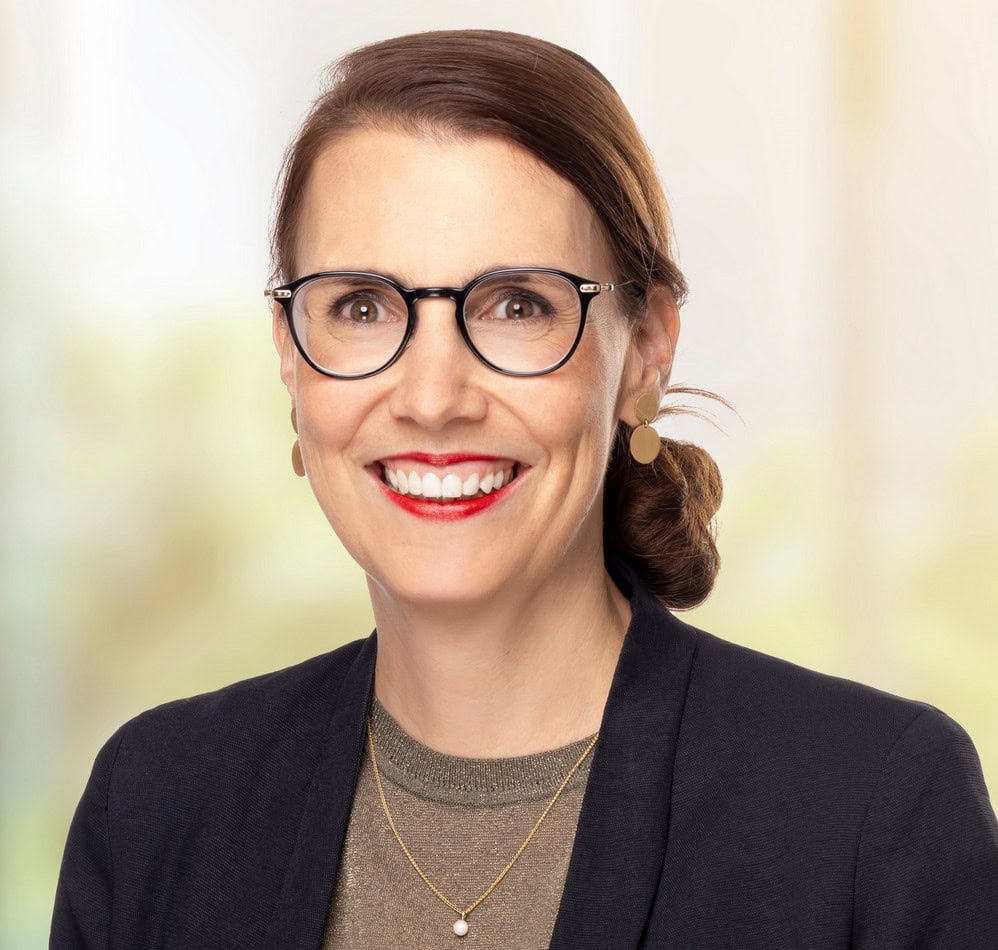
 As previously announced at the SWA SUMMIT in March 2026, Yvonne Baumgartner has now assumed her position at the association in September. Through the end of the year, Roland Ehrler will gradually introduce her to all of the association’s responsibilities. This joint onboarding period ensures a smooth transition at the office, and the two will be able to tackle important matters—such as the next SWA SUMMIT on March 11, 2027—together right away. As a result, Yvonne Baumgartner will already be connecting with many members and partners in the Swiss advertising market over the next few weeks.
Yvonne Baumgartner brings more than 18 years of experience in marketing and leadership roles at national and international companies and is thoroughly familiar with the advertising, media, and communications industries. Since 2024, she has served as Global Brand Director at Capri-Sun, where she was responsible for the beverage brand’s global brand strategy, innovation, communications, and media across more than 100 markets. Prior to that, she spent ten years at the Emmi Group, most recently as Global Marketing Head for the Emmi CAFFÈ LATTE brand. Earlier in her career, she worked at Johnson & Johnson and Swiss public television SRF. She earned her degrees from the University of Fribourg in media and communication studies, business administration, and sociology. Since then, she has continued to pursue professional development in marketing and leadership.
Back in June 2026, Yvonne Baumgartner was elected on behalf of the SWA to the Board of Directors of WEMF AG for Advertising Media Research and to the Executive Board of Digital Ad Trust Switzerland. She will assume additional positions and represent the SWA in the coming months.
Until his early retirement at the end of 2026, Roland Ehrler will remain responsible for the management of the SWA in his capacity as director. After that, he will continue to serve in specific, temporary capacities for the association. These include representing the SWA on the executive boards of KS/CS and Mediapulse AG, as well as serving on the board of trustees of the Swiss Fair Trading Commission.
More info at www.swa-asa.ch
]]>
With the newly published «Pitch Guidance,» LEADING SWISS AGENCIES and the Swiss Association of Advertisers (SWA) For the first time, a joint industry standard for conducting agency pitches. The goal is to make selection processes fairer, more efficient, and more transparent—and thereby improve a process that often involves considerable effort for both clients and agencies.
Common Guidelines for an Often-Criticized Process
In the communications and marketing industry, pitches are a standard tool for selecting agencies. At the same time, they have been the subject of criticism for years: they are too complex, too costly, and do not always focus sufficiently on criteria relevant to decision-making.
The new guidance addresses precisely these issues and is aimed at both sides of the market—clients and agencies alike. It offers specific recommendations on key aspects of the pitch process, including the quality of the briefing, the number of participating agencies, potential expense reimbursements, evaluation criteria, and the handling of intellectual property.
Industry associations are pulling together for the first time
With this joint publication, LSA and SWA are taking their first coordinated step. Both organizations bring different perspectives to the table—LSA as the representative of leading agencies, and SWA as the voice of clients. This creates a framework that deliberately takes both interests into account.
The guidance is not intended to be a binding set of rules, but rather a practical guide and a common foundation for more professional collaboration in the market.
LSA President Andreas Hugi emphasizes the importance of a coordinated approach:
„Pitches tie up enormous resources on both sides. With this guidance, we’re creating a framework that makes the selection process fairer and more efficient for both clients and agencies. The fact that we’re doing this together with the SWA sends a strong signal to the industry.“
SWA President Jan De Schepper also emphasizes the benefits of the new recommendations:
„A good pitch conserves resources, promotes sound decision-making, and strengthens trust between clients and agencies. These shared guidelines thus make an important contribution to a healthy and sustainable Swiss advertising market. That is why the SWA wholeheartedly supports the new pitch guidance.“
Alternative models were explicitly taken into account
In addition to traditional pitch structures, the guidance also includes recommendations for alternative forms of agency evaluation. The aim is to make it clear that a pitch is not always the most appropriate method and that, depending on the situation, it should be determined which selection model offers the greatest benefit.
Available now
The «Pitch Guidance» is now available free of charge in the download section of both associations’ websites and is intended to serve as a guide for clients and agencies throughout Switzerland.
]]>
The SWA is holding its "SUMMIT" today in Zurich-Oerlikon with around 400 members and guests from the Swiss advertising industry. Prior to this, the 77th General Assembly for invited members took place in the early afternoon. SWA President Jan De Schepper (CMO, Swissquote Bank and CEO, Yuh), who was newly elected last year, swiftly led through the agenda items. Founded in 1950, the association now has exactly 218 advertising member companies from all sectors, which is a new record. The President explained that the many association activities with events, webinars and expert groups are particularly appreciated by the members. After another successful year for the association, the members were presented with a positive income statement and an extremely solid balance sheet. However, things only got really exciting when it came to elections. This involved a new election, a re-election and finally the succession of the SWA Director.
Successor to Roland Ehrler
Constance Courtois, Head of Marketing at Coca-Cola Switzerland, was the first new member of the Board of Directors to be elected. This was followed by the re-election of Karin Held, Director Marketing, PR & Sponsoring at Jaguar Land Rover Switzerland. Both were unanimously elected and re-elected to the SWA Board. The President then reported on the recruitment process for the successor to Roland Ehrler, who will be taking early retirement at his request at the end of 2026 after 14 years. After numerous interviews, the Board of Directors has chosen Yvonne Baumgartner as his successor. Yvonne will start as Co-Director at SWA on September 1, 2026. After a joint induction period with Roland, she will then take over as Managing Director on January 1, 2027. With this early succession plan, the SWA is ensuring the continuity and continued success of the association's work.
Finally, Yvonne Baumgartner briefly introduced herself to the members at the AGM: She has over 18 years of experience in marketing and management roles in national and international companies and is very familiar with the advertising, media and communications industry. She has been Global Brand Director at Capri-Sun since 2024 and is responsible for the global brand strategy, innovation, communication and media for the beverage brand in over 100 markets. She previously worked for the Emmi Group for ten years, most recently as Global Marketing Head for the Emmi CAFFÈ LATTE brand. Earlier in her career, she worked for Johnson & Johnson and Swiss television SRF. She completed her studies at the University of Fribourg in media and communication science, business administration and sociology. She then continued her education in marketing and leadership.
Following the elections at the AGM, the SWA Board is once again complete and the following individuals are in office: Jan De Schepper (SWA Chairman, Swissquote Bank and Yuh), Pierre Besnard (Swisscom), Constance Courtois (Coca-Cola Switzerland), Heike Kammerer-Vercelli (Nestle Suisse), Karin Held (Jaguar Land Rover Switzerland), Marc Hofer (Bayer Consumer Care), André Hefti (Switzerland Tourism), Nadine Kamski (L'Oréal DACH), Rémy Müller (Migros Supermarkets), Aydin Sahin (UBS Switzerland), Sacha Zuberbühler (Coop).

]]>

In September 2025, 538 companies worldwide and 36 well-known advertising clients in Switzerland took part in a survey conducted by the World Federation of Advertisers (WFA) and Ebiquity. The Swiss Advertising Client Association (SWA) also took part for the first time. The study now enables a direct comparison between global and national trends in media budgets for 2026.
Cautious media outlook for 2026
The results for Switzerland are significantly more pessimistic than the global average: slightly less than a third of advertisers (28%) plan to spend more money on media advertising in the coming year. A good third (36%) of those surveyed plan to spend the same amount or less on advertising. The global picture is different: 50 percent of those surveyed plan to spend more in 2026, 30 percent the same amount and only 20 percent less.
Performance before branding
While 43% of respondents see the mix of performance and branding remaining unchanged, 34% in Switzerland want to invest more in performance and only 23% want to invest more in branding. Globally, the pendulum is swinging slightly in the other direction: 32% want to invest more in branding and 28% more in performance. 40 percent want to leave the mix unchanged.
Digital still on trend
The following can hope for more budget growth, in this order: addressable/CTV, digital video, paid search, DOOH, influencer marketing, digital display, retail media and radio. The outlook is less positive for OOH, linear TV and print, whose shares of the media mix are expected to fall.
Integration of media and creation
In Switzerland, 42% of respondents want to integrate media and creation more closely, 6% want to separate them and 53% want to leave them unchanged. This trend towards integration is much more pronounced globally: 66% want to bring media and creation closer together, while 7% want to separate them and only 28% see no changes.
Agency remuneration and use of AI
While the remuneration models of media agencies are undergoing global upheaval, 76% of respondents in Switzerland want to stick with the current model. AI has arrived in the media business and is used in particular for media optimization (44%), media strategy and planning (39%), monitoring and measurement (33%), reporting (33%), governance and compliance (22%) and purchasing (19%).
Recommendations for Swiss advertising clients
The authors of the study recommend that Swiss advertisers adjust their media budgets in line with inflation and ROI expectations. In addition, more focus should be placed on branding in order to achieve sustainable growth and market share. Further recommendations include the optimization of video planning (Total TV) for maximum effectiveness, the development of creative media workflows for agility and relevance as well as the definition of key figures for results-oriented remuneration negotiations with agencies. A strategic approach to AI and transparency in the use of AI by agency partners are also considered important.
Members of the SWA can download the complete Media Budget Survey 2026 from the SWA office at [email protected] request
]]>
Today, moving image planning no longer means thinking in terms of channels, but in terms of user behavior. The focus is on attention, context and impact - regardless of the channel and screen.
Traditional linear TV is still very important in the Swiss media market. On the one hand, high net reach can still be achieved with linear TV. On the other hand, classic TV picks up viewers in a "lean back" situation. At this moment, the focus is on more relaxed, passive use; media content is consumed without actively "interfering" in the action (for example by quickly scrolling or swiping or when using gaming content). This passive use in turn has a positive effect on the advertising impact and thus on the overall success of the campaign, as the activation level of content and advertising is close to each other (source: Video Impact, SevenOne Media GmbH, January 2020).
Despite these advantages of traditional, linear television, linear TV usage is declining. There are increasing gaps in reach, particularly in younger age segments. These gaps can be filled - at least in part - by using moving image offerings that pick up the target audience in the same emotional state, i.e. address them in a comparable "lean back" situation. This includes streaming offers, but also replay ads. Outstream formats (such as those offered by news platforms) and social media formats, on the other hand, are less suitable, as the target audience is in a different emotional state when using them.
If you want to pick up the target persons in "lean back" mode, the TV screen remains central as the playout device, provided the TV is a connected TV, i.e. a device connected to the Internet (such as a smart TV). However, passive media consumption behavior can also take place on mobile devices, be it on a desktop or laptop or even on a smaller screen, whether at home or on the move.
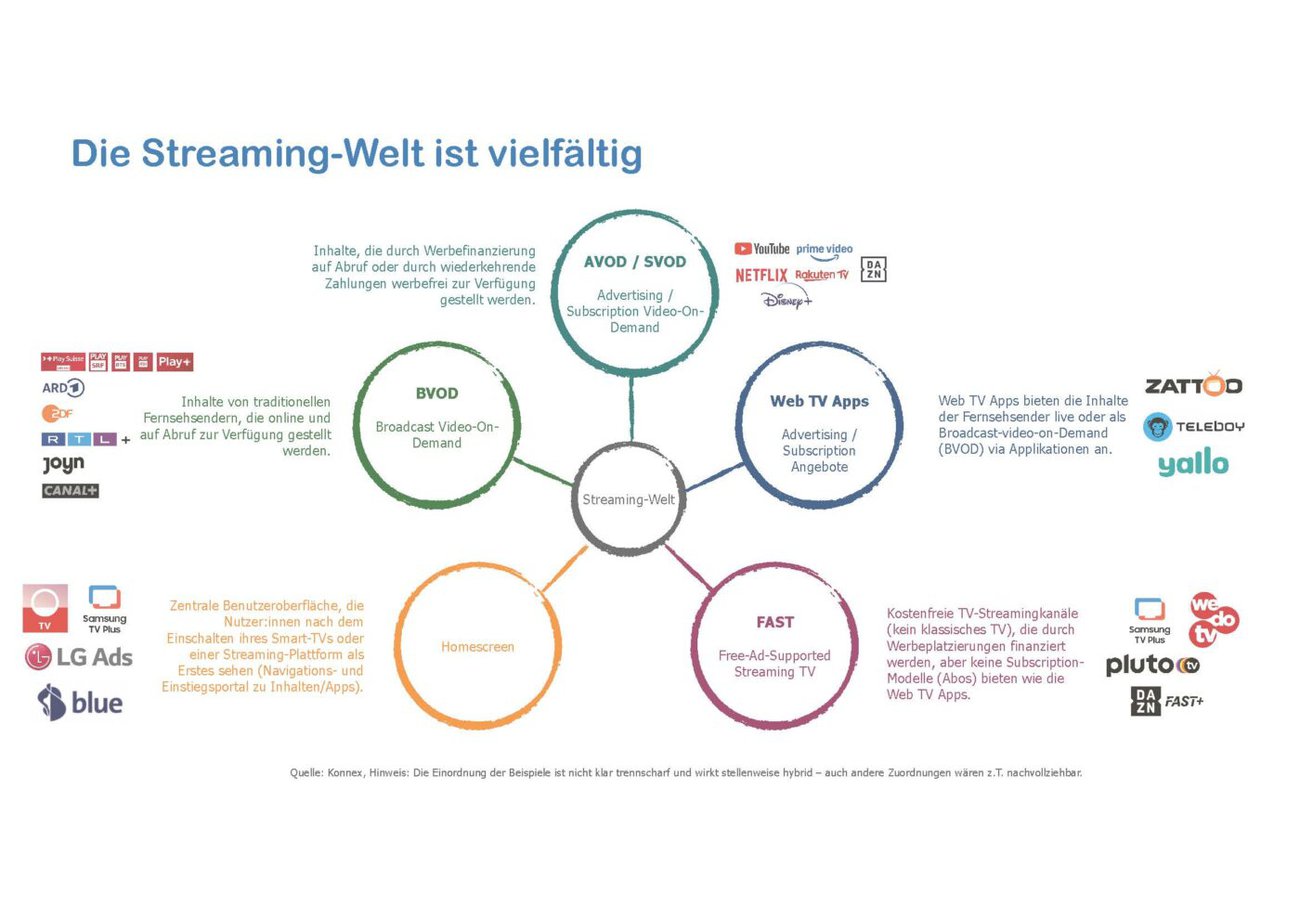
However, implementing holistic moving image planning that combines to form an effective whole is not easy. Even with a focus on the streaming world or even just the CTV sector (i.e. content that is played exclusively on a TV set connected to the internet), advertisers are faced with a highly fragmented ecosystem of platforms, publishers and end devices.
Although the various streaming services can be categorized by provider, type of service or financing, the same inventory is offered by several marketers, which leads to countless overlaps. Here is an example: pluto tv, a free, ad-financed streaming service from Paramount, can currently be booked to target Swiss users via Goldbach Media, Ringier, Screen on Demand and, of course, the Google advertising platform DV360, among others. No marketer can specify the priority of the bookings made through them.
Device owners (i.e. TV device brands such as Samsung or LG) are another market player alongside app and content owners as well as pure marketers. This multitude of providers marketing identical inventory increases the risk of campaign cannibalization. If the same campaign accesses the same advertising space across different platforms, it competes with itself and drives up bid prices. This in turn reduces the efficiency of playout. The advertiser can therefore only focus on as few providers as possible and exclude offers that are marketed by several providers, thus preventing double booking.
However, the streaming market is not only characterized by strong fragmentation on the marketer side, but also on the content supplier side. Irrespective of the risk of possible duplication, this generally makes it more difficult to control playout. The issue of brand safety therefore represents a further challenge.
In contrast, brand safety is a given for bookings in the linear TV environment (at best, the brand fit of certain environments can be discussed). Ad fraud is also becoming a risk with the increasing importance of streaming inventory. This involves the use of bots or fake CTV devices that simulate viewer numbers. As a result, advertisers pay for non-existent or unseen ad placements. Ad fraud can be countered by booking through established, trustworthy marketers. But here too, fraudsters are always one step ahead!
Another major challenge for holistic video planning is the lack of uniform research standards and metrics. When planning TV, we are used to obtaining reach and contact figures. With the exception of replay ads, there are no corresponding standards from the digital platforms. At the moment, it is primarily the gross reach of a campaign that can be measured, i.e. the number of video ads played. Multiple contacts can sometimes be identified at device level, but without personal information. Statements on the number of people reached or on incremental reach are therefore generally based on estimates. In most cases, these are based on login data. However, this does not say anything about who actually uses the media content played and whether only one or several people are sitting in front of the respective device (so-called "co-viewing"). At the same time, this means that in most cases it is not possible to work with target group criteria analogous to TV planning. It is necessary to work much more with environment-related criteria. This is not a disadvantage per se, as the relevance of age-related criteria is debatable. However, the comparability or "fit" with linear TV use is only possible to a limited extent.
This makes the test carried out as part of a joint initiative by Goldbach and Mediapulse to measure the net personal reach of online video ads and combine this with TV reach all the more interesting. The test run was carried out in October 2024 with a Migros campaign. According to the partners involved, the test was so successful that the possibilities of further developing the measurement approach are now being examined and the costs and refinancing options are being clarified.
Until a standardized and neutral measurement solution is available to the market, many assumptions and estimates still have to be made when planning and implementing overall moving image campaigns. The data provided by WEMF's MACH Strategy and IGEM's "igemDigiMonitor" on the use of various moving image platforms is a great help here.
Replay ads are advertisements that are displayed within time-shifted television. They are available on the Swiss advertising windows of German TV channels marketed by Goldbach Media and on CH Media channels and are expected to be available on SRG channels marketed by Admeira in German- and French-speaking Switzerland from January 1, 2026. Their performance can be evaluated both ex ante and ex post and in combination with linear TV campaigns using the TV replay ad data collected by Mediapulse.
Checklist for advertisers for holistic moving image planning:
- Definition of the relevant target group and analysis of their media usage behavior (e.g. using the MACH Strategy)
- Definition of the requirements for the emotional state in which the target group should find itself (based on the communication objectives or the advertising message and campaign content)
- Selection of relevant media channels and platforms and budgetary weighting based on reach potential, environmental criteria, etc. (Rule of thumb: for target groups aged 30 and over, linear TV is still a key medium; for younger target groups, the focus is on digital offerings)
- When booking digital offers: Selection of relevant marketers in order to maximize reach potential while avoiding overlaps.

The SWA is looking for a successor to the current Director with immediate effect. From spring 2026, the successor will initially act as Co-Director and later assume overall responsibility. With the early appointment of a successor, the SWA will thus operate with a dual leadership until the end of 2026. During their time together, the successor will be introduced to all of the association's areas of responsibility and introduce themselves to members and partners in the Swiss advertising and media market. After his departure, Roland Ehrler will continue to manage a few selected mandates on behalf of the association.
Even if it is still far too early to take stock today, the Board and the President of the SWA, Jan De Schepper (Yuh / Swissquote Bank), would like to thank the long-standing Director for his enormous commitment. The association's press release states: "Roland Ehrler has not only put his heart and soul into representing the interests of advertising clients since November 2012, but has also become the strong voice of the SWA. His greatest successes include making the activities program more attractive with events, workshops and webinars, expanding it to six expert groups today and the more than 30 value-added partnerships and association services for today's 218 members. Under his management, the small SWA team - in close cooperation with the President and the Executive Board - has achieved great things and the association is very well positioned in the advertising market after 75 years."
 The advertising companies were asked about their assessments of and outlook for the Swiss advertising market. Despite uncertainties, 50% expect revenues to rise and 35% to remain stable in 2023. Around a quarter of respondents anticipate a decline in revenues. Most, however, expect revenues to remain flat or increase. Despite this outlook, many advertisers are taking a cautious approach to budgeting. While around half of the companies want to invest the same amount of advertising money, the number of those who want to invest slightly less this year is rising.
The majority of advertisers want to invest about the same amount of money in communications in the new year as last year (49.2%). However, the proportion of those intending to invest less this year is slightly higher (31.8%) than of those intending to spend more (18.9%). This intention is also reflected in the planned media budget: for 54.6% it remains unchanged, for 26.5% it decreases and only for 18.9% of the respondents it increases.
Channel distribution remains constant
Asked about the allocation of funds to marketing channels, respondents will invest 34% of their budget in offline media. Last year, the figure was slightly higher at 35%. The rest of the breakdown remains similar to last year: digital advertising (15%), social marketing (12%), event marketing (11%), website (8%), SEO (8%), email marketing (4%), mobile marketing (3%), digital commerce (3%) and channel/affiliate marketing (3%).
Brand management remains important
As last year, the creation of independent and relevant brand worlds still seems to be of central importance. This is shown by the thematic distribution of funds among specific marketing disciplines. Content/campaign creation and branding continue to be in the foreground. Sales support and marketing operations follow in third and fourth place.
Digital before offline
When it comes to the question of how the media budget will develop within digital and offline, the pendulum once again swings in the direction of digital. There, 42.5% want to invest more in the new year and only 11% less. In response to the same question, only 10.9% more want to invest in offline media and a whopping 42.3% less. Exactly the same number of respondents want to invest the same amount in digital and offline media this year (46% each).
Outdoor advertising, direct marketing and cinema in vogue
In terms of offline media, OOH/DOOH, direct marketing and cinema are once again more in demand than in the previous year. There, the proportion of those who want to invest more is higher than those who want to invest less. The opposite is true for TV, print and radio.
Distribution of offline budget: OOH, TV and print
In terms of the specific distribution of the media budget, OOH/DOOH (27%) TV and print (26% each) are in particularly high demand this year. These are followed by direct marketing (17%) and radio (3%). Little can be expected from cinema and "others" such as events, POS or brochures with 1% each.
Something more direct than programmatic
Advertisers plan to allocate about 53% of their digital budget via direct bookings in 2023 and 47% programmatically.
Distribution of online budget: Google Search, Meta and Youtube
The most popular digital advertising formats in the new year are display, search and video. Here, advertisers plan to allocate their budgets to the advertising inventories as follows: Google Search 27%, Meta 20%, YouTube 16%, Premium Publisher Networks 10%, LinkedIn 7%, Open RTB Networks 7%, Premium Publisher Single Sites 5%, TikTok 4%, Snapchat 1%, Bing 1% and Other 3%.
Improving customer experience is more important than uncertainty
The very important challenges cited this year are improving the customer experience (49%), digital transformation (47%), data management (45%), and customer journey management (43%). Summarizing the very important and significant challenges, the order is as follows: Improving Customer Experience (94%), Data Management (88%), Digital Transformation (86%), Demonstrating ROI (86%), and Choosing the Right Technology (85%). Slightly less important to respondents at present are topics such as artificial intelligence, market uncertainties, shaping organizational change, or shorter time to market.
Personal recommendation remains most important in agency search
Recommendation (80.6%) is still the most important source of information for selecting an agency. Contacts with agency management are slightly less important this year (55.6%) followed by the agency website/appearance (51.4%) and the trade press (29.2%). Rankings and awards play a less important role in this regard.
Chemistry and skills most important
The most important criterion in agency selection is still personal chemistry and cultural fit (94.4%). Followed by an agency's mission/competencies (91.3%), references (59.7%) and agency size (26.4%).
Chemistry Meeting and competition presentation most often
In the new year, Chemistry Meeting is clearly the most used for agency evaluation (32.3%) followed by Competitive Presentation (27.6%). The award of a trial contract has increased in importance compared to 2022. This is followed by direct award and written request for proposal.
Agency services for content and digital
In 2023, advertisers increasingly want to work with agencies in the disciplines of content, digital, analytics, branding and creation. Collaboration for live com or corporate communications is somewhat less in demand and, at best, will be handled by the agencies themselves.
Offers and expense fee most popular
Advertising clients continue to be very interested in fees in the form of offers/scope of work and agile pricing based on time and effort. This year, there has been a slight increase in team hire, while fees based on success parameters are hardly used at all. The latter is generally only used in addition to the basic fee.
In the "Industry Indicator 2023" survey conducted by SWA and LSA between October and November 2022, a total of 174 well-known advertising clients in German and French-speaking Switzerland took part online. The detailed results can be obtained from the offices of the two associations.
Swiss Association of Advertisers (SWA)
Roland Ehrler, Director
T +41 44 363 18 38
[email protected]
LEADING SWISS AGENCIES
Catherine Purgly, Managing Director
T +41 43 444 48 18
[email protected]