
Does negative content in advertising have a negative impact? The study «The Trust Factor—Advertising Effectiveness in the News Environments of Regional News Brands» by Score Media Group reaches a clear conclusion: It is not the content of the news that determines advertising effectiveness in a news environment, but rather trust in the media brand.
Advertising Impact in a News Context: Content Plays Hardly Any Role
A total of 3,856 internet users between the ages of 18 and 69 participated in the quantitative online survey, which was designed as an experimental study. Readers spent two minutes navigating faithful replicas of four regional news brand websites, complete with their typical ad placements, while non-readers navigated a fictional news site. They were randomly assigned to view either a negative international article, a negative regional article, or a neutral article, along with an advertisement from a real brand. The study examined ads from three FMCG brands.
Although negative posts are perceived as more unsettling and emotional than neutral ones, the study finds that this does not carry over to the evaluation of the advertised brands. The brand image remains stable in terms of professionalism, reliability, high quality, credibility, and likability. There are also no significant differences in positive brand impressions, purchase intent, or interest in information. Fifty-eight percent of all respondents say it makes no difference to them whether an ad appears alongside good or bad news.
Trust as the Most Powerful Influencing Factor
A regression model examined several influencing factors, including news context, trust in the regional media brand, use of the advertised brand, interest in the product category, as well as age, gender, and device. According to the model, trust in the media brand explains 24 percent of the variations in brand image and 23 percent of the variations in advertising effectiveness. The news context contributes only 0.2 percent to brand image, and no measurable influence on advertising effectiveness was found. Brand usage accounts for 15 percent (advertising impact: 10 percent), while interest in the product category accounts for 9 percent (14 percent).
The greater the trust, the greater the impact
When trust in the media brand is very high, ad recall and brand recognition are significantly higher than when trust is moderate or low, with differences of up to 11 percentage points. The differences are even more pronounced when it comes to activation: 77 percent of readers with very high trust report that the ad leaves a positive impression of the brand, compared to 40 percent among those with moderate or low trust. For purchase intent, the figures are 73 percent versus 40 percent; for interest in information, they are 66 percent versus 33 percent.
According to the press release, the findings are particularly relevant for regional news brands: 69 percent of their readers have high or very high trust in their regional news brand, and 70 percent view quality media as an important daily source of information.
Christian Kusserow, Chief Sales Officer at Score Media Group, comments: «Those who blanketly exclude news environments are not protecting their brand; rather, they are forgoing a key driver of impact. What matters isn’t whether the news context is positive or negative. What matters is whether people trust the media brand.»
Study Design
The study is based on an experimental online survey conducted on desktop and mobile devices in June 2026. The sample comprised 3,856 respondents, including 2,782 readers and 1,074 non-readers. Three articles and three FMCG brands were tested, rotated across four news sites of regional daily newspapers. Annalect and Trend Research served as service providers.
More information: www.score-media.de
]]>
The Zurich-based startup Underheard has made its AI interviewer available to all companies. The platform conducts customer interviews at any time of the day or night and processes the responses into structured insights. This is intended to enable organizations to gather qualitative feedback from far more people than a research team could reach on its own.
Survey Instead of Simulate
According to the report, interviews remain one of the most reliable ways to understand customers. However, conducting them on a large scale is time-consuming and expensive. As a result, more and more companies are using AI models to simulate how customers or the public might respond. The Pew Research Center examined this approach in a study published on September 30, based on its own surveys. According to the study, the responses generated by two AI models deviated on average by about 12 percentage points from the responses of real respondents.
«Some companies now rely on AI to guess what their customers would say. We prefer to ask them ourselves,» says Navid Mani, co-founder and CEO of Underheard.
How the AI Interviewer Underheard Works
Underheard uses AI during the interview itself, not as a substitute for the people being interviewed. A team describes what it wants to learn, and the platform creates the interview. This can range from a brief feedback session to a full-scale market research study. The AI conducts each conversation and asks follow-up questions based on the respondent’s answers. It then groups the answers by topic and links each insight to the underlying quotes. The results are expected to be available within minutes.
27 organizations in three months
According to Underheard, in its first three months, the company conducted interviews for 27 organizations, ranging from hotels to multinational brands. Among them was a marathon organizer that invited runners to share their race stories after the event. Most of the conversations on the first night took place after 10 p.m., when no human team would have been available.
According to the press release, the willingness to speak with an AI is consistent with recent research. In a field experiment conducted by researchers at Chicago Booth and Erasmus University, 78 percent of applicants who had the choice preferred an AI interviewer to a human recruiter. Other studies have shown that people give longer answers when they speak than when they type.
Anyone can at underheard.ai/start Talk to Lina, Underheard’s AI guide, right in your browser without having to sign up. Companies can also start their two-week free trial there. Underheard is supported by SFF Studio, the venture studio of the Swiss Founders Fund.
]]>
Under the term “Generative Engine Optimization” (GEO), companies measure how often they appear in responses from ChatGPT, Gemini, and similar AI systems. Less attention is paid to what is actually said about them in those responses. A brand’s image often shifts unnoticed in AI responses. This phenomenon can be described as semantic drift. Miriam Schwellnus, managing director of the Berlin-based agency Mashup Communications, explores this topic in this guest post.
Just like in «Chinese Whispers»: Information gets distorted
In the children’s game «Chinese Whispers,» what was said at the beginning rarely ends up being what’s said at the end. No one is lying; everyone just passes on what they understood in a slightly different way. The same thing happens with information that AI assistants summarize and categorize. A study by the European Broadcasting Union (EBU) and the BBC shows just how often things get distorted in the process. Specialized journalists reviewed more than 3,000 responses from ChatGPT, Copilot, Gemini, and Perplexity across 18 countries and 14 languages. Forty-five percent contained at least one significant comprehension error (EBU/BBC, October 2025).
The study focused on news content. However, the mechanism is the same when an assistant describes a company: it condenses, weights, and omits information. Monitoring tools show how often a brand is mentioned, which sources appear, and whether the tone is generally positive or negative. They do not indicate whether the information is accurate.
Semantic Drift: Meaning Shifts Unnoticed
In linguistics, semantic drift describes how the meaning of words shifts over time. When applied to brands, the term refers to a shift in reputation resulting from AI’s tendency to interpret context only approximately. One aspect is overemphasized, another is missing, and outdated information persists. Individual responses may not seem wrong, but the overall picture is no longer accurate.
Additional figures from the same study: 31 percent of the responses had serious sourcing issues because evidence was missing, misleading, or incorrectly attributed. 20 percent contained significant inaccuracies, such as outdated information or fabricated details (EBU/BBC, October 2025).
Why GEO metrics don't capture the drift
According to Schwellnus, the visibility rate depends on which questions a tool tests. These are typically sample questions predetermined by a marketing team, not what people actually type in. Since assistants are increasingly familiar with users from previous conversations, a real-world question is more likely to be «Which agency is right for me?» than «What agencies are there in Berlin?».
Cited sources only indicate what a response explicitly refers to. What a language model «knows» from its training data never appears as evidence. While tone can be measured, it says nothing about whether a statement is true. What matters most is attribution: Does this statement actually come from this company, in this context? That is precisely where trust is built among applicants, customers, and business partners.

What Companies Should Do Now
First: read, don’t just count. If you regularly review what AI systems say about your own company, you’ll spot shifts long before they become entrenched. This includes questions that applicants, customers, or partners would actually ask—not just those that are easy to measure.
Second: Sharpen your positioning and scrutinize every word. Is a claim substantiated or merely asserted? A statement like «We offer flexible work hours» remains interchangeable as long as it isn’t backed up by real numbers, voices from within the company, and external validation. The more topics a company addresses that aren’t part of its core positioning, the easier it is to miscategorize it.
Third: Patience. A reputation built up over years cannot be corrected in just a few weeks. Those who focus solely on short-term spikes in visibility miss out on the opportunity to continuously build up their own and external sources. Visibility in AI responses is then a byproduct of a reputation that is already solid. Reputation is infrastructure, not a one-time campaign.
About the author
Miriam Schwellnus is the founder and managing director of the Berlin-based agency Mashup Communications. She is the author of the bestseller *Storytelling for Businesses* and, by her own account, has been combining public relations with content marketing and narrative strategies for nearly 20 years.
]]>
Ad spending by global brands is growing more slowly than their revenue. This is according to the report «Global Ad Trends: The Cost of Being Seen» by WARC Media. The study examines how advertising intensity has changed among 25 of the largest advertisers and to what extent major brand owners are driving the growth of the global advertising market. Consumer goods manufacturers are an exception to this trend.
Advertising Expenditures by Global Brands: Share of Revenue Declines
WARC Media forecasts that global advertising spending will grow by 11.9 percent this year to 1.34 trillion U.S. dollars. Adjusted for inflation, this represents a 61.3 percent increase over 25 years, driven by new channels such as retail media and platform advertising. However, advertising intensity has declined in recent years.
Among 25 major U.S. advertisers, the combined ratio of advertising spending to revenue fell from 6.1 percent in 2019 to 5.5 percent in 2025. This does not mean a retreat from advertising: Advertising spending rose by a combined 56 percent, while revenue rose by 73 percent.
Big Tech is driving down the rating
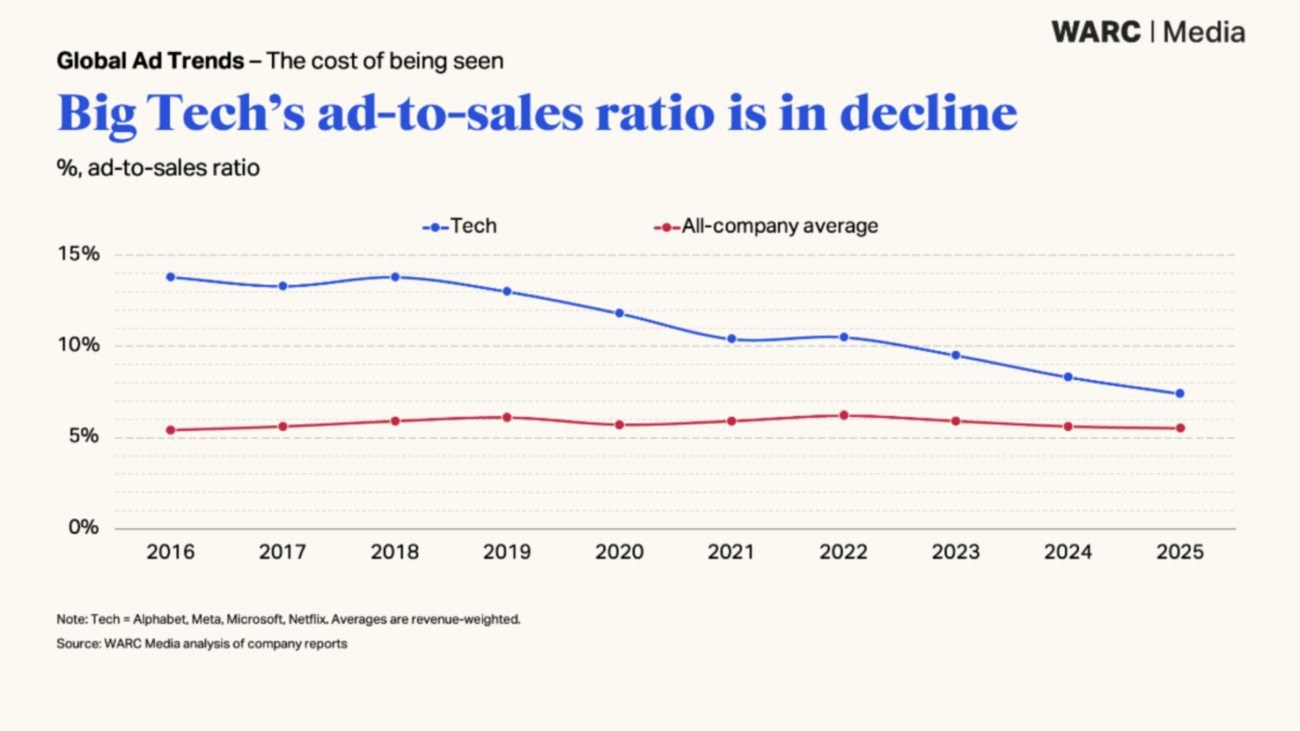
For Alphabet, Meta, Microsoft, and Netflix, the combined ratio fell from 13.0 to 7.4 percent between 2019 and 2025. Their combined revenue grew by 146 percent, from $379 billion to $931 billion. If the companies had maintained their 2019 spending rate, they would have invested $121 billion in 2025, according to WARC—$52 billion more than they actually did.
The consumer goods industry is taking the opposite approach
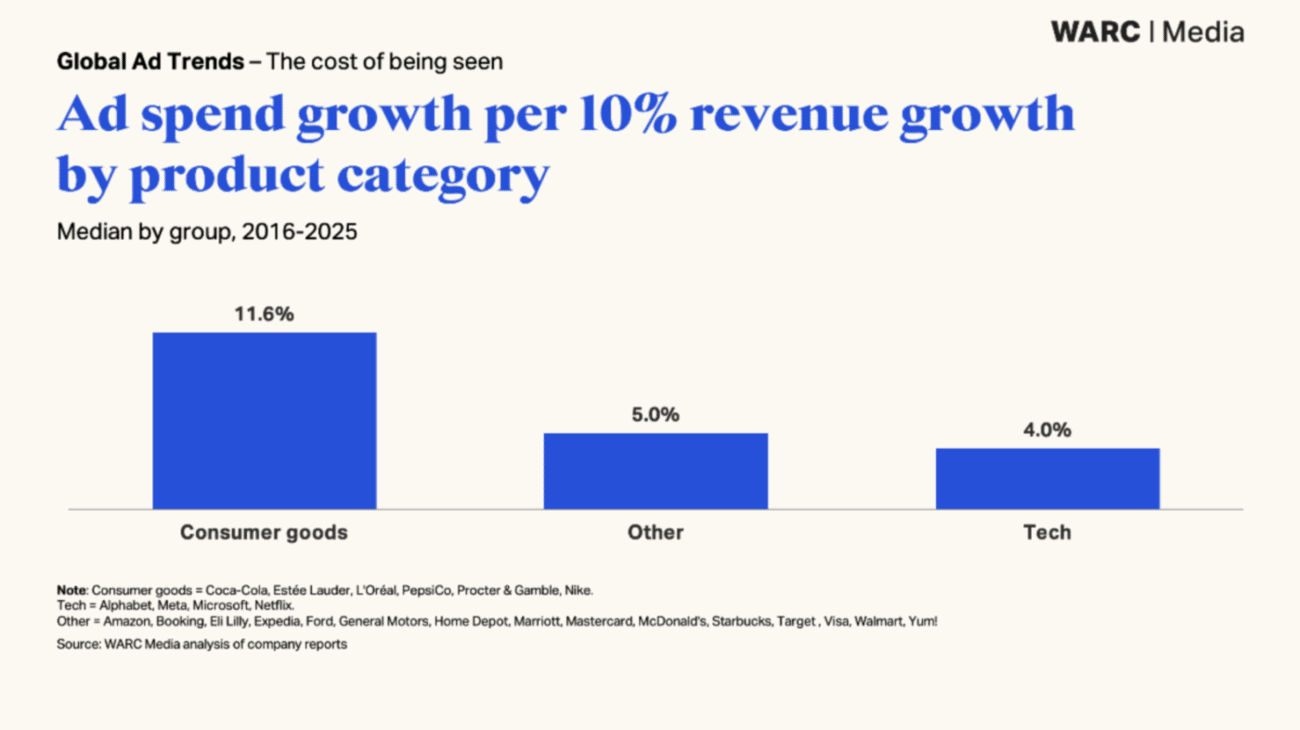
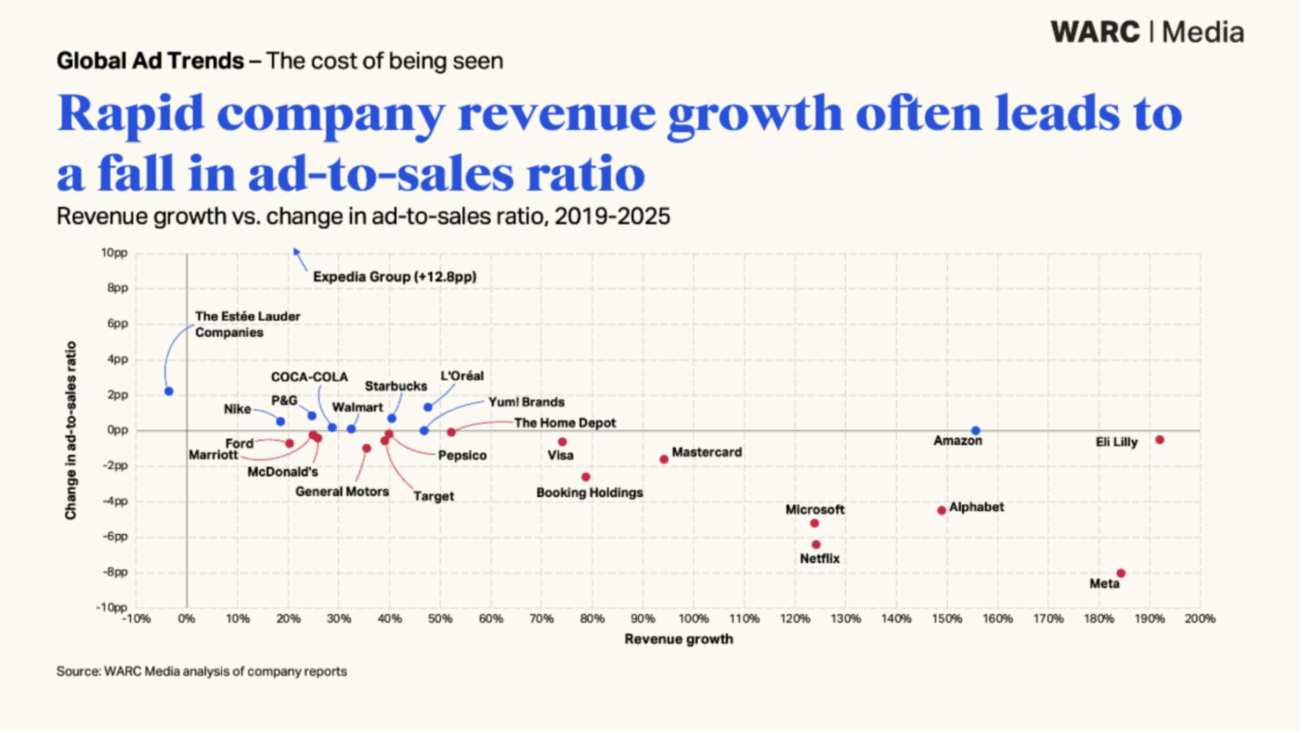
The six consumer goods brands analyzed—Coca-Cola, Estée Lauder, L’Oréal, Nike, PepsiCo, and Procter & Gamble—showed divergent trends. Five of them increased their ratio between 2019 and 2025, while PepsiCo’s remained largely stable. Due to weaker revenue growth, the combined ratio rose from 11.6 percent in 2023 to 12.5 percent in 2025. Their advertising spending grew by 36 percent from 2019 to 2025, while revenue grew by 29 percent.
The picture is mixed for the remaining 15 advertisers. The revenue-weighted average remained the same or rose slightly, but ten companies saw their share decline. Ford fell from 2.3 to 1.6 percent, General Motors from 2.7 to 1.7 percent, Visa from 4.8 to 4.2 percent, Mastercard from 5.6 to 4.0 percent, McDonald’s from 1.7 to 1.3 percent, and Target from 2.0 to 1.4 percent. Marriott, Booking Holdings, Eli Lilly, and The Home Depot also saw declines. Amazon and Yum! Brands remained largely unchanged, while Walmart, Starbucks, and Expedia saw their shares rise.
Three Factors Behind the Divide
WARC identifies three factors that influence advertising intensity. First, weak sales: Companies that maintain their advertising spending during difficult market conditions may see an increase in advertising intensity. Second, budget shifts: Funds that used to be allocated to sales teams for trade and shopper marketing are now flowing into retail media and, consequently, into advertising placements. Third, ownership of attention: Companies like Alphabet and Meta own an audience and can grow without having to pay for attention.
Alex Brownsell, Head of Content at WARC Media, says: «The global advertising market is growing rapidly, yet companies ranging from Meta to Mastercard and McDonald’s are spending a shrinking share of their revenue on advertising.» Only consumer goods companies, which were suffering from slowing revenue growth and saw their trade budgets shift to measured media, increased their advertising intensity. The expansion of platform spending by smaller companies and cross-border e-commerce providers is far outpacing the growth in advertising investment by major brands. This has major implications for the ecosystem of agencies and service providers in the enterprise market.
Methodology
WARC analyzed annual SEC filings from 25 large publicly traded U.S. companies. The ratio is calculated by dividing annual advertising spending by revenue and multiplying by 100. Since some companies report only combined sales and marketing expenditures, WARC supplemented the data with industry figures from Schonfeld & Associates and its own ROI benchmarks. WARC Media subscribers can read the full report. A podcast discussing the findings is scheduled to be available starting November 17.
]]>
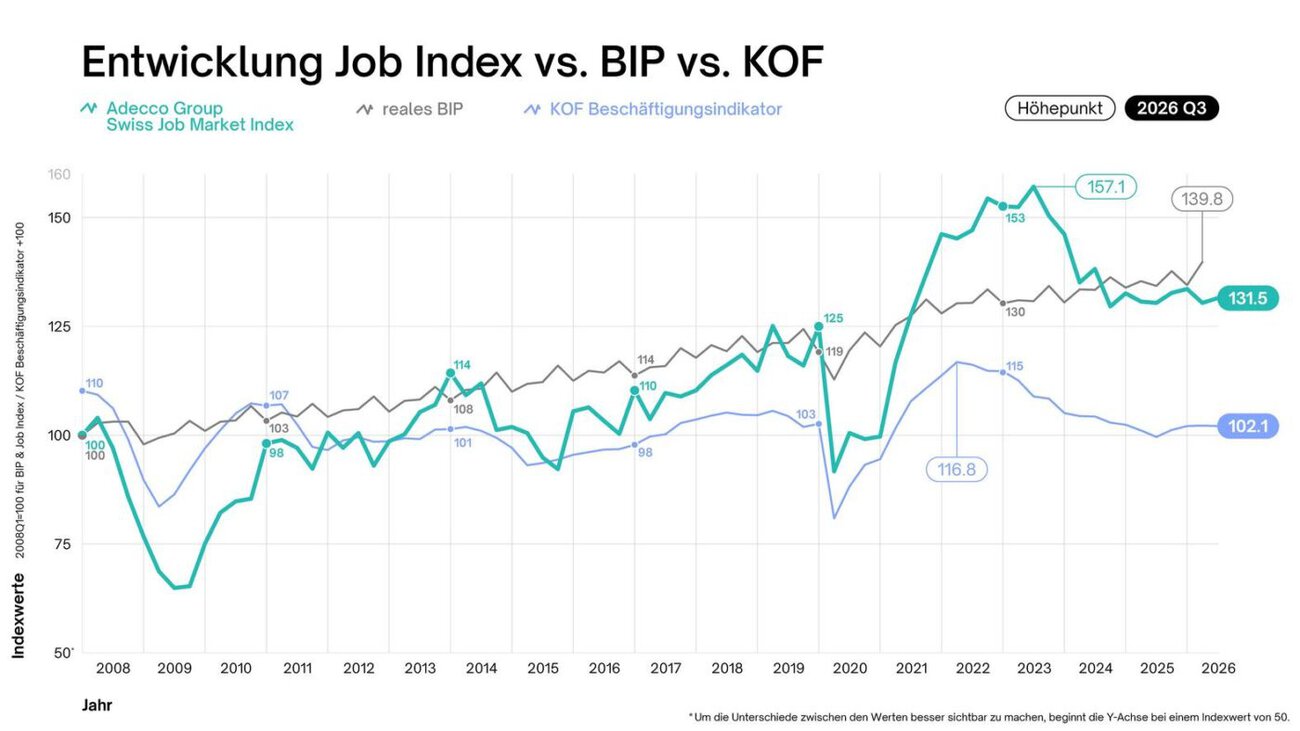
Die Zahl der offenen Stellen in der Schweiz steigt im dritten Quartal 2026 um 0.8 Prozent, sowohl gegenüber dem Vorquartal als auch im Vorjahresvergleich. Das zeigt der Swiss Job Market Index, den die Adecco Gruppe Schweiz gemeinsam mit dem Stellenmarkt-Monitor Schweiz der Universität Zürich erhebt. Im Berufsfokus weisen Handwerks- und technische Berufe ein überdurchschnittliches Stellenwachstum aus.
Swiss Job Market Index: leichte Erholung am Stellenmarkt
Der KOF-Beschäftigungsindikator deutet laut Mitteilung zudem auf eine leicht gestiegene Einstellungsbereitschaft der Unternehmen hin. Die saisonbereinigte Arbeitslosenquote blieb im August mit 3.1 Prozent praktisch unverändert gegenüber dem Vormonat. Das SECO korrigierte seine Wachstumsprognose für 2026 von 0.9 auf 1.7 Prozent. Grund sei das ausserordentlich starke zweite Quartal, das von der exportorientierten chemisch-pharmazeutischen Industrie geprägt war. Begünstigt wurde diese Entwicklung durch die konjunkturelle Erholung des weltwirtschaftlichen Umfelds.
Handwerk wächst mehr als viermal so stark wie der Gesamtmarkt
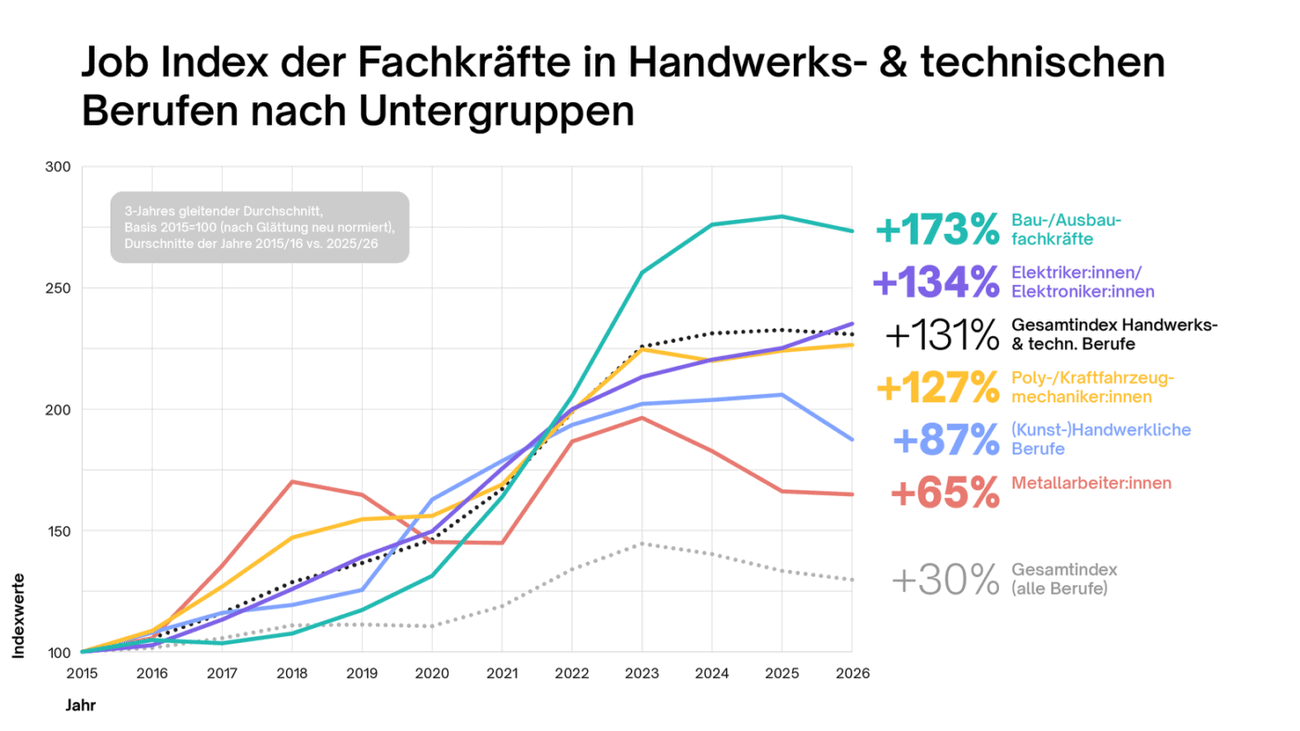
Die offenen Stellen in Handwerks- und technischen Berufen haben seit 2015/16 um 131 Prozent zugenommen. Das ist mehr als viermal so stark wie der Gesamtindex aller offenen Stellen mit plus 30 Prozent. Den stärksten Zuwachs verzeichnen die Bau- und Ausbaufachkräfte mit plus 173 Prozent, darunter Bauspengler:innen, Sanitär- und Heizungsinstallateur:innen sowie Zimmerleute und Bautischler:innen. Bei den Elektriker:innen und Elektroniker:innen beträgt das Plus 134 Prozent.
Das Wachstum konzentriert sich in allen fünf Untergruppen grösstenteils auf wenige Einzelberufe, etwa Bauspengler, Sanitär- und Heizungsinstallateure sowie Kraftfahrzeugmechaniker:innen. Getrieben sein könnte es teils durch die gute Baukonjunktur, teils durch andere Faktoren wie die demografische Alterung und den damit verbundenen Ersatzbedarf.
Fachkräftemangel entspannt sich, KI-Risiko gering
Der Fachkräftemangel in Handwerks- und technischen Berufen entspannt sich seit 2023 trotz weiterhin hoher Nachfrage. Nur die Untergruppen Elektriker:innen und Elektroniker:innen (Rang vier) sowie Polymechaniker:innen und Kraftfahrzeugmechaniker:innen (Rang fünf) bleiben knapp im Mangel- beziehungsweise im neutralen Bereich.
Zudem gilt nur rund ein Viertel der Handwerks- und technischen Berufe als moderat automatisierungsgefährdet durch Künstliche Intelligenz, gerade noch 2 Prozent als hoch gefährdet. Die Ergebnisse zeigten, dass diese Berufe trotz konjunktureller Unsicherheiten robuste Beschäftigungsperspektiven böten, heisst es in der Mitteilung.
Marcel Keller, Country President der Adecco Gruppe Schweiz, sagt: «Handwerks- und technische Berufe bieten auch in einem anspruchsvollen wirtschaftlichen Umfeld gute Perspektiven.» Gleichzeitig müssten sich Unternehmen und Arbeitnehmende darauf einstellen, dass technologischer Wandel, geopolitische Entwicklungen und wirtschaftliche Umbrüche die Rahmenbedingungen am Arbeitsmarkt laufend verändern.
Der Index erscheint jeweils im Januar, April, Juli und Oktober. Er beruht auf repräsentativen Quartalserhebungen der Stellenangebote in der Presse, auf Online-Stellenportalen sowie auf Websites von Unternehmen.
More information: https://www.adeccogroup.com
]]>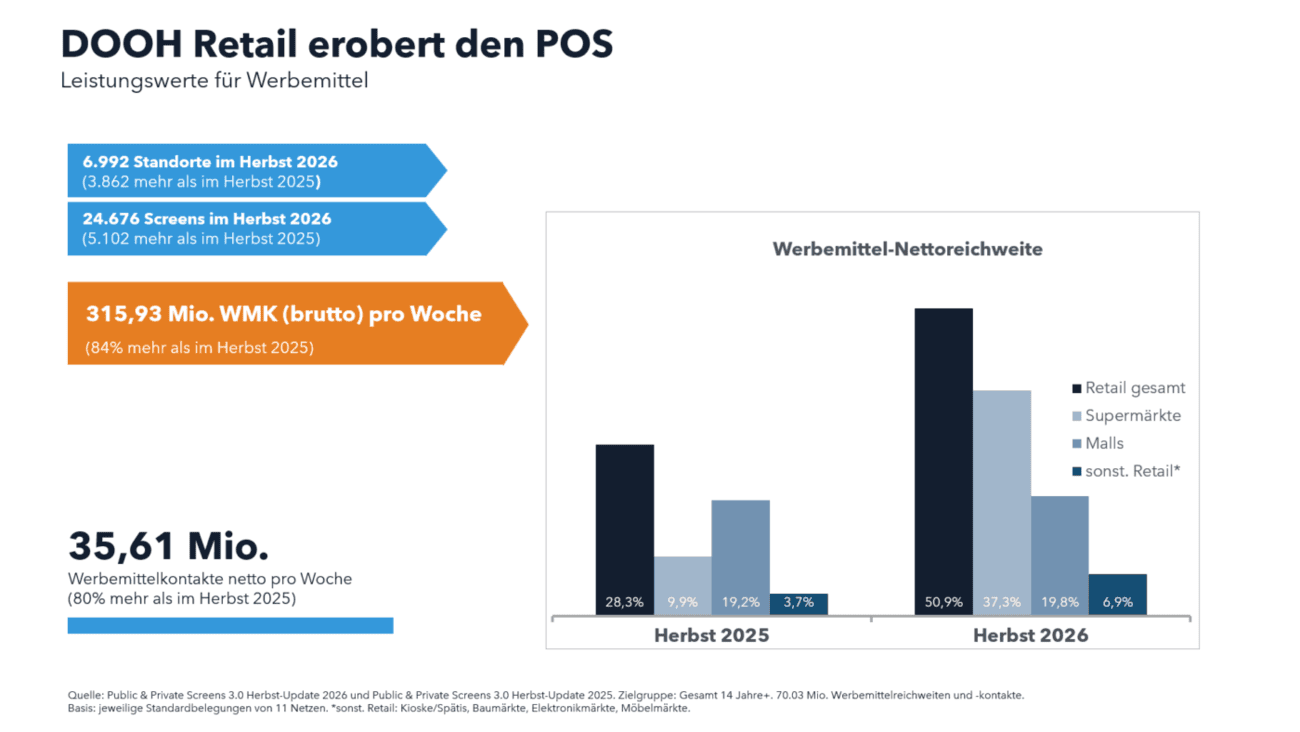
Retail DOOH is growing: The fall update of the market media study «IDOOH Public & Private Screens 3.0» (P&PS 3.0) shows how digital out-of-home advertising is evolving at the physical point of sale. The study is published by the Institute for Digital Out of Home Media (IDOOH) in Munich. Since fall 2025, the number of retail DOOH locations tracked has increased by 120 percent.
More Screens, Greater Reach in Retail DOOH
The number of screens increased by more than 25 percent, from more than 19,500 to nearly 25,000. According to the study, the reach of retail DOOH increased by 80 percent, and the number of ad impressions rose by as much as 84 percent.
The number of retail DOOH advertisers represented has also risen from eight to eleven within a year. New additions include the networks of Kaufland, Ocean Outdoor, and Rewe. Together with the portfolios of Cittadino, eisbach.media, and Ströer, as well as other POS networks in grocery retail, kiosks, late-night stores, and home improvement, electronics, and furniture stores, advertisers and agencies now have a comprehensive portfolio to choose from.
Branding and Engagement All the Way to the Checkout Counter
Digital screens reach consumers in parking lots, at the entrance to a shopping center, inside the mall, or right in the supermarket. According to the announcement, this medium is suitable not only for short-term purchase activation but also for traditional branding campaigns. Brands can showcase their messages on large-format screens and guide shoppers all the way to the checkout.
Frank Goldberg, CEO of IDOOH, says: «Retail DOOH combines the reach and branding power of a mass medium with immediate proximity to the point of purchase.»
Overall, the range is stable
Even beyond the retail sector, the update confirms the effectiveness of Digital Out of Home. Within a week, DOOH reaches 74.1 percent of the German population aged 14 and older with light inventory utilization. With full inventory utilization, approximately ten billion impressions could be delivered per week.
P&PS 3.0 is based on a big-data-driven bottom-up model that uses mobility data from approximately one million smartphones, supplemented by surveys on contacts, duration of stays, and usage patterns. The study is available free of charge in the mediMACH planning tool via the IDOOH website: https://idooh.media/marktforschung/. Anyone already using mediMACH for other studies will automatically be granted access through their existing account.
More information: https://idooh.media/
]]>
For the third time, swissreputation.group and pressrelations Switzerland have examined the media reputation of Swiss industrial and technology companies. The analysis covered media coverage of 65 companies from September 1, 2025, through August 31, 2026. Siemens, Dormakaba, Dätwyler, and Sensirion achieved the highest reputation scores in their respective categories. According to the press release, strong overall rankings sometimes mask significant differences between individual reputation dimensions.
How the Study Measures Switzerland's Media Reputation
The analysis focused on Swiss online and print media. With the help of AI, statements relevant to reputation are identified, evaluated based on tone, and categorized into six dimensions: products and services, innovation, economic performance, management and leadership, workplace, and ESG and sustainability. The Reputation Score ranges from 0 to 100 and takes into account media presence, tone, as well as the reach and significance of the media sources. Companies are divided into four presence groups based on media reach, with each group comprising 15 to 17 companies. This classification is recalculated for each issue.
A Leader with a Strong Presence and a Pacesetter
Among the top-ranked companies, Siemens leads with 84 points and achieves the highest score in ESG and sustainability. ABB follows with 78 points, while Stadler Rail ranks third with 66 points. Stadler Rail leads in Products and Services, Innovation, and Workplace, but scores significantly lower in Management and Leadership as well as ESG. Pilatus Flugzeugwerke (56) and Logitech (51) round out the top five.
In the "Pacesetters" category, Dormakaba leads with 79 points. Hitachi Energy follows with 68 points and leads in the Workplace category. V-Zug scored 63 points and achieved the highest ESG score in the group. Huber+Suhner (61) and Georg Fischer (59) round out the top five.
Pioneers and Hidden Champions
Among the trailblazers, Dätwyler, with 79 points, is just ahead of the Bühler Group, with 78 points. Dätwyler leads in products and services, while the Bühler Group leads in management and leadership as well as workplace. Novelis follows with 67 points, Belimo with 64, and Temenos with 58 points.
Sensirion leads the Hidden Champions with 83 points, confirming its top position from the previous year. Zehnder scored 73 points, Schneider Electric 69, Liebherr 67, and Endress+Hauser 58 points.
Changes Compared to the Previous Year
Siemens has replaced Stadler Rail at the top of the “Presence Leaders” category. ABB has moved up one spot, while Pilatus Flugzeugwerke and Logitech have entered the top five. Dormakaba also leads the new comparison group following its move from the “Pioneers” to the “Pacesetters.” The number of articles on Hitachi Energy has more than tripled, and the coverage has become more positive. Coverage is also significantly more positive for ABB, Pilatus Flugzeugwerke, Dormakaba, Dätwyler, and Zehnder. Sensirion reports a much more positive tone despite the number of articles being cut in half.
Different Strengths, Different Profiles
The leading companies base their position on various dimensions; top scores in individual dimensions do not necessarily translate into an overall victory. «A good overall score is the starting point. To manage their reputation, companies need to understand which issues strengthen their reputation and where critical perceptions arise,» says Lukas Zihlmann, CEO of swissreputation.group.
Many industrial and technology companies primarily do business with other companies; the general public is largely unfamiliar with their products from personal experience. Media coverage therefore plays a key role in shaping how these companies are perceived as employers, drivers of innovation, or in terms of their social responsibility. Zihlmann: «Consistent coverage of a company’s various achievements can help build a broad reputation profile. If, on the other hand, a company is perceived almost exclusively in connection with financial results or individual controversies, its public image remains correspondingly one-sided.»
More information: https://www.swissreputation.group
]]>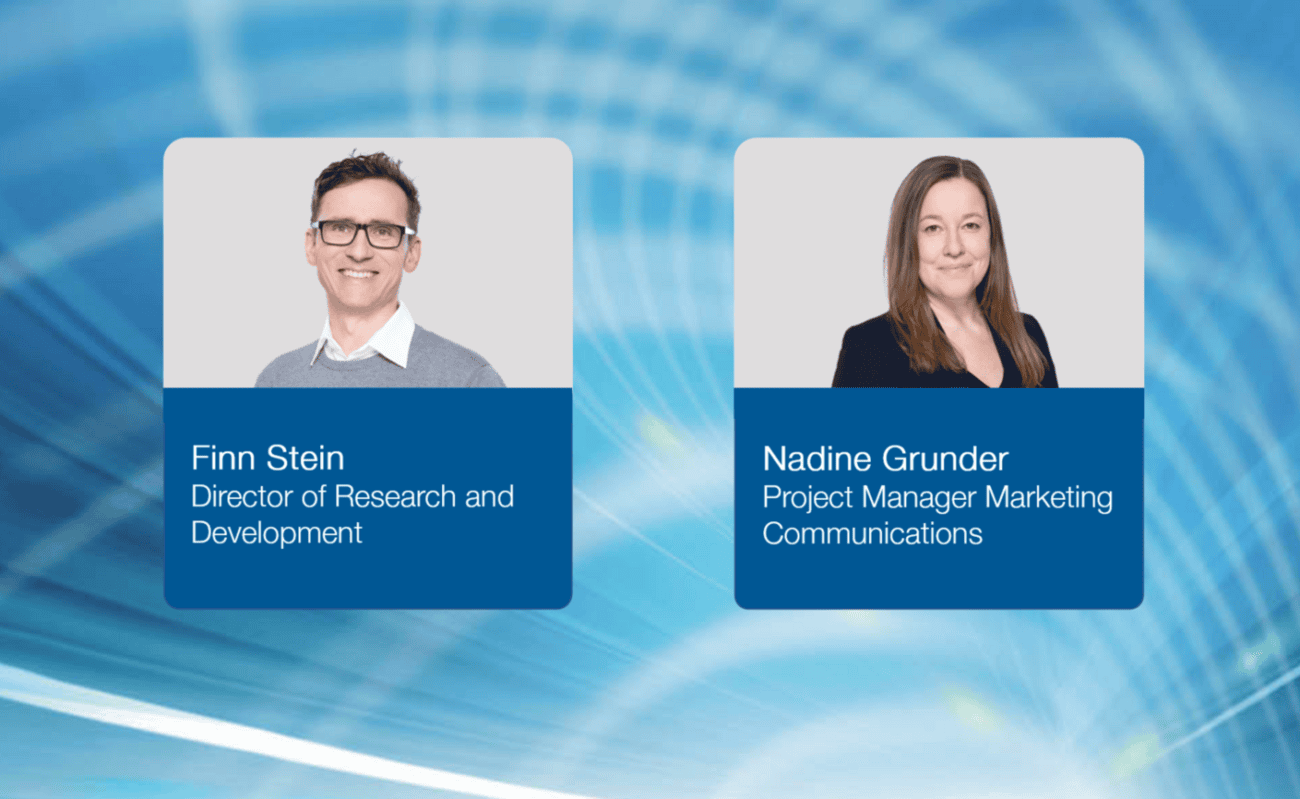
Finn Stein provides information about the new features. Source: zvg
As part of the WEMFacademy, WEMF is hosting a free webinar on the latest updates to the MACH research system. It will take place on Tuesday, November 3, 2026, from 10:00 a.m. to 10:30 a.m. According to the WEMF, the system is continuously being developed to meet the needs of the advertising and media market.
An Overview of the MACH Research System
In the webinar, Finn Stein, Director of Research and Development, will provide an overview of the latest updates. Participants will learn about the new variables and audience characteristics that are now available.

WEMF presents MACH innovations. Source: zvg
A Focus on Media Genres and Consumption Data
Next, we’ll discuss which additional media types the MACH Strategy offers for media planning. The webinar will also provide information on the new consumer data included in MACH Consumer.
The event is aimed at professionals in the advertising and media industries. WEMF notes that the invitation may be forwarded to other interested individuals. Registration for the webinar is free.
]]>
At the first BRANDS’n’GAMES CONVENTION on February 23, 2027, in Vienna, advertising companies from the DACH region will learn what gaming can achieve as a marketing and advertising platform and what approaches brands are currently using to operate successfully in the gaming environment. The marketing agency Purpur Media is serving as the main sponsor.
According to the press release, games have long been more than just entertainment: they are media, social spaces, pop culture, and one of the most relevant platforms for communicating with millions of people. The conference will explore how brands can be perceived in this world not as a disruptive force, but as a credible part of the experience. The content will focus on six key areas: marketing objectives, target audience, efficiency, booking, measurement, and proof of success.
BRANDS’n’GAMES CONVENTION: Gaming in the Marketing Mix
The conference at the sophie7 event venue in 1070 Vienna is aimed at marketers, advertising professionals, and media and communications experts from across the DACH region. The goal is for them to learn how to tap into the potential of gaming in strategic, creative, and measurable ways. From classic in-game advertising and product placement to branded experiences, collaborations with publishers, and custom-developed gaming worlds, a new communication space is emerging whose possibilities extend far beyond traditional advertising.
The event brings together brands, agencies, gaming experts, publishers, market researchers, and technology providers. Keynotes, best practices, and panel discussions will focus not on the next big trend, but on how gaming can become an effective component of the marketing mix.
Key Questions from Marketing Practice
Among other things, the following questions will be addressed: What goals can be achieved through gaming? Which target audiences do brands encounter in which games and on which platforms? How effective are gaming activations compared to established channels? How are campaigns planned and booked? What data and metrics are available? And how can the contribution to brand and business success be transparently demonstrated?
Success stories will showcase what is already possible today. Experts will analyze technologies, formats, and trends, while decision-makers will discuss the future role of gaming in brand management, media, and communication.
Organization and Tickets
The BRANDS’n’GAMES CONVENTION is organized by the communications agency MOMENTUM Vienna, which also organizes the JETZT conferences and MARKETING X. The event focuses on the theoretical foundations as well as concrete solutions at the intersection of marketing and gaming.
]]>
There is an almost painful irony in the air: While smart algorithms and artificial intelligence are permeating our everyday lives at record speed, a quiet unease is growing in offices and living rooms—the fear of losing control over our own digital tools. It has long been evident that mastery of hardware and software ranks on the same fundamental level as the classic cultural skills of reading, writing, and arithmetic. Anyone who falls behind technologically today finds themselves left behind in the digital world. The global Logitech study «Ctrl Tomorrow» brings this to light: there is a measurable correlation between digital competence and personal well-being that noticeably accelerates the pulse of our society..
The New Everyday Classroom: Between Control Dividends and Control Taxes
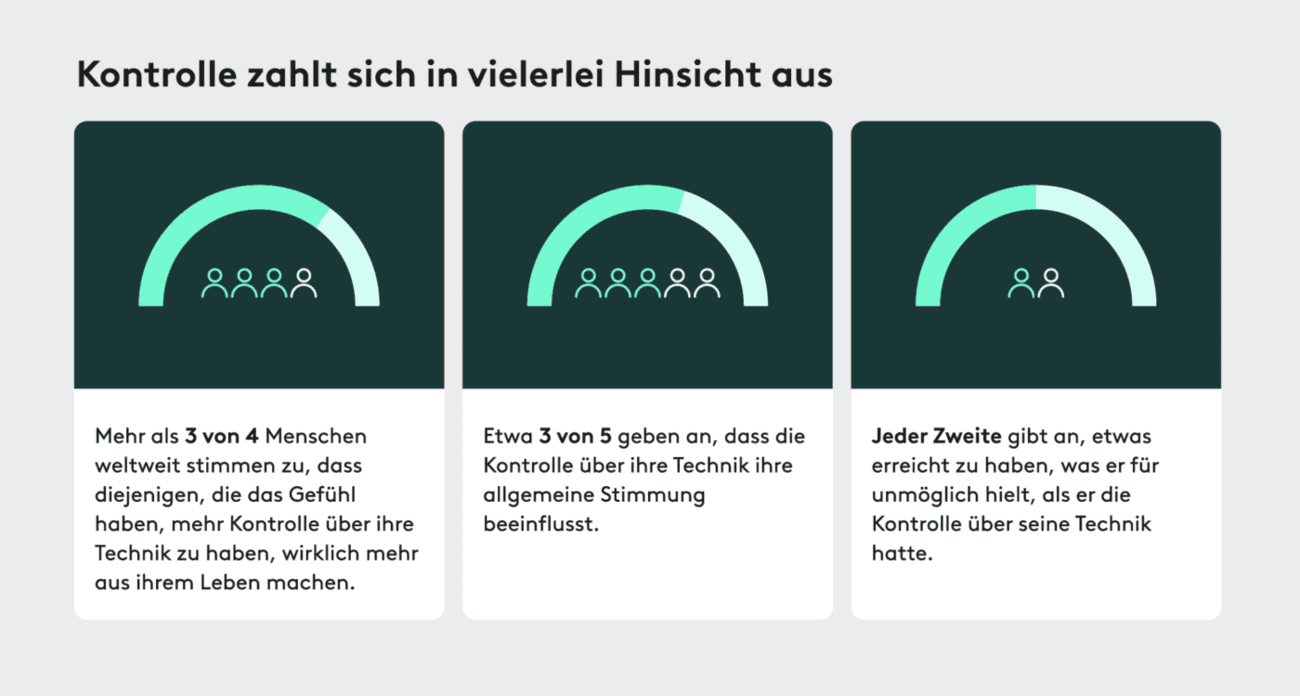
The global study conducted by the communications agency Burson in May and June 2026—based on over 9,000 respondents in nine countries as well as a special survey of IT decision-makers—examines the relationship between humans and machines in an exemplary manner. At the heart of it all is a fascinating phenomenon: the so-called "control dividend". Those who have mastered their tools—especially physical devices—intuitively benefit from tangible psychological and physical advantages. Self-confidence, productivity, creativity, concentration, inner peace, and physical well-being are the rewards of digital sovereignty.
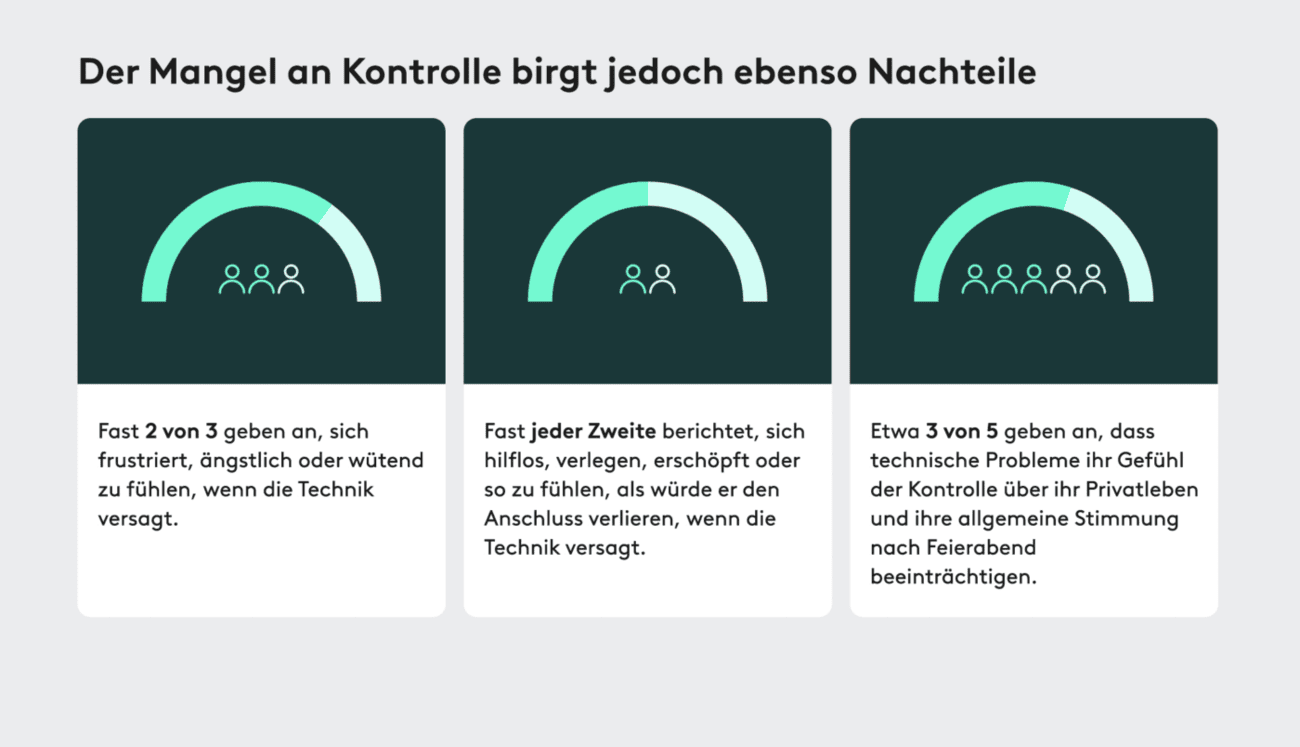
But there is a drastic downside to this, which is treated as a control tax. When technology fails, frustration strikes mercilessly: On a global average, 64 percent of respondents say that technical glitches have a massive negative impact on their overall mood after work and their sense of control over their personal lives. Almost as many (64 percent) feel overwhelmed by frustration, fear, or anger when their computer malfunctions. About 46 percent even report feelings of helplessness, shame, exhaustion, or the painful sense of being left behind.
The New Tech Currency: The «Ctrl Score» and the Anatomy of a Loss of Control
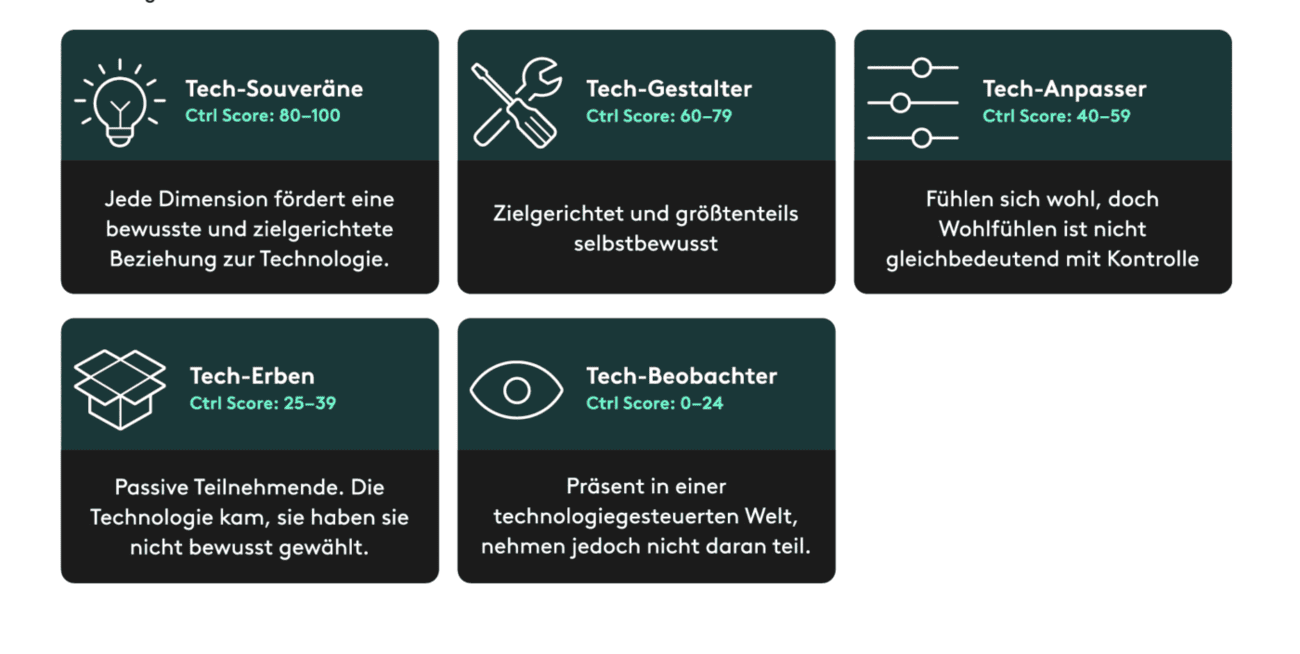
To make this phenomenon more tangible, Logitech has developed the «Ctrl Score»—the world’s first composite index that makes technological agency measurable and improvable. The score is based on three dimensions: conscious technical proficiency (intentionality), personal attitude and openness toward new tools, and one's perspective on one's own potential.
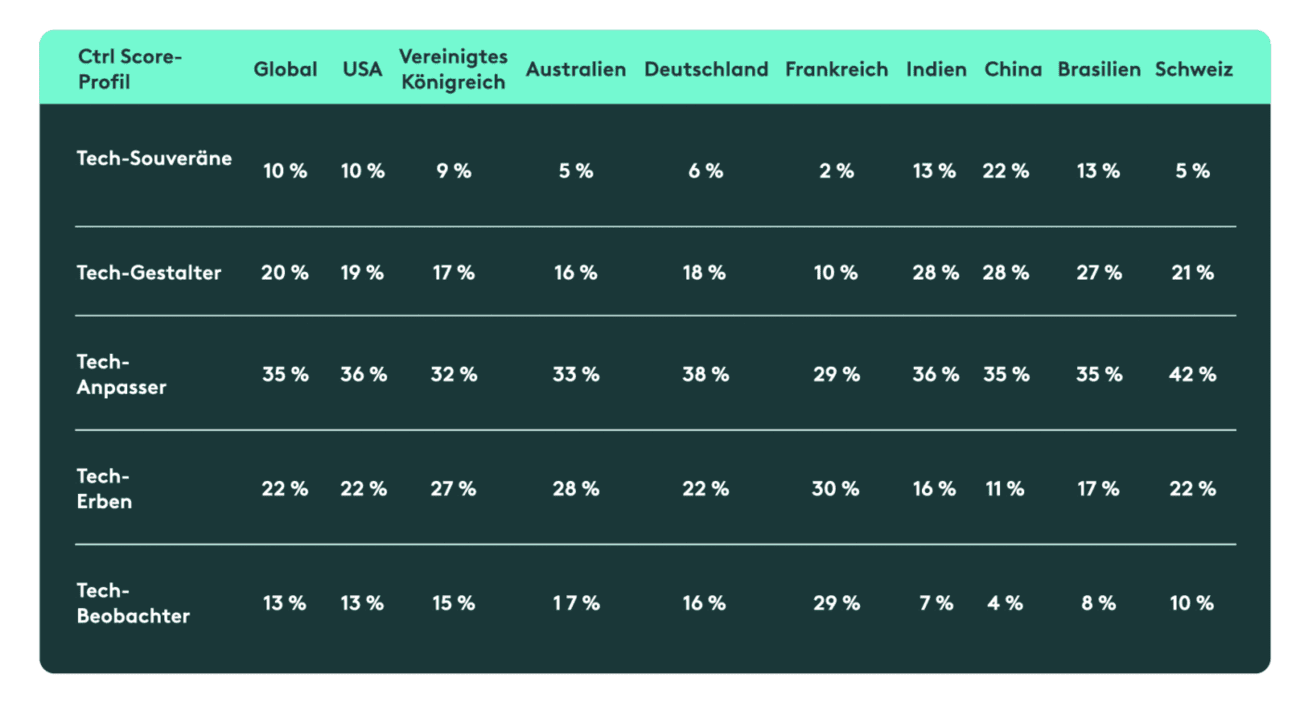
The global survey categorizes people into five distinct profiles, ranging from the 10 percent who are “tech sovereigns,” to the 20 percent who are “tech shapers,” and the broad group of 35 percent who are “tech adapters,” all the way to the remaining 35 percent who are “tech heirs” and “tech observers.”. Worldwide, this amounts to approximately 4.2 billion people who, as passive participants, are at risk of being left behind. It is particularly revealing to examine the "money fallacy": Contrary to popular belief, control cannot simply be bought. Only 21 percent believe that the wealthy have the most control, while 44 percent are convinced instead that people with genuine technical expertise hold the reins.
Haptic Anchors in an Abstract World: Why Hardware Saves the Day
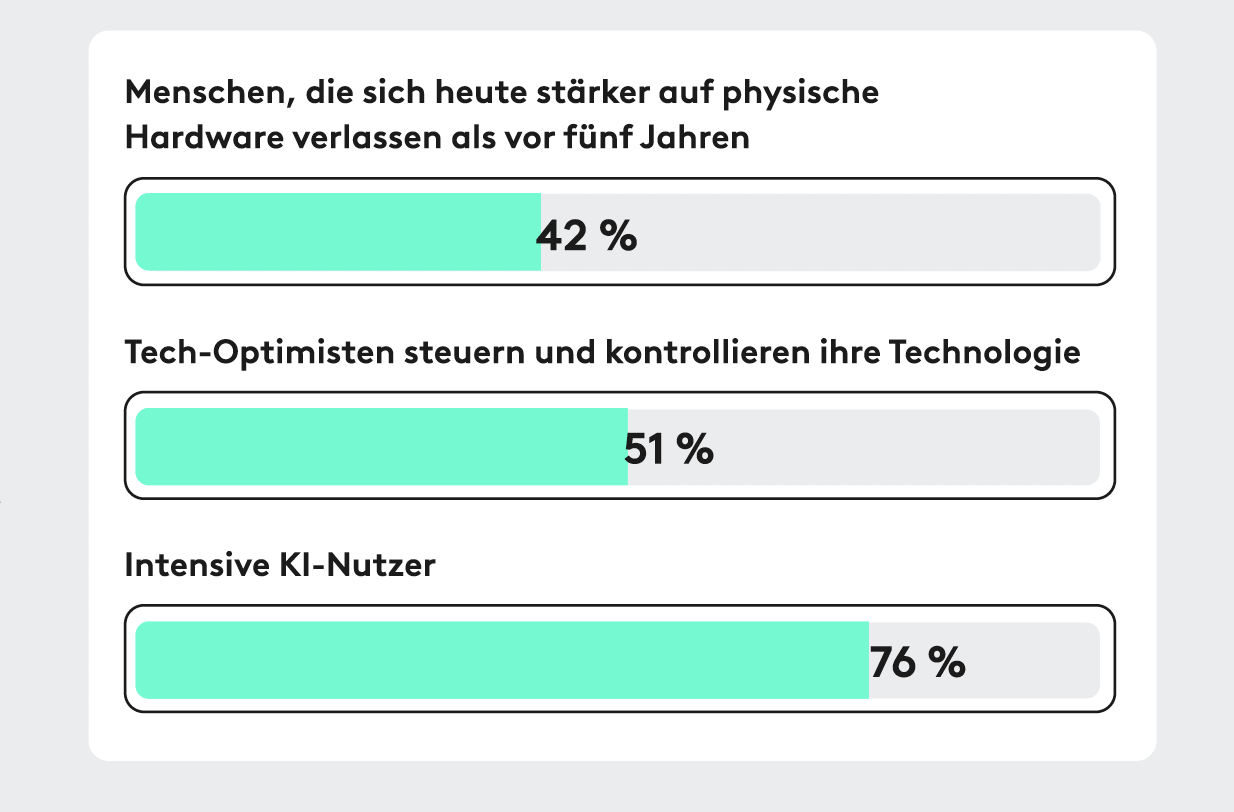
The more abstract software, cloud computing, and artificial intelligence become, the more people cling to the tangible. Nearly two-thirds say they feel the greatest sense of control when interacting with physical hardware. Today, 42 percent of all respondents rely more heavily on physical devices than they did five years ago—among heavy AI users, this figure soars to a staggering 76 percent.
This also highlights the phenomenon of gamers as role models: Gamers spend an above-average amount of time optimizing their environments. 81 percent of them confirm that gaming boosts their self-confidence in everyday life, reduces anxiety, and helps them keep their cool in high-pressure and chaotic situations. The confidence gained through gaming directly carries over into everyday work life.
Office vs. Home: The Workplace as a Control Desert
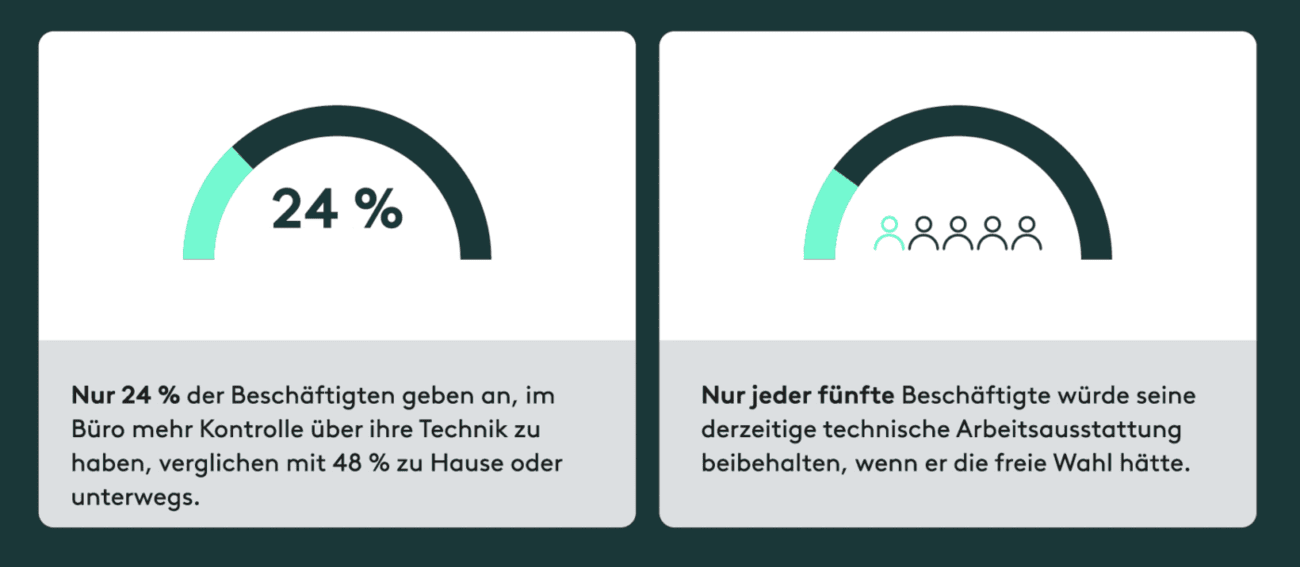
This is where perhaps the greatest point of failure in the modern workplace becomes apparent: While employees have often created a customized, highly functional, comfortable environment for themselves at home, the office, in the eyes of many, has been relegated to the bottom of the list.. Just 24 percent of employees feel they have more control over their technology at the office than at home or on the go. Only one in five employees would voluntarily keep their current office technology.

The consequences are serious: Discrepancies between personal autonomy and frustration with bureaucratic technology hinder concentration, energy, and ultimately employee retention.. While IT decision-makers recognize the problem—after all, 64 percent of them identify as gamers and understand the power of good hardware—only 35 percent formally and regularly track the human impact of their IT decisions using specific metrics.
The Drive for Success vs. Western Skepticism: Where Innovation Meets Fear
The study reveals, in particularly striking terms, the global differences in mindset when it comes to dealing with the future. While in Western countries technology is often viewed as an administrative convenience or a tool for streamlining processes, in emerging nations such as India, China, and Brazil, it serves as the primary driver of social and professional advancement. In India and Brazil, 84 percent of respondents in each country are firmly convinced that technology creates new opportunities rather than new pressures. China (80 percent) and Brazil (78 percent) lead the world in agreement that technology enhances personal potential.
In stark contrast to this cross-national trend, the Old West reveals a potentially fatal skepticism: In France, optimism about technology has dropped to a meager 60 percent, and only 45 percent believe at all in the ability of these tools to make life easier. This discrepancy is also evident when it comes to brand-new artificial intelligence: While 41 percent of people in India are wildly enthusiastic about how AI expands their possibilities, the figure is a meager 16 percent in the U.S., 15 percent in the United Kingdom, and just 13 percent in Australia. Skepticism threatens to become a barrier to innovation in this country, while the Global South is advancing inexorably.
Looking Beyond National Borders: Where Does Switzerland Stand?
Switzerland continues to play its customary special role within the European context: The Swiss consistently rank in the upper middle tier of European countries, yet they operate with a calm, measured approach and a focus on quality.. For example, 73 percent of Swiss people are convinced that greater technical proficiency enriches their lives (global average: 77 percent). When it comes to artificial intelligence, Switzerland—with 23 percent of respondents expressing enthusiasm for the expanded possibilities—is noticeably more open-minded than its major European neighbors (Germany: 13 percent; France: 12 percent), though it remains far behind the momentum of growth in Asia and South America.
Exclusive: Your m&k Payment Service
-
77 percent Of those surveyed worldwide, many are convinced that the better people are at mastering technology, the more they get out of life.
-
64 percent state that technical problems have a negative impact on the overall mood after work and on their personal lives.
-
52 percent Through their mastery of technology, they have already been able to achieve things they previously thought impossible.
-
30 percent People around the world have a high degree of autonomy over their technology; only 10 percent act like confident tech professionals.
-
4.2 billion people Worldwide, they fall into the group of less aware or self-assured users who are at risk of feeling left behind.
-
42 percent Today, users rely more heavily on physical hardware (such as keyboards and mice) than they did five years ago to maintain control.
-
73 percent of the Swiss population agree that better mastery of technology leads to a higher quality of life (global average: 77 %).
-
64 percent of the IT decision-makers surveyed identify as gamers, compared to only 28 percent in the general population.
-
35 percent IT decision-makers formally and regularly monitor the impact of their technology decisions on employee well-being in the workplace.
Gamification in Customer Loyalty: Switzerland Ahead of Germany and Austria
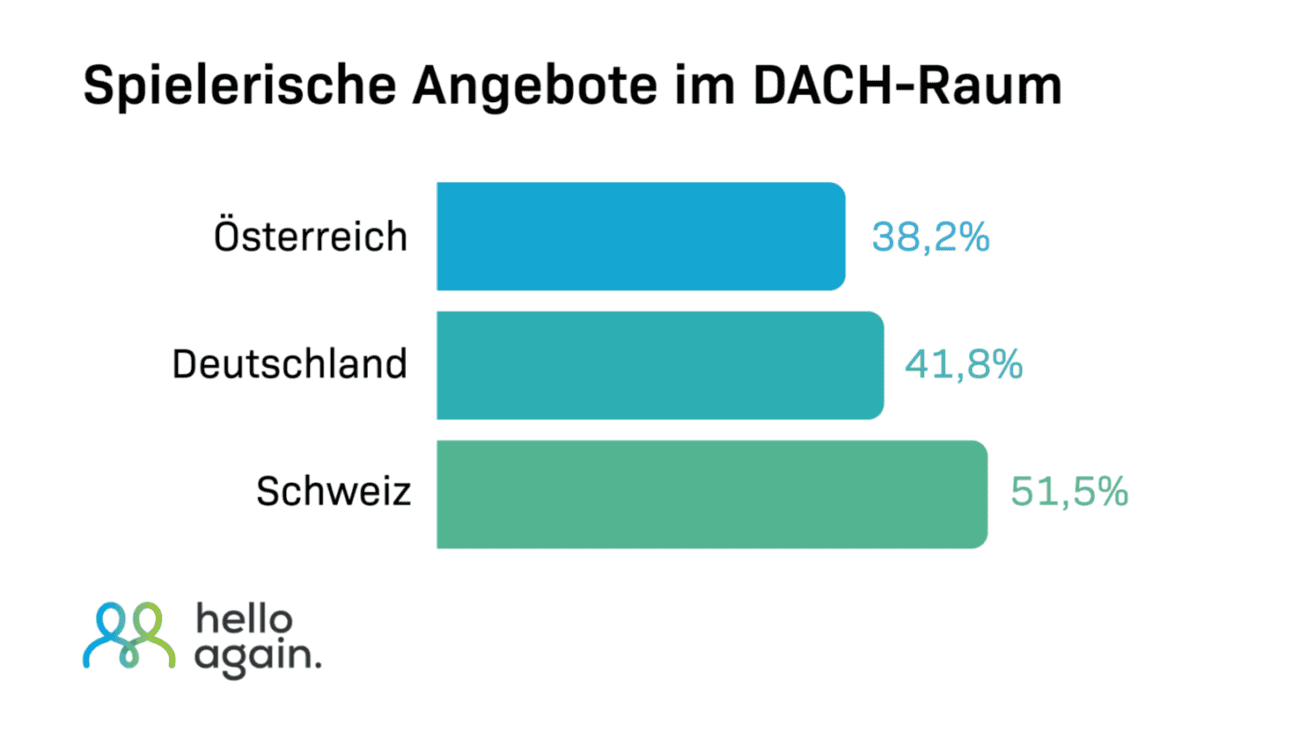
According to hello again, gamification in customer loyalty programs is the decisive factor between a program that customers actually use and one they ignore. This is evident from the DACH Loyalty Report 2026. According to the report, 51.5 percent of respondents in Switzerland enjoy or very much enjoy using gamified elements in customer loyalty programs. Germany ranks in the middle with 41.8 percent, followed by Austria with 38.2 percent.
More engagement instead of just discounts
Gamification elements in loyalty programs are designed to measurably increase engagement. According to hello again, customers open the app more often, visit more regularly, and build an emotional connection to the brand. Those who offer only discounts condition app users to expect price advantages and lose them as soon as the competition offers more.
Not Just a Phenomenon Among Young People
In Germany, people aged 25 to 34 (65.6 percent) and those aged 18 to 24 (61.4 percent) are particularly fond of using playful elements. Among 55- to 65-year-olds, one in five (20.3 percent) still actively uses them. There are hardly any differences based on gender.
As an example, hello again cites the Sorger Bakery’s 2025 digital Advent calendar: 11,400 customers opened a total of 115,100 virtual doors—an average of ten per person.
Reward Immediately, Build Long-Term Loyalty
For 82.4 percent of consumers, the ability to redeem rewards immediately is the deciding factor in whether they participate in a loyalty program. Furthermore, even the illusion of progress—such as having two stamps already on a new stamp card—doubles the likelihood that customers will complete a program. Well-designed systems tier incentives so that the initial experience turns into a habit. It’s not the reward itself that triggers dopamine, but the anticipation of it.
«Gamification isn’t just a digital toy,» says Franz Tretter, founder and CEO of hello again. «It’s the link between what customers experience in the store and what connects them to a brand afterward.»
White Paper with Application Examples
The white paper «Gamification in Customer Loyalty» explores the psychological foundations, provides an overview of the key mechanics, and highlights examples of its application in the restaurant, bakery, retail, and tourism industries. The report is based, among other sources, on data from the DACH Loyalty Report 2026, for which hello again, in collaboration with marketagent, surveyed more than 2,000 people in Germany, Austria, and Switzerland.
More information: https://www.helloagain.com/de
]]>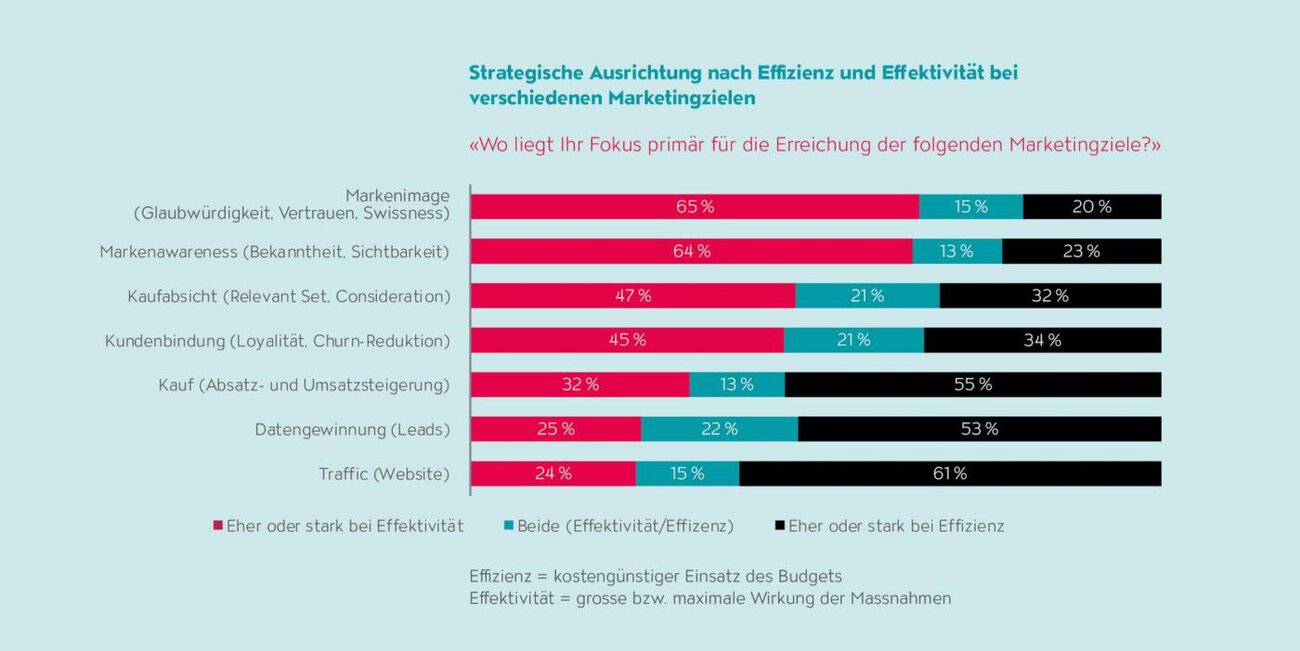
The Admeira study «Markt-Echo 2026 – Advertising Effectiveness: Successfully Achieving Marketing Goals» examines key success factors for modern campaign strategies. To this end, Admeira, in collaboration with GfK Switzerland, surveyed 47 experts from agencies and advertising clients throughout Switzerland. The study focuses on the tension between short-term efficiency and long-term advertising effectiveness.
Admeira Study: Efficiency Is Not the Same as Effectiveness
According to the study, a low-cost ad placement does not necessarily guarantee brand impact. Linear TV achieves the highest effectiveness rating at 81 percent and, at the same time, offers a strong balance between impact and efficiency. For video platforms, perceived effectiveness is in some cases significantly lower than efficiency. Cost-efficiency alone is therefore not a reliable measure of advertising impact.
When Precision Leads to Invisibility
72 percent of respondents see a high risk that brands will lose visibility in the long term if their target audience is defined too narrowly. Avoiding mass media could also weaken a brand’s position in the Relevant Set. With the rise of AI-driven automation, presence in the Relevant Set is becoming even more important. Healthy brand growth requires reaching audiences outside the core target group, as growth stems primarily from new customers. Linear TV and OOH are considered particularly effective for this type of reach expansion.
TV Provides Reach and Impact
94 percent of media professionals attest that linear TV is highly effective in building brand awareness. In addition, a broad TV presence has an impact beyond the medium itself: 62 percent view it as a catalyst for the effectiveness of targeted digital initiatives.
Yvonne Rüegg, a research specialist at Admeira, says: «Efficiency alone does not guarantee a sustainable advertising impact. Brands need reach and breadth to remain visible and relevant.»
The report also examines the marketing goals of the Swiss advertising industry, reach and brand growth, as well as the future role of connected TV, TV replay, and digital video formats. It is available for free download on the Admeira website.
More information: https://admeira.ch/forschung/markt-trends/detailseite/markt-echo-studienreport-2026
]]>