Anyone setting up a campaign in Meta Ads Manager can filter audiences by Mustang fans or governments in Asia. Anyone who follows wedding planners is considered engaged. With «Advantage+ Audience,» the algorithm doesn’t even need input anymore. This is how it’s described in the book «Unlock your [ai]dentity» by Céleste and Marinko Spahić. The logic behind it: More time on the platform means more ads, and more ads mean more money.
Céleste Spahić founded the startup «Mindzeit,» a mental health app; she was named Female Founder of the Year in 2023 and calls herself a tech philosopher: she reflects on technology and builds it herself. In the new episode of the podcast «AI and Society,» she explains why she doesn’t demonize AI despite all this. «Technology is, after all, a tool, and a tool can amplify effects in both directions.» To Kant’s «Sapere aude» we can now add «Conscius esse aude»: have the courage to be conscious. In other words, to be aware of what technology does to you.
Discussing with AI as if with philosophers
She sees the most common mistake in working with AI as using the language model as an answer machine. She demonstrates it: «Write this email for me.» «Okay, done.» «I’ll send it out.» If you stop checking the output, you’re giving up the thinking. She sees working with AI as a loop: «It’s a dialogue. It’s a constant back-and-forth between the large language model and the human.» In the book, this is called a Socratic dialogue partner: the AI asks questions, and the human thinks.
Many copywriters and creative professionals see AI as a threat. Spahić distinguishes between two separate debates. The creative community faces real problems, such as those related to copyright. Separate from that is the question of whether to outsource or enhance one’s creativity. «Creativity is the ability to combine things in ways that haven’t been combined before.» The first step remains with humans. Only then does the language model come into play.
«Generation AI—that's all of us»
The prompts in the book encourage readers to share personal information with the AI. This data ends up with U.S. corporations. Spahić’s advice: «You should always keep in mind that there might be someone reading or listening in.» Real names, addresses, and bank account information don’t belong in the chat. That’s why she’s calling for data-sovereign solutions from Europe, including Switzerland.
Instead of bans, Spahić advocates for regulation and education. At phil.cologne, she led a panel discussion in which more than 400 students were surveyed about their use of AI. The result: Nearly 90 percent said they use ChatGPT for their homework. This makes it all the more important to specifically prepare young people for working with AI. The seven «Future Skills» outlined in her book should therefore be firmly integrated into the school curriculum. “We are all the AI generation,” says Spahić.
The podcast episode on Spotify
The episode featuring Céleste Spahić is part of the video series «AI and Society—Paths to a New World,» produced by the Swiss Text Academy Foundation, the Swiss Prompt Engineering Academy, Science City Davos, and Lab42 Davos. It is available at YouTube, Spotify and available on all major podcast platforms. Hosted by Christoph Soltmannowski, produced by castalavista.com
]]>
In the Text Akademie podcast «AI and Society» with Christoph Soltmannowski, he explains why the media does far too little to explain the technology, why real journalism is becoming increasingly valuable in the pursuit of AI, and what truly concerns him about this whole development.
Gaudenz Looser has been described as «Switzerland’s most dangerous journalist.» «It’s a nice title they’ve given me. I didn’t go looking for it—and I’m only resisting it a little bit now.» For him, there isn’t much more to it than that anyway: Anyone who heads the country’s largest media outlet for a certain period of time bears responsibility and wields influence. Looser is fine with that.
«Nobody talks about it»
It wasn’t his own enthusiasm that led him to the topic of AI, but rather an assignment from his boss at the time. «At first, I was forced into it—and I’m grateful for that,» he says. But as soon as he began to explore it, he became captivated by the subject and couldn’t let it go. He quickly realized how great the need was to explain and contextualize a technology «that has such a powerful impact on all our lives and is evolving so rapidly.».
This is precisely where his central criticism of his own industry lies. While publishing houses have made intensive efforts to integrate AI into everyday life, they have criminally neglected the media’s actual mission—to explain to society the opportunities and risks associated with the technology. «Every individual is left a little bit on their own with the technology,» says Looser. He identifies two successive fears behind this: first, FOMO—«I have no idea what this is all about, but we have to do it too»—and then the fear of «being caught not having a clue yet.».
What Can Be Automated—and What Can't
Looser considers the idea that AI is revolutionizing text writing, of all things, to be the least interesting prospect. «AI Slop» remains recognizable: «Whenever you think, »No one will notice this anymore,« it takes two weeks and the flaws become obvious.» The real strength lies elsewhere: “Processing large amounts of unstructured information has never been easier than it is now”—a tool that opens up entirely new research possibilities for journalism.
However, that doesn’t change the nature of the profession. His formula is simple: Anything that involves drudgery should be left to machines—«and the time saved should be invested where you are irreplaceable: in connecting with the audience, being human, and being authentic.»
Consequently, he has little faith in the promise of efficiency. «You can’t replace content with AI, because content without intention isn’t content—it’s just a imitation of content.» That’s why he doesn’t believe in a fully automated AI newspaper. A story that no longer has a human behind it remains soulless: «You can just feel it—the subtext is missing.»
The Divide Between Nerds and the General Public
What’s missing, he says, is the bridge between the «nerd sphere» and the general public. «There’s no standard for AI applications,» says Looser. It would be helpful to have an authority that says, «Today, you need to be able to do this, this, and this.» But society isn’t moving that fast—every curriculum is outdated after just two weeks. «We just have to put up with it until things stop moving so fast.»
The Real Concern: Digital Sovereignty
What really concerns Looser isn’t buzzwords like «deepfakes.» Fake content would eventually be detected. «But what bothers me is that we’re chasing after these buzzwords,» while what’s truly significant is happening: «the complete erosion of privacy.» Combined with our dependence on foreign technologies, this results in «a shift in power unlike anything humanity has ever experienced.» Looser takes this all the way to direct democracy: “If everything can be calculated, then everything can also be manipulated.”
For him, the answer is digital sovereignty: «I don’t want Donald Trump to decide who has access to my data and who doesn’t.»
The Analog Aspect as a USP
The more you engage with AI, the more valuable face-to-face interactions become. «The analog experience suddenly becomes a USP again,» says Looser. He is nonetheless fascinated by the technology: he observes how AI speeds up his life and creates shortcuts. Minor «nerdy problems» simply disappear—he no longer needs instruction manuals at all.
«Don't worry» as a message
And so *Tour d’Horizon* concludes with a message one might not necessarily have expected from Switzerland’s supposedly most dangerous journalist. Don’t be afraid, but remain cautious and skeptical. «I believe in society’s ability to get through this in a positive way.»
The podcast episode on Spotify
«AI and Society – Pathways to a New World» is a video podcast produced by the Swiss Text Academy Foundation and the Swiss Prompt Engineering Academy in collaboration with Science City Davos and Lab42 Davos. Hosted by Christoph Soltmannowski. Available on YouTube, Spotify, and all other major podcast platforms: tinyurl.com/5t4fyfex
]]>Jonas Paul Klatt is 24 years old, the founder of OnRep Consulting in Frankfurt, and, by his own account, has already spoken with over 25,000 entrepreneurs. His area of expertise is online reputation—but no longer just in the sense of Google reviews. He’s addressing a more fundamental question: What happens when it’s no longer people, but AI systems like ChatGPT, Claude, or Gemini, that decide which companies to recommend?
Google, once a reliable gatekeeper, has long since lost that role. The other systems—ChatGPT, Perplexity, Claude—are essentially on par with one another: «At the end of the day, AI has only one task: to keep the user engaged for as long as possible. And to do that, it’s even willing to lie.»
«The Winner Takes It All»
For companies, this has one concrete consequence: If you don’t appear in AI responses, you no longer exist—neither for potential customers nor for job applicants. Generation Z uses ChatGPT to research employers in their region. Klatt describes the principle behind this as «the winner takes it all»: Whereas a search query used to yield 20 to 50 results, the AI now returns just two or three—and the user has no way of knowing that there are others out there that might be just as good.
The obvious reflex—optimizing your own website for AI—doesn’t go far enough. The term «Generative Engine Optimization» (GEO) primarily describes the technical and structural aspects of a website. The real problem lies elsewhere: external mentions are five to six times more important than the website itself. Good, old-fashioned PR has thus become the strategic foundation for AI visibility. «As a company, you have to build a kind of online reputation infrastructure,» says Klatt.
Paid advertising doesn't help at all
Specifically, this means: comprehensive review management on authoritative platforms such as YouTube and LinkedIn, detailed customer testimonials, and video case studies. On LinkedIn, Klatt recommends structured articles: up to 100,000 characters, with clear headings, FAQ sections, and complete answers to realistic user questions. Paid advertising, on the other hand, doesn’t help at all—AI can spot that.
In the case of negative content, Klatt recommends first contacting the operators directly and, if in doubt, taking legal action. Anyone who has been compromised by a major negative press article has few options: «Then you’ve basically lost for good.» The only option left is to consistently counter it with positive content.
«Classic SEO isn't dead,» Klatt emphasizes. Backlinks, keyword optimization, structured page content—these remain the foundation. But you have to think like a person asking an AI: not «best sales software for SMEs,» but “best sales CRM for service providers with offerings that require explanation and a one-week sales cycle.” The more specific the niche, the more realistic the visibility.
Google is still the best for research
In closing, Klatt offers some personal advice: Anyone who wants to inform themselves should steer clear of AI systems and instead conduct a traditional Google search, visit reputable websites, and read up on the subject «the old-fashioned way, just like in the past.» «Form your own opinion and don’t let AI lead you to believe something that, in the end, isn’t true at all.»
The episode on Spotify
Jonas Paul Klatt was a guest on the video podcast «AI and Society—Paths to the New World» produced by the Swiss Text Academy Foundation. The podcast is released every two weeks on YouTube, Spotify, and all major podcast platforms: https://tinyurl.com/5t4fyfex
]]>Alain Graf has 25 years of experience in sales, business development and entrepreneurship in the construction, real estate and SaaS sectors. In the video podcast «AI and society - paths into the new world» from the Text Academy Foundation, the founder and CEO of EncoSphera talks to presenter Christoph Soltmannowski about the issue of justice in the AI transformation.
What drives Alain Graf is an uncomfortable calculation: 83 percent of companies are currently unable to quantify their AI profits - and practically zero percent of employees receive a share of this. «Pure shareholder capitalism is reaching its limits - we need an expanded capitalism that also includes the people who create value. Otherwise, AI will win in the end - and AI will win over people.» With the «Human Dividend Model», Graf has developed a framework that makes efficiency gains visible and can be shared fairly - between companies, employees and society. He sees the fact that OpenAI itself spoke of an «efficiency dividend» in April as retrospective confirmation.
What is not measured cannot be distributed fairly
The model is based on three building blocks. A quick scan shows the efficiency potential in francs or euros. The EncoSphera Amplification Score measures the degree of maturity along the dimensions of efficiency, value creation and employees on a scale from 0 to 100. From a score of 50, the Human Dividend becomes payable. 32 transparent and comprehensible parameters record where the profits are actually generated - in terms of people, materials and energy. Only this transparency makes fair distribution possible. As long as no one knows how big the cake is, it can be made as small as you like.
Four-day week instead of job cuts
For Graf, fair distribution does not automatically mean higher wages. It can mean a four-day week with full pay compensation, a training budget, more time for creativity and social contacts. «Efficiency doesn't mean that we have to be worse off.» Instead of replacing people with AI, they should share in its profits. For Graf, the fact that around 49% of employees are afraid of AI is the biggest obstacle to innovation: «Any project that doesn't involve people will fail.» A transparently distributed dividend defuses this fear - and thus turns a supposed cost factor into a transformation accelerator.
The economy must deliver - not the state
Graf is deliberately not advocating a state-imposed basic income. Anyone replacing people with AI should not pass on the consequential costs to the state: «The economy has initiated the transformation - it must also shape it.» Nevertheless, he believes politicians have a role to play. His picture is clear: «Politicians see a tsunami approaching - but instead of setting up a warning system and protective structures, they are still discussing whether life jackets are enough.»
His vision is that in five years« time, job interviews will ask about a company's distribution model as naturally as they ask about its environmental footprint today. Those who share efficiency gains win threefold: with talent, with customers and on the capital market. Those who withhold them first lose the motivation of their workforce - and then the legitimacy of their business model. For Graf, it is clear that the real question of AI transformation is not a technical one, but a question of distribution. »People are the compass, AI is the engine. We set the course - not the other way around."
The podcast episode on Spotify
The video podcast format «AI and Society - Paths into the New World», hosted by Christoph Soltmannowski, is produced by the Swiss Text Academy Foundation. Two episodes are published monthly on Spotify, YouTube and the major other podcast platforms.
]]>Anyone using ChatGPT or Claude today assumes they are talking to a single model. But this idea is outdated. Sven Pfiffner, AI researcher at the Computer Graphics Lab at ETH Zurich, explains: "The future belongs to networked specialists - different sub-models coordinate with each other, similar to specialists in a hospital. The user is transformed from prompter to orchestrator: it is no longer the fine-tuning of every instruction that counts, but the ability to communicate what you want. "This is becoming less and less different from how I would explain it to a team colleague," says Pfiffner.
Trust is good, evaluation is better
As autonomy increases, so does the question of control. As AI works probabilistically, the unexpected can always occur, admits Pfiffner. Ongoing qualitative evaluation is therefore crucial - recording, analyzing and readjusting interactions. He warns of the difference between demo and reality: "Many manufacturers only show controlled scenarios. "It's not the most impressive demo that counts, but the verifiable quality in real use."
Avatars: Fascination and risk
The more complex the systems in the background, the simpler the interface must become. Chat windows are only an intermediate stage in the long term, says Pfiffner. He is working at ETH under Dr. Rafael Wampfler on a digital Einstein that speaks with the physicist's voice and reacts to its counterpart via webcam. However, the more human the machine appears, the higher the risk of emotional attachment. OpenAI had to scale back its GPT model in 2025 after users developed a personal dependency. Pfiffner believes the responsibility lies with the manufacturers: "It has to be clearly communicated - this is a machine, not a person."
AI as a colleague, not a replacement
Pfiffner does not foresee any mass redundancies in the near future, but does see a change: repetitive tasks will be delegated and people will gain space for creativity and personal experience. "Everything an AI creates is a combination of everything it has seen. Humans have their own feelings - and you will always feel that." His advice: develop an intuition for AI systems through regular interaction instead of getting lost in technical details.
The episode on Spotify
The video podcast «AI and Society—Paths to a New World,» hosted by Christoph Soltmannowski, is produced by the Text Akademie Foundation. Two episodes are released each month on Spotify, YouTube and the other major podcast platforms.
]]>
The communications and strategy expert and lecturer views artificial intelligence (or AI) primarily as a tool for democratization, as it enables many people to articulate their thoughts more precisely and professionally. But at the same time, this progress leads to a «linguistic uniformity» in which individual nuances and creative quirks are lost. As the expert explains in a conversation with host Christoph Soltmannowski, she views this trend so critically that she’s even adapting her own writing style to set herself apart from the machine; for example, she now consciously avoids using hyphens, as they strike her as a typical AI style today.
The responsibility lies with people
A key risk of technological change is the «mental sleep mode» into which many users fall when they uncritically accept the AI’s “perfect” results. Schwede, however, emphasizes unequivocally that responsibility for content must always remain with humans. Anyone who puts their name on a text must be able to stand by every sentence, especially since AI models tend to invent facts or sources that sound plausible. The ability to critically question and actively intervene in text drafts is thus becoming a new core competency.
The boundaries are shifting in journalism and corporate communications as well. While AI efficiently handles repetitive tasks and standard texts, in-depth research, emotional interpretation, and a clear personal stance remain indispensable human domains.
The Dangers of Fabric Softener
Today, brands must deliberately develop their own language profiles to avoid getting lost in the sea of «watered-down» AI-generated texts. The future of language-related professions no longer lies in pure production, but in the role of the curator—someone who uses technology as a source of inspiration while retaining creative control.
The video podcast «AI and Society—Paths to a New World,» hosted by Christoph Soltmannowski, is produced by the Text Akademie Foundation. Two episodes are released each month on Spotify, YouTube and the other major podcast platforms.
]]>Frank Petzold belongs to Hollywood's premier league when it comes to special effects. With contributions to blockbusters such as Starship Troopers, The Ring or The Legend of Tarzan and as Visual Effects Director for Nothing new in the West (for which he received an Oscar nomination and the German and European Film Awards, among others), he has helped shape the visual language of modern cinema. In conversation with Christoph Soltmannowski, he now sheds light on a topic that is dividing the industry: Artificial intelligence (AI).
AI - a double-edged sword of innovation?
Frank Petzold sees the current development of AI as a "double-edged sword": He warns against overheating as in the "Atomic Age", as too fast a pace could cloud the view of sensible use. In post-production, however, the technology is already proving to be a benefit by automating tedious routine tasks such as rotoscoping or camera tracking. It also serves as an efficient tool for layouts and inspiration, for example to create different background variations in a matter of seconds.
The "black box" and the loss of control
Despite the speed advantages, the expert sees risks in the lack of controllability. Many AI platforms act as a "black box" - you don't know exactly what is happening under the "hood". This is problematic for a visual effects director, as they have to guarantee consistent results across hundreds of camera angles.
The development is particularly critical when it comes to deepfakes and the protection of actors. There is resistance in Hollywood, as stars such as Robert Downey Jr. have already been completely digitally scanned. "You have to put the lid on it and install filters to prevent the misuse of voice and appearance," demands Petzold.
Why the "soul" is not calculable
A central point of the conversation is the irreplaceability of human creativity. Petzold emphasizes that real art thrives on spontaneity and mistakes. Visual effects are at their best when they have a "soul" and details take on a deeper meaning in the storytelling - like the subtle airplane fights in the background of Nothing new in the Westwhich made the constant presence of war palpable.
Frank Petzold's advice to the next generation: learn the craft from the ground up. Despite all the AI plug-ins, an understanding of optics, light and analog photography remains the basis for quality.
Frank Petzold's showreel:
The video podcast "AI and Society - Paths into the New World" is produced by the Text Academy Foundation. Two episodes are published monthly, on Spotify, YouTube and other podcast platforms.
]]>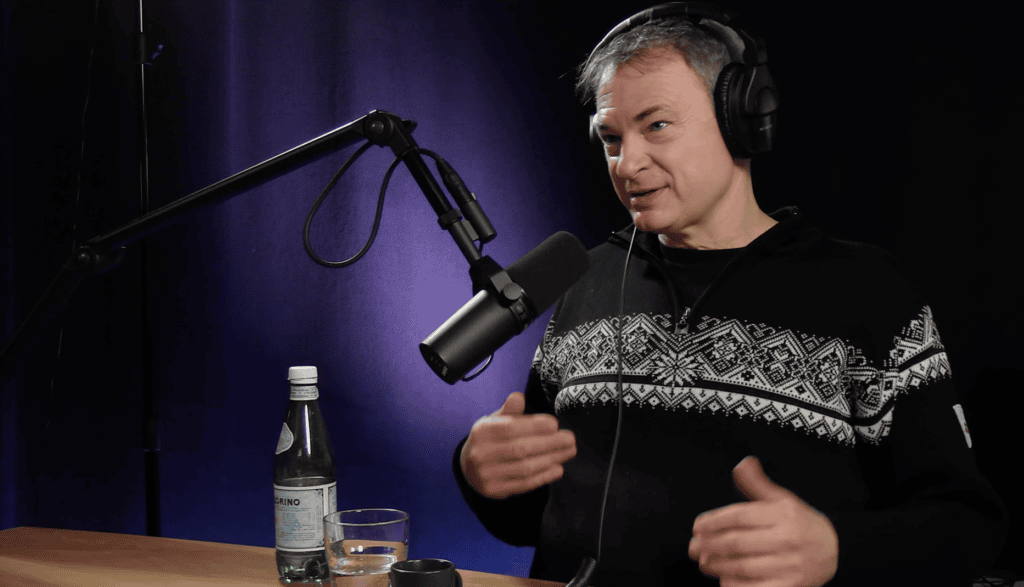
Turrell's practical examples seem almost utopian: he increased his personal productivity twentyfold within a year. He used to create one project proposal per day - now it's up to 30. Instead of ten contacts, he now maintains 150 personalized follow-ups. This leap is the result of a consistent orchestration of AI tools that is fundamentally changing knowledge work.
The looming employment crisis
But progress has its downsides. Turrell warns of a massive crisis on the labor market in the next 15 years. The discrepancy between the education system and the AI economy is huge. An example from his company illustrates the explosive nature of this: he would theoretically need 20 employees for his current output - in reality, he manages the workload with just two employees and AI. Company growth therefore no longer necessarily leads to new job creation.
Architecture instead of blind faith
Despite the euphoria, Turrell remains a realist. He describes current language models as "approximated intelligence" that occasionally produces errors. A simple prompt is not enough for serious business use; a complex architecture of verification, intelligent data management and human quality control is required.
UnDavos and the future of mankind
With his "UnDavos" initiative, Turrell is also creating an inclusive counterpoint to the World Economic Forum (WEF) in order to generate practical solutions in areas such as AI and health tech.
In ten years' time, it is estimated that AI will be able to perform 98% of tasks better than humans. According to Turrell, our niche remains in critical thinking, genuine creativity and physical presence. Success will accompany those who see lifelong learning as a survival strategy and collaborate with AI instead of competing against it.
with a focus on impact and action. The doctoral researcher currently lives and works in Berlin.
]]>
Stéphanie Kioutsoukis is a guest on the latest episode of the Text Akademie Foundation’s AI podcast. The Biel-based entrepreneur and innovation expert has observed a paradoxical pattern: the pressure to produce more content in less time is increasing. At the same time, restrictions are hindering the structured use of AI tools that could provide relief precisely in this area. Employees are responding by resorting to shadow IT, using personal accounts, and testing campaign ideas outside of any oversight.
The podcast on YouTube:
The potential is particularly evident in marketing. Many teams use ChatGPT to generate ideas for social media posts or newsletters. Kioutsoukis sees this as just the beginning. Communication will only become truly «AI-native» once entire content process chains are reimagined. Her team uses the AI to analyze opinion leaders, cluster topics, and generate post suggestions based on them. People curate the content, refine the tone, and adapt examples, while the AI handles the groundwork and generates variations.
Any company that responds with bans is doing its brand a double disservice. Campaigns take longer, responses to trends come later, and testing remains sporadic. At the same time, the company is missing out on the opportunity to learn systematically from data. AI can identify patterns of engagement, reveal target audience preferences, and refine strategies. Without these signals, communication remains based on gut instinct.
Kioutsoukis advocates for clear guidelines rather than bans. Marketing and communications teams should be encouraged to experiment with AI—on defined systems, with guidelines for data and content. Mistakes are inevitable, but they are instructive. It is crucial that executives protect these learning processes rather than penalize them.
Swiss SMEs, in particular, are at a crossroads. Their visibility depends increasingly on digital communication, while budgets remain limited. AI can help produce content more frequently and in a more targeted manner—from topic research to personalized messages. Those who turn a blind eye to this option risk falling behind in their communications.
In this way, AI in marketing becomes neither a panacea nor a threat, but rather a standard set of tools. Bans cement old structures and drive usage underground. Clear guidelines, training, and the courage to experiment turn AI into an amplifier for brands, messages, and dialogue.
The podcast episode on Spotify:
The video podcast "AI and Society - Paths into the New World" is produced by the Text Academy Foundation. Two episodes are published monthly, on Spotify, Youtube and other podcast platforms. Biel-based AI strategy expert Stéphanie Kioutrsoukis talks about this in the podcast by the Text Academy Foundation.
]]>
A video version of the podcast is available at Youtube as well as on Spotify and on most popular audio podcast platforms.
Autonomous robots are no longer a dream of the future in Zurich. What sounds like science fiction is becoming visible in everyday life: in Oerlikon and Regensdorf, robotic helpers deliver food and parcels to your doorstep. In the podcast "AI and Society - Paths into the New World" by the Swiss Text Academy, Marko Bjelonic, co-founder of Rivr.ai and ETH graduate, talks about the opportunities, hurdles and visions of this technology.
Bjelonic explains how his team has already implemented specific projects with partners such as SwissPost and JustEat. Pilot trials also encounter regulatory issues, but in close coordination with the authorities, hurdles can often be overcome more quickly than in other countries.
Switzerland is therefore becoming an ideal testing ground for robotics in everyday life. The investment by Jeff Bezos marked a special milestone. With the trust of the Amazon founder, Rivr.ai not only gained capital, but also international attention. "We are part of the first wave of robots on the streets," says Bjelonic. "It's not just about technology, but about the benefits for society."

The question of jobs is also central to this. Robotics is not a job killer, emphasizes Bjelonic, but a stimulus for new occupational fields such as robot management. Delivery work is relieved by intelligent systems, while new opportunities are created at the same time.
Rivr.ai's vision for the future extends far beyond Zurich. The plan is for multimodal robots that can move in different environments, right up to international scaling. The start-up from ETH Zurich not only wants to change the logistics industry, but also help shape the global discourse on the social integration of robotics.

The video podcast "AI and Society - Paths into the New World" is produced by the Text Academy Foundation. Two episodes are released monthly, on Spotify ( https://open.spotify.com/show/4mSsEJuaShBuanBfBjoAeM?si=01b4363426db4d28) , Youtube https://youtube.com/playlist?list=PL4InE9vz-QptAjyy0QXyk6lWFKXreWEh2&feature=shared and other podcast platforms.
]]>
Six candidates - the pioneering generation of these new creative professionals - have passed. They act as "one-person campaigning teams": from analysis and strategy to text, moving images and audio.
Pioneering achievement with AI integration
The test is the first of its kind with comprehensive AI integration. It shows that AI in marketing and communication enables talents to develop complete campaigns from a single source. Today, one person can use AI tools to create competitive campaigns - from concept to implementation.
Qualitative quantum leap
Compared to the old copywriting certificate, the requirements have clearly increased: more complex projects, more strategy, more creativity, more technology. The work submitted ranged from professional concepts to internationally competitive campaigns. "We have seen project work that is absolutely suitable for campaigns," says Fabian Zahner, President of the sponsoring association. This strengthens the industry's competitiveness and positions it as a pioneer in the interplay between creativity and technology.
First graduates demonstrate new professional profile
Language and creativity remain the focus, now enhanced by AI. The first six graduates have delivered the "Proof of Concept" Switzerland certification for AI-supported creative professionals: Elisa Ganter, Verónica Gattuso, Miriam Mathis, Anina Tschanz, Claudia Hollenstein and Fabian Kaufmann. They show that a single person can develop marketable campaigns with AI support. The success rate was 75 percent.
Five of the six graduates prepared for the exam at the Swiss Text Academy (textakademie.ch).
Outlook: Audit 2026
The next competition will be held in 2026: written on May 4, oral on June 11/12 in Zurich. The closing date for applications is January 2, 2026 and is open to professionals in marketing, communication, copywriting, journalism, design or social media with at least two years of copywriting experience.
Info under konzeptext.ch.
]]> AI - a curse or a blessing? "More of a blessing," is Chris Sidow's answer to the central question. The tasks of copywriters have not changed, but the way they work has changed significantly. "AI tools are indispensable today. Working without them is like going up against a computer with a typewriter". This development is particularly evident in copywriting training: when developing headlines or claims today, students use AI tools as a matter of course. This technology is simply part of it - negative attitudes towards AI tools are no longer relevant.
The danger of the average
The expert sees the greatest risk in mediocrity: "What comes out of the machine is usually average". Large language models often produce interchangeable texts based on probability calculations. Companies that do without professional copywriters risk differentiating their brand. If companies are satisfied with average texts simply because they are error-free and reasonably clear, the entire communications landscape could suffer. Advertising is supposed to differentiate brands from their competitors. But this differentiation is at risk.
Critical thinking is the new key skill
Sidow describes the change in the professional role in fundamental terms: critical thinking is becoming a key skill, because large language models want to please and formulate even the most nonsensical ideas very convincingly. Human experience is required here in order to be able to judge what is good and what is just average. Prompt engineering is developing in parallel with the new core skill - how you communicate with the machine determines the quality of the results.
Frankenstein texts: The creative symbiosis
Sidow calls one of his working methods "Frankenstein texts". He says: "I have the machine make several suggestions and then take out individual formulations. A best-of, so to speak." This is how individual texts are created from various AI outputs. It is a creative mixture of machine support and human design. The AI output serves as the raw material for further creative work.
Promoting young talent remains essential
Sidow warns against short-sighted frugality in the midst of the AI euphoria. "It is crucial to train junior copywriters," he emphasizes. "This is the only way we will have professionals in the future who can professionally assess AI output and continue to work with it." Otherwise, our industry could lose expertise. In turbulent times, agencies tend to forgo the promotion of young talent and blindly rely on AI. But this approach is a short-term solution at best. In the long term, without trained talent, the ability to assess quality will be lacking. Looking ahead remains crucial.
The text industry is experiencing a paradigm shift. AI is increasing efficiency, but human creativity remains the key to success. Copywriters who use AI as a tool rather than a threat will be successful. The ability to critically evaluate AI output and add creative nuance to develop unique brand languages will secure the future of the profession.
Chris Sidow is a copywriter and concept developer in Zurich. He works at the Therefore agency and is an expert in text, brand strategy and artificial intelligence. He also teaches at the Swiss Text Academy and the Prompt Engineering Academy. He is an ADC member and is an expert in the combination of creative copywriting and new technologies.
The video podcast "AI and Society - Paths into the New World" is produced by the Swiss Text Academy, which also offers courses on artificial intelligence in its Prompt Engineering program. Two episodes are published monthly, on Spotify, Youtube and other podcast platforms.
]]>